When families face trauma, its effects often disrupt relationships and emotional stability. Structured interventions can help repair these dynamics and support recovery. Here’s a summary of three approaches:
- Trauma-Focused Cognitive Behavioral Therapy (TF-CBT): Designed for children 7 and older, TF-CBT combines cognitive-behavioral techniques with family-based principles. It reduces PTSD symptoms and improves emotional regulation through structured steps like relaxation, trauma processing, and parent-child communication. Typically involves 12–25 sessions.
- Child–Parent Psychotherapy (CPP): Aimed at children aged 0–5, CPP focuses on strengthening the caregiver-child bond to heal trauma. It includes joint sessions to address attachment disruptions and helps caregivers process their own trauma. Treatment lasts 20–32 weeks, with sessions often incorporating play-based activities.
- Growth and Change Counseling: This approach addresses family dynamics and emotional regulation using methods like in-vivo coaching and integrative therapies (e.g., CBT, EMDR). It emphasizes active parental involvement and practical exercises. Options include 6–8 session parent-child plans and a 12-week couples program, available in California or via telehealth.
Each method targets specific needs based on the child’s age, trauma type, and family goals. Choosing the right fit depends on these factors and the family’s ability to commit to treatment.
Quick Comparison
| Feature | TF-CBT | CPP | Growth and Change Counseling |
|---|---|---|---|
| Best For | Ages 7–18, PTSD | Ages 0–5, attachment trauma | Families, couples, emotional regulation |
| Duration | 12–25 sessions | 20–32 weeks | 6–8 sessions (parent-child), 12 weeks (couples) |
| Focus | Cognitive-behavioral skills | Caregiver-child relationship | Relational dynamics, emotional regulation |
| Delivery | In-person, verbal therapy | Play-based and dyadic sessions | In-person (CA) or telehealth, practical exercises |
Each option offers tools to rebuild emotional balance and family connections.
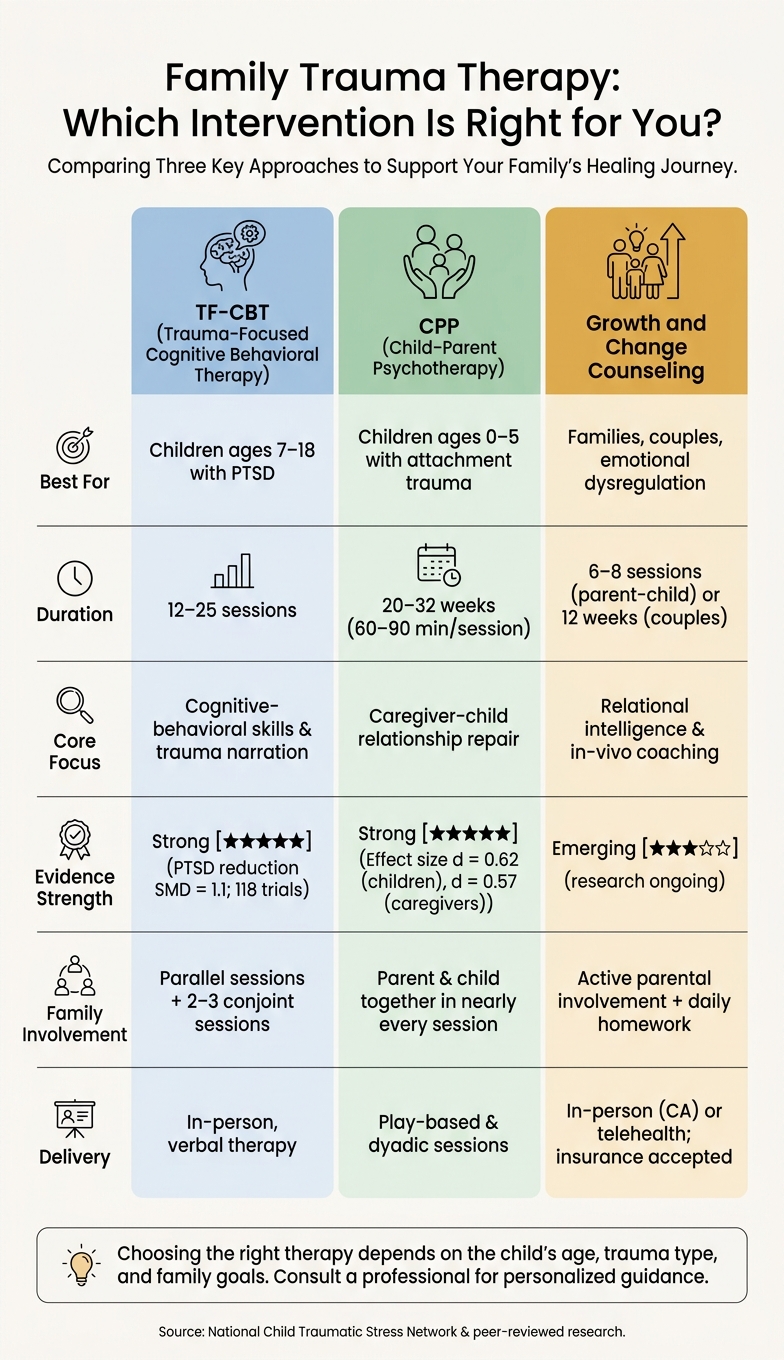
TF-CBT vs CPP vs Growth and Change Counseling: Family Trauma Therapy Comparison
Children, Violence, and Trauma – Treatments That Work
sbb-itb-596b85d
1. Trauma-Focused Cognitive Behavioral Therapy (TF-CBT)
Trauma-Focused Cognitive Behavioral Therapy (TF-CBT) is one of the most extensively studied treatments for trauma in children and families. It blends cognitive-behavioral methods with trauma-informed family therapy techniques to address trauma symptoms at their core.
Core Mechanisms
TF-CBT follows the PRACTICE framework, a structured approach that helps both children and their caregivers work through trauma recovery:
| Component | Purpose |
|---|---|
| Psychoeducation & Parenting skills | Helps families understand trauma symptoms and teaches effective parenting techniques |
| Relaxation techniques | Manages physiological stress through breathing exercises and muscle relaxation |
| Affective expression & regulation | Develops emotional awareness and self-soothing abilities |
| Cognitive coping | Connects thoughts, emotions, and behaviors to improve coping strategies |
| Trauma narrative & processing | Gradually revisits the trauma to lessen its emotional impact |
| In vivo exposure | Reintroduces safe trauma reminders to reduce avoidance behaviors |
| Conjoint parent/child sessions | Enhances communication and creates shared safety plans |
| Enhancing safety & future growth | Equips families with skills for healthy relationships and handling future challenges |
A key element of TF-CBT is gradual exposure, which empowers children to face trauma-related triggers in a controlled and supportive way. This structured method directly addresses the emotional challenges that can strain family dynamics.
Effectiveness for Emotional Dysregulation
TF-CBT is particularly effective in managing emotional dysregulation. Techniques like thought stopping and distraction help children regain control over intrusive thoughts. The impact is clear: a network meta-analysis of 118 trials found that TF-CBT achieved the highest reduction in PTSD symptoms (SMD 1.1) [5]. Additionally, children undergoing TF-CBT are 1.6 times more likely to experience at least a 50% reduction in symptoms [5].
Family Involvement
TF-CBT uses a parallel treatment model, where both the child and caregiver attend individual sessions before coming together for joint sessions later in the process. This approach helps parents better understand their child’s trauma-related behaviors, reducing parental stress and improving the overall home environment.
"The practice of TF-CBT is founded on establishing a strong working alliance and honoring a systemic approach to recovery from trauma symptoms for the client and caregivers." – A. Stephen Lenz and K. Michelle Hunnicutt Hollenbaugh [6]
Caregiver involvement is crucial for success. Research shows that including families in treatment significantly lowers dropout rates. For example, one study found that family-inclusive protocols cut dropout rates from 40% to 20% [8]. This is especially important given that most youth in community mental health programs quit treatment before the seventh session [7].
Practical Considerations
TF-CBT generally involves 12 to 25 weekly sessions, though shorter versions with just 8 sessions have shown positive results for teens who have experienced multiple traumas [5]. Sessions are typically divided evenly, with about 45 minutes for the child and 45 minutes for the caregiver [3]. However, families may face challenges like scheduling and transportation due to the weekly commitment. Revisiting trauma through narrative work is a core aspect, and evidence supports its effectiveness when done safely.
"If family members are not educated about the rationale and evidence supporting these treatments… they may be worried that such a focus is harmful." – Johanna Thompson-Hollands [8]
TF-CBT is widely regarded as the go-to treatment for children aged 7 and older. For younger children or those with complex attachment issues, alternative approaches may be more suitable – a topic covered in the next section.
2. Child–Parent Psychotherapy (CPP)
Child–Parent Psychotherapy (CPP) is a trauma-focused intervention designed for children aged 0–5. It zeroes in on the relationship between a child and their primary caregiver, emphasizing this bond as the foundation for healing rather than isolating the child for treatment.
Core Mechanisms
CPP operates on a simple but powerful idea: the caregiver-child relationship is the key to recovery for young children.
"A central goal is to support and strengthen the caregiver-child relationship as a vehicle for restoring and protecting the child’s mental health." – The National Child Traumatic Stress Network [4]
Through CPP, caregivers and children work together to create a shared narrative that addresses trauma triggers and redefines their responses. The therapy also explores how a caregiver’s own trauma history may influence their parenting, aiming to break cycles of intergenerational trauma through healing and emotional safety.
"The better parents remember their past, the less likely it is for them to repeat it with their children." – Frontiers in Psychiatry [11]
The treatment unfolds in three structured phases:
| Phase | Focus | Typical Duration |
|---|---|---|
| Foundational | Assessment, safety planning, trauma history | 4–8 weekly sessions |
| Core Intervention | Dyadic sessions, trauma narratives, affect regulation | 20+ weekly sessions |
| Closing | Reviewing progress, planning sustainability | 4–8 weekly sessions |
Effectiveness for Emotional Dysregulation
CPP is particularly effective in addressing emotional regulation by helping caregivers act as emotional anchors for their children [9]. A study conducted in 2026 on children aged 2 to 6 found significant improvements: reductions in child post-traumatic stress symptoms (d = 0.62), caregiver post-traumatic stress symptoms (d = 0.57), and caregiving disorganization (d = 0.64) [2]. These improvements persisted at a 6-month follow-up, showing that the benefits extend well beyond the immediate therapy period.
Another noteworthy outcome: CPP has been linked to slowing Epigenetic Age Acceleration in children, a biological marker associated with long-term health and psychiatric risks [10]. This suggests that CPP not only supports emotional and behavioral recovery but also impacts physical development.
Family Involvement
CPP takes a family-centered approach, involving both the child and caregiver in most sessions. The initial Foundational Phase includes caregiver-only sessions to establish a shared understanding before transitioning to joint work [12][10]. Additionally, therapists collaborate with daycare providers, healthcare professionals, and child welfare workers to ensure the child’s safety and support across all environments [1]. This broader involvement ensures that therapeutic progress extends beyond the therapy room.
Practical Considerations
A typical CPP program involves 20 to 32 sessions, with weekly meetings lasting 60 to 90 minutes, depending on the child’s engagement [12][1]. For cases involving severe trauma, up to 52 sessions may be necessary [11]. Sessions often incorporate play-based activities tailored to the child’s developmental stage, allowing them to express emotions without relying solely on words [11].
Therapists trained in CPP must hold a Master’s degree in a mental health field and complete an 18-month Learning Collaborative training program [12][10]. As of 2026, over 2,000 clinicians in 40 states and 5 countries offer CPP [10][4]. While traditionally conducted in person, studies during the COVID-19 pandemic confirmed that CPP can also be effectively delivered via telehealth [1].
Next, we’ll dive into the third intervention method to further explore approaches for family trauma recovery.
3. Growth and Change Counseling
Growth and Change Counseling, founded by LMFT John Mark Kane, focuses on making real-time adjustments within family systems to restore emotional balance. This approach addresses anxiety, depression, and emotional dysregulation by working directly on the dynamics that drive these issues.
Core Mechanisms
This counseling method relies on Relational Intelligence and Thought Life Transformation to help families identify genuine needs, manage emotions, and challenge harmful beliefs. A standout feature is its in-vivo coaching, which interrupts destructive communication patterns as they happen, rather than revisiting them after the fact [14][15]. The practice incorporates evidence-based therapies like EFT, CBT, somatic therapy, and EMDR, creating a well-rounded approach [15][16].
"Relational health significantly reduces anxiety, addiction, and depression." – John Mark Kane, Founder, Growth and Change Counseling [16]
Effectiveness for Emotional Dysregulation
Rather than just addressing symptoms, this approach focuses on the root causes of emotional dysregulation, such as unresolved anger, unhealthy patterns, and trauma-based beliefs [16]. Studies on systemic therapy models show a success rate of 66% compared to 34% in control groups, with recovery rates increasing to 78–81% when combined with medication [13].
"Conflict is not the enemy; it is the road map to intimacy if done correctly." – John Mark Kane, Licensed Marriage & Family Therapist [14]
Family Involvement
Active participation from parents is a cornerstone of this practice, especially in child-focused therapy. Kane emphasizes that parental involvement is essential for reinforcing progress:
"We will not do therapy with a child unless we are also working with the parents… anything that goes from you to your child is way more meaningful and effective than anything that goes from any therapist." – John Mark Kane, Founder, Growth and Change Counseling [17]
Families are given Relational Homework – short daily exercises lasting 15–30 minutes – to help embed new skills into their routines beyond therapy sessions [14][15].
Practical Considerations
Growth and Change Counseling offers flexible session formats to fit busy family schedules. Programs include a 6- to 8-session parent–child plan and a 12-week intensive couples program through the Marriage Rescue Institute, designed to rebuild relationships [14][17]. Sessions are available in-person at locations across California (Campbell, San Jose, Los Angeles, Roseville) or via secure telehealth throughout the state. Major insurance plans, including Aetna, Anthem Blue Cross, Cigna, United Health Care, and Medicare, are accepted. Fees for associate-level therapists start at $150 per 45-minute session [15][17].
Comparing Therapy Approaches for Growth and Change Counseling
Here’s a breakdown of the strengths and limitations of three different therapeutic approaches. This comparison can help you decide which method might be the right fit for your needs.
TF-CBT has been shown to effectively reduce PTSD symptoms in children and teens, backed by over 10 randomized controlled trials [18]. Its structured approach teaches practical skills like relaxation and cognitive coping, which kids can use in everyday life. The parent–child model also allows caregivers to learn these skills, supporting progress at home. However, TF-CBT requires children to have a certain level of verbal and cognitive ability, so it may not work well for very young kids or those with severe symptoms like suicidality, who might need stabilization first [5]. Its impact on co-occurring depression is moderate, with treatment effects ranging from g = -0.25 to -0.78 [6].
CPP is ideal for younger children, from birth to age 5, as it focuses on repairing attachment disruptions caused by trauma [12]. Its dyadic model involves both parent and child in nearly every session, addressing relational issues directly. Studies show sustained improvements in PTSD symptoms for both children and caregivers, with effect sizes of 0.62 for children and 0.57 for caregivers at 6- and 12-month follow-ups [2]. However, CPP requires a significant time commitment and specialized training that can take up to 18 months [12], making it less accessible in some areas.
Growth and Change Counseling uses a flexible, integrative approach that combines elements of EFT, CBT, somatic therapy, and EMDR within a relational framework. It includes in-vivo coaching and daily Relational Homework, offering practical tools for families. The program includes a 6- to 8-session parent–child option and a 12-week Marriage Rescue Institute program, providing structured yet adaptable options. It’s also accessible via telehealth across California and accepts major insurance plans, helping to reduce access barriers. However, compared to TF-CBT and CPP, its research base is still developing, with fewer randomized controlled trials supporting its effectiveness.
| Feature | TF-CBT | CPP | Growth and Change Counseling |
|---|---|---|---|
| Core Mechanism | Cognitive-behavioral skills, trauma narration, and PRACTICE components | Attachment-based dyadic therapy focused on relationship repair | Relational intelligence, in-vivo coaching, integrative therapies (EFT, CBT, EMDR, somatic) |
| Best For | Children ages 3–18 with PTSD and complex trauma | Children birth–5; cases of attachment disruption or domestic violence | Families, couples, and individuals dealing with emotional dysregulation and relational trauma |
| Effectiveness | Strong evidence for PTSD (SMD = 1.1); moderate effects for depression [5][6] | Strong for enhancing attachment security and reducing PTSD symptoms; benefits sustained at 12 months [2] | Emerging evidence; further research is needed |
| Family Involvement | Parallel sessions with 2–3 conjoint sessions in later phases [18] | Parent and child participate together in nearly every session [12] | Active parental involvement with daily Relational Homework |
| Duration | 12–25 sessions | 20–32+ weeks (60–90 min sessions) | 6–8 sessions (parent–child) and 12 weeks for the couples program |
| Practical Considerations | Manualized, suitable for most families; less suitable for cases with severe instability [5] | Requires extensive training and longer commitment; less accessible in some areas [12] | Available via telehealth and in person (in CA); major insurance accepted; session fees starting at approximately $150 |
Conclusion
The comparison above highlights how each intervention addresses distinct aspects of trauma recovery, making it easier for families to determine the best fit for their needs.
TF-CBT is most effective for school-age children and teenagers (ages 7–17), focusing on structured, skill-based strategies to help manage PTSD symptoms. On the other hand, CPP is tailored for families with infants and toddlers (ages 0–5), prioritizing the restoration of the parent–child bond. For families and couples dealing with relational trauma or crises, Growth and Change Counseling provides a more flexible option, especially when a child-centered model isn’t the best approach.
Choosing the right intervention depends on factors like the child’s age, the severity of relational challenges, and the family’s willingness to commit to treatment. Families in the U.S. can consult the National Child Traumatic Stress Network (NCTSN) to find providers offering evidence-based care [10][19].
For those in California, Growth and Change Counseling offers telehealth services, with individual sessions starting at around $150, alongside a structured 12-week couples coaching program. This option is ideal for families seeking focused, actionable strategies to address their challenges.
"Conflict is not the enemy; it is the road map to intimacy if done correctly." – John Mark Kane, LMFT [14]
FAQs
How do I choose between TF-CBT and CPP for my child?
Choosing between Trauma-Focused Cognitive Behavioral Therapy (TF-CBT) and Child-Parent Psychotherapy (CPP) comes down to your child’s age and specific needs.
- CPP is best suited for younger children, typically ages 0–5. This therapy emphasizes strengthening the caregiver-child relationship as a way to help the child process and heal from trauma.
- TF-CBT is designed for children and teens aged 3–18. It follows a structured framework, involving both individual and joint sessions with the parent and child. If your child is able to verbalize and discuss their memories, TF-CBT might be the better fit.
Each approach offers unique benefits tailored to different developmental stages and circumstances.
Will talking about trauma in therapy make symptoms worse?
Talking about trauma in therapy doesn’t automatically make symptoms worse – it all comes down to the approach. Trauma-informed care focuses on building a foundation of stabilization, safety, and emotional regulation before diving into detailed memories. At Growth and Change Counseling, we take the time to ensure your nervous system is prepared to handle trauma processing in a way that minimizes the chances of feeling overwhelmed or retraumatized.
What can parents do at home to support trauma recovery between sessions?
Parents play a key role in helping children recover from trauma. One way to do this is by creating a safe and predictable environment. Consistent routines – like having meals and bedtimes at the same time every day – can provide a sense of stability.
When emotions run high, co-regulation techniques can help. These might include practicing deep breathing, trying mindfulness exercises, or taking short cooling-off breaks to reset. Open communication is also essential. Using "I" statements encourages honest dialogue, and scheduling weekly family check-ins can provide a space for everyone to share feelings and concerns.
Rebuilding joy and connection is another important step. Simple activities like family walks or playing games together can foster a sense of togetherness. Setting aside dedicated "special time" with your child can further strengthen your bond and help them feel secure.
Related Blog Posts
- Trauma-Informed Family Therapy Techniques
- Family Therapy for Trauma Recovery: What Works
- How Family Therapy Improves Trauma Communication
- Short-Term Trauma Interventions for Families
