When trauma strikes, it impacts not just individuals but entire families. Family therapy addresses how trauma disrupts relationships, communication, and trust within households. Here’s what you need to know:
- Trauma affects 2% to 9% of people diagnosed with PTSD, but its ripple effects extend to everyone in the family.
- Family therapy focuses on collective healing, helping families rebuild trust, improve communication, and create a safe space for emotional expression.
- Key approaches include Trauma-Focused Cognitive Behavioral Therapy (TF-CBT), Eye Movement Desensitization and Reprocessing (EMDR), and Family Systems Therapy – all designed to address trauma’s impact on family dynamics.
- Emotional isolation, strained trust, and disrupted routines are common challenges families face during recovery.
Why this matters: Trauma recovery is more effective when families heal together, rather than individuals navigating it alone. With evidence-based methods, families can restore stability and support each other toward lasting healing.
Read on to learn how trauma affects families, the challenges they face, and the therapeutic approaches that help rebuild connection and trust.
Addressing Childhood Trauma through Trauma-Informed Care
How Trauma Affects Family Dynamics
Trauma has a ripple effect on relationships, disrupting communication, trust, and emotional bonds. When someone experiences trauma, their brain often triggers "fight, flight, or freeze" responses even in routine interactions. For example, a parent might react with verbal aggression over a small issue ("fight"), a teenager might emotionally withdraw and refuse to engage ("freeze"), or a spouse might bury themselves in work to avoid intimacy ("flight"). These reactions aren’t personal flaws – they’re automatic survival mechanisms that trauma has hardwired into the brain. This context helps explain the hurdles families face when dealing with trauma.
Two-thirds of American children and adolescents report experiencing at least one traumatic event, and one-third endure multiple traumas before adulthood [4]. Trauma often leads to what researchers describe as a loss of connection within families. Parents overwhelmed by their own trauma responses may struggle to meet their children’s emotional needs. For instance, mothers with PTSD symptoms are often observed to be less sensitive, more avoidant, or even intrusive in their parenting compared to those without PTSD [5]. This lack of connection can leave children feeling unseen or unsafe, even when their parents are physically present.
Trust is often the biggest casualty. Dr. Judith A. Cohen of Drexel University College of Medicine explains:
"Trauma experiences teach children that the world is dangerous and that adults may not protect them" [4].
This sense of betrayal can lead to hypervigilance – constantly scanning for danger – and emotional numbing, where individuals build walls to shield themselves from further pain. These defenses make it hard for family members to truly understand one another. A father might misinterpret his daughter’s silence as defiance when it’s actually a freeze response. Similarly, a wife might see her husband’s long hours at work as emotional abandonment, when he’s actually avoiding feelings he doesn’t know how to process.
Common Challenges Families Face During Trauma Recovery
Emotional isolation often becomes the norm in families affected by trauma. Shame tied to trauma can make individuals defensive. For example, a mother might lash out at her partner’s suggestion to "take a break", perceiving it as a critique of her worth. Meanwhile, siblings who once got along may find their usual rivalries escalating into full-blown conflicts under the strain of household stress.
Communication often shifts into survival mode. Instead of calmly addressing issues, families may fall into cycles of attack, withdrawal, or complete shutdown. Everyday routines and traditions – those small but meaningful rituals that bring families together – often fall by the wayside because trauma drains the energy needed to maintain them. Without these stabilizing practices, families lose their sense of structure and safety.
Adding to the complexity, intergenerational patterns can perpetuate dysfunction. Parents who experienced abuse or neglect themselves may unintentionally repeat those patterns with their children – not out of malice, but because trauma has shaped their understanding of what "normal" family life looks like. These challenges highlight the importance of addressing trauma collectively, rather than focusing solely on individuals.
Why Family-Centered Therapy Works
Healing trauma as a family unit makes sense when you consider that trauma doesn’t just affect individuals – it affects entire systems. Trauma and family dynamics are deeply intertwined. For example, PTSD symptoms can strain relationships, and strained relationships can, in turn, worsen PTSD symptoms. A supportive family environment can help ease these symptoms, while a tense one can make them worse.
Even when individual therapy helps someone process their trauma, they often return to a household still operating in survival mode. This can quickly undo any progress. Family-centered therapy works because it addresses these dynamics, helping everyone in the household heal together, rather than leaving individuals to navigate recovery alone.
Effective Family Therapy Interventions for Trauma Recovery
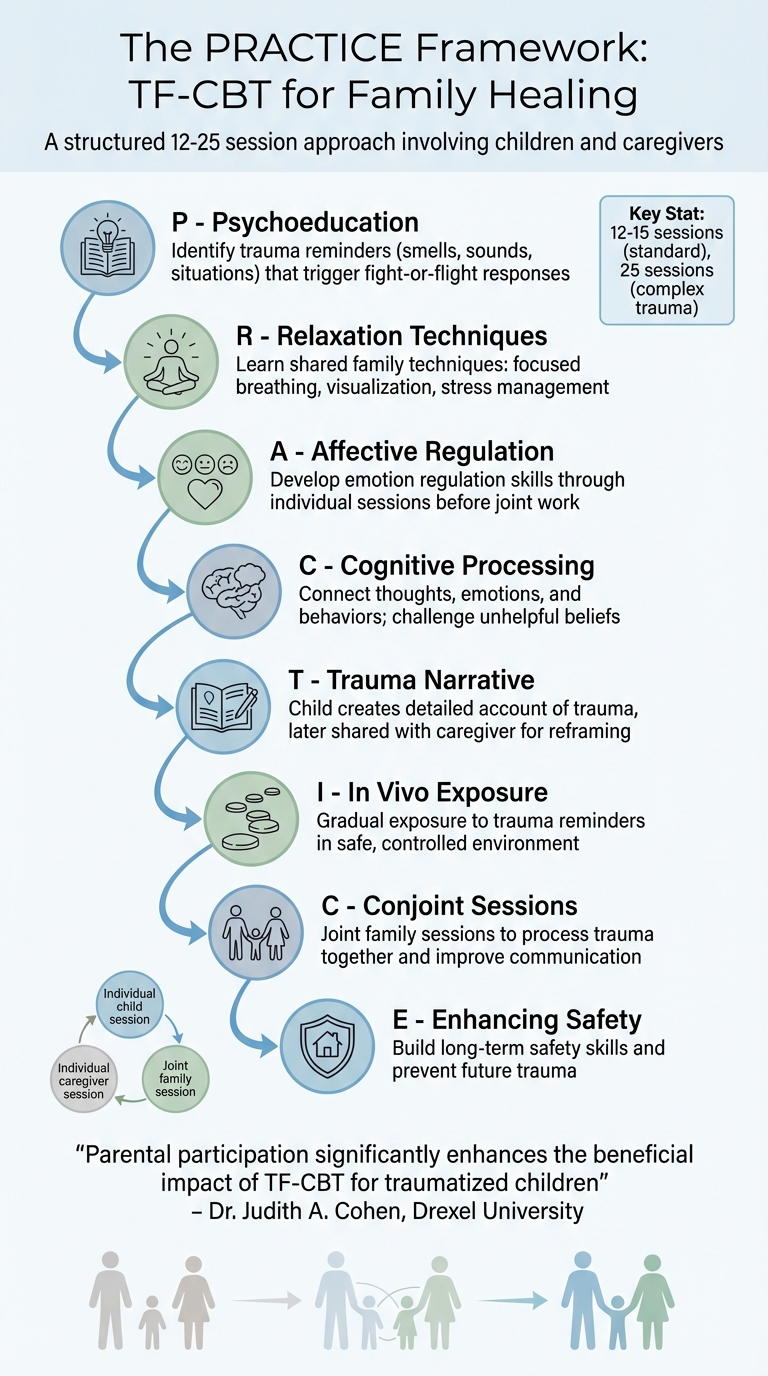
TF-CBT PRACTICE Framework: 8-Step Process for Family Trauma Recovery
When families face trauma, breaking free from survival mode and rebuilding healthy connections can feel overwhelming. Evidence-based interventions provide a pathway toward healing by addressing the relational dynamics that often keep families stuck. These methods go beyond individual treatment, offering tools to improve communication, process painful memories, and establish a sense of safety within the family. Below are some proven approaches that help families navigate this journey.
Trauma-Focused Cognitive Behavioral Therapy (TF-CBT)
TF-CBT is a structured therapy that involves both children and their non-offending caregivers, ensuring the healing process includes the entire family. Sessions are divided between individual time for the child and caregiver, followed by joint sessions to address trauma together. The therapy is guided by the PRACTICE framework, which organizes the healing process into key stages.
The journey begins with psychoeducation, helping families identify "trauma reminders" like specific smells, sounds, or situations that might trigger a fight-or-flight response. Caregivers also learn practical tools, such as "Time In", which emphasizes giving positive attention to help children manage behavioral challenges. Families are taught shared relaxation techniques, including focused breathing or visualization, to handle stress more effectively.
A cornerstone of TF-CBT is the trauma narrative, where the child creates a detailed account of their traumatic experience. This narrative is eventually shared with the caregiver, allowing the parent to help reframe the trauma’s meaning. Dr. Judith A. Cohen of Drexel University College of Medicine highlights the importance of caregiver involvement, stating:
"Parental participation significantly enhances the beneficial impact of TF-CBT for traumatized children" [4][6].
Typically, TF-CBT spans 12–15 sessions, though it may extend to 25 for cases involving complex trauma [4]. Research underscores that lower parental stress and higher levels of caregiver support are critical predictors of successful recovery for children [4].
Eye Movement Desensitization and Reprocessing (EMDR) for Families
EMDR is a therapy that uses bilateral stimulation – like guided eye movements or rhythmic tapping – to help the brain reprocess distressing memories, reducing their emotional intensity. When adapted for families, EMDR can address shared traumatic experiences, lessening emotional distress across multiple members.
Attachment-Focused EMDR (AF-EMDR) specifically targets emotional patterns that contribute to relationship strain. Licensed Marriage & Family Therapist Kawanna Gritney describes it as:
"A powerful, research-supported method that transforms long-standing pain at its root rather than simply managing symptoms" [7].
In family-based EMDR, each member often begins with individual sessions to process their personal feelings about the trauma. Later, joint sessions bring everyone together to discuss their experiences, fostering deeper healing. Families can also create a "safe container", a space where members feel free to express themselves without judgment [7]. In this environment, parents model grounding techniques and mindfulness practices, showing children how to manage emotional reactions in real time [1]. By identifying shared triggers, families can practice relaxation techniques together, preventing conflict before it escalates [4].
Family Systems Therapy
Family systems therapy views the family as an interconnected unit, where each member’s actions influence the whole. In the context of trauma, this therapy helps families recognize and change unhealthy interaction patterns – like emotional withdrawal or enabling behaviors – that might perpetuate trauma symptoms [1]. For instance, a father who distances himself when stressed could unintentionally trigger his child’s fear of abandonment. This approach focuses on repairing attachment bonds through nurturing interactions that heal emotional wounds and disrupt intergenerational trauma cycles [1].
Taylor Mayman from The Pennsylvania State University emphasizes:
"Family dynamics can either contribute to the development of trauma or support the recovery process" [1].
In a clinical trial involving 57 couples, Structural Approach Therapy, a type of family systems therapy, proved more effective than general family education in reducing PTSD symptoms for the primary patient [3]. By prioritizing collective healing and setting shared goals, this therapy ensures that every family member plays an active role in recovery.
sbb-itb-596b85d
Building Trust and Safety in Family Therapy
Creating Emotional Safety
In trauma therapy, establishing safety is the essential first step – without it, families can’t begin the healing process. Therapists focus on creating a secure and predictable environment where every family member feels heard and validated, minimizing the risk of retraumatization.
Trauma-Focused Cognitive Behavioral Therapy (TF-CBT) often begins with short individual sessions aimed at developing emotion regulation skills. Once a foundation is set, therapy moves into joint family sessions to promote collective healing. For families dealing with complex trauma, about half of the treatment is dedicated to building safety and stabilization skills [4].
Therapists also use brief psychoeducation to explain that reactions like anger or withdrawal are normal responses to trauma. This helps reduce feelings of blame and fosters empathy among family members. Parents are taught to recognize specific trauma triggers – such as certain sounds, smells, or situations – that might activate a fight-or-flight response. This understanding allows them to respond with support rather than punishment [4].
Rebuilding Trust Through Therapist-Guided Conversations
Once safety is established, the focus shifts to rebuilding trust through structured, therapist-guided discussions. During these sessions, families practice new ways of communicating that emphasize validation and empathy. Taylor Mayman from The Pennsylvania State University highlights:
"Caregivers are encouraged to practice empathetic listening, validate the child’s experiences, and show consistent love and support" [1].
These guided interactions help strengthen attachment bonds, which often leads to improved emotional regulation and reduced anxiety in children.
Therapists also introduce strategies like "Time In", encouraging parents to engage in frequent, positive, and nurturing interactions. For instance, offering immediate, specific praise – such as, "I appreciate how quickly you helped with the dishes" – helps children feel noticed and valued. Parents are also coached to tolerate their child’s expression of negative emotions, viewing it as a normal part of emotional growth rather than as defiance. Through these structured conversations, families begin to understand the link between thoughts, emotions, and behaviors. Over time, this process helps replace unhelpful beliefs like "I’m not safe" with healthier, more positive perspectives [4].
Growth and Change Counseling‘s Trauma-Informed Family Therapy
Trauma-Informed Care for Families
Growth and Change Counseling takes a thoughtful and personalized approach to family therapy, focusing on trauma’s unique impact on each family. Using evidence-based methods, their trauma-informed family therapy aims to support both individual and collective healing. The process follows a structured phase-based model, starting with stabilization. In this initial phase, families learn essential coping strategies. From there, therapy progresses to trauma narration and processing, and finally to integration, where families practice applying their new skills in real-life situations [4][6].
The treatment is tailored to meet developmental needs. For younger children, play-based techniques are used, while adolescents may benefit from cognitive processing and Eye Movement Desensitization and Reprocessing (EMDR) [8]. Each session includes time for parents and children individually, followed by a joint family discussion to foster understanding and communication [4][6].
This phase-based approach aligns with earlier strategies for rebuilding trust and ensures safety and healing at all levels of the family dynamic. Therapists use the TF-CBT PRACTICE model, incorporating tools like parenting techniques, relaxation exercises, and cognitive processing to address trauma symptoms. Additionally, the therapy explores intergenerational trauma, examining how past traumatic experiences within a family continue to shape current behaviors and relationships [8]. This methodical and personalized approach ensures families receive the care they need to heal and grow.
Services Across California
Growth and Change Counseling provides trauma-informed family therapy in several in-person locations, including Campbell, San Jose, Los Angeles, and Roseville. For families unable to attend in person, telehealth services are available throughout California, making specialized trauma care accessible no matter where you live.
Families can afford these services through various options like employer insurance, Health Insurance Marketplace plans, Medicaid, and sliding scale fees starting at $100 for a 45-minute session. Health Savings Accounts (HSA) and Flexible Spending Accounts (FSA) can also be used. To reduce out-of-pocket costs, families are encouraged to verify if their insurance is in-network [8].
Conclusion
Trauma has a profound impact on family systems, often disrupting communication and the sense of safety. Family therapy steps in to address these ripple effects by focusing on the family as a whole, rather than treating individuals in isolation. Approaches like Trauma-Focused Cognitive Behavioral Therapy (TF-CBT) have shown strong results in reducing trauma symptoms and helping families regain stability.
Healing, however, goes beyond just processing the trauma itself. It’s about rebuilding trust, reestablishing routines, and shifting perspectives – from blame to empathy and understanding. As one parent shared during their recovery journey:
"I was so focused on my own worries that I almost didn’t notice how upset my son was. But once I did, finding activities to help calm him ended up calming me as well." – Parent/Caregiver, NCTSN [2]
This quote highlights the essence of mutual healing. It’s a process rooted in connection, proving that recovery thrives when families work together rather than in isolation. This interconnected approach lays the groundwork for trauma-informed care that fosters long-term healing and growth.
Growth and Change Counseling offers a phase-based, trauma-informed framework to help families rebuild trust and break free from cycles of trauma. With flexible options like telehealth and in-person sessions across California, they make specialized trauma care accessible, meeting families wherever they are on their path to recovery.
Begin Your Healing Journey with Growth and Change Counseling
How can family therapy support trauma recovery?
Family therapy creates a supportive space where families can come together to heal after facing trauma. By including all family members, it helps strengthen bonds, improve communication, and build emotional security – key elements for moving forward.
Using proven methods like trauma-focused cognitive-behavioral therapy (TF-CBT), families learn practical skills to handle emotional and behavioral challenges. These approaches focus on leveraging a family’s strengths while reducing stress, ultimately helping to rebuild trust and connection.
At Growth and Change Counseling, family therapy is designed to address the specific needs of each family. With the flexibility of both in-person and telehealth sessions available throughout California, families can access expert care to regain resilience and work toward lasting recovery.
What are the main methods used in family therapy to help with trauma recovery?
Family therapy for trauma takes a holistic approach by involving the entire family in the healing journey while addressing an individual’s specific traumatic experiences. Here are some widely used and effective methods:
- Trauma-Focused Cognitive-Behavioral Therapy (TF-CBT): This method combines skill-building for individuals with joint parent-child sessions. It focuses on improving emotional regulation, enhancing communication, and gradually addressing trauma-related topics in a safe and structured way.
- Family-Centered Treatment (FCT): This home-based approach highlights the strengths of the family unit. It works to restore emotional safety and build resilience through collaborative goal-setting and teamwork.
- Risk Reduction through Family Therapy (RRFT): Tailored for adolescents, this approach blends trauma treatment with strategies for addressing substance use and improving family communication.
At Growth and Change Counseling, these evidence-based techniques are integrated into their family therapy services. They offer a safe, supportive space for trauma recovery, with options for in-person sessions or telehealth services throughout California, ensuring families can access care in a way that works best for them.
Why is family involvement essential in trauma recovery?
Family involvement plays a vital role in trauma recovery because trauma rarely impacts just one person – it often ripples through the entire family. When families come together, they can rebuild trust, establish emotional safety, and offer the kind of support that makes healing possible. This shared effort not only eases feelings of isolation but also strengthens the bonds that are essential for lasting recovery.
At Growth and Change Counseling, licensed therapists use proven family therapy methods, like trauma-focused cognitive-behavioral therapy, to help families navigate communication challenges, redefine roles, and build resilience. By collaborating, families can create a nurturing environment that supports healing for everyone. Services are offered in-person throughout California or via telehealth for greater accessibility.
Related Blog Posts
- How Family Therapy Restores Trust After Addiction
- How Trauma Impacts Parent-Child Relationships
- Trauma-Informed Family Therapy Techniques
- Intergenerational Trauma and Addiction Recovery
