Co-parenting during addiction recovery is challenging but manageable with the right approach. This article compares key strategies to help parents balance co-parenting in recovery and their children’s well-being:
- Parenting Styles: Parallel parenting minimizes conflict with clear boundaries, while cooperative co-parenting fosters collaboration but requires trust.
- Visitation Arrangements: Supervised visits ensure child safety in early recovery stages, while unsupervised visits allow natural bonding after sobriety milestones.
- Monitoring Systems: Technology-assisted tools like breathalyzers provide objective sobriety verification, while trust-based systems focus on emotional healing through therapy.
Quick Comparison
| Aspect | Parallel Parenting | Cooperative Co-Parenting | Supervised Visitation | Unsupervised Visitation | Tech Monitoring | Trust-Based Systems |
|---|---|---|---|---|---|---|
| Communication | Limited, logistics only | Open, collaborative | Professional oversight | Private, natural | Objective data | Emotional growth |
| Trust Level | Low | High | Not required | Requires sustained sobriety | Provides verification | Relies on relationships |
| Child Safety | Shielded from conflict | Sees teamwork | High | Relies on parent’s stability | Immediate deterrent | Long-term emotional stability |
| Emotional Impact | Neutral | Positive | Can feel artificial | Boosts confidence | May strain relationships | Strengthens family bonds |
| Cost | Low | Moderate | Moderate | Low | High | Varies |
Each family situation is unique. Combining strategies, like pairing tech monitoring with therapy, can address short-term safety and long-term healing. Professional guidance, such as therapy or counseling, can also help parents navigate these transitions effectively.
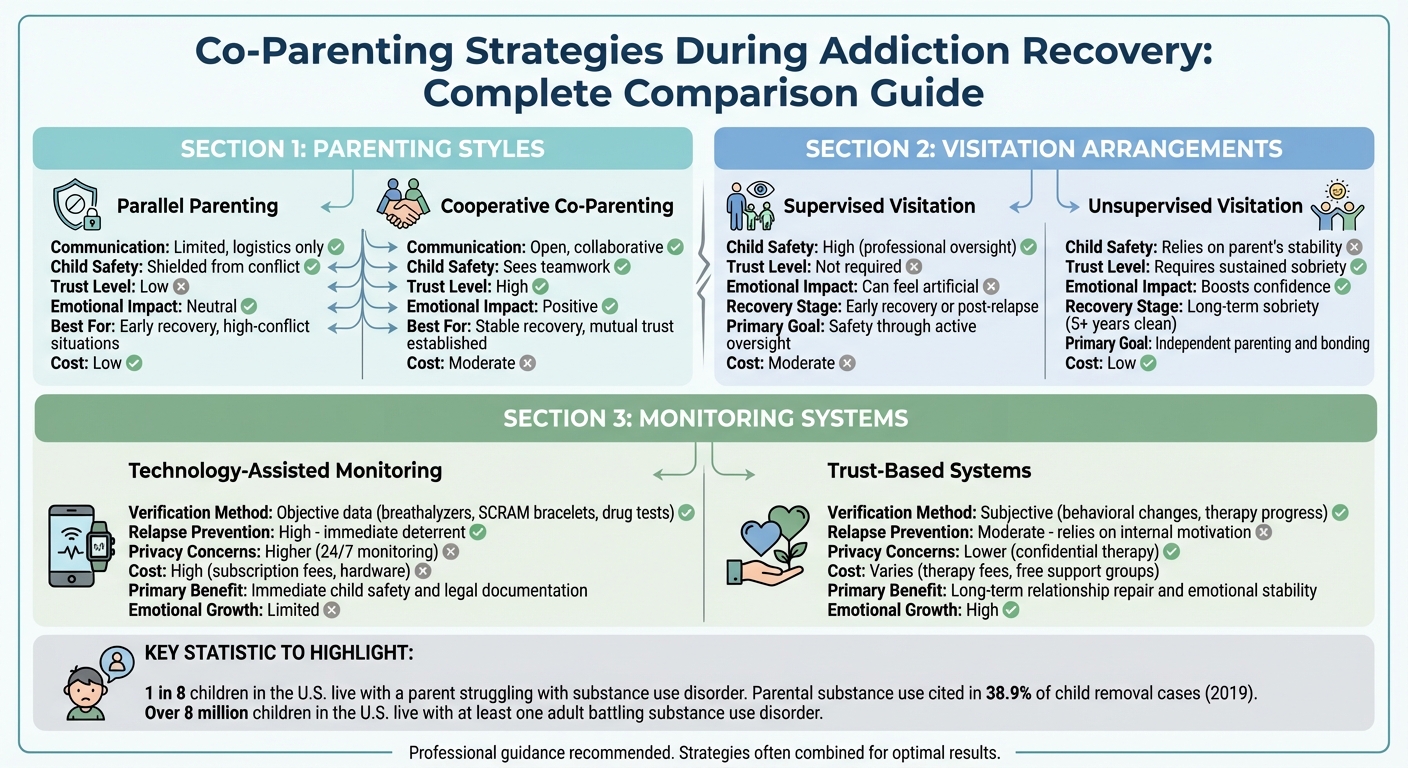
Co-Parenting Strategies During Addiction Recovery: Complete Comparison Guide
Parenting Through Addiction: Risks, Recovery, and Child Well-Being
sbb-itb-596b85d
Parallel Parenting vs. Cooperative Co-Parenting
In addiction recovery, choosing the right co-parenting approach is a key step toward maintaining family stability. Two primary methods are cooperative co-parenting and parallel parenting. Cooperative co-parenting involves a collaborative effort where both parents share responsibilities and decisions about their child’s education, health, and activities, maintaining open and regular communication [4]. This method works best when both parents are emotionally stable, willing, and able to put their child’s needs above personal conflicts [5].
On the other hand, parallel parenting sets firm boundaries to minimize conflict. Each parent makes independent decisions during their parenting time, with communication limited to essential logistics through emails or parenting apps [5]. Holly Beare explains this approach succinctly:
"Parallel parenting is disengaging from your ex while remaining fully engaged with your child" [5].
Many families start with parallel parenting, especially during the early stages of recovery or high-conflict periods, and gradually transition to cooperative co-parenting as stability and trust improve – often within 3–5 years after separation [4][5]. Research highlights that children benefit significantly from high-quality co-parenting, showing better emotional adjustment, fewer behavioral issues, and improved academic performance [5]. However, in situations where trust is fragile, parallel parenting serves, as Beare describes, as:
"a harm-reduction strategy, not a cure-all" [5].
Below, we explore the strengths and challenges of each approach to help parents make informed decisions.
Pros and Cons of Parallel Parenting
The primary advantage of parallel parenting is its ability to reduce conflict. By limiting communication to essential matters, such as weekly updates for non-emergencies, and using neutral locations like schools for child exchanges, this method helps avoid situations that might jeopardize sobriety or lead to disputes [5]. Each parent has the autonomy to handle day-to-day decisions during their time, which eliminates the need for constant negotiations [4].
However, this approach has its downsides. The rigid boundaries can make it difficult to adapt to changes, like rescheduling a soccer practice or attending a last-minute school event. Children may also pick up on the emotional distance between their parents, even if they aren’t exposed to direct conflict. While tools like the BIFF method (Brief, Informative, Friendly, and Firm) can help keep communication professional, they can’t replicate the emotional warmth that comes with genuine collaboration [5].
Pros and Cons of Cooperative Co-Parenting
Cooperative co-parenting offers the benefit of presenting a united front to children. Parents work together on decisions – both big and small – and maintain open lines of communication across multiple channels [4]. This approach reinforces accountability and follow-through, which are essential for rebuilding trust during recovery.
However, cooperative co-parenting requires a high level of mutual trust and can be risky in situations where emotions are raw or relapse triggers are present. Frequent interactions increase the chances of conflict, especially if one parent doubts the other’s commitment to sobriety [4]. In cases of high conflict, boundary violations can lead to heightened stress for parents and negatively affect the child’s well-being [5]. Forcing cooperation when one or both parents are unwilling can ultimately cause more harm than good.
Comparison Table
| Criterion | Cooperative Co-Parenting | Parallel Parenting |
|---|---|---|
| Communication Style | Regular, open, and flexible | Minimal, structured, logistical |
| Decision-Making | Joint/Collaborative | Independent per household |
| Interaction | High (shared events) | Low (separate celebrations) |
| Conflict Management | Collaborative problem-solving | Rigid boundaries and disengagement |
| Trust Requirement | High mutual trust | Low; relies on documentation and rules |
| Primary Goal | Connection and unity | Conflict reduction and stability |
| Child’s Experience | Sees parents working as a team | Shielded from parental interaction and discord |
Supervised Visitation vs. Unsupervised Arrangements
When it comes to co-parenting in the context of recovery, visitation arrangements play a crucial role in balancing child safety with parental rehabilitation. The choice between supervised and unsupervised visits can significantly impact both the child’s well-being and the parent’s journey toward stability.
Supervised visitation offers a controlled setting where professionals like child welfare workers or clinicians monitor interactions in real time, ensuring the child’s safety and observing the parent’s sobriety. This approach is particularly relevant considering that about 1 in 8 children in the U.S. live with a parent who struggles with substance use disorder [2].
Unsupervised arrangements, on the other hand, allow for more natural bonding between parent and child. However, these visits are typically granted only when the parent has demonstrated consistent recovery milestones, such as completing treatment programs and maintaining sobriety. For instance, Arizona law assumes it’s not in a child’s best interest for a parent with recent substance abuse (within the past 12 months) to have custody. This presumption can be overturned with evidence, such as five years of clean drug tests [6].
The transition from supervised to unsupervised visits isn’t arbitrary. It involves meeting specific benchmarks, often overseen by Family Treatment Courts, which monitor progress toward safe reunification [2]. Legal editor E.A. Gjelten explains, "It’s usually up to the judge to decide how long you must be clean and sober before you can have unsupervised visitation or increased parenting time" [6]. Ultimately, decisions are guided by what serves the "best interests of the child", not the parent’s visitation rights [6].
Benefits and Challenges of Supervised Visitation
Supervised visitation serves as a safety measure, particularly in the early stages of recovery. It ensures that the parent’s behavior does not put the child at risk, especially during periods of heightened vulnerability, such as after a relapse or during the abstinence stage of recovery, which can last one to two years and is often marked by intense cravings [7].
However, the constant oversight can feel intrusive for parents, potentially undermining their confidence and making interactions with their child feel less natural. While children may understand the protective intent of these visits, they might also find the structured environment somewhat unnatural [6].
Benefits and Challenges of Unsupervised Arrangements
Unsupervised visitation provides a more natural setting for parent-child bonding, which can boost the parent’s confidence and offer the child a sense of stability [2][6]. This arrangement is typically reserved for parents who have shown they can maintain long-term recovery, including managing Post-Acute Withdrawal Syndrome (PAWS). PAWS can cause mood swings and irritability for up to two years after stopping substance use [7].
The downside, however, is the lack of immediate intervention if a relapse occurs during these visits. Addiction specialist Steven M. Melemis emphasizes, "Recovery involves creating a new life in which it is easier to not use. When individuals do not change their lives, then all the factors that contributed to their addiction will eventually catch up with them" [7]. To mitigate risks, courts often include sobriety clauses in parenting agreements, requiring 24-hour sobriety before and during unsupervised visits [6].
Comparison Table
| Factor | Supervised Visitation | Unsupervised Arrangements |
|---|---|---|
| Child Safety | High – professional oversight prevents risks [2] | Relies on parent’s sustained sobriety and stability [2] |
| Emotional Impact on Parent | Can feel embarrassing due to constant observation [6] | Boosts confidence through private, natural interactions [6] |
| Emotional Impact on Child | Provides safety but may feel artificial [6] | Encourages normal bonding and a sense of permanency [6][7] |
| Recovery Stage | Ideal for early recovery or after a relapse [2][7] | Suitable for parents with long-term sobriety [7] |
| Legal Requirement | Often mandated by courts or child services [2] | Granted after verified recovery milestones [2][6] |
| Primary Goal | Ensures safety through active oversight [6] | Promotes independent parenting and lasting bonds [6] |
Technology-Assisted Monitoring vs. Trust-Based Systems
When co-parents navigate recovery, they often face a choice: rely on measurable tools like breathalyzers and SCRAM bracelets, or focus on relationship-driven methods such as family therapy and support groups. Each approach offers distinct benefits and challenges, and understanding these can help families make informed decisions.
Technology-assisted monitoring provides real-time data on sobriety. Tools like portable breathalyzers, SCRAM bracelets (which monitor alcohol consumption through the skin 24/7), and drug tests (urine, hair, or breath analysis) deliver objective results. These tools can reduce conflicts between co-parents by removing ambiguity. As Keepr® highlights:
"Personal breathalyzers like Keepr® can provide real-time, verifiable results about a co-parent’s sobriety while caretaking" [8].
This data is particularly useful in legal situations where custody arrangements may need adjustments.
On the other hand, trust-based systems emphasize emotional growth and repairing relationships over immediate verification. Methods like family therapy, support groups, and the Community Reinforcement and Family Training (CRAFT) approach focus on long-term recovery. Research shows that CRAFT increases the likelihood of individuals entering and staying in treatment [1]. Laura Lander, an Assistant Professor at West Virginia University School of Medicine, explains:
"Treating the individual without family involvement may limit the effectiveness of treatment… it ignores the devastating impact of SUDs on the family system" [1].
However, both systems have limitations. Technology-assisted monitoring confirms sobriety at a specific moment but doesn’t address the emotional roots of addiction. Trust-based systems, while fostering emotional recovery, lack the objective verification that technology provides. For example, children may struggle to recognize signs of intoxication, and symptoms like mood changes aren’t always reliable indicators of alcohol use [9]. Attorney Michael Flannery underscores this complexity:
"The journey of recovery is hardly ever a straight path. Relapses are common and custody arrangements often have to change during recovery" [9].
Many families find success by combining these approaches. Remote alcohol monitoring can provide the assurance needed for trust-based methods like therapy to thrive [8]. This blended strategy is especially critical considering that over 8 million children in the U.S. live with at least one adult battling a substance use disorder, and substance use plays a role in 33% to 66% of child maltreatment cases [1]. By integrating both methods, families can ensure immediate safety while fostering long-term healing.
Advantages and Limitations of Technology-Assisted Monitoring
Technology-assisted monitoring shines in creating accountability and exposing the "family secrets" that often accompany addiction [1]. Tools like SCRAM bracelets and portable breathalyzers deliver objective data, which is especially valuable in early recovery when trust hasn’t been rebuilt. These tools also provide legal protection by creating a factual record that courts can use if custody changes are necessary.
However, constant monitoring can feel intrusive and may strain relationships. Some recovering parents might view it as "policing" rather than a protective measure. Privacy concerns are also valid – 24/7 monitoring or frequent data sharing can feel invasive. Additionally, these tools come with financial burdens, such as subscription fees and maintenance costs. While technology can confirm sobriety, it doesn’t address deeper emotional or psychological patterns contributing to addiction.
Advantages and Limitations of Trust-Based Systems
Trust-based systems focus on emotional recovery and strengthening family bonds. These methods aim to repair what researchers call the "relational attachment system", which acts as a psychological buffer against future mental health challenges. Laura Lander elaborates:
"Healthy attachment is a psychological immune system of sorts… the relational attachment system provides protection against psychological problems and illness" [1].
Family therapy helps clarify roles within the household, often blurred in families affected by substance use disorders. Support groups like AA/NA and approaches like CRAFT not only encourage individuals to seek treatment but also help them stay engaged [1].
These systems promote open communication, teach emotional regulation, and address multigenerational trauma. Unlike technology, they avoid the relationship strain caused by constant monitoring. However, without objective verification, trust-based systems can falter during early recovery. Families may fall into unhealthy habits, known as homeostasis, which can undermine progress. Professional guidance is often necessary to recognize and break these cycles.
Comparison Table
| Factor | Technology-Assisted Monitoring | Trust-Based Systems |
|---|---|---|
| Relapse Prevention | High – provides an immediate deterrent through scheduled or random testing [8] | Moderate – relies on internal motivation and support networks [1] |
| Verification Method | Objective data (BrAC levels, EtG tests, hair samples) [8] | Subjective (behavioral changes, verbal transparency) [9] |
| Cost | Subscription fees for apps; hardware costs for devices [8] | Professional fees for therapy; support groups are often free [1] |
| Privacy Concerns | Higher – involves 24/7 monitoring or data sharing [8] | Lower – focuses on private communication and confidential therapy [9] |
| Ease of Implementation | Quick – tools can be deployed immediately upon court order [8] | Slow – requires time to build emotional rapport and consistency [1] |
| Primary Benefit | Immediate child safety and legal documentation [8] | Long-term relationship repair and emotional stability [1] |
| Emotional Growth | Limited – focuses on sobriety data rather than underlying issues [1] | High – addresses attachment, communication, and affect regulation [1] |
| Legal Evidence | Strong – provides verifiable records for court proceedings [8] | Weak – relies on subjective observations that are harder to prove [9] |
Using Family Therapy in Recovery
Family therapy shifts the focus from treating an individual to addressing the entire family system. Addiction doesn’t just affect the person struggling; it impacts everyone in the household. Family therapy helps rebuild relationships strained by addiction and addresses unhealthy dynamics that may contribute to the problem. For co-parents, this approach isn’t just about sobriety – it’s about healing the family as a whole.
In 2019, parental substance use was cited in 38.9% of cases where children were removed from their homes [10]. Family therapy aims to address these issues by involving all affected parties, including parents, children, and sometimes extended family.
Several therapy models offer targeted strategies for co-parents. Behavioral Couples Therapy (BCT) utilizes "Recovery Contracts", where the recovering parent commits to daily sobriety while their partner provides documented support. Functional Family Therapy (FFT) focuses on parenting skills and communication, while Family Behavior Therapy (FBT) allows families to choose evidence-based strategies that align with their goals [10]. These approaches not only support sobriety but also strengthen family bonds.
Research shows that family support significantly increases the likelihood of staying in treatment, maintaining sobriety, and avoiding relapse [10]. Couples who engage in BCT report better communication and higher rates of abstinence compared to those in individual therapy [10]. As the American Addiction Centers explain:
"Addiction can significantly affect families by impairing the functioning, health, and overall well-being of every family member – for those suffering with substance abuse and those who are not, too."
- American Addiction Centers [10]
For co-parents in California, Growth and Change Counseling offers family therapy tailored to addiction recovery. Their services focus on relational and emotional well-being through solutions-focused therapy, available in cities like Campbell, San Jose, Los Angeles, Roseville, and via telehealth statewide.
By improving communication and clarifying roles within the household, family therapy lays a strong foundation for lasting recovery.
Benefits of Family Therapy
Family therapy provides a platform for co-parents to address conflicts that may have fueled substance use or worsened during addiction. Unlike individual therapy, which focuses solely on the person in recovery, family therapy examines how everyone’s behaviors interact – often uncovering patterns that individual sessions might miss.
One immediate benefit is better communication. Therapy teaches active listening and reduces misunderstandings, creating a more stable home for children [10]. Co-parents learn to navigate tough topics – like relapse concerns or custody arrangements – without escalating conflicts. It also helps clarify roles within the household, allowing children to focus on being kids while parents share responsibilities more effectively.
For children, family therapy offers a safe space to express feelings about a parent’s addiction and recovery. Many children struggle with guilt, anger, or confusion, and a skilled therapist can guide them through these emotions in an age-appropriate way.
Over time, strengthening family connections during recovery builds resilience that benefits everyone involved.
Challenges of Family Therapy
Despite its benefits, family therapy comes with challenges. Scheduling can be a major hurdle, especially for co-parents in separate households. Coordinating sessions around children’s school schedules and other commitments often requires flexibility. Some families manage this by alternating attendance or opting for longer, less frequent sessions.
Emotional resistance is another common obstacle. Past trauma may make some family members hesitant to participate. Even one person’s reluctance can disrupt progress. Co-parents might fear that admitting problems in therapy could impact custody disputes, while children may worry that speaking openly could create conflict. A skilled therapist is crucial in fostering a safe, supportive environment where these concerns can be addressed.
Finding the right therapist is another challenge. Not all family therapists are trained to handle both addiction and complex family dynamics. Models like BCT or FFT require professionals who can navigate emotional intricacies and power imbalances effectively [11]. In rural areas, accessing such specialists can be even more difficult.
The cost of therapy also poses a barrier. Standard sessions typically last an hour, and models like Brief Strategic Family Therapy (BSFT) often require 12–16 sessions [10]. With rates ranging from $100 to $200 per session, families may face a total cost of $1,200 to $3,200 or more. Additionally, not all insurance plans cover family therapy for addiction, leaving many families to pay out of pocket.
One way to ease resistance is for therapists to meet individually with hesitant family members before starting group sessions [10]. This approach helps build trust and allows concerns to be addressed privately. Some families also find value in combining therapy with family retreats or parenting classes, which can provide a less intimidating introduction to the process [10].
Conclusion: Choosing the Right Co-Parenting Approach
When it comes to co-parenting during addiction recovery, there’s no one-size-fits-all solution. Each approach – whether it’s parallel parenting, cooperative co-parenting, or a system involving visitation and monitoring – carries its own benefits depending on your recovery stage, the dynamics with your co-parent, and your children’s current needs. The key is finding the strategy that works best for your unique situation.
Co-parenting methods often shift as family circumstances change. Research from Oklahoma State University highlights that parents frequently adjust their strategies as emotions stabilize, with a focus on reducing conflict being more beneficial than exposing children to disputes. Over time, as trust is rebuilt, you may progress from supervised visits to unsupervised ones or move from technology-based monitoring to more trust-driven systems. These transitions should align with your children’s developmental needs and maintain a balance between consistent routines and adaptability. Expert guidance can be a valuable resource in navigating these changes effectively.
Role of Professional Guidance in Co-Parenting
Making these transitions smoother often requires professional support. Therapists and counselors can provide essential tools to help co-parents improve communication and establish more stable arrangements. As Matt Brosi and Jana Payne from Oklahoma State University explain:
"It’s also a good idea to get help from a trained professional, such as a therapist or counselor, to learn how to communicate and problem solve more effectively with your co-parent" [3].
Growth and Change Counseling in California offers services specifically designed for families navigating addiction recovery and marriage. Their parent coaching and family therapy programs focus on creating boundaries, crafting tailored parenting plans, and fostering a child-centered approach. With offices in Campbell, San Jose, Los Angeles, and Roseville, as well as telehealth options throughout California, they provide solutions-based therapy to meet each family’s unique needs. Whether you’re working toward cooperative co-parenting or implementing parallel parenting to reduce conflict, expert guidance can help ensure smoother transitions and lasting progress.
Common Co-Parenting Questions for Growth and Change Counseling
How do I know when to switch from parallel parenting to cooperative co-parenting?
Shifting from parallel parenting to cooperative co-parenting hinges on three key factors: communication, trust, and conflict management. Parallel parenting is a practical option when high conflict or poor communication makes frequent interaction unproductive or even harmful. It allows parents to minimize contact while focusing on their child’s needs.
However, as trust builds and communication improves, transitioning to cooperative co-parenting becomes possible. This approach works when both parents can set aside personal differences, manage joint decisions respectfully, and consistently prioritize their child’s well-being. The ultimate goal of this shift is to create an environment that supports the child’s emotional health and development.
What milestones can help a parent move from supervised to unsupervised visitation?
Milestones for moving from supervised to unsupervised visitation often revolve around showing steady improvement and responsibility. This includes maintaining emotional stability, adhering to court orders, and displaying positive parenting habits. Courts typically assess progress by looking for actions like completing required counseling or parenting classes, keeping a stable living environment, and avoiding any form of misconduct. Demonstrating a strong commitment to the child’s well-being and responsible parenting can pave the way for reconsidering visitation terms.
When is tech sobriety monitoring helpful, and when should we focus more on therapy?
Tech-based sobriety monitoring can play a helpful role early in recovery by providing accountability and tracking progress. However, it’s important to see it as a support tool rather than a substitute for therapy. Therapy dives into the deeper layers – emotional, psychological, and relational challenges – helping individuals develop coping mechanisms, strengthen communication, and repair trust. While monitoring serves short-term goals, therapy becomes crucial for sustaining long-term recovery and fostering healthier relationships as individuals continue to grow.
Related Blog Posts
- Ultimate Guide to Co-Parenting in Recovery
- Parenting Strategies For Addiction Recovery Support
- How Relapse Impacts Co-Parenting Dynamics
- Balancing Sobriety Goals with Parenting Duties
