Parenting during addiction recovery is challenging but achievable with the right strategies. The focus is on rebuilding trust, creating stability, and maintaining clear boundaries to support both yourself and your children. Here’s a quick breakdown of key methods:
- Mindful Parenting: Stay emotionally present by practicing active listening, managing stress with deep breathing, and modeling healthy emotional regulation.
- Routines and Emotional Tools: Establish predictable daily schedules and use tools like journals or family meetings to manage emotions and improve communication.
- Healthy Boundaries: Use an authoritative approach to balance warmth with consistent discipline. Involve children in setting rules and consequences.
- CRAFT Techniques: Encourage positive behavior with rewards and clear communication while avoiding confrontational methods.
- Professional Support: Parent coaching and family therapy can address emotional challenges, rebuild trust, and improve family dynamics.
With nearly 1 in 8 children affected by parental substance use, these strategies aim to create a stable, supportive environment that helps break the cycle and fosters resilience. Start small – simple acts like regular family dinners or daily mindfulness can make a big difference.
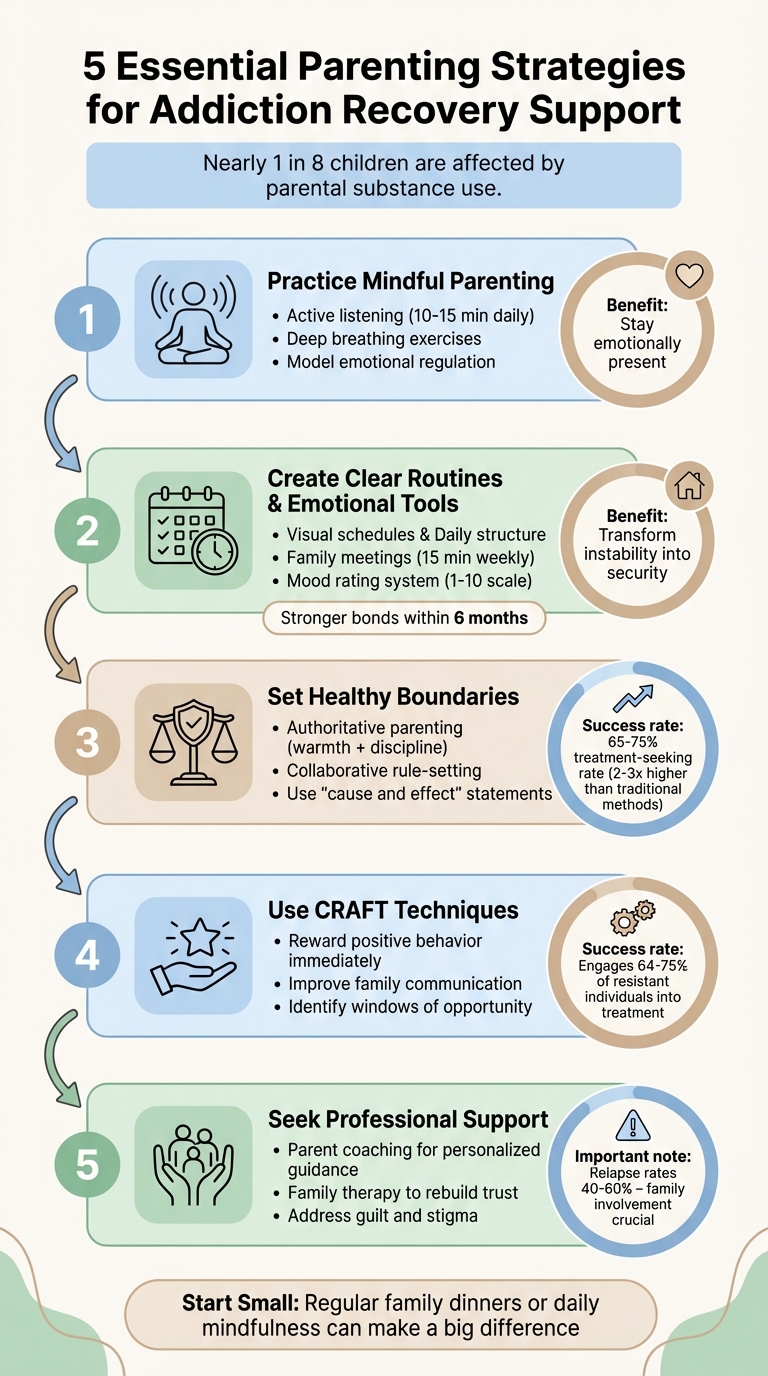
5 Essential Parenting Strategies for Addiction Recovery Support
Strategy 1: Practice Mindful Parenting to Stay Emotionally Present
What Is Mindful Parenting?
In addiction recovery, staying emotionally connected is a cornerstone of rebuilding trust within your family. Mindful parenting encourages you to be fully present with your children, responding thoughtfully rather than reacting impulsively. For parents navigating recovery, this approach can help disrupt patterns of negative behaviors that may have developed during active addiction.
Christie Bates, MA, a therapist and leader of mindful parenting groups, describes mindfulness as:
Mindfulness is about more than just stress reduction. It’s about self-acceptance, breaking with the past and nurturing a feeling of well-being.
The focus isn’t on being a perfect parent. Instead, it’s about understanding your child’s needs while managing your own emotional triggers. Practicing mindfulness enhances self-awareness and allows you to pause before reacting. This pause sets an example for your children, showing them how to handle stress in a healthy way. Over time, they can learn emotional regulation by observing your behavior.
This mindful approach provides a foundation for practical strategies that reduce stress and rebuild trust with your children.
How to Stay Present with Your Children
Mindful parenting becomes more effective when paired with simple, actionable techniques. Start with small daily practices to remain emotionally present, even during challenging moments. For instance, deep breathing can be a lifesaver when stress hits. If you feel overwhelmed, pause to take three deep breaths and assess your stress on a scale from 1 to 10. If your stress level is high, step away briefly for something calming – like a short walk, a phone call with a friend, or a few quiet minutes alone. Explain to your child that you need a moment to cool down, modeling a constructive way to manage strong emotions.
Active listening is another powerful tool. Dedicate 10–15 minutes each day to giving your child your full attention. Put away distractions, maintain eye contact, and truly listen to what they’re saying. This focused time helps your child feel seen and valued. If you do overreact in a moment of stress, own it. Apologizing shows your child that everyone makes mistakes and can work to improve.
You might also create a simple family ritual to help reconnect after tough moments. For example, start each morning by taking three deep breaths together, followed by a group hug. These small but consistent actions provide the emotional grounding your family needs as you navigate recovery. Through mindful practices like these, you can rebuild a sense of trust and stability within your family.
Parenting in Early Recovery from Alcoholism and Drug Addiction
Strategy 2: Create Clear Routines and Use Emotional Regulation Tools
In recovery, establishing predictable routines and using tools to manage emotions can help transform instability into a sense of security.
Build Consistent Daily Routines
Structure brings stability. For children navigating recovery alongside their family, predictability can ease stress and reduce anxiety. According to the Substance Abuse and Mental Health Services Administration, involving family in recovery efforts greatly improves outcomes [6]. A consistent daily routine provides a foundation for this involvement.
Start small. Use a visual schedule – like a whiteboard in the kitchen – to outline daily activities such as morning routines, meals, homework, and bedtime. For younger kids (ages 3–6), picture schedules or "feeling faces" charts can make the process engaging and easier to follow. The goal isn’t perfection but consistency. Even starting with just 10 minutes of structured activity can make a difference, and families often see stronger bonds within six months of maintaining predictable routines [6].
Don’t forget to include recovery-focused activities in the schedule. For instance, if you attend support meetings, add them to the calendar. When children see these commitments treated as priorities, they understand the importance of recovery. MedMark Treatment Centers highlights that "structure and routine are essential for recovery from substance use disorder" [2]. Weekly family meetings, even if only 15 minutes long, can be a valuable time to review schedules, share feelings, and celebrate small victories, like sticking to a morning routine for a full week.
Once routines are in place, incorporating tools to manage emotions can further strengthen your family’s recovery journey.
Use Tools to Manage Emotions
Journals and worksheets encourage accountability. They help both parents and children recognize emotional triggers before they lead to conflict. Dedicate 15–20 minutes each evening to quiet emotional check-ins. For kids aged 7–12, structured journals with prompts like "Today I felt ____ when ____" can help them process their emotions. Teenagers may benefit from trust-rebuilding worksheets that address relationship dynamics and future family goals.
Modeling healthy communication is key. Use "I" statements, such as "I feel frustrated when the morning routine is skipped", instead of placing blame with statements like "You never follow the rules." This approach demonstrates how to express emotions constructively and helps children learn to do the same [6]. With consistent use, these tools can improve family communication within just 30 to 60 days [6].
To take it a step further, implement a simple mood rating system. Each evening, have everyone in the family – including yourself – rate their day on a scale of 1 to 10. Over time, this practice can reveal emotional patterns and provide a clearer picture of progress. These efforts show your commitment to creating a stable environment, which is far more impactful than striving for perfection.
Strategy 3: Set Healthy Boundaries with Authoritative Parenting
Authoritative parenting blends warmth with firm boundaries, creating a supportive environment for recovery. Unlike authoritarian "tough love" or permissive enabling, this approach emphasizes both nurturing and consistent discipline. Research backs this up – using authoritative strategies like those in the CRAFT approach leads to treatment-seeking rates of 65-75% among individuals with addiction, which is 2-3 times higher than traditional methods [8].
Balance Warmth and Discipline
Mutual respect grows through collaborative planning. Work with your child to create a recovery plan that includes rewards for positive actions, like attending meetings or completing household tasks, and clear consequences for crossing boundaries. When children have a voice in setting expectations, they’re more likely to stick to them.
To avoid emotional outbursts, use "cause and effect" statements to define boundaries. For example: "If substances are brought into the house, then you will need to find another place to stay." This clarity ensures everyone understands the consequences.
Ron Grover, a parent and advocate, shared in January 2010 how he shifted his approach from yelling rules like "No lying, no stealing" to setting personal boundaries. He stated, "I do not wish to live in a home where substances are being used." This change allowed him to focus on his own actions rather than trying to control his son’s addiction [10]. As Grover put it:
"Boundaries are not rules. Boundaries help direct your universe when the rules do not apply or are not relevant." [10]
Celebrate healthy choices with small but meaningful gestures, like sending a supportive text, giving a hug, or planning a special dinner. Positive reinforcement not only encourages the behaviors you want to see but also shows your child that their progress is noticed and valued.
Clear boundaries help create a foundation for open and honest conversations about addiction.
Talk to Children About Addiction
Once boundaries are in place, addressing addiction openly becomes crucial. Honesty is key to building trust. Transparent conversations help rebuild trust while giving children a better understanding of the situation. Tailor these discussions to your child’s age to ensure they grasp the message without feeling overwhelmed or blamed.
For younger children, simple metaphors can make complex ideas easier to understand. MedMark Treatment Centers suggests phrases like "Daddy’s addiction is like a fish on a hook" or "Mommy’s addiction is like gum stuck in your hair" to explain the feeling of being "stuck" [2]. For older school-age children, frame addiction as a chronic medical condition – similar to diabetes or hypertension – rather than a moral failing [9].
Take responsibility for your condition to help the family move forward. Create a safe space where children feel comfortable expressing their emotions without fear of judgment. Ask open-ended questions like "How can I help you today?" and listen attentively without interrupting [9]. If emotions run high, take a break and revisit the conversation when everyone is calmer.
For teens and young adults, involve them in recovery planning. Reinforce their confidence with affirmations like "You can do it", "You have good ideas", and "You are important" [9]. Consistency is vital – boundaries and guidelines only work if they’re enforced every time. When children see you follow through on your commitments, they learn to respect the process and the importance of recovery.
sbb-itb-596b85d
Strategy 4: Use CRAFT Techniques to Encourage Positive Change
Building on routines and boundaries, CRAFT techniques help families create an environment where sober behavior becomes more rewarding than substance use.
Community Reinforcement and Family Training (CRAFT) provides an alternative to confrontational methods. This approach equips parents with tools to reshape family dynamics, making sobriety more appealing. Unlike interventions that rely on surprise confrontations or detachment, CRAFT empowers parents to actively support their child’s recovery journey [8].
Studies reveal that CRAFT successfully engages 64% to 75% of resistant individuals into treatment – two to three times more effective than traditional methods [8][11]. As the Partnership to End Addiction explains:
"CRAFT works to change your interactions with your loved one so that sober behavior is more rewarding to them than continued substance use." [8]
Reward Positive Behavior
Reinforcing healthy behavior makes sobriety more appealing. When your child demonstrates non-using behaviors – attending a meeting, completing chores, or having calm conversations – acknowledge it right away. Use verbal praise or small rewards to show appreciation and encourage these actions.
CRAFT also emphasizes withholding positive reinforcement when negative behaviors occur [12]. This doesn’t mean punishment or guilt trips. Instead, it involves letting natural consequences unfold. For instance, if substance use leads to missed work or legal trouble, stepping back and allowing these outcomes can often be more impactful than a lecture [15].
Dr. Robert Meyers, the creator of CRAFT, highlights the importance of family insight:
"No one knows more about the individual’s behavior, triggers, and strengths than the people who live in their household." [13]
Using this understanding, families can perform a functional analysis – identifying triggers, thoughts, and feelings tied to substance use. This helps tailor positive reinforcement strategies to encourage lasting change.
These methods naturally set the stage for better communication within the family.
Improve Family Communication
Better listening can turn conflicts into meaningful conversations. Paraphrasing your child’s words shows them they’re truly heard, reducing defensiveness and encouraging honest dialogue [3]. CRAFT also promotes assertive communication – being clear, direct, and respectful – avoiding both aggressive demands and passive enabling [15].
Keep an eye out for "windows of opportunity" when your child may be more open to discussing treatment. These moments often follow challenges like health scares, relationship struggles, or financial issues [15]. Having a plan ready for these moments, such as access to treatment resources, ensures you can act quickly.
Barbara Straus Lodge, writing for the Journal of Substance Abuse Treatment, captures the essence of this approach:
"Loved ones are not powerless. While we can’t make a person change, we can contribute to making them want to change." [14]
The skills learned through CRAFT – problem-solving, communication, and self-care – support not only immediate recovery efforts but also long-term family well-being [8][12]. By blending clear communication with positive reinforcement, families can build resilience and navigate the recovery process together.
How Professional Support Helps Parents During Recovery
Recovery is a deeply personal journey, but when parenting is part of the equation, professional guidance can make all the difference. Parent coaching and family therapy provide structured support to navigate the emotional challenges, broken trust, and behavioral struggles that often come with addiction recovery.
Research from national support programs shows that structured parent coaching enhances emotional well-being, reduces depression, and strengthens family communication [18]. These findings highlight how a family’s involvement can play a key role in encouraging a loved one to seek and benefit from treatment [18].
Parent Coaching for Personalized Guidance
Parent coaching equips families with tools to support recovery without unintentionally enabling addiction – an all-too-common challenge when dealing with substance use [16]. Coaches rely on evidence-based strategies like positive reinforcement and structured routines to address issues such as defiance and impulsivity. Instead of offering one-size-fits-all advice, coaching tailors solutions to each family’s unique needs. Whether it’s managing a child’s anxiety, improving communication with a teenager, or establishing enforceable boundaries, these strategies are designed to address real-life challenges. Additionally, coaches help parents process feelings of guilt, shame, and stigma [1][17].
Growth and Change Counseling in Campbell, CA, emphasizes empowering parents as a pathway to long-term success, focusing on equipping them with tools rather than solely targeting children [4]. Offering both in-person and telehealth services across California, their parent coaching sessions are accessible and competitively priced.
As South Florida Intervention explains:
Parent coaching offers a compassionate and structured approach to support families facing these complexities [16].
The chance to connect with professionals – or even other parents who have faced similar situations – is often what draws families to parent coaching in the first place [18].
While coaching focuses on individual behavior changes, family therapy works to rebuild trust and improve dynamics across the entire household.
Family Therapy to Rebuild Trust
Rebuilding trust within a family takes time, honesty, and consistent communication [17]. Family therapy provides a safe, structured environment to address unhealthy patterns, such as the "fugitive/detective" dynamic – where one family member hides information while another constantly seeks it out. Therapists help reframe these behaviors, turning a parent’s "judgment" into "concern" and a child’s "defiance" into "anxiety" [19].
Molly Bobek, L.C.S.W., Vice President at FACTS, stresses:
The relationship with your child is the most important thing to attend to – don’t lose sight of this core value when you’re legitimately concerned about your son or daughter’s substance use [19].
Family therapy prioritizes strengthening the parent-child bond while addressing deeper family rules and patterns that may have contributed to the addiction [19].
Growth and Change Counseling takes a solutions-focused approach to family therapy, tackling the root causes of addiction, anxiety, and depression – issues often linked to strained relationships [4]. As Jamula Taylor, LMFT, explains:
We understand that our mental health conditions are related to the breakdown in our relationships and that we can’t simply make depression, anxiety, or other problems go away by simply treating the symptoms [4].
The practice also offers specialized support for neurodiverse couples and a 12-week Marriage Rescue Institute program designed to help marriages in crisis, including those affected by addiction [4]. Therapy sessions include "relational homework" and practical skills that families can apply in their daily lives, ensuring progress continues long after therapy ends [4].
With relapse rates for individuals in recovery hovering between 40% and 60%, active family involvement in monitoring mental health and potential triggers is crucial [20]. Professional support fosters the communication skills and emotional intelligence needed to sustain recovery over the long haul.
Conclusion
Parenting during addiction recovery calls for mindfulness, structure, clear boundaries, and seeking help when needed. By focusing on consistent routines and clear boundaries, you create a sense of stability and trust that your children can rely on. These strategies lay the groundwork for deeper healing and professional support.
As Willingway wisely puts it, "Bonding doesn’t require abundance – it thrives on presence" [21]. Your consistent presence is what helps rebuild trust and connection with your children.
Beyond these foundational steps, parent coaching and family therapy can offer additional support to strengthen your family’s recovery journey. With nearly 1 in 8 children living with a parent struggling with substance use disorder [7][5], it’s important to remember you are not alone in this process. Growth and Change Counseling in Campbell, CA, provides parent coaching and family therapy – both in-person and via telehealth throughout California – to help families develop the skills needed for lasting recovery.
Consider starting small. Something as simple as committing to a regular family dinner or taking a moment for mindfulness can create stability and set the tone for progress. Recovery is a long journey, but every small step you take moves your family closer to resilience and healing. Professional guidance can be a valuable ally in sustaining that progress.
FAQs
How does mindful parenting support addiction recovery?
Mindful parenting plays a crucial role in addiction recovery by helping parents stay grounded, emotionally present, and connected to their children. Instead of reacting impulsively – something that can happen during recovery – this approach encourages thoughtful and intentional responses to their children’s needs. By cultivating patience and empathy, mindful parenting helps rebuild trust and strengthens the parent-child relationship.
For parents, mindfulness practices also serve as a way to manage emotions, identify triggers, and reduce stress, which can be key in lowering the risk of relapse. This not only supports their recovery journey but also creates a more stable and caring environment for their children. A nurturing home promotes emotional security for kids while reinforcing the parent’s progress. In the process, mindful parenting benefits the entire family, fostering resilience and deeper connections during the challenges of recovery.
How can daily routines help children during a parent’s addiction recovery?
Daily routines play a crucial role in giving children a sense of stability and security when a parent is recovering from addiction. Having set times for meals, bedtime, schoolwork, and other daily activities creates a predictable environment. This consistency can help ease stress and reduce feelings of uncertainty.
A structured routine also supports children in developing important life skills like emotional resilience, self-discipline, and emotional regulation. By sticking to a consistent schedule, parents can build trust and encourage open communication – both of which are essential for nurturing their child’s well-being and strengthening family connections during the recovery journey.
Why is it important for families to seek professional help during addiction recovery?
Professional help plays a crucial role for families dealing with addiction recovery. It offers expert guidance to navigate the emotional and relational hurdles that often come with this journey. Addiction doesn’t just impact the person struggling with it – it ripples through the entire family. Children, for instance, might feel confused, anxious, or even take on caregiving roles that aren’t appropriate for their age. Professional counseling steps in to help families rebuild trust, communicate better, and set healthy boundaries, all of which are essential for creating a supportive recovery environment.
Therapists also address deeper issues, like feelings of guilt, shame, or trauma, which can stall the recovery process. With personalized strategies to manage stress, avoid relapse, and build emotional resilience, professional support equips families with the tools they need to heal as a unit and sustain long-term stability.
Related Blog Posts
- Ultimate Guide to Co-Parenting in Recovery
- How to Create Emotional Safety for Kids in Recovery
- How Shame Impacts Parenting in Recovery
- 7 Biblical Principles for Parenting in Recovery
