When addiction recovery involves a family member, the entire household plays a role in either supporting or hindering progress. Common relapse triggers often stem from family dynamics, including unresolved conflicts, enabling behaviors, poor boundaries, and ineffective communication. Research shows that over 50% of relapses are tied to interpersonal stress, and family-related social pressure contributes to 20% of cases.
Key strategies for families to help prevent relapse include:
- Identifying triggers: Understand emotional, mental, and physical relapse stages.
- Creating a relapse-prevention plan: Outline steps for managing cravings and risky situations.
- Setting clear boundaries: Establish consistent rules and avoid enabling behaviors.
- Improving communication: Use open, honest dialogue and active listening.
- Building a safe environment: Remove triggers like alcohol or drugs from the home.
- Seeking professional support: Family therapy can address deeper issues and improve relationships.
Relapse is often a gradual process, not a single event. By recognizing early warning signs like mood swings, isolation, or romanticizing past substance use, families can intervene effectively. Recovery is a shared journey, requiring effort, accountability, and compassion from everyone involved.
AODS 153: Family Relapse Prevention Planning
Common Relapse Triggers in Family Systems
Family dynamics can either support recovery or act as a stumbling block, leading to relapse. Understanding these triggers is key to creating a home environment that promotes long-term sobriety.
Unresolved Conflict and Criticism
Constant arguments and criticism within a family can create a tense atmosphere, making it harder for someone in recovery to manage stress. Studies reveal that adolescents who experience high levels of parent–child conflict show stronger emotional reactions to daily stress compared to those with less conflict in their lives [9]. Instead of becoming desensitized, repeated conflicts heighten emotional sensitivity.
When family members frequently criticize or assign blame, the person in recovery may internalize these negative messages. Clinical Psychologist Nicholas M. Morelli explains:
"The chronic interpersonal stress, social defeat, and criticism associated with family conflict are likely to promote negative self‐schemas, lower expectations for social rewards, and teach maladaptive strategies for coping with negative affect." [8]
Internalizing such criticism can lead to anxiety, depression, and self-doubt – all of which are powerful triggers for relapse. Interestingly, the emotional pain caused by family conflict activates the same brain regions as physical pain [11], potentially leading to a sense of learned helplessness, where the person feels their recovery efforts are pointless [10].
Codependency and Enabling Behaviors
Enabling happens when family members unintentionally shield the recovering individual from facing the natural consequences of their actions. This might look like being overly lenient with rules, making excuses for missed obligations, or stepping in to solve problems for them. While these actions often come from a place of love, they can undermine personal accountability, which is a cornerstone of lasting recovery.
In many cases, family systems become organized around the addiction itself. Without their own recovery work, families may unintentionally maintain an "addiction-centered" dynamic, reinforcing old roles and patterns. Even small choices – like keeping alcohol in the house "just for guests" – can create risky situations.
Another common pitfall is the "I’ve Got This" mentality. When family members or the recovering individual start believing that support groups or recovery meetings are no longer necessary, it can signal a dangerous return to self-reliance. As Alcoholics Anonymous and Narcotics Anonymous warn:
"If you hang around the barbershop long enough, you’re eventually going to get a haircut." [4]
Codependent relationships can also add stress, which may push the individual toward substances as a way to cope. Breaking these cycles is essential for building a recovery-focused family environment.
Poor Boundaries and Inconsistent Rules
Unclear expectations and inconsistent rule enforcement can create instability, making recovery more challenging. Clear boundaries aren’t about punishment – they provide structure and predictability, which are crucial for someone in recovery. When these boundaries are ignored, small lapses can quickly snowball into a full relapse.
Unprocessed Trauma and Family History
Substance use often becomes a way to numb the pain of unresolved childhood trauma or to cope with long-standing patterns of addiction, abuse, or neglect within the family. If these deep-rooted issues remain unaddressed, they can resurface during moments of vulnerability, even after a significant period of sobriety. Healing these wounds is essential for creating a recovery-friendly home environment.
Communication Breakdowns and Emotional Isolation
Healthy communication is the foundation of strong relationships. When family members stop engaging in honest, open dialogue – whether through avoidance, passive-aggressive behavior, or outright stonewalling – it creates emotional distance. This lack of connection can leave the recovering individual feeling isolated, a state that increases the risk of relapse.
Encouraging open and honest communication ensures that everyone feels heard and valued, which is a vital part of supporting long-term recovery. Building these connections helps create a sense of belonging and emotional security within the family.
Practical Strategies for Families to Prevent Relapse
Preventing relapse isn’t just about understanding triggers – it’s about turning that understanding into action. A strong prevention plan takes effort from everyone in the family. Below are some practical ways to create a supportive environment and keep recovery on track.
Developing a Written Relapse-Prevention Plan
A written plan turns good intentions into actionable steps. Start by gathering as a family to identify emotional, social, and environmental triggers [12][7]. The aim is to address relapse early, before it progresses to the physical stage, by recognizing warning signs.
The three stages of relapse – emotional, mental, and physical – can guide the plan. Emotional relapse involves neglecting self-care or withdrawing from others. Mental relapse is when the person starts romanticizing past substance use. Physical relapse is the act of using again [7]. For each stage, outline specific actions, including who to contact, coping strategies, and steps to take.
Include a crisis contact list of mentors, therapists, sponsors, or trusted friends – at least five people who can provide immediate support during moments of intense craving [12][13]. As a family, practice healthy coping methods such as mindfulness exercises, physical activities like jogging or yoga, or using "I" statements during tough conversations [12][7].
Research shows relapse rates for substance use disorders range between 40% and 60%, similar to chronic conditions like asthma or hypertension [7]. This highlights why a detailed and proactive plan is critical.
Be mindful of what experts call "Apparently Irrelevant Decisions" (AIDs) – small, seemingly harmless choices that can lead to relapse. For example, keeping alcohol at home "just for guests" can be a hidden risk [3]. Address these risks in your plan and set clear family agreements to avoid them.
Establishing Sober-Safe Environments
Your home should be a safe space, free from triggers. Stimulus control – removing items or situations that could prompt a relapse – is key [7][3]. Eliminate all related triggers from the house.
Set clear, written house rules that everyone agrees to follow. These rules aren’t about punishment – they’re about creating the structure and predictability that recovery thrives on. When hosting family events, opt for neutral, substance-free locations like parks, community centers, or volunteer activities [1]. Building new, positive memories in sober settings helps everyone move forward.
Since negative emotions and conflict can be triggers, minimize exposure to risky situations. Designate a "cool-down" space in the home where anyone can go to de-escalate emotions [3][5].
Strengthening Communication Skills
Open, healthy communication can help prevent the isolation that often leads to relapse. Practice non-reactive listening – focus on understanding what the person in recovery is saying instead of defending your actions or rushing to offer solutions [5]. This approach helps uncover the root of their struggles.
Take a collaborative stance to encourage accountability while reducing power struggles [3]. Teach all family members assertive communication techniques to express their needs and boundaries clearly [3].
When tough conversations arise, use tools like a decision matrix. Together, list the immediate and long-term outcomes of both using substances and staying sober. This can help challenge the belief that substances provide any real relief [3]. Break recovery into smaller, manageable goals – like attending a certain number of meetings each week or successfully navigating one high-risk event – rather than focusing on the daunting concept of lifelong sobriety [3].
Setting and Maintaining Clear Boundaries
Boundaries are essential for distinguishing between support and enabling. Supporting someone means allowing them to face natural consequences while remaining emotionally present. Enabling, on the other hand, shields them from those consequences, which can undermine accountability.
Consistency is key. Write down family agreements that clearly outline acceptable behaviors, consequences for crossing boundaries, and how you’ll respond to both setbacks and progress.
Social pressure plays a role in over 20% of relapse episodes [3]. To address this, your boundaries may need to include guidelines about which social situations are safe and which ones should be avoided, especially during early recovery.
These structured boundaries create a foundation for professional support to further strengthen recovery efforts.
Using Therapy and Professional Support
While family efforts are crucial, professional help adds another layer of support. Family therapy can address relationship patterns that contribute to relapse, ensuring the entire household is aligned in supporting recovery. As Sustain Recovery explains:
"When your child is in recovery, your family should be in recovery, too. To prevent a relapse for your child, your family should work hard not to be the trigger for your teen." [5]
Growth and Change Counseling (https://johnmarkkane.com) offers family therapy and addiction recovery services across California, including Campbell, San Jose, Los Angeles, and Roseville, as well as telehealth options. Their approach helps families identify and resolve communication issues, boundary challenges, and unresolved conflicts that could derail recovery.
For couples, addiction can place significant strain on relationships. Professional couples counseling provides tools to rebuild trust, improve communication, and handle the challenges addiction brings to a marriage. The Marriage Rescue Institute, part of Growth and Change Counseling, offers an intensive 12-week program specifically for couples in crisis.
While individual therapy remains essential for the person in recovery, family sessions ensure everyone learns the skills needed to support lasting sobriety. Professional guidance helps families uncover blind spots and break unhealthy cycles they might not even be aware of.
sbb-itb-596b85d
Detecting Early Warning Signs and Managing Slips
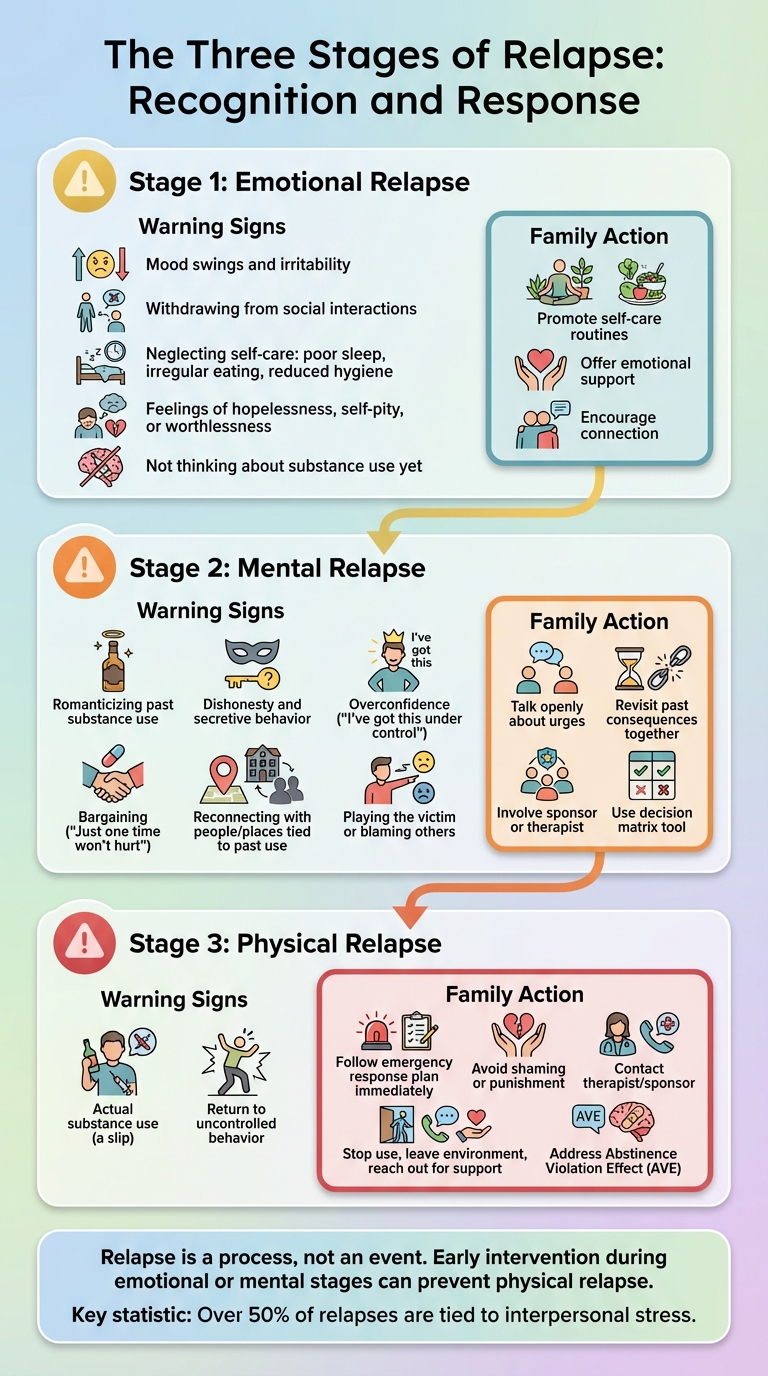
Three Stages of Relapse and Family Response Guide
Building on the strategies for prevention, catching early warning signs is just as important. Relapse doesn’t happen all at once – it’s a process that unfolds over time. Dr. Steven Melemis explains:
"Relapse is a process, it’s not an event. In order to understand relapse prevention, you have to understand the stages of relapse." [14][7]
Recognizing Emotional and Mental Relapse Signals
The first stage of relapse is emotional. At this point, someone might not even be thinking about substance use, but they may begin neglecting their well-being. Look for signs like mood swings, irritability, withdrawing from social interactions, or ignoring basic self-care – such as poor sleep, irregular eating habits, or reduced attention to hygiene. Emotional struggles like feelings of hopelessness, self-pity, or worthlessness may also surface.
Mental relapse follows, marked by an internal tug-of-war. This stage often involves romanticizing past substance use – focusing on the "good times" while glossing over the harm it caused. Warning signs include dishonesty, secretive behavior, or overconfidence, with thoughts like "I’ve got this under control" or "I’m cured." Other red flags include bargaining (e.g., "Just one time won’t hurt" or "I’ll use something less harmful") and reconnecting with people or places tied to past use. Behavioral shifts, such as playing the victim or blaming others, may also signal the risk of slipping into physical use.
Creating a Stepwise Response Plan
If you notice signs of relapse or a slip, how you respond can make all the difference. A slip refers to a single instance of use, while a relapse indicates a return to uncontrolled behavior. Often, the emotional fallout from a slip – known as the Abstinence Violation Effect (AVE) – can spiral into further use if guilt or shame isn’t addressed.
Instead of seeing a slip as a failure, treat it as a chance to learn. Revisit the relapse prevention plan together to identify triggers or "Apparently Irrelevant Decisions" (AIDs) – those small, seemingly harmless choices that might have led to risky situations. Use these insights to adjust the plan moving forward.
One helpful tool is an "emergency preparedness kit." This written plan should include clear steps, such as stopping use immediately, leaving the triggering environment, and reaching out to a therapist, sponsor, or trusted friend. If romanticizing substance use becomes an issue, encourage them to reflect on the negative consequences they’ve experienced in the past.
| Relapse Stage | Key Warning Signs | Family Action |
|---|---|---|
| Emotional | Mood swings, isolation, neglecting self-care | Promote self-care routines and offer emotional support |
| Mental | Fantasizing about use, dishonesty, cravings, planning to use | Talk openly about urges, revisit past consequences, and involve a sponsor |
| Physical | Actual use (a slip) | Follow the response plan, avoid shaming, and contact a therapist |
The goal is to balance accountability with compassion as you help your loved one navigate these challenges.
Balancing Accountability with Compassion
Accountability doesn’t mean punishment – it’s about helping your loved one recognize harmful patterns and take responsibility without being consumed by shame. Recovery isn’t about proving moral strength; it’s about developing new skills and habits over time. When a slip happens, address it honestly, but avoid black-and-white thinking that might push them toward full relapse.
Keep communication open and judgment-free. If your loved one shares their pain or identifies a trigger, resist the urge to defend yourself or justify your actions. Creating a safe space for open dialogue can ease their burden and help them feel supported.
Encourage accountability not only for substance use but also for behaviors like dishonesty, arrogance, or playing the victim – patterns that often pave the way for a physical slip. As Viktor Frankl wisely said:
"Between stimulus and response, there is a space. In that space is our power to choose our response. In our response lies our growth and our freedom." [4]
Building a Long-Term Recovery Culture in the Family
Creating a family environment where sobriety becomes the norm is crucial for long-term recovery. Studies reveal that recovery outcomes improve significantly when the entire family participates in the process, rather than focusing solely on the individual struggling with substance use [5][15]. This transformation involves reshaping daily routines, addressing past issues, and staying adaptable as each family member grows. Families often strive to maintain stability, or homeostasis, which can sometimes unintentionally support substance use [15]. By fostering a supportive environment, families can reduce relapse triggers and strengthen everyone’s commitment to sobriety, reinforcing earlier strategies for managing challenges together.
Building Shared Routines and Healthy Habits
Stress and rigid responsibilities can be major relapse triggers. Balancing external obligations (the "shoulds") with fulfilling activities (the "wants") can help reduce the temptation to turn to substances [3]. Introducing healthy habits into daily life allows families to replace the role that substances once played.
Start by planning activities that are enjoyable and substance-free. For example, visit a local farmer’s market on the weekend, try a yoga class together, or volunteer as a family in the community. To strengthen these efforts, consider tools like structured Daily Trust Discussions, keeping a Family Recovery Notebook to track progress and communication strategies, or simply making a habit of noticing and acknowledging kind actions within the family. These small but meaningful steps create a cycle of positive reinforcement that supports recovery [2].
As these healthy routines become part of daily life, rebuilding trust becomes the next important focus.
Rebuilding Trust and Addressing Past Hurts
Rebuilding trust takes time and consistent effort – it doesn’t happen overnight. Addressing past hurts and reestablishing trust helps solidify the boundaries and open communication that are essential for recovery. Therapist Elisa Blair explains:
"Once trust has been broken, the old relationship cannot exist anymore… The very foundation of your relationship needs to be rebuilt, therefore it is a new relationship." [16]
The process of rebuilding trust involves three key steps: acknowledging and taking responsibility for past mistakes, empathizing with the other person’s feelings, and working together to create a new relationship rather than trying to recreate the old one. In therapeutic settings, trust often begins to show improvement around the six-month mark [16]. Practicing the "most generous interpretation" of a family member’s actions – like assuming a late arrival is due to traffic rather than a relapse – can help maintain a calm and understanding atmosphere.
When emotions run high, having an "Escape Plan" in place can be a lifesaver. This prearranged agreement allows family members to take a break and cool off, preventing conflicts from escalating into triggers for relapse [5]. Since interpersonal conflict is a factor in more than 50% of relapse episodes [3], addressing deeper emotional wounds through therapy is essential. Many of these issues stem from attachment challenges or childhood experiences that resurface under stress. Growth and Change Counseling offers family therapy and addiction treatment to help families navigate these complexities, with services available in Campbell, San Jose, Los Angeles, Roseville, and statewide via telehealth.
Regular Review and Adaptation of Family Agreements
Recovery plans need to evolve as family dynamics and needs change. Testing short-term strategies and reviewing their effectiveness together can help keep the recovery process on track. Contingency contracts, which reward positive behavior, can be particularly helpful with adolescents by fostering mutual accountability.
As SAMHSA highlights:
"When family members change their thinking about and responses to substance misuse, the entire family system changes." [2]
Conclusion
Managing relapse triggers means understanding that addiction impacts the entire family, not just the individual struggling with substance use disorder. When one person faces this challenge, the whole family feels the ripple effects and must find its own way toward healing and recovery [5]. Shifting how families respond to substance misuse can redefine the recovery journey [2], creating a supportive environment for lasting change.
There are five guiding principles for recovery that apply not only to individuals but also to families: building a new life where substance use becomes difficult, practicing complete honesty, seeking help, prioritizing self-care, and sticking to recovery boundaries [6]. These principles highlight that recovery isn’t a one-time achievement – it’s an ongoing process that thrives on consistent effort and shared commitment. Relapse isn’t a sign of failure; it’s a reminder that recovery requires continuous attention and flexibility.
It’s important to understand that relapse often begins long before any physical use of substances. This gives families a valuable opportunity to step in during the early stages. Emotional relapse signs – like withdrawing from others or neglecting self-care – can be early warnings [6][17]. By recognizing these signals, setting firm boundaries, creating safe and sober environments, and fostering open communication, families can play a key role in reducing the chances of relapse.
While these strategies are essential, professional support remains critical for sustaining recovery. Navigating the complexities of family dynamics often requires expert guidance. Growth and Change Counseling provides specialized addiction treatment and family therapy services through telehealth across California. Whether addressing unresolved trauma, codependency, or communication challenges, professional intervention can turn obstacles into meaningful opportunities for healing and growth.
Support Your Journey with Growth and Change Counseling
What are some effective ways for families to identify and manage relapse triggers?
Identifying what triggers a relapse often begins with examining everyday patterns – specific people, places, routines, or emotions that might spark cravings. For families, keeping a simple log can be incredibly helpful. For instance, jotting down moments when triggers appear, such as a stressful day at work, a certain social setting, or even the presence of substances at home, can reveal key patterns. Talking openly about these observations allows everyone to pinpoint the most impactful triggers affecting their loved one.
Addressing these triggers calls for clear boundaries, honest communication, and professional guidance. Families can work together to develop a relapse-prevention plan, which might include alternative activities for risky situations – like diving into hobbies, staying active with exercise, or attending sober gatherings. Practicing active listening and sharing concerns in a non-judgmental way can make the person in recovery feel supported while still holding them accountable. In some cases, seeking professional family therapy, such as the services provided by Growth and Change Counseling, can help improve family relationships and create a more supportive environment for sustained recovery.
How does family communication help prevent relapse?
Family communication is a cornerstone in helping prevent relapse, as it creates a supportive and understanding space for recovery. When families engage in open and honest conversations, they can spot early warning signs, address concerns without judgment, and reaffirm their loved one’s dedication to staying sober. On the flip side, poor communication often leads to misunderstandings and stress, which can heighten the risk of relapse.
Improving communication within the family starts with a few key practices: active listening, setting healthy boundaries, and collaboratively solving problems. Simple techniques like holding regular family check-ins, using "I" statements to express feelings, and steering clear of criticism while focusing on shared goals can go a long way in reducing tension and building trust. When families strengthen their communication, they become a pillar of support and stability throughout the recovery journey.
At Growth and Change Counseling, family therapy sessions aim to enhance these communication skills. Using tailored, solutions-focused methods, families learn how to face challenges together, set realistic expectations, and create a positive environment that encourages lasting recovery.
Why are clear boundaries important for supporting a loved one’s recovery?
Clear boundaries play a crucial role in supporting recovery, as they provide a structured framework that separates helpful behaviors from those that enable addiction. By setting clear limits – whether it’s regarding finances, living arrangements, or emotional interactions – families can offer steady support while promoting accountability and independence. This approach not only reduces the likelihood of relapse but also fosters mutual respect within the family dynamic.
For families dealing with addiction, boundaries also help redefine roles and prevent destructive patterns, like the "rescuer-enabler" cycle. Growth and Change Counseling offers personalized family therapy and relapse-prevention planning to assist families in establishing practical and compassionate boundaries. These boundaries aren’t about punishment; they’re about creating a nurturing environment where everyone has the opportunity to grow and succeed.
Related Blog Posts
- How Family Therapy Restores Trust After Addiction
- Boundaries for Addiction Recovery and Healthy Love
- Family Systems Model for Addiction Recovery
- Ultimate Guide to Family Resilience in Addiction Recovery
