When a parent relapses, the effects go beyond their personal struggle – it disrupts co-parenting and impacts children. Relapse can lead to missed visits, broken trust, and legal consequences, including changes to custody arrangements. Children may face emotional instability, while the sober parent often takes on extra responsibilities.
Here’s what you need to know:
- Key Challenges: Relapse creates unpredictability, damages trust, and can lead to court-ordered supervised visitation or custody changes.
- Legal Considerations: Courts prioritize child safety, often requiring sobriety proof through drug tests or monitoring systems.
- Protecting Children: Set clear boundaries, document incidents, and ensure children have consistent routines.
- Support and Recovery: Therapy and structured recovery plans help rebuild trust and co-parenting stability over time.
This guide outlines strategies to safeguard children, manage legal issues, and rebuild trust while navigating co-parenting through relapse.
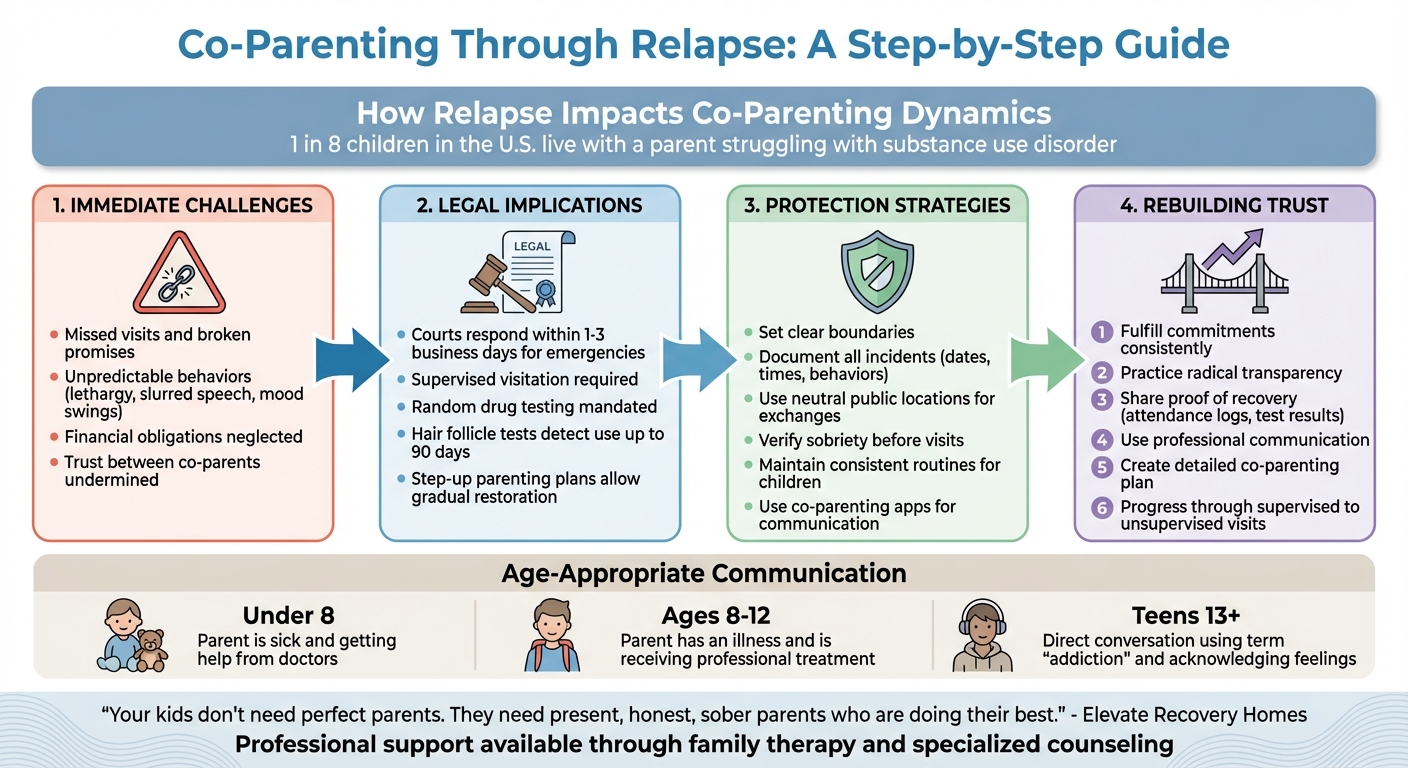
Co-Parenting Through Relapse: A Step-by-Step Guide to Safety and Recovery
Co-Parenting with an Addict: What I’m Going Through Right Now
sbb-itb-596b85d
How Relapse Disrupts Co-Parenting
When one parent relapses, the stability of co-parenting takes a hit. Missed pickups, canceled visits, and broken promises become the norm, leaving the sober parent scrambling to adapt. Financial obligations can also fall by the wayside, as money is redirected away from necessities [4][5].
Relapse often brings visible and troubling behaviors – lethargy, slurred speech, and unpredictable mood swings [1][5]. These changes can confuse children and force the sober parent into a constant state of high alert. Even basic conversations can spiral into shouting matches or emotional manipulation [4].
"Addiction can feel like a third entity in a marriage, siphoning time, money, and emotional energy away from the core partnership." – The McKinney Law Group [4]
This unpredictability undermines trust between co-parents. Behaviors like secrecy and hypervigilance only deepen the cracks in an already fragile relationship [4].
Shockingly, about 1 in 8 children in the U.S. live with a parent struggling with substance use disorder. These kids often face emotional upheaval and are forced into roles they’re not ready for, such as caretakers or mediators [5][6][2]. This role reversal not only disrupts their development but leaves lasting emotional scars [2][5].
The ripple effects of these challenges don’t just harm family dynamics – they can also lead to potential legal battles.
Legal and Custody Implications of Relapse
Court Responses to Parental Relapse
When a parent experiences a relapse, family courts act swiftly to prioritize the safety and well-being of the child. A relapse is often classified as a "material change in circumstances", which allows the other parent to seek adjustments to custody or visitation arrangements[11][12]. If the child is in immediate danger, courts can issue temporary emergency orders within 1–3 business days[13].
The severity of the relapse influences the court’s decisions. In many cases, supervised visitation is implemented, where a neutral third party oversees all interactions between the parent and child[1]. In more serious situations, the court may revoke legal custody, stripping the relapsing parent of their authority to make critical decisions about the child’s education, healthcare, and overall welfare[1]. For example, California’s Family Code §3011(d) mandates that judges consider habitual substance use when making custody determinations[8].
Some courts use "step-up" parenting plans, which allow the relapsing parent to gradually regain parenting time as they demonstrate progress. Attorney Jenna C. Sholk explains:
"As a parent displays progress, their parenting time can gradually increase. However, in the event of a setback or relapse, they may need to return to an earlier phase of the plan to rebuild trust and stability"[7].
Courts often impose strict sobriety requirements on the relapsing parent. These may include random drug testing, mandatory participation in rehabilitation programs, or the use of real-time alcohol monitoring devices like Soberlink[1][7]. Hair follicle tests, which can detect substance use for up to 90 days, are also commonly used to provide objective evidence of sobriety[7]. In some states, refusing a court-ordered drug test can be treated as an admission of substance abuse[13].
Accurate documentation plays a critical role in these proceedings, offering courts the evidence they need to make informed decisions.
Documentation and Communication Requirements
The parent seeking to protect the child must maintain a thorough record of incidents, including dates, times, and specific behaviors such as slurred speech, missed pickups, or erratic actions. Evidence like text messages, voicemails, and social media posts can serve as proof in court[1][13].
Documentation from third parties carries even greater weight. Police reports from DUI arrests, medical records from overdoses, and reports from Child Protective Services provide independent verification of the relapsing parent’s behavior[9][10]. As Moshtael Family Law states:
"Stability always wins over sentiment in high-risk custody decisions"[1].
Detailed records not only ensure the child’s safety but also outline a path for the relapsing parent to regain trust. Courts look for tangible signs of recovery, such as completing certified rehabilitation programs, attending AA or NA meetings consistently, securing stable housing, and maintaining steady employment[10][11]. The ultimate goal is to create a secure and stable environment for the child.
Strategies for Co-Parenting Through Relapse
Navigating co-parenting during a relapse requires clear strategies to ensure safety, support recovery, and rebuild trust. These steps help maintain stability for children while addressing the challenges of addiction within the family dynamic.
Setting Clear Boundaries for Safety
When a co-parent relapses, safety must come first. Treat the relationship as a professional partnership focused solely on the children’s well-being. Communication tools like emails, texts, or co-parenting apps (e.g., Our Family Wizard) can help create a reliable record and minimize potential conflicts.
Before any exchange, verify sobriety using tools like breathalyzers or remote monitoring systems. Always conduct drop-offs and pick-ups in neutral, public spaces such as parking lots or community centers to reduce tension and ensure safety. If the co-parent is actively struggling with addiction or is in early recovery, supervised visitation – whether through professional centers or trusted family members – may be necessary.
It’s also essential to have an exit plan. If the other parent appears impaired or if the interaction becomes hostile, leave immediately. These boundaries not only protect the children but also provide a framework for long-term recovery.
Supporting Recovery While Protecting Children
Balancing accountability with compassion can support recovery while safeguarding the kids. If you’re the parent in recovery, make your therapy and support meetings a priority – even during your parenting time. As Elevate Recovery Homes explains:
"Your kids don’t need perfect parents. They need present, honest, sober parents who are doing their best."
A strong recovery foundation allows you to show up as the parent your children need.
For the sober co-parent, reinforcing positive behaviors can encourage progress. Acknowledge when the recovering parent attends therapy, maintains sobriety, or follows through on commitments. Establish consistent routines at home – like set bedtimes, meal schedules, and house rules – to provide children with the stability they need, especially if the other parent’s behavior is unpredictable. Family counseling or support groups like Al-Anon can also help everyone process the challenges of addiction.
Graduated parenting plans can offer a way forward. By gradually increasing parenting time as the recovering parent demonstrates consistent sobriety through testing and documentation, children remain protected while the parent works toward restoring trust.
Age-Appropriate Communication With Children
Children need honest, age-appropriate explanations to understand what’s happening without feeling overwhelmed.
- For children under 8: Keep it simple. Let them know the parent is "sick" and working with doctors to get better. Reassure them that it’s not their fault and that they are safe.
- For ages 8–12: Provide more detail. Explain that the parent is dealing with an illness and receiving professional help. This helps them grasp the situation without framing it as a moral failure.
- For teens (13 and older): Be direct. Use terms like "addiction" and acknowledge their feelings, including anger or distrust. As Elevate Recovery Homes suggests, an honest conversation might sound like this:
"I’m an addict, and I hurt you through my actions. I can’t change the past, but I’m in recovery now and working every day to be better… I’m going to earn that trust back through my actions."
Regardless of their age, avoid using children as messengers or emotional outlets. Health Care Recovery Centers emphasizes:
"Children are not pawns. They should not be used as messengers or emotional outlets for issues between parents."
If needed, consider engaging a family therapist to help children process their emotions in a safe and supportive environment.
The Role of Professional Support in Recovery and Co-Parenting
Family and Individual Therapy
Therapy provides a structured environment for productive communication, especially during emotionally charged moments like child exchanges or custody discussions. A therapist can guide conversations to remain constructive, ensuring that both parties feel heard. As The McKinney Law Group explains:
"A mediator… helps each party voice concerns, ensuring the recovering spouse can share their progress without feeling attacked and the sober spouse can discuss boundaries without feeling dismissed."
Individual therapy is equally important for the recovering parent, helping them address feelings of overwhelming guilt, which, if left unchecked, can lead to isolation and increase the risk of relapse. Counseling shifts this guilt into "productive guilt", which inspires positive actions. For children aged 8 and older, therapy offers a judgment-free space to express their emotions about a parent’s substance use, reducing the risk of further conflict or misunderstandings.
Therapists also play a key role in documenting recovery progress, providing attendance logs, treatment certificates, and progress reports. These records are often critical for rebuilding trust with the co-parent and, when applicable, the court system.
Therapeutic support becomes even more impactful when paired with specialized services designed to address the unique challenges of addiction recovery within families.
Services Offered by Growth and Change Counseling

Specialized services can make a world of difference in navigating the intersection of addiction recovery and co-parenting. Growth and Change Counseling, based in California, offers targeted solutions to help families rebuild stability and trust.
The practice incorporates integrative approaches like Cognitive Behavioral Therapy (CBT) alongside addiction-specific treatment models. One standout service is parent coaching, which helps parents tackle the challenges of raising children during or after recovery. Additionally, in-vivo communication coaching provides real-time guidance for co-parents, helping them navigate defensive reactions or patterns like silent treatment. Karin Weisse, LMFT, explains:
"At Growth and Change Counseling, we have a foundational process that we take couples, individuals, addicts, and parents through. This process is tailored to your situation, building the relational intelligence needed to restore relationships and mental health."
The practice also addresses deeper issues through trauma-informed family therapy techniques, using methods like EMDR and somatic therapy to resolve underlying challenges that might hinder effective co-parenting. Sessions cost $165 for 45 minutes, and insurance is accepted through providers like Anthem Blue Cross, Aetna, United Health Care, Oxford, and Oscar Health. Services are available in Campbell, San Jose, Los Angeles, Roseville, and throughout California via secure telehealth platforms.
This combination of professional therapy and specialized services can rebuild trust and create a stable co-parenting framework, all while prioritizing the well-being of children during the recovery process.
Rebuilding Trust and Restoring Co-Parenting Stability
Steps to Rebuild Trust Over Time
Rebuilding trust takes time and consistency. It starts with fulfilling commitments, like attending 12-step meetings or being punctual for child pick-ups. These actions show the recovering parent’s dedication to their child’s safety and well-being. As AddictionCenter puts it:
"The reality is that it’s going to be a long process to earn [your loved ones’] trust back…you’re not going to be able to earn everybody’s trust in one day. You need to earn your own trust first and work from there." [14]
One way to rebuild trust is through radical transparency. This involves openly sharing proof of recovery, such as attendance logs, therapist letters, or drug test results. Tools like remote alcohol monitoring systems can provide real-time, court-admissible evidence of sobriety, giving the other parent peace of mind about the child’s safety.
Effective communication is also key. Shifting to a professional partnership focused on the child’s needs can reduce conflict. Using “I” statements – like “I feel concerned when schedules change abruptly” – helps express concerns without assigning blame, which can lower defensiveness. Co-parenting apps like OurFamilyWizard or AppClose can streamline communication by logging all interactions and storing important recovery-related documents in one place, reducing the need for direct contact.
A detailed co-parenting plan is essential. This plan should clearly outline visitation schedules, roles, and steps to take if a relapse occurs. Listening to and addressing the other parent’s concerns is also crucial. By doing so, the recovering parent can rebuild the emotional foundation needed for successful co-parenting.
These strategies lay the groundwork for restoring trust and eventually resuming full parenting responsibilities.
Gradual Restoration of Parenting Responsibilities
Restoring parenting time should happen in phases. It often begins with supervised visits or exchanges at neutral locations and progresses to unsupervised time as the recovering parent demonstrates stability. Elevate Recovery Homes emphasizes:
"Every kept promise rebuilds trust. Every broken promise sets you back." [3]
The recovering parent must prioritize their recovery above all else. Skipping therapy or support meetings to fit in parenting time can undermine their progress and their ability to provide a safe, stable environment for their child. A consistent routine – regular sleep, exercise, and therapy – helps create the stability that children need to feel secure.
Keeping detailed records of progress is important. Document therapy sessions, support group attendance, and test results to provide objective proof of recovery. This documentation not only reassures the co-parent but is also valuable for court proceedings. In cases where direct collaboration is too stressful, parallel parenting offers a solution. This approach allows each parent to manage their responsibilities independently, minimizing conflict while trust is still being rebuilt.
Legal agreements can also support this process. For example, parenting plans can include "step-up" provisions, where visitation time increases automatically after a set period of documented sobriety – such as six months of clean drug tests. This approach removes subjective judgment and provides clear milestones, giving both parents a shared goal to work toward.
Finding a Way Forward with Growth and Change Counseling
Relapse can shake the foundation of co-parenting, but it doesn’t have to dismantle the relationship entirely. Moving forward means prioritizing safety, setting clear boundaries, and treating co-parenting like a professional partnership centered on the children’s needs. As Dr. Mae Casanova, Licensed Clinical Psychologist, wisely states:
"We do have an impact on how it affects our children." [15]
Children thrive in environments that offer consistency and structure. Keeping predictable routines intact shields them from the emotional turbulence relapse may bring. At the same time, the sober parent must focus on their own mental health to remain a steady and dependable presence for the family.
Professional support can also play a vital role in navigating the complexities of parenting during recovery. Growth and Change Counseling provides tailored family therapy, parent coaching, and addiction recovery services across California, available both in-person and through telehealth options.
Rebuilding trust is a gradual process, achieved through consistent actions. Tools like documentation, open communication, and the careful restoration of responsibilities create a clear path forward. This approach not only helps parents regain trust but also ensures a stable environment for their children.
Ultimately, a shared commitment to their children’s well-being can help co-parents overcome the challenges that addiction leaves behind. By staying consistent, seeking support, and maintaining firm boundaries, co-parents can rebuild their partnership and provide the stability their children deserve – one step at a time.
FAQs
When should I seek emergency custody after a relapse?
If a child’s safety is in jeopardy due to a parent’s relapse or substance abuse, it’s crucial to act quickly. Warning signs might include consistent substance use, neglect, or behavior that puts the child in danger. In such cases, reach out to local authorities or consult a legal professional immediately to secure emergency custody and protect the child’s well-being.
What proof of sobriety do courts usually accept?
Courts often recognize evidence of sobriety, like clean hair follicle drug tests, which can indicate substance-free behavior for up to 90 days. Be sure to check with your legal counsel or review court guidelines to understand the exact requirements for your case.
How do I talk to my child about a parent’s relapse?
When talking to your child about a parent’s relapse, it’s important to be honest, keep the explanation age-appropriate, and offer plenty of reassurance. Kids are often very perceptive – they can sense when something is off and might even blame themselves for what’s happening.
Calmly explain the situation in a way they can understand. Make it clear that the relapse is not their fault, that recovery is possible, and that they are deeply loved. Pay close attention to any changes in their behavior, as children may find it hard to express their feelings with words. Providing consistent reassurance can help them feel safe and supported during this challenging time.
Related Blog Posts
- Ultimate Guide to Co-Parenting in Recovery
- 7 Tips for Supporting a Partner After Relapse
- Managing Relapse Triggers in Family Systems
- Parenting Strategies For Addiction Recovery Support
