If therapy ignores family, faith, migration stress, and gender roles, it can miss the main problem. For many African couples in the U.S., marriage is not just about two people. It often includes elders, in-laws, church life, money duties, and pressure from both home and U.S. norms.
Here’s the short version:
- Family matters: conflict may involve parents, elders, or in-laws, not just spouses.
- Migration stress matters: moving to the U.S. can change power, money, and parenting roles.
- Faith matters: prayer, ritual, and input from faith leaders may shape how repair happens.
- Past pain matters: trauma, depression, anxiety, and addiction can sit under repeat conflict.
- Fit matters: couples may need a therapist who understands African and diaspora family patterns, privacy concerns, and telehealth options in California and across the U.S.
- Structure can help: a 12-week format may work better than open-ended sessions when the marriage is in crisis.
A few details stand out. The article notes $200 for a 45-minute individual session and says some couples programs use custom pricing. It also points to 15 to 30 minutes of daily homework in a structured repair process. Those numbers matter if you are trying to judge time, cost, and effort before you start.
| Focus area | What the article says |
|---|---|
| Family role | Marriage may be seen as a bond between families |
| Main stress points | Acculturation gaps, money pressure, gender expectations, isolation |
| Support in therapy | Elders, faith leaders, prayer, and agreed spiritual practices |
| Deeper issues | Trauma, addiction, depression, anxiety, trust damage |
| Best use case for structure | Infidelity, betrayal, addiction, or pressure to separate |
If I had to sum it up in one line, it would be this: marriage counseling works better when it matches the couple’s family system, faith life, stress load, and level of crisis.
Marriage Unfiltered | Dr Rick Netshiozwi and Neo Maimela | Interview
sbb-itb-596b85d
African Marriage Values, Family Structure, and the Role of Community in Counseling
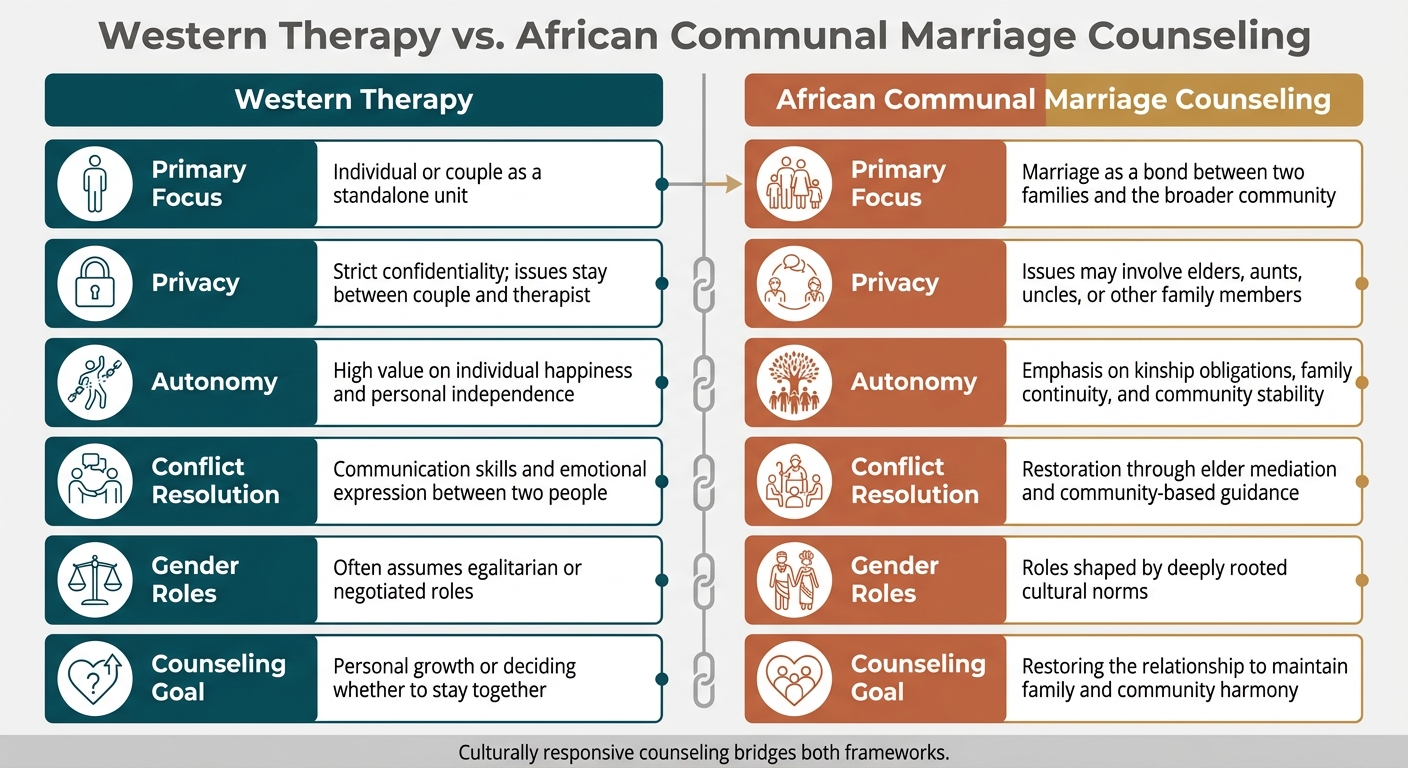
Western Therapy vs. African Communal Marriage Counseling: Key Differences
Marriage as a Bond Between Families, Not Just Two People
Those pressures can hit harder when marriage is shaped by family authority and community expectations. In many African cultures, marriage joins two families, not just two people, and brings duties to both sides. That shifts how counselors need to think about conflict, privacy, and repair.
Bridewealth practices such as ilobolo also frame marriage as a public family commitment tied to family continuity and community stability.
For a couple living in the U.S., that can create a real push and pull. On one side, there may be family expectations built around duty, kinship, and public accountability. On the other, there are more individual-focused norms that stress personal choice and couple privacy. That tension can become part of the conflict itself.
How Elders and Community Members Traditionally Guide Reconciliation
In many African communities, couples often speak with elders, parents, aunts, or uncles before they ever turn to a professional counselor. For those seeking professional support, understanding what to expect in couples therapy can help ease the transition from traditional methods. These family and community figures help preserve the relationship and restore family harmony. They bring authority, shared history, and a direct stake in what happens next.
The aim is often not to end the relationship fast, but to repair it.
That means counselors should look closely at who carries influence in the family and how that shapes both conflict and reconciliation. If a therapist ignores those voices, they may miss the people who are already guiding the couple behind the scenes.
Comparison Table: Western Couples Therapy Assumptions vs. African Communal Marriage Norms
These assumptions shape every part of counseling, from session format to the outcome.
| Feature | Western Therapy | African Communal Norms |
|---|---|---|
| Primary Focus | The individual or the couple as a standalone couple | Marriage as a bond between two families and the broader community |
| Privacy | Strict confidentiality; issues stay between the couple and therapist | Marriage issues may involve elders, aunts, uncles, or other family members |
| Autonomy | High value on individual happiness and personal independence | Emphasis on kinship obligations, family continuity, and community stability |
| How Conflict Is Resolved | Focus on communication skills and emotional expression between two people | Restoration through elder mediation and community-based guidance |
| Gender Roles | Often assumes egalitarian or negotiated roles | Roles and decision-making are shaped by deeply rooted cultural norms |
| Counseling Goal | Personal growth or deciding whether to stay together | Restoring the relationship to maintain family and community harmony |
These differences affect how a counselor sets up sessions, defines goals, and decides who should be included.
How Culturally Responsive Marriage Counseling Works in Practice
Once the family context is clear, the next step is to look at the pressures driving day-to-day conflict.
Assessing Migration Stress, Family Expectations, and Acculturation Gaps Early
Culturally responsive counseling starts by mapping the forces shaping the marriage before digging into the conflict itself. A big part of that is spotting acculturation gaps early, meaning differences in how each partner has adjusted to life in the United States. If one partner has moved toward more individualistic expectations while the other still leans on older family roles, tension often shows up around gender, parenting, and who gets the final say. Skip this step, and therapy can end up treating symptoms instead of the source.
Money is often tied to family duty, so it helps to frame it as a shared financial plan instead of a personal failing. Immigration stress matters too. So does the loss of day-to-day support from extended family. Those pressures shape how much weight the couple is already carrying before a single argument starts.
Generational trauma also needs to be part of the early picture. The way people communicate, pull away, lash out, or stay silent is often shaped by families that lived through hardship and discrimination. Naming those patterns early helps both partners see why they react the way they do, not just what set them off. [1][2]
For many couples, those pressures are tied closely to faith and shared meaning.
Bringing Spirituality, Respect, and Shared Meaning Into Sessions
Many African and African-diaspora couples want faith discussed openly, not pushed to the side as if it has nothing to do with therapy. That can mean making room for prayer, rituals, and direct conversations about what their faith tradition teaches about reconciliation. In that setting, forgiveness becomes more than a communication tactic. It can be treated as a spiritual act that supports apology, renewed commitment, and the rebuilding of trust.
Counselors can also shape communication work around the idea of respect. That gives couples a frame that feels familiar: how partners speak to each other, how they disagree, and how they hold onto dignity even in hard moments. It works better than dropping in outside models that may feel out of place.
From there, the counselor can bring in structured tools that match the couple’s values.
Counseling Methods That Fit African and African-Diaspora Couples
Some structured tools work well when they’re adjusted to fit the couple’s background and daily life.
- A cultural genogram maps family history, roles, and influence across generations. It helps each partner see where their views of marriage came from and where those views split. When paired with values mapping, where each partner names what matters most in the marriage, the counselor gets a clear view of where the couple lines up and where conflict is most likely. [4]
- Active listening exercises, structured time-outs, and “I feel” statements can help when a couple is stuck in a pattern where one person keeps pushing to talk and the other shuts down. [1][3]
When in-law involvement turns into a source of strain, counselors can help couples set clear limits without throwing respect out the window. The goal is simple: make room for both family respect and marital stability.
How Cultural Values Shape Therapy at Growth and Change Counseling
When Mental Health and Addiction Are Driving Marital Breakdown
When the same conflict keeps coming back, the issue may run deeper than poor communication. Trauma, addiction, or spiritual distress can sit underneath the surface and keep the marriage stuck. Unresolved trauma, long-term depression, anxiety, or compulsive behaviors wear down trust and intimacy over time. So the counselor has to look past the argument itself and pay attention to what is fueling it.
This pattern is often layered. Trauma may show up as fear, withdrawal, isolation, or a pursue-withdraw cycle that gets mistaken for indifference or anger [3]. Compulsive behaviors such as pornography or sex addiction can damage trust long before anyone names the problem [5]. Counselors also watch for unresolved anger as a hidden driver of persistent depression. Trauma, anxiety, depression, addiction, and relationship strain need to be treated together, not split into separate boxes. If those issues are spotted early, counseling is less likely to focus on symptoms while missing the root problem.
Working Respectfully With Prayer, Ritual, Faith Leaders, and Ancestral Beliefs
Once the clinical pattern is clear, spiritual beliefs should be part of care rather than treated like an add-on. Faith often shapes how couples make sense of suffering, healing, and marital duty. In trauma and addiction recovery, prayer, ritual, and faith leaders can provide accountability and support reconciliation in ways that purely clinical tools may not.
The counselor should ask directly about prayer, ritual, faith leaders, and ancestral beliefs, and use only the practices both partners accept. It also helps to name which practices support healing and which ones clash with the couple’s faith or recovery goals. Put simply, not every spiritual practice helps just because it is familiar. Some practices steady the couple. Others may pull them off course.
Comparison Table: Standard Recovery-Focused Couples Work vs. Culturally Integrated Recovery Support
| Feature | Standard Recovery-Focused Work | Culturally Integrated Recovery Support |
|---|---|---|
| View of conflict | Focuses on individual pathology or communication deficits | Views conflict as a cycle shaped by cultural and historical trauma |
| Addiction approach | Focuses on abstinence and behavioral triggers | Addresses relational and emotional wounds through faith-informed frameworks |
| Role in recovery | Spiritual practice treated as separate from clinical work | Integrated through prayer, ritual, and faith-based accountability |
| Accountability | Primarily between the couple and the therapist | May involve family members, elders, or faith leaders |
| Trust building | Focuses on individual transparency and reliability | Focuses on restoring the bond between families and honoring communal responsibilities |
| Decision making | Encourages choices based on individual emotional needs | Emphasizes living by spiritual and relational principles over fluctuating feelings |
When a couple needs more structure, that worldview should shape the recovery plan.
Structured Counseling Options in California and Key Takeaways
When a Structured 12-Week Process May Help a Couple in Crisis
When family systems, migration stress, and spiritual concerns shape conflict, a clear plan can help turn insight into action.
If infidelity, addiction, betrayal, or pressure to separate has pushed a marriage into crisis, a structured 12-week process may do more than open-ended weekly sessions. Growth and Change Counseling offers The Marriage Rescue Institute in Campbell, San Jose, Los Angeles, and Roseville, CA, along with telehealth across California. Over 12 weeks, the process moves from stabilization to communication and repair skills, then into trust and intimacy repair. Between sessions, couples complete 15 to 30 minutes of daily homework.
That kind of structure can help create steadiness, respect family expectations, and keep the work on track. For African and African-diaspora couples, it links the program directly to communal marriage norms. In plain terms, it builds accountability inside a framework that respects family roles, privacy, and faith. Couples get a defined repair plan and daily follow-through. In California, that option is available both in person and through telehealth. [6]
Practical Factors Couples Should Review Before Starting Counseling
Before starting counseling, couples should look closely at fit in three areas: crisis level, cultural understanding, and privacy—including whether to choose couples therapy or self-healing after a breach of trust.
Crisis level comes first. If the marriage feels more like coexisting than partnering, or if daily life is shaped by constant conflict or long stretches of silence, a structured program may work better than standard talk therapy.
Cultural fit matters just as much. It helps to ask direct questions: Does the counselor understand acculturation gaps? Do they grasp extended family dynamics? Can they see how communal values shape conflict inside the marriage? If not, couples can end up explaining the whole context before any repair work even starts.
Confidentiality is also a serious concern for many African couples. A good counselor should address privacy expectations clearly and early, not dance around them. On cost, individual therapy is about $200 per 45-minute session. The Marriage Rescue Institute uses custom pricing, and telehealth is billed at the same rate as in-person care. [7]
Conclusion: Key Points for Culturally Sensitive Marriage Repair
Effective counseling for African couples works best when it fits communal marriage values. That means accounting for family systems, migration stress, faith, and any underlying trauma or addiction, instead of treating the marriage as if it exists on its own, cut off from family and culture. [2][4][6] The strongest repair plan matches the couple’s culture, crisis level, and need for trust.
FAQs
How do I know if a counselor understands African family dynamics?
Look for a counselor who understands how your background shapes identity, communication, and what each partner expects from the relationship. That includes things like extended family roles, community support, and the social pressures around you, without reducing any of it to stereotypes.
You should also feel safe and respected in the room. You shouldn’t have to teach your counselor your lived experience from the ground up. Growth and Change Counseling offers support shaped around each couple’s background, situation, and needs.
Should elders or faith leaders be involved in counseling?
In many African communities, elders and faith leaders carry a lot of weight. Their guidance can help you make sense of hard moments while still honoring family ties and long-held customs.
That said, wisdom matters here. If their advice clashes with your personal faith or with scriptural values, it makes sense to put those convictions first. Professional counseling can also give you a safe, private space to work through marital challenges while still making room for your heritage.
When is a structured 12-week program better than weekly therapy?
A structured 12-week program often works better when a marriage is in crisis and needs immediate, practical change. It gives couples a clear roadmap to help steady the relationship, stop destructive patterns, and build conflict-resolution skills fast.
This kind of program can be especially helpful for couples who feel stuck in the same conversations without getting anywhere. Instead of more open-ended sessions that can lose steam, it focuses on action, follow-through, and homework that pushes change week by week.
Related Blog Posts
- Study: Impact of Cultural Awareness on Marriage Counseling
- How Christian Counseling Supports Family Healing
- Trauma Recovery for Cross Cultural Couples
- Christian Counseling Tools for Marriage Recovery
