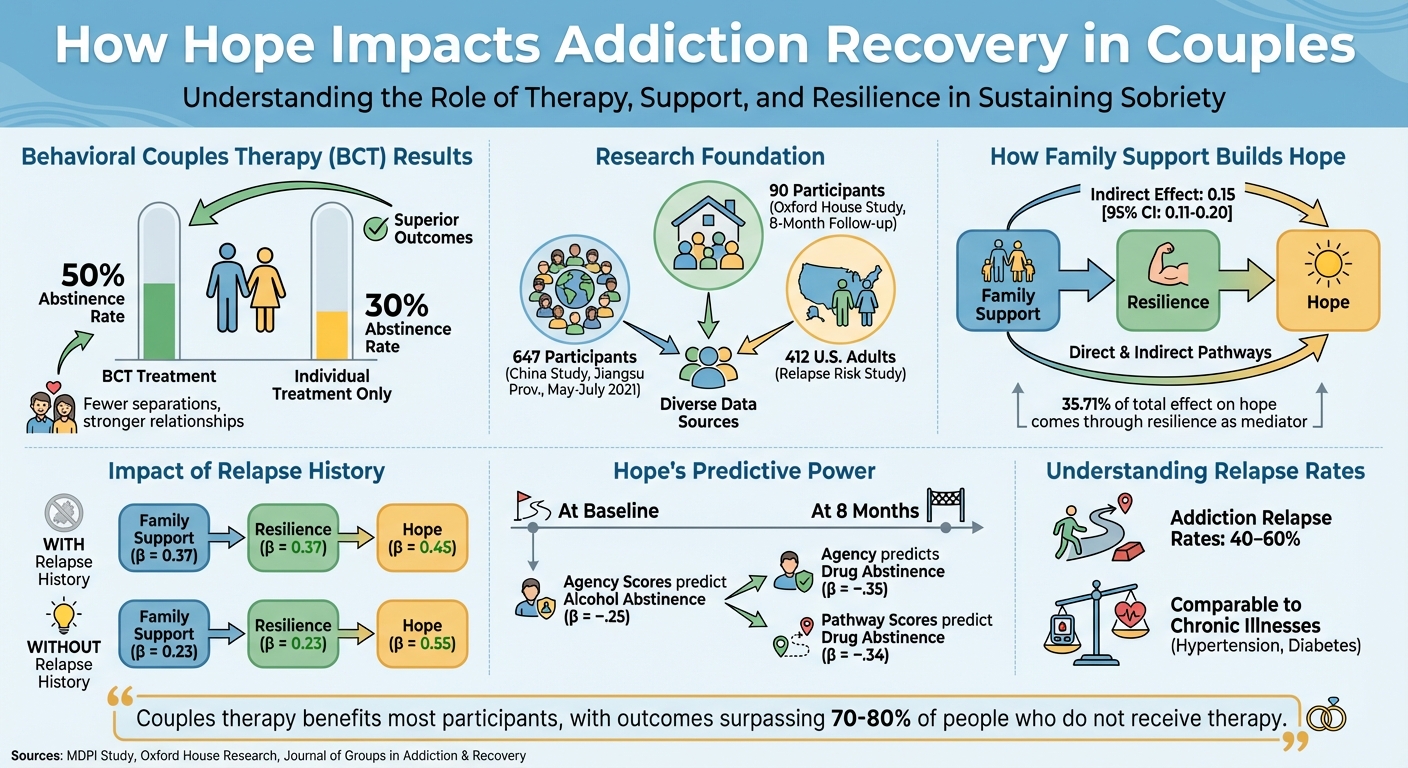
Hope plays a critical role in addiction recovery, especially for couples. It drives motivation (agency) and helps create plans to overcome obstacles (pathways). Research shows that couples who nurture shared hope experience better recovery outcomes, including reduced relapse rates and stronger relationships. Behavioral Couples Therapy (BCT), for example, leads to higher abstinence rates (50% vs. 30% with individual treatment) and fewer separations. Key findings include:
- Hope reduces relapse risk: Higher hope levels correlate with better impulse control and self-regulation.
- Family support boosts resilience: Strong family ties directly and indirectly increase hope.
- Relapse challenges hope: Those with relapse history rebuild hope more slowly but benefit significantly from extra support.
- Couples therapy is effective: Addressing addiction and relationship issues together strengthens recovery.
Therapists use tools like recovery contracts, gratitude exercises, and communication strategies to help couples rebuild trust and hope. These approaches enable couples to shift from cycles of conflict to healthier, supportive dynamics, making long-term recovery more achievable.
How Hope Impacts Addiction Recovery in Couples: Key Statistics and Outcomes
What the Research Shows About Hope and Recovery
How the Study Was Conducted
To understand how hope influences recovery, researchers used various methods to gather and analyze data. One significant study took place between May and July 2021 in Jiangsu Province, China, involving 647 individuals with substance use disorders across six rehabilitation centers [7]. Participants were assessed using three standardized tools: the Perceived Social Support from Family Scale (PSS-Fa), the Connor-Davidson Resilience Scale (CD-RISC), and the Herth Hope Index (HHI). Notably, the Herth Hope Index proved highly reliable, with a Cronbach’s α of 0.883, indicating consistent results across participants [7].
Researchers relied on Structural Equation Modeling (SEM) to explore the intricate relationships between family support, resilience, and hope. This statistical method allowed them to identify both direct and indirect effects [7]. Meanwhile, in the United States, a separate longitudinal study followed 90 new residents of Oxford Houses, which are communal recovery homes. Participants completed the 12-item Adult Dispositional Hope Scale at the start of the study and again after 8 months [6]. These rigorous approaches provided a solid foundation for understanding how family support and resilience contribute to hope during recovery.
Main Results: Family Support, Resilience, and Hope
The research highlights that family support directly increases hope and also boosts resilience, which in turn enhances hope [7]. In the China-based study, resilience served as a partial mediator between family support and hope, accounting for 35.71% of the total effect [7]. The indirect effect was measured at 0.15, with a 95% confidence interval of [0.11, 0.20] [7].
"Family support not only has a direct effect on hope, but also has a significant indirect effect on hope through resilience." – MDPI Study Conclusion [7]
Findings from the Oxford House study revealed that at baseline, agency scores (a component of hope) predicted alcohol abstinence (β = −.25). At the 8-month mark, both agency (β = −.35) and pathway scores (β = −.34) were strong predictors of drug abstinence [6]. Another study of 412 U.S. adults found that hope partially mediates the link between recovery progress and relapse risk. In simpler terms, as individuals make progress in recovery, their hope increases, which reduces the likelihood of relapse [4]. These results underscore hope’s critical role in driving recovery forward, especially for couples working through these challenges together.
How Relapse Affects Hope Levels
The relationship between hope, resilience, and support becomes even more complex when factoring in relapse history. According to the China-based study, individuals without a relapse history scored higher in both resilience and hope compared to those who had relapsed [7]. For those with a relapse history, family support played a larger role in building resilience (β = 0.37) compared to individuals without relapses (β = 0.23) [7]. However, resilience was less effective in increasing hope for those who had relapsed (β = 0.45) compared to those who hadn’t (β = 0.55) [7].
This suggests that people with a history of relapse need stronger family support to rebuild resilience. Even then, converting that resilience into hope proves more challenging for them [7]. For couples navigating recovery, this means that partners who have faced setbacks require extra encouragement and support to stay on track. The data also showed that cravings often keep individuals stuck in the "precontemplation" stage, where they aren’t yet ready to change. Hope, however, is the factor that propels them toward "contemplation" and eventually into "action" [1]. Without hope, breaking free from the cycle of craving and substance use becomes an uphill battle.
Using These Findings in Solution-Focused Therapy
Building Hope in Couples Counseling
Therapists can turn these research insights into actionable strategies to help couples rebuild hope and resilience, particularly when addiction is part of the equation. In solution-focused therapy, two key components take center stage: hope-agency (the drive to achieve goals) and hope-pathways (the ability to devise plans to reach those goals) [2]. By addressing both, couples can shift from crisis mode toward a shared sense of purpose.
One effective tool is the Recovery Contract, which includes a daily "Sobriety Trust Discussion." In this exercise, the partner in recovery commits to staying sober for the next 24 hours, while their spouse offers verbal encouragement [3]. Therapists also use activities like "Catch Your Partner Doing Something Nice", where each partner identifies and acknowledges one positive action the other has taken that day. Another popular method, "Caring Days", involves planning small, thoughtful surprises to rebuild emotional closeness [3].
"What you believe about yourself defines and shapes all of your relationships!" – John Kane, Founder, Growth and Change Counseling [8]
When relapse occurs, couples often need more intensive support. Research highlights the importance of family involvement in regaining resilience after a relapse. Therapists respond by reinforcing trust-building exercises and helping couples create relapse contingency plans. These plans outline immediate actions, such as contacting the therapist or attending a self-help meeting [10]. This approach shifts the narrative around relapse, framing it as a chance to learn rather than a failure. Considering that addiction relapse rates range from 40–60% – similar to chronic illnesses like hypertension or diabetes – this perspective is crucial [11].
These strategies lay the groundwork for integrating addiction recovery with relationship repair, as explored in the next section.
Treating Addiction and Relationship Problems Together
Hope-building techniques are even more effective when paired with a combined focus on addiction and relationship issues. Addressing both simultaneously – rather than in isolation – yields better results. Behavioral Couples Therapy (BCT) exemplifies this approach, fostering a "constructive cycle" where improvements in the relationship reinforce sobriety, and vice versa [3]. This dual focus helps couples strengthen both their partnership and individual recovery. Studies show that couples therapy benefits most participants, with outcomes surpassing those of 70–80% of people who do not receive therapy [9].
Therapists also teach communication techniques to help couples navigate emotionally charged situations. Tools like "softened startups" and "cooling-off breaks" enable partners to discuss sensitive topics without spiraling into conflict [5]. Couples set SMART goals (Specific, Measurable, Achievable, Relevant, and Time-bound) to track their progress in both sobriety and relationship health [5]. Another helpful guideline is the "No-Past-Talk" rule, which limits discussions about past substance use or fears of relapse to therapy sessions, reducing unnecessary emotional triggers [10].
"The more relationally healthy people are, the less anxious, addicted, and depressed they are." – John Kane, Founder, Growth and Change Counseling [8]
Therapists also tackle co-occurring challenges like depression or PTSD alongside addiction recovery [9]. This integrated approach recognizes that hope is a driving force for change. Research confirms that hope is essential for taking meaningful action during recovery [1]. By focusing on both the relationship and individual resilience, therapists give couples the tools they need to sustain long-term recovery and build a stronger future together.
What Couples Can Do to Build Hope During Recovery
Exercises to Increase Hope for Couples
Couples looking to strengthen their hope during recovery can rely on specific exercises designed to enhance teamwork and resilience. A great starting point is shared goal setting, where partners work together to identify small, achievable milestones. For example, they might train for a 5K or save for a weekend getaway. These shared goals create a sense of partnership and prove that progress, no matter how small, is possible [2][12].
Another helpful tool is practicing gratitude rituals. Taking a moment each day to reflect on what they’re thankful for shifts the focus from past struggles to the possibilities ahead [12][13]. This simple habit fosters optimism and counters the feelings of hopelessness that often accompany addiction. For couples seeking a deeper emotional connection, the "Inside/Outside" Bag exercise can be transformative. In this activity, each partner decorates the outside of a paper bag with qualities they present to the world, while the inside reveals hidden feelings or traits they share with one another [14]. This exercise encourages vulnerability and strengthens emotional intimacy.
Visualization techniques can also be a powerful way to stay grounded during tough times. One popular exercise involves imagining a "glimmer of light" that guides them through challenges [14]. For couples who have faced relapse, the "Memory Fixing" exercise helps reframe setbacks by identifying triggers and brainstorming supportive strategies to move forward [14].
Replacing unhealthy habits with positive routines is another effective strategy. Activities like morning walks, fitness classes, or even rock climbing provide a natural endorphin boost that can reduce cravings while strengthening the couple’s bond. These shared experiences promote both physical and emotional well-being [12].
By incorporating these practices, couples can create a foundation of hope and resilience as they navigate recovery.
Adjusting Recovery Plans Based on Relapse History
When setbacks occur, it’s essential for couples to adapt their recovery plans while holding onto hope. Relapse doesn’t have to mean failure; instead, it can be reframed as a learning opportunity. Research highlights that hope is a key factor in sustained abstinence. To maintain hope after a setback, couples should focus on creating new strategies – or "pathways" – to address the challenges that led to the relapse [15][6].
Analyzing the triggers behind a relapse, such as environmental factors, stress, or lapses in support, is a crucial first step [15]. This allows couples to adjust their recovery plans with targeted solutions. For instance, setting small, manageable goals like attending three support meetings a week or committing to a 10-minute daily meditation can help restore a sense of control and agency [15].
"Hope appears to be an important associate of contemplation toward change and appears to be required for action." – Researchers, Journal of Groups in Addiction & Recovery [15]
Addressing feelings of shame is equally important, as shame can block progress and keep couples stuck. Practicing self-compassion and shifting from a perfectionist mindset to one focused on progress helps partners recognize how far they’ve come instead of fixating on setbacks. Studies show that individuals recovering from opioid addiction who maintained higher levels of hope experienced fewer relapses after detoxification [15].
Strengthening external support systems is another critical step. This might involve increasing therapy sessions, attending more support group meetings, or leaning on a trusted network of friends and family. These connections help combat the isolation that often comes with addiction [15][6].
Daily practices like positive affirmations and mindfulness meditation can reduce negative self-talk and ease worries about future relapses [16]. Couples can also benefit from visualizing a positive, sober future together. This shared vision makes long-term goals feel more attainable and reinforces their commitment to recovery [16].
sbb-itb-596b85d
Growth and Change Counseling: Supporting Hope and Recovery
The Marriage Rescue Institute
When addiction puts a marriage under strain, The Marriage Rescue Institute steps in with a focused 12-week program designed to rebuild both the relationship and support individual recovery. This intensive approach tackles addiction recovery while addressing the relational dynamics that have been impacted. As John Kane, LMFT, puts it, the program works to "restore marriages in crisis by building relational intelligence" – helping couples develop the skills they need to manage addiction-related struggles and deeper relationship patterns.
To ensure progress continues beyond therapy sessions, couples are given relational homework, helping them apply therapeutic principles to their everyday lives. This approach weaves together marriage recovery and personalized addiction treatment, offering a dual focus that combines healing the relationship with supporting individual recovery.
Comprehensive Support for Addiction and Mental Health
Growth and Change Counseling builds on this solutions-focused framework, offering comprehensive care for addiction recovery and mental health challenges. With over 13 years of experience in addiction and mental health treatment across California, the center addresses a range of issues, including substance abuse, sex, pornography, and media addictions. The treatment process digs into root causes like unresolved anger, trauma, and unhealthy relationship patterns. Services are available both in-person – at locations in Campbell, San Jose, Los Angeles, and Roseville – and through telehealth for clients across California.
The practice incorporates several evidence-based methods, including Cognitive Behavioral Therapy (CBT), attachment theory, somatic therapy, and EMDR (Eye Movement Desensitization and Reprocessing) for trauma care. Practitioners maintain a consistent focus on relational and emotional well-being, a foundation that research has shown to yield better outcomes. Studies indicate that couples-based treatment approaches lead to higher abstinence rates and fewer relapses compared to individual therapy [10].
"Our goal is to provide prompt, effective therapy that prevents future relapses."
- Arione Capolupo, LMFT
Growth and Change Counseling offers a free initial consultation to understand client needs and explore therapy options. Individual therapy sessions start at $150 for a 45-minute session with an Associate Marriage and Family Therapist, with sliding scale options available for those facing financial challenges. For couples with a history of relapse, the program customizes plans to address their unique circumstances. By blending targeted relationship support with proven strategies for addiction recovery, Growth and Change Counseling highlights the powerful role that hope and connection play in the healing process.
From Addiction to Hope: A Couple’s Journey Through Recovery
Conclusion: How Hope Changes Recovery Outcomes
Research shows that hope plays a measurable role in shaping recovery outcomes. When couples work together to nurture hope, they strengthen two key elements: agency – the determination to achieve sobriety – and pathways – the practical strategies to overcome challenges. These components help couples move from simply thinking about change to actively pursuing and maintaining it, even when setbacks arise [1][6].
A clinical trial revealed that couples therapy led to higher abstinence rates and fewer drug-related arrests compared to individual treatment approaches [3].
"Hope appears to be an important associate of contemplation toward change and appears to be required for action."
- Spencer D. Bradshaw, Texas Tech University [1]
Hope’s power lies in its ability to partially mediate recovery progress and reduce the risk of relapse [4]. As couples see tangible progress, their hope grows, which further decreases the likelihood of falling back into substance use. This creates a positive feedback loop: improvements in the relationship bolster sobriety, and sobriety, in turn, strengthens the relationship [3]. These findings highlight the importance of professional guidance in fostering hope as a shared resource.
Couples dealing with addiction benefit greatly from structured support. Therapists play a critical role by teaching communication skills, helping partners create recovery agreements, and reframing setbacks as opportunities to learn rather than failures. For couples facing the challenges of addiction, seeking professional, couples-focused treatment can be the key to turning contemplation into lasting recovery.
FAQs
What role does hope play in addiction recovery for couples?
Hope plays a critical role in helping couples navigate the complexities of addiction recovery. It fuels motivation, strengthens resilience, and supports emotional well-being – key ingredients for tackling the hurdles of recovery as a team. With hope, couples can find the strength to rebuild trust, deepen their connection, and stay committed to a sober lifestyle.
When couples nurture hope, they’re more likely to embrace solution-oriented strategies, working together to overcome challenges and picture a brighter future. Therapy that prioritizes hope can be life-changing, offering practical tools to support both personal recovery and the relationship’s growth. Growth and Change Counseling offers solution-focused therapy aimed at helping couples foster hope and resilience throughout their recovery journey.
How does family support help couples build hope and resilience during addiction recovery?
Family support plays a crucial role in building hope and resilience during addiction recovery, especially for couples. A supportive family creates a foundation of emotional stability, encouragement, and connection. These elements are key to staying motivated and tackling the challenges that come with recovery. It also helps combat feelings of isolation and hopelessness, reinforcing the idea that healing and positive change are within reach.
For couples, family support can be a bridge to rebuilding trust and improving communication – two areas often damaged by addiction. Activities like practicing forgiveness or participating in community or spiritual programs can help strengthen their relationship and foster mutual growth. With a strong family network, individuals and couples are more prepared to approach recovery with confidence and emotional strength.
How can therapy help couples address addiction and relationship challenges together?
Therapy can be a powerful resource for couples grappling with addiction and relationship challenges. Research points to behavioral couples therapy (BCT) as an effective method for addressing substance use disorders while improving the overall health of the relationship. This approach zeroes in on enhancing communication, rebuilding trust, and developing strategies that support both sobriety and a stronger partnership.
A sense of hope also plays a crucial role in the recovery process. Studies suggest that nurturing hope can inspire individuals to pursue treatment and maintain long-term recovery. Solution-focused therapy, which highlights strengths and future aspirations, empowers couples to build resilience and work together toward healing. By combining these therapeutic techniques in a supportive setting, couples can tackle addiction, mend their relationship, and pave the way for a healthier, more connected future.
Common Questions About Recovery at Growth and Change Counseling
- Solution-Focused Therapy for Addiction Recovery Couples
- Addiction Recovery and Marriage: What Works
- Trauma and Addiction: Impact on Marriage and Recovery
- Study: How Shared Goals Improve Sobriety for Couples
