Recovery at home works better when I keep communication calm, clear, and consistent. The article’s main point is simple: I can help my family more by listening well, using “I” statements, setting clear boundaries, choosing the right time to talk, and getting outside help when talks keep breaking down.
Here’s the short version:
- Recovery affects the whole family, not just one person.
- Old roles and habits can keep showing up even after substance use stops.
- Active listening can lower tension and help trust come back.
- Blame usually shuts people down, while empathy and direct language keep talks on track.
- Boundaries are for safety and stability, not punishment.
- Kids, teens, partners, and grandparents all need different kinds of conversations.
- When the same fights keep repeating, family therapy can help.
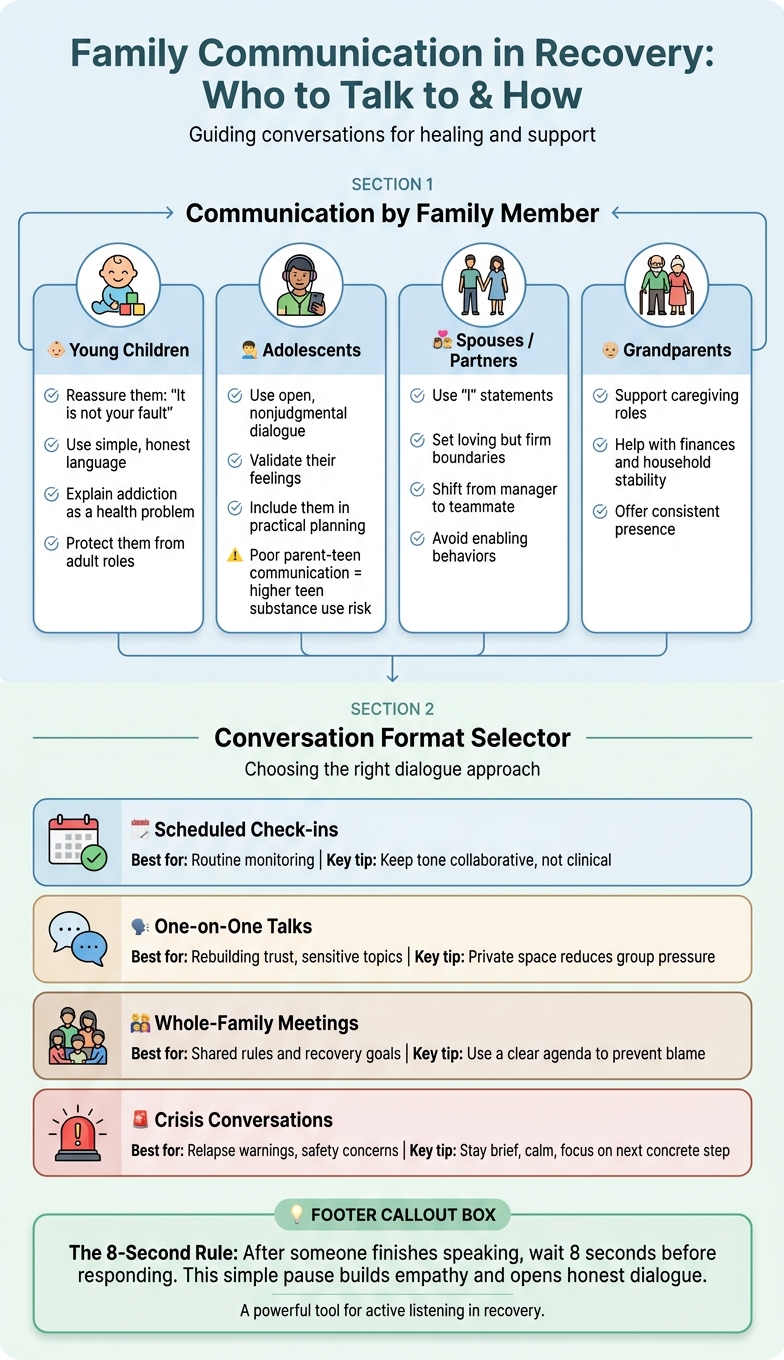
A few facts stand out in the article: it points to an 8-second pause before replying as a simple way to improve listening, and it notes that poor parent-teen communication is linked to higher teen substance use risk. It also explains that family conflict can feed relapse risk, which is why day-to-day communication matters so much.
If I had to boil the full article down into one line, it would be this: steady, honest talk plus firm limits gives families a better way to support recovery without losing themselves in the process.
Family Communication in Recovery: Age-Based Guide & Conversation Formats
Family Systems in Addiction Recovery with Dr Kristy Soloski
sbb-itb-596b85d
Why Family Communication Matters In Recovery
Recovery doesn’t happen in isolation. When one person starts to change, the whole family shifts with them. That shift can be subtle or messy, but it often pulls people back into old habits.
Families often fall into roles and routines that keep things stable on the surface. But those same patterns can also feed addiction. In other words, what once helped the family get through the day may no longer help at all.
Open communication starts to break that cycle because it makes those patterns easier to see and change. It also helps rebuild trust. Small mix-ups get talked through before they harden into resentment. And since family members are often the first to notice when something feels off, steady communication can help them spot early warning signs of relapse and respond with support instead of panic.
This guide centers on four core principles: empathy, validation, consistency, and healthy boundaries. These ideas shape how families talk, listen, and set limits during recovery. They start to matter most in day-to-day life, when recovery changes the way people speak to each other at home.
1. Understand How Recovery Changes Family Communication
Recovery changes the whole family system.
"When one person in a family begins to change his or her behavior, the change will affect the entire family system. It is helpful to think of the family system as a mobile: when one part in a hanging mobile moves, this affects all parts of the mobile but in different ways, and each part adjusts to maintain a balance in the system." [1]
You usually see that shift first in everyday communication. The way people talk, listen, react, and even go quiet at home starts to change.
Many families have a strong pull toward staying the same, even when the old pattern wasn’t healthy. That pushback can be hard to spot. Sometimes it shows up as a family member hanging on to a familiar role long after it stopped helping.
The roles people took on during active addiction need to change too. A child who stepped into adult duties needs room to go back to an age-appropriate role. A partner who carried everything alone needs to move from manager to teammate.
Here’s what that shift can look like:
| Communication Dynamic | During Active Addiction | During Recovery |
|---|---|---|
| Conflict Style | Blame, shame, defensiveness | Empathy, accountability, "I" statements |
| Family Roles | Blurred; children acting in adult roles | Clear, age-appropriate boundaries |
| Support Style | Enabling or covering up to keep the peace | Collaborative support and healthy detachment |
Substance use and family conflict often feed each other. Breaking that cycle starts with changing how people speak to one another at home. Once families can spot these patterns, they can start listening first instead of reacting on autopilot.
2. Practice Active Listening In Every Conversation
When family roles start changing in recovery, listening can calm things down fast. Active listening means you give the other person your full attention. You don’t cut in, and you don’t spend their whole sentence getting your own reply ready. After secrecy and conflict, feeling heard is often the first step toward rebuilding trust.
Being heard can lower tension and make honest talk easier. Once the goal stops being winning the conversation and starts being understanding the other person, the whole tone shifts. That’s when people are more likely to speak openly.
Active listening won’t look exactly the same in every relationship. With children, validate feelings and keep the conversation age-appropriate as part of building family resilience. With teens, stay nonjudgmental. With partners, stop managing and speak as a teammate. [1][3]
One simple habit can help: the 8-second pause. When the other person finishes speaking, wait at least eight seconds before you respond. That short silence often gives them space to keep going and say what they actually mean. [2] It also makes empathy and "I" statements much easier in the next step.
3. Use Empathy And "I" Statements Instead Of Blame
Next, use language that lowers defensiveness. Blaming lines like "You never follow through" or "You always make this about yourself" tend to put people on guard. "I" statements shift the focus to your feelings and needs instead of placing judgment on the other person.
For example, instead of "You scared everyone when you relapsed", try, "I felt frightened, and I need us to be able to talk honestly when things get hard." That small shift can change the tone of the whole talk. It makes the other person less likely to get defensive, which helps both of you stay in the conversation and move toward a fix.
Accountability should name the impact of a clear action without shaming the person. As RECO Intensive puts it:
"Accountability gains power when delivered with warmth rather than judgment." [2]
That same clarity also helps when it’s time to set boundaries for couples.
A simple structure can help:
- Name the behavior
- Make the request
- State the consequence if it continues
This keeps the conversation specific, calm, and actionable.
4. Set Clear, Compassionate Boundaries
Once accountability is clear, boundaries give it shape. The point of a boundary is to protect recovery, not to punish someone for slipping up. Keep the focus on the result you want. For example, "I need you home by 10 PM because consistent sleep supports your recovery" puts the attention on health and stability.
Use the same structure from the previous section, but keep your response calm and fair. Name the behavior, state the request, and explain what will happen if it keeps happening. That makes the conversation specific instead of turning it into a vague argument.
The exact boundary will change based on who you’re talking to. With a spouse, a shared responsibility chart can stop one partner from quietly covering for the other. With a teenager, naming one feeling and one need helps keep the conversation steady. With younger children, the main goal is safety and making sure they aren’t silently taking on adult roles.
Even strong boundaries tend to work better when the conversation happens at the right time.
5. Choose The Right Time And Setting For Hard Conversations
Once boundaries are clear, timing decides whether people can actually hear them. Even honest talks can fall apart if the moment is off.
Don’t wait for a blowup. Set hard conversations for a time when everyone is calm, sober, and not rushing out the door. A weekly family check-in can help because it gives these talks a steady place to happen. Start with one clear agenda item, then move into the harder stuff. That kind of structure helps keep the talk on track when emotions start to climb.
A simple format can help more than people expect:
- Use a "two truths" approach: each person shares one feeling and one need.
- Let one person speak at a time.
- Keep each turn to one issue.
These small guardrails help keep the conversation grounded when feelings run high.
The setting matters just as much as the schedule. Pick a place that feels private and calm, where people can be honest, take responsibility, and follow through without a lot of noise or pressure. If the conflict is more serious, a therapist’s office or another structured therapeutic setting can offer a safer container for the conversation.
Match the communication format to the couple, but choose the time and setting on purpose.
6. Adjust How You Communicate With Children, Teens, And Adults
Different ages need different conversations.
Young children need one thing first: reassurance. They need to hear that the addiction is not their fault. Parental substance use raises the risk of abuse and neglect. So when you talk with a child, keep the language simple and honest. Explain addiction as a health problem in words they can grasp. That helps protect them from slipping into adult roles too soon.
Teenagers can usually handle more honesty. They also tend to respond better when they feel included instead of talked at. Poor parent-teen communication is linked to higher substance use in teens. That’s why open dialogue matters. Let them speak, acknowledge what they feel, and give them practical roles that add structure without putting too much on their shoulders.
Adult family members and spouses are often trying to rebuild trust while also stepping back from enabling. These talks usually work best when you use honest dialogue, "I" statements, and loving but firm boundaries. That way, you can say what you need without turning the whole exchange into a blame game.
Use this quick guide to match your message to the person.
| Family Member | Communication Focus |
|---|---|
| Young Children | Reassure them they are not responsible; use simple, honest language. |
| Adolescents | Use open dialogue; validate feelings; include them in practical planning. |
| Spouses/Partners | Use "I" statements; set boundaries; avoid enabling. |
| Grandparents | Support caregiving, finances, and household stability. |
These age-based shifts make the next conversation format work better.
7. Use Professional Support To Improve Family Communication
When family conversations keep ending in blame, shutdowns, or long stretches of silence, a therapist can help. Sometimes a family needs a neutral space where people can practice talking in a different way.
Family therapy restores trust and helps create emotional safety. With a trained professional in the room, family members are often more willing to say what they actually feel – the fear, the grief, the frustration – without worrying that things will spiral. That level of openness is hard to build alone, especially when trust has taken a hit.
Therapists also help families spot the link between conflict and substance use. One can feed the other, and that cycle is easy to miss when you’re living inside it every day.
They can also teach simple tools families can use right away, such as brief check-ins and pause-before-responding habits. The goal is skill-building: helping people slow down, listen, and answer without making things worse, even when stress is high. These tools tend to work best when the whole family understands which format fits the moment.
Growth and Change Counseling offers family therapy and addiction recovery support in Campbell, San Jose, Los Angeles, Roseville, and through telehealth across California.
Conversation Formats That Work Best In Recovery
Different conversations call for different formats. A routine check-in is not the same as a private repair talk. And neither of those works like a family meeting or a crisis response.
The format should match the goal: routine support, private repair, shared decisions, or urgent response. Empathy, active listening, and boundaries still matter in all cases, but they show up in different ways.
| Format | Best Use | Advantages | Limitations |
|---|---|---|---|
| Scheduled Check-ins | Routine monitoring of sobriety, medication adherence, and emotional health | Reduces anxiety and helps prevent small issues from becoming crises | Can feel repetitive or clinical if empathy isn’t prioritized |
| One-on-One Talks | Rebuilding trust or addressing sensitive personal topics | Creates space for honest, private conversation without group pressure | May exclude other family members or reinforce unhealthy patterns if boundaries are weak |
| Whole-Family Meetings | Setting household rules, recovery goals, and shared expectations | Aligns everyone and reduces enabling behaviors | Can become highly conflictual without a structured agenda or neutral facilitator |
| Crisis Conversations | Responding to early warning signs of relapse or boundary violations | Allows for immediate intervention before things escalate | High emotional intensity; often needs professional support |
Scheduled check-ins work best when they stay focused. Talk about triggers, setbacks, and progress. Keep the tone collaborative, not like an inspection.
One-on-one talks fit sensitive topics and private questions. They give people room to speak openly without the pressure of an audience. That space can help, especially when trust is still being rebuilt.
Whole-family meetings are useful when everyone needs to get on the same page. They work well for household rules, recovery goals, and shared expectations. But they can slide into blame fast, so a clear agenda matters. If things get heated, shift the issue to a calmer setting or bring in a marriage therapist for a guided conversation.
Crisis conversations are for relapse warnings, safety concerns, or boundary breaks. In those moments, less is more. Keep the talk brief, calm, and centered on the next concrete step instead of rehashing old fights.
When a conversation turns urgent or unsafe, move fast toward professional support.
When To Bring In Professional Help
When check-ins, active listening, and boundaries stop changing the pattern, it’s time to bring in outside help. If the same arguments keep coming back, every serious talk ends with someone shutting down or walking away, or boundaries change from day to day, the family is stuck in a loop it can’t break on its own.
These signs often point to a back-and-forth cycle where substance use and family conflict keep feeding each other. From the inside, that loop can be hard to spot. In many cases, the family’s push to keep things the same makes it even harder to see clearly. Specific warning signs include children taking on caregiving roles because a parent is struggling, constant fear of relapse, and one partner being left out of recovery decisions. [1] Over time, those patterns can damage trust, stability, and safety.
Professional support gives families a place to work on the same core skills – listening, clear communication, and boundaries – when talks at home keep falling apart. A therapist can offer a neutral setting where people can say what they mean without the whole conversation going off the rails.
Growth and Change Counseling offers family therapy, parent coaching, couples counseling, and telehealth across California. A professional intake can help identify the right level of support.
Conclusion
The goal isn’t perfect conversations. It’s steadier ones.
Recovery puts pressure on every relationship in a family systems model. Steady communication helps people rebuild intimacy and stay connected through that pressure, and what matters most is using those skills again and again.
Over time, healthy communication starts to feel more natural. Repetition helps the whole household build better habits. Not every talk will go well, and that’s part of real life. What families can do is get better at repairing the conversations that go off track.
"Sustainable sobriety is nurtured through connection, accountability, and mutual understanding." – RECO Institute [3]
When talks keep falling apart, therapy can give families a clear place to practice these skills. With practice, recovery communication becomes clearer, calmer, and more consistent.
FAQs
How do I start a recovery conversation without causing a fight?
Focus on active listening and use “I” statements to say how you feel and what you need without putting the other person on the defensive. It helps to name one clear feeling and one clear need so the conversation stays steady instead of turning into a blame game.
A simple statement-request-consequence approach can help too: describe the behavior, make a direct request, and explain the logical response that follows. If you need extra support, Growth and Change Counseling offers family therapy and coaching to help build these skills.
What boundaries help most in early recovery?
In early recovery, clear, loving, and consistent boundaries can help create a safe, steady home life. They give everyone more structure, support trust and healing, and cut down on enabling, codependency, and emotional distance.
What does that look like in day-to-day life? Often, it means putting expectations in writing, setting careful limits around money, agreeing on shared household rules, and following through with firm, loving consequences when those boundaries are crossed.
Growth and Change Counseling supports families through individual and family therapy during recovery.
When should my family seek therapy?
You don’t have to wait for a crisis to get professional support. It may be time to look into therapy if your family is seeing signs of substance misuse or having a hard time keeping home life steady and healthy.
Getting help can improve communication, set clearer boundaries, and help create a more supportive recovery environment. Growth and Change Counseling offers family therapy and parent coaching tailored to your family’s needs.
Related Blog Posts
- Managing Relapse Triggers in Family Systems
- Top 5 Communication Tools for Couples in Recovery
- Balancing Sobriety Goals with Parenting Duties
- Parenting in Recovery: Balancing Trust and Healing
