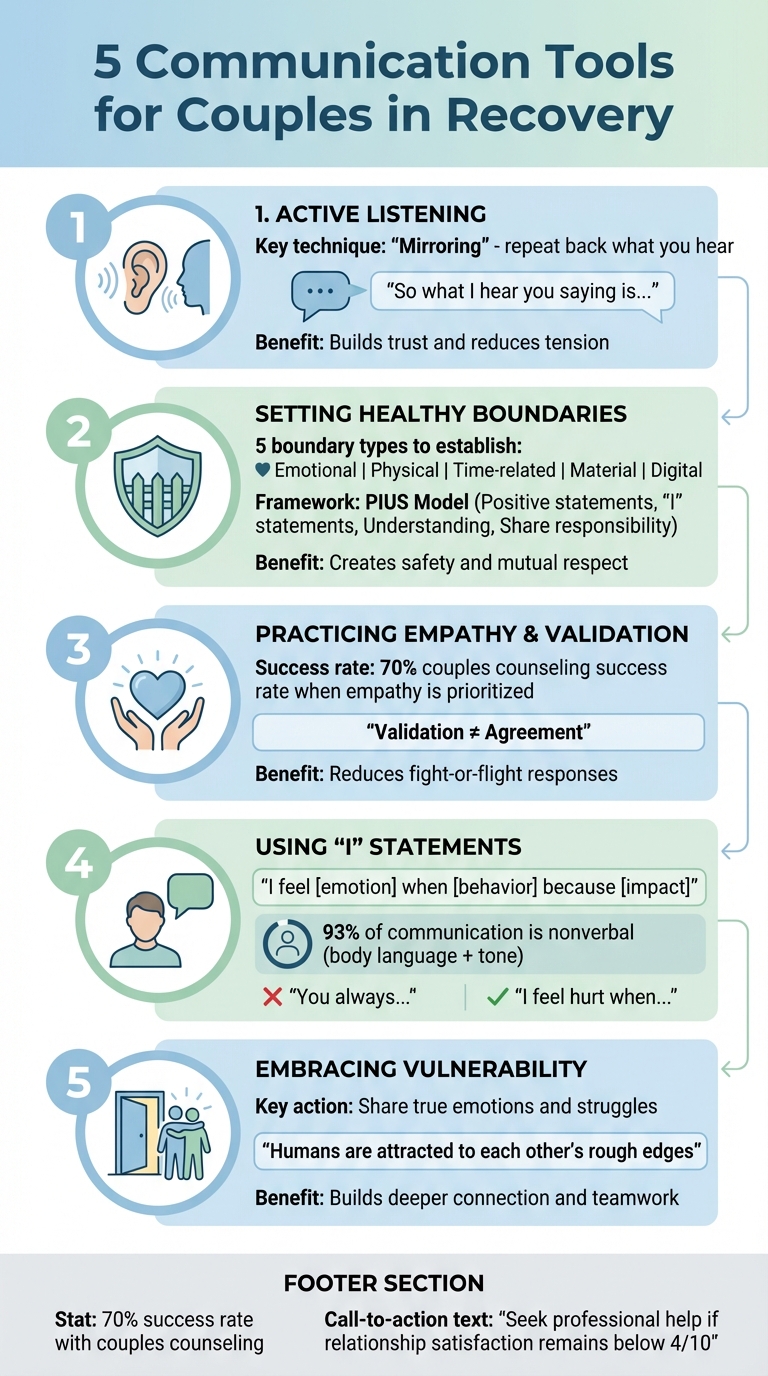
Recovery can strain relationships, but communication tools can help couples rebuild trust and connection. Here are five strategies to improve communication during this challenging time:
- Active Listening: Focus fully on your partner’s words without planning your response. Techniques like "mirroring" (repeating back what you hear) can help clarify understanding and reduce tension.
- Setting Healthy Boundaries: Clearly define emotional, physical, and time-related limits to ensure mutual respect and emotional safety.
- Practicing Empathy and Validation: Acknowledge your partner’s feelings without judgment, creating a safe space for honest conversations.
- Using "I" Statements: Express your feelings without assigning blame. For example, say, "I feel hurt when…" instead of "You always…"
- Embracing Vulnerability: Share your true emotions and struggles, encouraging deeper connection and teamwork.
These tools provide a foundation for stronger, healthier communication, helping couples navigate the complexities of recovery together.
5 Essential Communication Tools for Couples in Recovery
Supporting Couples in Recovery with Growth and Change Counseling
1. Active Listening
As Recovery Centers of America points out:
Communication skills in recovery start with active listening. This type of listening entails paying attention to what the other person is saying without thinking about how to respond [2].
Active listening is more than just a skill – it’s a powerful way to build meaningful connections and navigate challenges during recovery.
Building Trust and Emotional Connection
When you truly listen, you’re not just hearing words; you’re rebuilding trust that addiction may have strained. This kind of attention helps your partner feel understood and valued, creating the emotional safety essential for healing and growth.
Tackling Challenges in Recovery
Active listening can be a game-changer in calming heated moments. When your partner feels genuinely heard, their stress response eases, making it easier to work together on challenges – a critical step in early recovery [3]. This approach also helps reduce the accusatory tendencies that can arise in tense situations.
Creating Space for Non-Judgmental Communication
One effective technique to practice is "mirroring." After your partner shares something, repeat what you’ve understood using phrases like, "So, what I hear you saying is…" This ensures you’re capturing their perspective correctly. Rob Flood, a marriage consultant, explains:
The point of mirroring is not to be right, not to defend yourself, but to know that you are hearing accurately [4].
Promoting Growth for Both Partners
Mirroring can feel awkward, especially when it brings up difficult truths [4]. However, that discomfort often sparks growth. Shifting your focus to understanding rather than defending creates room for deeper conversations and resolution. Pair this with open body language – maintain eye contact, keep a relaxed posture, and avoid defensive gestures – to reinforce trust and connection [6].
2. Setting Healthy Boundaries
Building Trust and Emotional Connection
Boundaries act as the framework for safety and respect in any relationship. By openly communicating your limits, you show that you value both yourself and the partnership. This clarity not only strengthens trust but also reinforces your commitment to working through challenges together during recovery.
Candice Rasa, Clinical Director at Beach House Center for Recovery, highlights this idea:
"Giving yourself permission to have healthy boundaries is itself a way to support your spouse in their recovery." [1]
Addressing Addiction Recovery Challenges
When navigating recovery, it’s important to address various types of boundaries – emotional, physical, time-related, material, and digital. These boundaries help protect feelings, personal space, schedules, finances, and mental well-being [7].
Encouraging Non-Judgmental Communication
It’s essential to separate the individual from their addiction, recognizing that substance use disorder is a treatable condition rather than a personal failing [1]. To approach boundary discussions with care, consider the PIUS model: make Positive statements, use "I" statements, show Understanding, and Share responsibility. For instance, the Hazelden Betty Ford Foundation suggests framing conversations like this:
"I know it’s partly my fault that we argue so much. I’m going to try to be more understanding, and I hope you will also try to see my side of the issues." [3]
Supporting Mutual Growth
Setting boundaries is about finding balance – clarify what you can and cannot do to support your partner while ensuring your own needs are met. Choose calm, distraction-free moments to discuss these boundaries, and once established, stick to them without feeling the need to repeatedly explain or apologize [7]. This consistency helps both partners grow together while respecting each other’s limits.
3. Practicing Empathy and Validation
Building Trust and Emotional Connection
Empathy is about stepping into your partner’s shoes to understand their perspective, while validation involves acknowledging that their feelings make sense – even if you don’t agree with their actions [2]. As Erik Mildes, a Christian Counselor, puts it:
"Validation is not the same as agreeing. It is a willingness to enter someone else’s world in the service of listening and making communication safe."
When you validate your partner’s emotions, you create an environment where they feel secure, reducing the likelihood of triggering a defensive or "fight-or-flight" reaction [8]. This emotional safety is essential for rebuilding trust, especially during recovery. In fact, couples counseling that prioritizes empathy has been shown to have a 70% success rate [5].
Addressing Addiction Recovery Challenges
Recovery often brings challenges unique to each relationship. Viewing addiction as an "uninvited guest" in your partnership – rather than a personal flaw – can help you approach the problem as a team. Candice Rasa, LCSW and Clinical Director of the Beach House Center for Recovery, highlights this idea:
"Mutual empathy (the emphasis being on the ‘mutual’) will be a critical building block in both your recovery, your spouse’s recovery, and your relationship’s recovery."
This perspective encourages both partners to shift their focus toward collaboration and shared healing, laying the groundwork for more effective communication.
Encouraging Non-Judgmental Communication
Techniques like mirroring, mentioned earlier in the Active Listening section, are powerful tools for fostering empathy. By repeating back what your partner shares, you demonstrate that you’re truly listening. Another approach is to gently explore deeper emotions. For example, you might say, "If I were in your position, I might feel lonely; are you feeling that?" These efforts show a sincere desire to connect and understand.
Supporting Mutual Growth
To keep conversations constructive, focus on understanding before expressing your concerns. The Hazelden Betty Ford Foundation suggests starting with empathy, such as: "I know how hard it is for you to look for work right now, but I’m worried about our finances" [3]. This approach minimizes defensiveness and encourages a more thoughtful, responsive dialogue.
For couples navigating recovery, professional help can provide valuable tools for strengthening communication and rebuilding trust. Growth and Change Counseling offers specialized services designed to support couples on this journey, helping them reconnect and grow together.
sbb-itb-596b85d
4. Using "I" Statements
Building Trust and Emotional Connection
Starting sentences with "I" instead of "you" can make a big difference in how your message is received. When you begin with "you", it might come across as blame or criticism, triggering a defensive reaction. But using "I" statements allows you to express your feelings without assigning fault, creating a safer space for open and honest conversations [9]. This approach helps rebuild trust and keeps communication steady, which is especially important during recovery.
Addressing Addiction Recovery Challenges
"I" statements are a great way to avoid confrontations that might escalate into arguments. They follow a simple structure: "I feel [emotion] when [specific behavior] because [impact on me]" [11]. For example, instead of saying, "You’re always drunk when I need you", try something like:
"I felt terrified when I came home from work to find you passed out on the couch." [1]
This phrasing shifts the focus away from blaming the person and instead highlights the shared challenges of addiction. It frames the issue as something you’re tackling together, rather than pointing fingers.
Encouraging Non-Judgmental Communication
Centering the conversation on your own feelings rather than labeling your partner helps create a more understanding atmosphere. Avoid using words like "always" or "never", as these generalizations can come across as accusatory. Instead, be specific about the situation. Keep in mind that communication isn’t just about words – body language and tone play a huge role. In fact, 93% of how your message is received depends on nonverbal cues. Pair your words with open gestures and a calm tone to ensure your partner feels your sincerity [9].
Supporting Mutual Growth
When tensions rise, "I" statements can help diffuse the situation before emotions boil over. These statements work best when they include a constructive way for your partner to support you. For example:
"I’m feeling really sad; would you be willing to hold me?" [9]
This approach shifts the focus from the problem to finding solutions together. It fosters a sense of partnership and can strengthen your connection as you navigate recovery side by side.
5. Embracing Vulnerability in Conversations
Building Trust and Emotional Connection
Opening up can feel risky, but it’s an essential step in strengthening the bond between you and your partner. Being vulnerable means sharing your true emotions, desires, and opinions, even when you’re unsure how they’ll be received [12]. Showing your imperfections – your "rough edges" – makes you more human and relatable. As Robert Glover wisely notes:
"Humans are attracted to each other’s rough edges." [12]
When you allow yourself to be seen in this way, you build trust and mutual respect. Responding to your partner’s bids for attention and expressing your authentic feelings creates a safe space where both of you can connect more deeply. Instead of pulling away, vulnerability encourages you to turn toward each other, reinforcing the foundation of active listening and respectful communication.
Addressing Addiction Recovery Challenges
Addiction often dulls empathy, making emotional connection harder to achieve. This is why vulnerable communication – using phrases like "I feel" and "I need" – can be more effective than assigning blame [1][3]. Sharing your feelings reframes addiction as an external challenge, rather than a personal failing. This shift fosters understanding, helping both partners feel heard and supported, while also laying the groundwork for healing.
Encouraging Non-Judgmental Communication
Vulnerability doesn’t mean unloading all your emotions without accountability – that can overwhelm or alienate your partner [12]. Instead, it’s about acknowledging your own role in shared struggles. For instance, saying something like, "I know I sometimes overreact… Can we work together to address this?" removes blame and invites collaboration. This approach opens the door to honest, judgment-free dialogue [3].
Supporting Mutual Growth
Taking responsibility for your challenges paves the way for mutual solutions. When you admit your struggles – whether it’s with trust, communication, or managing triggers – you give your partner a chance to support you [12][13]. A simple statement like, "I really appreciate your patience as I work through this", can strengthen your connection and build resilience together. As Mark Manson puts it:
"In order to become more resilient, more formidable, you must first bare your flaws and weaknesses for the world to see. In doing so, they lose their power over you." [12]
Conclusion
Recovery is about more than just overcoming addiction – it’s about mending the relationship that addiction may have strained or broken. The five communication tools we’ve discussed work hand in hand to create a space where both partners feel heard and valued. This approach isn’t just theoretical; it’s supported by research and real-world success stories.
Studies indicate that couples counseling boasts a success rate of around 70% [5]. A critical factor in this success is maintaining what relationship experts describe as a high positive-to-negative interaction ratio [10]. These tools help couples turn moments of stress into opportunities for connection, transforming external challenges into shared victories [10].
That said, meaningful change doesn’t happen overnight. Shifting deeply ingrained communication habits can feel like an uphill battle [3]. If your relationship satisfaction remains stuck below 4/10 despite applying these strategies, it may be time to seek professional help [14].
When self-help efforts fall short, professional support can make all the difference. Growth and Change Counseling’s Marriage Rescue Institute offers a 12-week couples coaching program tailored for relationships in crisis. Whether you’re in Campbell, San Jose, Los Angeles, Roseville, or anywhere in California via telehealth, this program provides structured support to address not only addiction but also related challenges like anxiety, depression, and trauma.
Recovery isn’t easy, but every conversation is a new opportunity to rebuild trust, deepen your bond, and grow together.
FAQs
How does active listening help rebuild trust in a relationship during recovery?
Active listening means focusing entirely on what your partner is saying – paying attention not just to their words, but also to their emotions and tone – without interrupting or mentally preparing a response. This approach fosters a respectful and safe environment where both individuals feel truly heard, which is particularly critical when navigating the complexities of addiction recovery.
When couples make active listening a regular habit, it can help reduce misunderstandings, demonstrate empathy, and rebuild trust. Feeling understood and supported strengthens the emotional bond and paves the way for open, honest conversations about challenges like triggers, personal goals, and progress. This, in turn, helps nurture a relationship that’s more connected and resilient.
What are some effective ways to set healthy boundaries with your partner during recovery?
Setting healthy boundaries plays a key role in building a strong relationship while supporting recovery. Boundaries are essential for safeguarding emotional health, avoiding enabling behaviors, and fostering mutual respect. Start by pinpointing situations or actions that feel uncomfortable or harmful. Communicate your needs with calm and clear "I" statements, such as, "I need us to keep our home substance-free." Be specific about what is acceptable and what isn’t, and make sure these expectations are clearly understood.
Here are some tips to make setting boundaries more effective:
- Write down your non-negotiables, like steering clear of drug-related topics or dedicating time to recovery-focused activities.
- Have open discussions with your partner about these limits, encouraging their input to create a sense of teamwork.
- Be consistent in enforcing boundaries, and follow through with consequences if they are crossed – without guilt or blame.
If these conversations feel overwhelming, seeking professional support can be incredibly helpful. Growth and Change Counseling offers an intensive 12-week couples coaching program specifically designed to help partners in recovery establish healthy boundaries while rebuilding trust and connection.
Why are ‘I’ statements important for couples in addiction recovery?
Using "I" statements can be a game-changer for couples working through recovery. This method focuses on sharing personal feelings and experiences rather than assigning blame, which helps keep conversations constructive. For instance, saying "I feel hurt when plans change without notice" is far less likely to provoke defensiveness than "You never tell me anything." By shifting the focus to one’s own emotions, this approach fosters empathy and understanding – two essential ingredients for rebuilding trust.
Beyond reducing conflict, "I" statements promote accountability and allow partners to express their emotions and needs clearly, without accusations. This creates a safer and more supportive space where both individuals feel valued and understood. At Growth and Change Counseling, couples are taught to use "I" statements as part of the 12-week Marriage Rescue Institute program. This practice helps them break out of negative cycles and build a stronger, healthier connection as they work through recovery together.
Related Blog Posts
- Addiction Recovery and Marriage Communication
- Addiction Recovery and Emotional Connection in Marriage
- Trust-Building Exercises for Couples in Recovery
- Top Strategies for Couples in Recovery
