Secondary trauma affects families of those with addiction, causing emotional and physical strain. It happens when family members absorb the stress of a loved one’s substance use disorder (SUD). This can lead to symptoms like exhaustion, anxiety, and disrupted relationships. Families play a critical role in recovery but often need their own support to heal. Studies show unresolved family issues can increase relapse risks and even impact future generations. Addressing secondary trauma through therapy models like Behavioral Couples Therapy or CRAFT can improve recovery outcomes for everyone involved. Families must focus on setting boundaries for couples, improving communication, and seeking specialized therapy to rebuild stability.
Research Findings on Secondary Trauma in Families
Frameworks for Understanding Family Impact
Family systems theory and trauma-informed care provide valuable insights into how addiction impacts families.
Family systems theory treats the family as a connected whole, where changes in one member affect the entire group. Addiction doesn’t just impact the individual – it ripples through the family, forcing everyone to adjust. One study illustrates this concept with a vivid metaphor:
"When one person in a family begins to change his or her behavior, the change will affect the entire family system. It is helpful to think of the family system as a mobile: when one part in a hanging mobile moves, this affects all parts of the mobile but in different ways." – Lander, Howsare, & Byrne [6]
This interconnectedness becomes especially important during recovery. Families often develop patterns that unintentionally support substance use. When these dynamics shift during treatment, the family must reorganize, which can create additional stress.
Trauma-informed family therapy adds another layer to this understanding by acknowledging that family members may also carry their own emotional scars. These frameworks lay the groundwork for examining how secondary trauma unfolds within families.
What the Research Shows
Research highlights the significant psychological toll on family members of individuals with substance use disorders. For example, a July 2025 pilot study conducted at The Matilda Centre, University of Sydney, found that 131 participants supporting loved ones with substance use had an average K-10 score of 28.4, reflecting moderate to severe distress [8].
A recurring theme in the research is ambiguous loss – a form of grief for a loved one who is physically present but emotionally or behaviorally altered. Many partners and parents describe this as mourning the person their loved one used to be [10].
Gender differences also emerge in how secondary trauma manifests. A 2026 study at the University Hospital in Lübeck examined 30 parents of children with substance use disorders. Among 21 mothers, 7 reported moderate depression on the PHQ-8, while none of the 9 fathers did [5]. Mothers often internalize stress, experiencing guilt, shame, and emotional exhaustion. Fathers, on the other hand, are more likely to externalize their stress through conflict or aggression. Social withdrawal is another common response, driven by "courtesy stigma" – the shame associated with being connected to someone struggling with addiction [8][9].
Gaps and Limits in Current Research
Despite these findings, there are notable gaps in the research. Much of the existing literature focuses on Alcohol Use Disorder (AUD), leaving other substances like opioids or cannabis underexplored [6]. Additionally, studies tend to focus on young children or spouses, with limited attention given to adult children of parents with substance use disorders [6].
Small sample sizes and a reliance on qualitative methods also limit the generalizability of findings [9][10]. For instance, a 2025 web-based resilience program for family members saw only 37% of participants complete the post-program survey, underlining the difficulty of maintaining engagement in this population [8].
Another critique is the emphasis on dysfunction over resilience. Researchers increasingly call for strength-based studies that focus on how families adapt and thrive in the face of challenges [11].
"The relative paucity of research on Addiction-Affected Families’ (AAF) issues and the lack of attention given to their difficulties and treatment in interventions and clinical practices indicate that the primary focus consistently revolves around individuals with addictive disorders." – BMC Psychiatry [9]
These gaps highlight the need for more inclusive and strength-focused research. Addressing these issues could improve how clinicians support families and ensure that secondary trauma is fully acknowledged and treated.
sbb-itb-596b85d
Addiction, Trauma, and Family Recovery with Dr. Michael Barnes
How Secondary Trauma Affects Family Systems
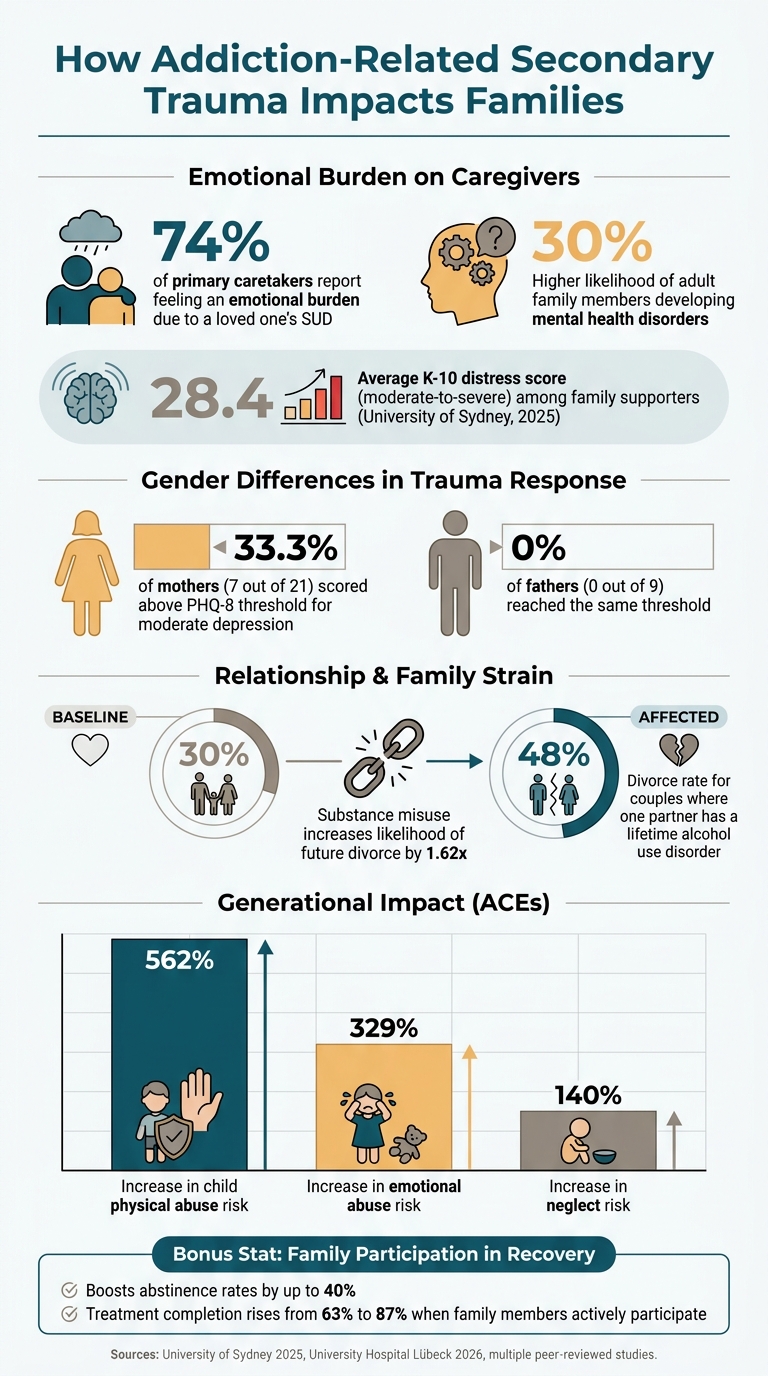
Secondary Trauma & Addiction: Key Statistics on Family Impact
Symptoms in Individual Family Members
Having a loved one who struggles with addiction can deeply impact family members, reshaping their daily lives and emotional well-being. Over time, the constant unpredictability can push them into a perpetual "survival mode", where their nervous systems stay on high alert, even during calmer moments [1][12].
This stress often manifests in various ways. Emotionally, family members might experience fear, guilt, and shame. Cognitively, they may become hyper-vigilant, always bracing for the next crisis. Physically, the toll can include disrupted sleep, chronic fatigue, and even conditions like high blood pressure [1][5][3].
One mother described the physical and emotional exhaustion in her family:
"We can’t get any rest anymore. Neither of us can sleep. We both have blood pressure problems." – Participant 1019, Mother of a son with multiple drug use [5]
Interestingly, studies show that these symptoms can differ between genders. For example, in one study, 33.3% of mothers (7 out of 21) scored above the PHQ-8 threshold for moderate depression, while none of the 9 fathers in the same group reached that level [5]. Mothers often internalize their struggles, carrying feelings of guilt and shame, while fathers may express stress outwardly through conflict or by emotionally distancing themselves. These individual struggles inevitably shape how family members interact and take on roles within the household.
Effects on Relationships and Family Roles
The strain of secondary trauma doesn’t just affect individuals – it ripples through family dynamics, altering relationships and roles. This is especially evident in marriages. For instance, couples where one partner has a lifetime alcohol use disorder (AUD) face a divorce rate of 48%, compared to 30% for couples without AUD. Substance misuse also increases the likelihood of future divorce by 1.62 times [6].
Daily responsibilities within the family often shift under this strain. Tasks like managing bills, childcare, and household chores frequently fall unevenly, leading to caregiver burnout [7]. Instead of functioning as partners, family members may find themselves operating in crisis mode, tiptoeing around each other to avoid triggering conflict or relapse [4].
Children are particularly vulnerable in these situations. In many cases, they take on responsibilities far beyond their years – becoming emotional supports for struggling parents or even acting as primary caregivers for younger siblings. This phenomenon, known as parentification, can disrupt healthy development and leave lasting emotional scars [6][13].
One father voiced his struggle with navigating his role:
"I actually want to be a good father, but in the current situation I don’t know what that is. What is a good father in a situation like this?" – Participant 1007, Father of a son with addiction [5]
Effects Across Generations
The impact of secondary trauma doesn’t stop with the immediate family – it often carries over to future generations. Children who grow up in households affected by parental substance use disorders face significantly higher risks. For example, parental addiction is linked to a 562% increase in child physical abuse, a 329% increase in emotional abuse, and a 140% increase in neglect [6].
These experiences are classified as Adverse Childhood Experiences (ACEs) and can have far-reaching consequences. Prolonged exposure to addiction-related stress can alter a child’s stress-response system, particularly the HPA axis, which controls how the body reacts to threats. This heightened sensitivity to stress can persist into adulthood, increasing the risk of developing a substance use disorder later in life [6][14]. Research even suggests that childhood trauma can leave biological marks – known as epigenetic changes – that amplify stress responses well into adulthood [14].
Addressing secondary trauma isn’t just about easing current struggles. It’s a critical step toward protecting future generations and breaking a cycle that might otherwise continue.
Trauma-Informed Interventions for Families
Family-Focused Treatment Approaches
Addressing family trauma alongside addiction is essential for meaningful recovery. Research highlights several approaches that treat both issues together, directly tackling the secondary trauma that impacts family dynamics.
Behavioral Couples Therapy (BCT) stands out as a highly supported option. This method treats the couple as a unit, focusing on contingency management and communication skills to encourage sobriety and improve relationship satisfaction. By reducing relational strain caused by secondary trauma, BCT significantly boosts treatment outcomes. For example, when family members actively participate in recovery, treatment completion rates rise from 63% to 87% [15].
For families facing the challenge of a loved one refusing treatment, Community Reinforcement and Family Training (CRAFT) offers an effective solution. This approach empowers family members with tools to communicate and reinforce positive behaviors, addressing feelings of helplessness. Impressively, CRAFT successfully engages 64% of treatment-resistant individuals into recovery programs [15].
Structural Family Therapy (SFT) provides another valuable option by focusing on reorganizing the family’s internal structure. It works to clarify roles, re-establish parental authority, and resolve disruptions caused by secondary trauma [13].
| Therapy Model | Outcomes |
|---|---|
| Behavioral Couples Therapy | Improved sobriety rates and relationship satisfaction [13] |
| CRAFT | 64% success in engaging treatment-resistant individuals [15] |
| Structural Family Therapy | Clearer roles, stronger boundaries, and better daily functioning [13] |
Core Principles of Trauma-Informed Care
Regardless of the therapy model used, trauma-informed care for families revolves around a few key principles.
Psychoeducation is a cornerstone of this approach. By explaining the psychological and neurological effects of addiction and trauma, families can better understand their experiences. This knowledge reduces self-blame and helps identify unhealthy patterns, such as enabling behaviors. As one framework puts it, addiction is like a "toxic seed" that grows unhealthy dynamics over time [4]. Recognizing these patterns is the first step toward change.
Boundary-setting is another critical skill. Trauma-informed therapists guide families through a structured process: identifying limits, clearly communicating them, defining consequences for violations, and enforcing them consistently. This replaces vague or emotionally charged reactions with clear and predictable boundaries [13].
Communication training rounds out the approach. Techniques like using "I" statements, practicing active listening, and applying repair sequences – steps to de-escalate conflicts – help families shift from reactive to intentional and constructive interactions [13].
"Contemporary scholars argue that it may be more effective to conceptualize codependency as a response to relational trauma rather than a set of pathological behaviors." – Jessica Swan, Executive Director, Recovery Consulting [15]
This perspective reframes behaviors like hypervigilance, emotional withdrawal, or controlling tendencies as survival mechanisms rather than dysfunctions. Such a shift can transform how families approach the recovery process, creating space for understanding and growth.
How Growth and Change Counseling Can Help
For families navigating addiction and trauma, professional support can make a world of difference. In California, Growth and Change Counseling offers tailored services to help families rebuild trust, clarify roles, and improve communication. Their family therapy sessions focus on addressing the relational impact of addiction.
Couples experiencing severe strain due to addiction-related issues can turn to The Marriage Rescue Institute. Their intensive 12-week coaching program is designed to help couples in distress rebuild their relationships from the ground up. Considering that couples with a history of alcohol use disorder face a 48% divorce rate [6], this structured approach can provide much-needed guidance and support.
Growth and Change Counseling also offers individual therapy, parent coaching, and specialized addiction and trauma services. Available in Campbell, San Jose, Los Angeles, and Roseville, as well as through telehealth across California, these sessions are priced at $150 for 45 minutes with an Associate or $200 with a Licensed Marriage and Family Therapist.
Key Takeaways and Next Steps
Clinical Implications
Addiction doesn’t just disrupt the life of the individual using substances – it ripples through the entire family dynamic. The impact of secondary trauma is both significant and measurable. For instance, about 74% of primary caretakers report feeling an emotional burden due to a loved one’s substance use disorder [18]. Additionally, adult family members face a 30% higher likelihood of developing mental health disorders [17].
Starting the healing process early can make a world of difference. Family participation in recovery programs has been shown to boost abstinence rates by as much as 40% [16]. These findings highlight the importance of prioritizing family-focused interventions in treatment plans and expanding research in this area.
Where More Research Is Needed
There are still critical gaps in understanding and addressing the challenges faced by families dealing with addiction. One major issue is the lack of consistent terminology. Terms like "vicarious traumatization", "secondary traumatic stress", and "secondary traumatization" are often used interchangeably, which complicates research and clinical applications [2]. Long-term studies are essential to better understand how secondary trauma evolves over time.
Another notable gap is the underrepresentation of male family members, particularly fathers, in both research and treatment settings [5]. Most studies tend to focus on mothers or adult children of parents with alcohol use disorder, leaving the experiences of fathers and families affected by opioid or cannabis use disorders largely unexamined [6]. Expanding research to include a wider range of family dynamics is crucial for creating a more comprehensive understanding of addiction’s impact.
Filling these gaps will equip clinicians with better tools to develop and implement trauma-informed strategies tailored to diverse family needs.
Closing Thoughts
"The family system, once disrupted by addiction, rarely returns to its previous state without intentional intervention." – Glendora Recovery Center [18]
Trauma-informed family interventions offer clear and evidence-based pathways for recovery. Programs like Behavioral Couples Therapy, CRAFT, structured family therapy, and The Marriage Rescue Institute’s 12-week couples coaching program provide families with the tools they need to rebuild and heal. Resources such as Growth and Change Counseling stand as valuable options for families seeking support and guidance.
FAQs
How can I tell if I have secondary trauma from a loved one’s addiction?
Secondary trauma happens when you’re repeatedly exposed to a loved one’s struggles, leaving you feeling as though their pain has become your own. It can show up in physical ways – like constant fatigue, headaches, or trouble sleeping – and in emotional shifts, such as irritability, feeling detached, or losing hope. You might even find yourself withdrawing from social situations or feeling tense all the time. Growth and Change Counseling offers guidance to help you regain balance, establish healthy boundaries, and prioritize your well-being.
What boundaries help without enabling or escalating conflict?
Healthy boundaries are about focusing on your own actions rather than trying to control someone else’s behavior. When communicating your limits, it’s important to stay calm and avoid bringing them up during heated arguments. Instead, use a gentle approach to express your needs without placing blame.
For instance, you might say something like: "If you come home intoxicated, I will sleep in the guest room." This approach clearly states your boundary while keeping the tone constructive.
The key to effective boundaries is consistent follow-through. Additionally, it’s essential to shift your role from trying to "fix" the person to being a supportive presence. If you’re looking for guidance, Growth and Change Counseling provides therapy to help families define boundaries and enhance communication.
Which family therapy is best: CRAFT, Behavioral Couples Therapy, or Structural Family Therapy?
For someone dealing with a substance use disorder, the best approach often hinges on whether they are already receiving treatment. If they are, Behavioral Couples Therapy (BCT) can be a powerful tool. It not only supports abstinence but also works to strengthen and improve the relationship between partners.
On the other hand, if the individual is not yet in treatment, Community Reinforcement and Family Training (CRAFT) offers families a way to encourage their loved one to seek care. This method equips families with strategies to support and motivate change effectively.
Growth and Change Counseling addresses both scenarios by offering couples coaching and addiction-focused therapy tailored to these specific needs.
Understanding Secondary Trauma at Growth and Change Counseling
- Intergenerational Trauma and Addiction Recovery
- Family Therapy for Trauma Recovery: What Works
- Trauma and Addiction: Impact on Marriage and Recovery
- How Addiction Impacts Marriage and Family Systems
