Addiction doesn’t just affect individuals – it disrupts entire families. It creates emotional distance, breaks trust, and reshapes roles within marriages and households. Research shows that families with substance misuse face higher rates of divorce, violence, and neglect. Children in these environments are more likely to experience abuse and take on adult responsibilities, leading to long-term emotional and behavioral challenges.
Key takeaways:
- Marriage struggles: Addiction acts as a "third person", creating mistrust, poor communication, and role imbalances.
- Family dynamics: Members often adopt unhealthy roles (e.g., caretaker, scapegoat) to cope, disrupting boundaries and routines.
- Children’s risks: Kids in these households face higher rates of abuse, neglect, and emotional difficulties.
- Therapy solutions: Family-based approaches like Behavioral Couples Therapy (BCT) and Multidimensional Family Therapy (MDFT) can rebuild trust, improve communication, and support recovery.
Addressing addiction as a family issue, not just an individual one, can help break harmful cycles and promote healing for everyone involved.
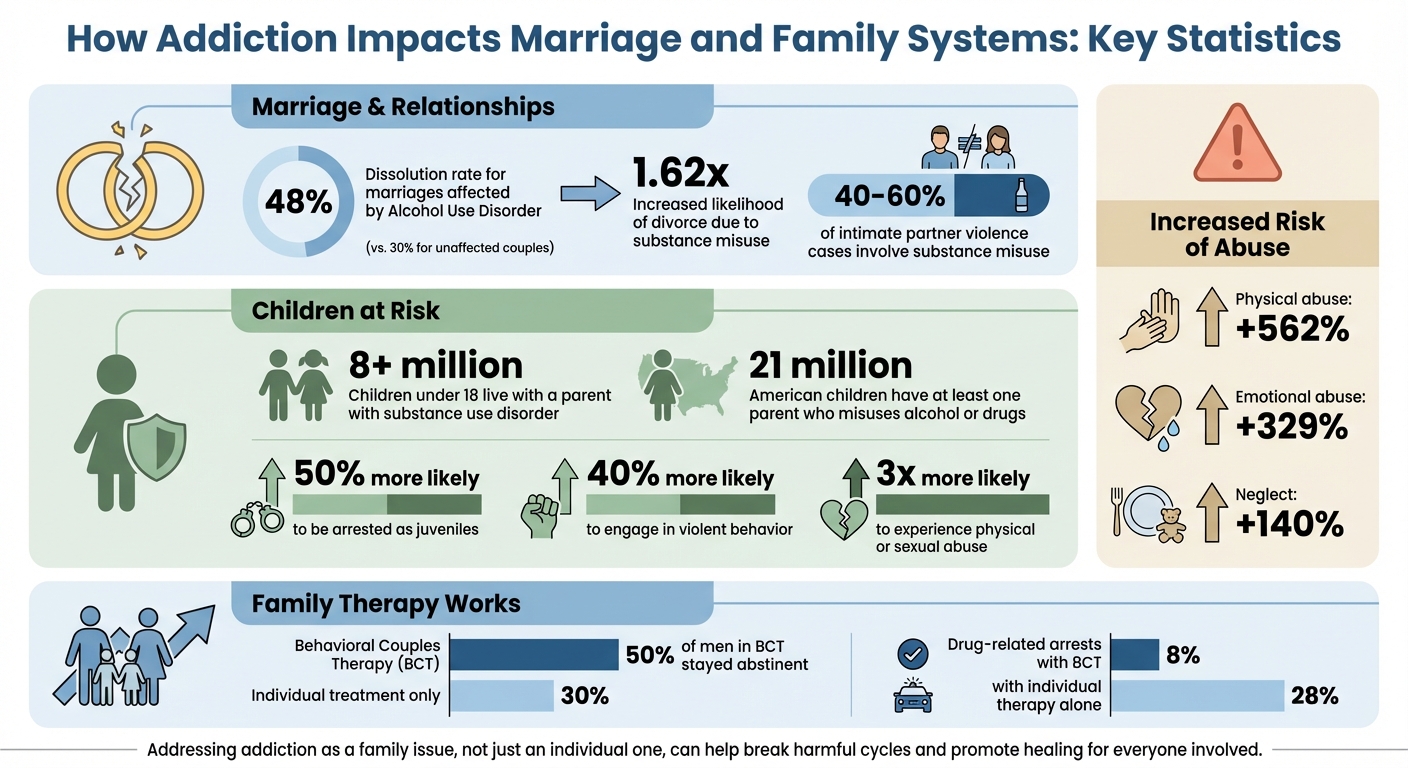
How Addiction Impacts Marriage and Family: Key Statistics and Effects
Roles In The Addicted Family System
How Addiction Affects Marriage
When addiction takes hold in a marriage, it disrupts the entire relationship dynamic. The substance essentially becomes a "third person" in the marriage, where the addicted partner prioritizes their drug of choice over their spouse. This leaves the non-addicted partner feeling abandoned and betrayed [11]. Over time, this imbalance can create a ripple effect of issues that may strain even the strongest relationships.
Trust, Communication, and Emotional Distance
Addiction erodes trust. It often brings secrecy, dishonesty, and broken promises into the relationship. Addicted partners may lie about their substance use, misuse household funds, or hide their behaviors [10][11]. These actions lead to a breakdown in communication. Instead of open conversations, couples may find themselves locked in arguments filled with accusations and defensiveness. The non-addicted spouse may feel like the "villain" for addressing the issue, while the addicted partner retreats further into isolation [11][12].
In some cases, families resort to triangulation – communicating indirectly through a third party instead of addressing the addicted partner directly [6]. This avoidance makes resolving conflicts nearly impossible. Addiction also diminishes the addicted partner’s ability to empathize, creating emotional barriers that reduce quality time and physical intimacy [10][12].
To address these challenges, couples need to rethink how they communicate. Shifting from accusatory "you" statements to "I" statements can help reduce defensiveness. For example, saying, "I felt scared when I found you passed out", is more constructive than, "You always do this" [12]. Candice Rasa, LCSW, Clinical Director of the Beach House Center for Recovery, highlights the importance of empathy:
"Mutual empathy… will be a critical building block in both your recovery, your spouse’s recovery, and your relationship’s recovery" [12].
Setting healthy boundaries is also essential. Non-addicted partners must clearly define acceptable and unacceptable behaviors – such as banning substances from the home – and stick to these boundaries to protect their own well-being [9][12]. Viewing addiction as a diagnosable condition, rather than a flaw, can foster understanding and pave the way for solutions [12]. Support groups like Al-Anon, Nar-Anon, or SMART Recovery Family & Friends can provide guidance and reduce feelings of isolation for non-addicted spouses [9][13].
These communication struggles often lead to deeper shifts in marital roles, creating new sources of tension.
Role Imbalances and Resentment
Addiction often forces one partner to take on the role of a "caretaker" or "rescuer," stepping in to handle responsibilities the addicted partner neglects. This might include managing finances, parenting, or taking over household duties [10]. Over time, this dynamic can evolve into infantilization, where the non-addicted spouse treats their partner more like a dependent than an equal. When this happens, mutual respect erodes, and the relationship may start to feel more like a parent-child dynamic [10].
This caretaker role can also lead to codependency. By maintaining the status quo, the non-addicted spouse may unintentionally enable the addicted partner’s substance use [9][10]. Families often strive to maintain homeostasis, or a sense of balance, even when it’s unhealthy. Ironically, if the addicted partner begins to change, the non-addicted spouse may resist, unconsciously sabotaging recovery to preserve their familiar role as the "needed" caretaker [6][1].
The statistics underscore the severity of these challenges: marriages affected by Alcohol Use Disorder have a 48% dissolution rate, compared to 30% for unaffected couples [2]. Substance misuse also increases the likelihood of divorce by 1.62 times and plays a role in 40% to 60% of intimate partner violence cases [2].
Behavioral Couples Therapy (BCT) offers a structured way forward, helping couples improve communication, set clear roles, and create a "recovery contract" to restore balance [9]. Individual therapy for the non-addicted spouse can also help them break free from codependent patterns and develop healthier ways to address damaging behaviors without enabling them [14]. Setting firm boundaries and allowing the addicted partner to face the consequences of their actions – without shielding them – is a crucial step [9][13]. In cases where the addicted spouse refuses help, a therapeutic separation can disrupt denial and encourage treatment [14].
Rebuilding the relationship requires intentional efforts to restore emotional connection and intimacy.
Rebuilding Intimacy and Attachment
To heal the damage caused by addiction, couples need to make a deliberate effort to rebuild intimacy. Behavioral Couples Therapy (BCT) is widely regarded as an effective approach for addressing addiction within relationships. It focuses on both recovery and strengthening the partnership. Out of 41 therapies studied, BCT is one of only 16 shown to have strong empirical support for treating alcohol-related issues [5][9].
The link between intimacy and addiction is often cyclical. Relationship distress can lead to substance use, and recovery tends to improve family cohesion and emotional expression [5][15]. For recovery to succeed, the non-addicted partner must shift from controlling behaviors to supportive, problem-solving communication [15].
A "recovery contract" can help. This involves the recovering partner committing to staying substance-free for 24 hours, while the spouse offers encouragement. Daily acknowledgments of positive actions can rebuild trust and emotional closeness [9][15]. Couples can also practice "relationship promises" by engaging in small, positive gestures – like sharing a chore or having a brief, meaningful conversation [5].
Another helpful practice is to "catch your partner doing something nice." This means actively looking for and appreciating positive behaviors, which shifts focus from past grievances to present efforts [5]. Scheduling shared activities, free from substances, can also help couples reconnect and rebuild their friendship [5][15]. As Dr. Rod Amiri, MD, explains:
"Healing begins when family members are able to speak openly and honestly with each other" [16].
Breaking the silence around guilt, shame, and resentment is a critical step toward genuine healing.
For couples in particularly challenging situations, Growth and Change Counseling offers specialized services through The Marriage Rescue Institute. Their 12-week coaching program is designed to help couples rebuild their relationships. With locations in Campbell, San Jose, Los Angeles, and Roseville, CA, as well as telehealth options across California, they provide tailored therapy, including addiction recovery support, to meet the unique needs of each family.
How Addiction Disrupts the Family System
Addiction doesn’t just affect the individual – it ripples through the entire family, damaging relationships and dismantling stability. Over 8 million children under 18 live in households where a parent struggles with substance use disorder [1]. These children, along with their families, can find themselves trapped in unhealthy cycles that often span generations.
Disrupted Family Roles and Boundaries
When addiction shakes up the family dynamic, members often take on specific roles to restore some sense of balance – though this balance is usually dysfunctional. Families naturally strive for stability, but addiction disrupts this equilibrium, leading to role shifts. For example, children may take on adult responsibilities while the addicted parent becomes more dependent [1][2].
Take Ashley, a 15-year-old who became the “Hero” in her family after her mother developed alcohol dependence. Starting at just 9 years old, Ashley took care of her younger brother and managed household tasks [1].
Other children in similar situations might adopt different roles. The Scapegoat acts out, drawing attention away from the addiction. The Mascot uses humor to ease tension, while the Lost Child withdraws entirely, avoiding the chaos [7]. These role shifts often blur boundaries within the family. Parents may lean on their children for support, while families might enforce rigid external boundaries to hide the addiction from others, leading to isolation [1][2][7].
Family systems therapy can help restore healthier dynamics. Tools like a genogram – a family history map – can identify patterns of addiction and unhealthy roles [8]. Therapy often focuses on rebuilding a strong parental unit and setting clear, flexible boundaries that prioritize open communication and protect children’s emotional well-being [1].
Beyond roles and boundaries, addiction also disrupts the family’s daily routines, adding another layer of instability.
Breakdown of Family Routines
Addiction often throws daily life into chaos, replacing predictable routines with constant crisis management. Mealtimes become irregular, bedtimes are unpredictable, and basic household responsibilities fall by the wayside. This lack of structure is especially damaging for children, who rely on routines for emotional stability [1].
Parental substance use also increases the risk of neglect and abuse [2]. Children in these households are 50% more likely to be arrested as juveniles and 40% more likely to engage in violent behavior [1].
Rebuilding stability often involves reintroducing structure. Simple tools like daily schedules or recovery contracts – where the person in recovery commits to sobriety for a set time while receiving family support – can help. Activities like “Catch Your Partner (or Child) Doing Something Nice” encourage family members to focus on positive actions, fostering warmth and connection. Similarly, contingency contracts, which reward specific behaviors (e.g., a teenager checking in regularly in exchange for privileges), can help replace chaos with predictability [4].
This lack of routine doesn’t just create logistical challenges – it also deepens emotional strain within the family.
Emotional Climate and Intergenerational Risk
Families affected by addiction often live under a cloud of secrecy, fear, and chronic stress. Around 21 million American children have at least one parent who misuses alcohol or drugs [3]. Many of these children experience attachment disruptions, which can lead to anxiety, depression, and difficulty managing emotions [1].
These children may struggle with emotional regulation, showing either internalizing behaviors (like withdrawal or anxiety) or externalizing behaviors (like aggression) [1][2]. Often, the family’s energy is consumed by the addicted parent’s needs, leaving children feeling neglected – a dynamic known as the "reversal of dependence needs" [1].
Addiction’s impact frequently spans generations, influenced by both genetic predispositions and environmental factors. Children who witness destructive behaviors may adopt similar coping mechanisms. A parent with a substance use disorder is three times more likely to physically or sexually abuse their child [1], and intimate partner violence rates in these families range from 47% to 90% [2].
Breaking this cycle often begins with education. Helping families understand addiction as a chronic health condition – not a moral failing – can reduce shame and open the door to healing [3][4]. Approaches like Multidimensional Family Therapy (MDFT) address issues across the individual, family, and community levels, making it especially effective for adolescents [4]. Tools like a Family Recovery Maintenance Notebook, which tracks communication strategies and educational insights, can also be helpful. Additionally, support groups like Al-Anon, Nar-Anon, and Alateen provide family members with emotional support and practical tools to focus on their own well-being [3][7].
For families ready to rebuild healthier dynamics, professional services like those offered by Growth and Change Counseling can provide tailored, solutions-focused therapy.
Recognizing how addiction affects the entire family is the first step toward creating a path to healing for everyone involved – not just the individual struggling with substance use.
sbb-itb-596b85d
Family Systems Therapy Approaches for Addiction
When addiction takes hold, it doesn’t just affect the individual – it ripples out, reshaping the entire family dynamic. Effective therapy acknowledges this interconnectedness, treating the family as a system where every member plays a role. Think of it like a mobile: when one piece moves, the others shift too. This systems perspective has become a cornerstone of modern addiction treatment.
Instead of isolating the individual with substance use as the sole issue, therapy examines how family interactions and communication patterns either help or hinder recovery. And the results speak for themselves: randomized trials show that 50% of men undergoing Behavioral Couples Therapy (BCT) stayed abstinent, compared to just 30% of those who received individual treatment only. Arrest rates also dropped significantly – just 8% of BCT participants faced drug-related arrests, versus 28% in the individual therapy group [17]. These findings highlight how addressing family dynamics can disrupt cycles of addiction.
Family Systems Therapy Techniques
Family systems therapy is built on core principles that explain why addiction persists and how families can break free from harmful patterns.
One key concept is circular causality, which recognizes that substance use and family conflict feed into each other in a loop – addiction creates dysfunction, and dysfunction fuels further substance use [2]. Another is homeostasis, the family’s unconscious tendency to maintain its current balance, even if that balance is unhealthy. Change, though necessary, can feel threatening, and therapy works to help families establish clear, flexible boundaries [4].
Therapists often use behavior loop mapping to illustrate how interactions within the family sustain substance use. This tool helps family members see that the problem isn’t about assigning blame to one person but understanding how their dynamics contribute to the cycle [4].
The therapy process is collaborative and nonblaming, focusing on the family’s strengths and fostering a shared commitment to positive change [4].
| Therapy Approach | Primary Focus | Key Techniques |
|---|---|---|
| Behavioral Couples Therapy (BCT) | Intimate partner relationships | Recovery contracts, communication skills, positive reinforcement [4][17] |
| Multidimensional Family Therapy (MDFT) | Adolescents and their environments | Addressing the adolescent, parent, family, and community [4] |
| Brief Strategic Family Therapy (BSFT) | Family structure and dysfunction | Tackling maladaptive alliances, boundary issues, and scapegoating [4] |
| CRAFT | Concerned family members | Teaching family members to change their responses to substance use [4] |
Trauma-Informed and Attachment-Based Interventions
Addiction often intersects with trauma and attachment challenges. For children, parental substance use is considered an Adverse Childhood Experience (ACE), which can disrupt neurodevelopment and attachment patterns [2]. Parents struggling with addiction may have difficulty regulating their own emotions, making it harder to form secure bonds with their children. This can lead to intergenerational cycles of addiction, with children displaying behaviors like withdrawal, anxiety, or aggression [1][2].
Trauma-informed therapy addresses these deeper issues by shifting the focus from “What’s wrong with you?” to “What happened to you?” This approach fosters a safe environment for healing. Meanwhile, attachment-based interventions aim to rebuild trust and connection within families. For example, parents can learn to better attune to their children’s needs, while couples work on restoring emotional intimacy. Together, these interventions create a path toward healing for the entire family system.
Integrative Treatment Planning
The most effective addiction treatment involves a coordinated approach that addresses both individual challenges and family dynamics. Integrative treatment planning weaves together individual therapy, couples counseling, and family therapy into a unified strategy. While individual sessions focus on personal coping skills, couples and family therapy tackle communication patterns and relationship dynamics [4].
As Klostermann, Kelley, Mignone, Pusateri, and Wills put it:
"The goal of BCT is to create a ‘virtuous cycle’ (i.e., enlisting the … partner’s support in the client’s recovery) between substance use recovery and relationship functioning by using interventions designed to address both sets of issues concurrently and reinforce positive behaviors" [4].
Successful integrative plans require therapists to coordinate efforts and share information. For instance, a patient might explore career goals during a couples session, while their individual therapist arranges vocational training to align with recovery goals [17].
Growth and Change Counseling exemplifies this approach, offering services that address addiction within the context of relationships and family systems. Their programs – ranging from individual therapy to intensive couples counseling through The Marriage Rescue Institute – are available in Campbell, San Jose, Los Angeles, and Roseville, as well as via telehealth across California.
Timing is also key to integrative treatment. Therapists often begin with strategies focused on stabilizing abstinence before introducing more complex relationship work, such as communication skills training. This step-by-step approach helps families avoid feeling overwhelmed and increases the chances of lasting recovery [4][17].
Practical Steps for Families Seeking Change
To address the disruption addiction brings to family life, it’s crucial to take actionable steps. Start by identifying the impact addiction has had, pinpoint harmful patterns, and commit to rebuilding safety and structure within your family unit.
Recognizing Systemic Warning Signs
Addiction doesn’t usually make a dramatic entrance. Instead, it creeps in, slowly altering family dynamics. Signs of trouble often include persistent conflict – whether verbal, physical, or even sexual [9]. Emotional withdrawal can become common, with family members hesitating to share their feelings or experiences [2]. In some cases, children may step into adult roles, a phenomenon known as parentification [2].
Financial and legal issues are another red flag. Unpaid bills, sudden financial losses, DUIs, or custody battles can signal that addiction has grown from an individual struggle into a family-wide crisis [2][9]. Social isolation often compounds these problems, as families withdraw from friends and extended relatives due to feelings of shame or embarrassment [3]. A breakdown in communication is also telling – when family members talk about the person with addiction instead of addressing them directly, it highlights a deeper issue [6].
The urgency of recognizing these signs is backed by alarming statistics. Substance misuse is linked to 40% to 60% of intimate partner violence cases, while parental substance use disorders increase the risk of child physical abuse by 562%, emotional abuse by 329%, and neglect by 140% [2]. These numbers reflect the harsh realities many families face.
Once these patterns are identified, the focus must shift to ensuring the safety of everyone involved.
Stabilizing the Family System
Creating a safe and stable environment is the first step toward recovery. Address any active violence or abuse before considering joint counseling [8][17]. This isn’t about placing blame – it’s about laying the groundwork for meaningful change.
Stability can be reintroduced by establishing consistent routines. Regular mealtimes, predictable bedtimes, and family check-ins provide a sense of security, particularly for children [2]. A brief recovery contract can formalize commitments to abstinence and mutual accountability [4][17]. Daily “trust discussions” can help foster accountability without resorting to shame.
It’s also essential to set firm boundaries to stop enabling behaviors. Actions like bailing someone out of legal trouble or making excuses for their behavior only perpetuate the cycle of addiction. Clear limits help everyone move forward.
Engaging in Structured Counseling and Support
Once safety and stability are in place, the next step is seeking professional help to rebuild trust and communication. Recovery is a team effort. Behavioral Couples Therapy (BCT) is one approach that has shown promising results. Studies reveal that 50% of men in BCT remained abstinent compared to just 30% in individual treatment [17]. BCT addresses both addiction and relationship dynamics, creating what researchers call a “virtuous cycle” [4].
Programs like Growth and Change Counseling take a similar approach. They offer services ranging from individual therapy to intensive couples counseling through The Marriage Rescue Institute. With locations in Campbell, San Jose, Los Angeles, and Roseville, along with telehealth options across California, they focus on blending individual coping strategies with family-focused communication and relationship-building tools.
When selecting a counseling program, look for one that uses strengths-based assessments. These evaluations help identify your family’s “recovery capital,” like shared values, spiritual ties, past resilience, and social support networks [8]. Effective therapy builds on these strengths and often includes psychoeducation about addiction’s effects on the mind, body, and relationships. This approach reduces feelings of isolation and shame while providing a clear roadmap for recovery [4].
Timing matters. Begin by stabilizing your environment – ensuring safety and structure – before moving on to more complex work, such as communication skills and rebuilding intimacy. Taking things step by step prevents overwhelm and increases the chances of long-term success.
Conclusion
Understanding addiction as a challenge that impacts the entire family dynamic is crucial. When substance use takes hold, it sets off a cycle where conflict and addiction feed into one another, creating a ripple effect on relationships and emotional well-being [17]. Focusing solely on the individual struggling with addiction often overlooks the broader impact on spouses, children, and the family as a whole. This misses a key opportunity to involve the family as an essential part of the recovery process [1].
Research highlights the effectiveness of family-based treatments in breaking this cycle [17]. These approaches go beyond addressing substance use – they help rebuild trust, redefine roles within the family, and restore emotional balance.
For families seeking a way forward, structured counseling can provide a clear path. Programs like Growth and Change Counseling offer tailored, solutions-focused therapy designed to meet both individual and family needs. With services available in Campbell, San Jose, Los Angeles, Roseville, and through telehealth across California, families can access specialized addiction treatment alongside couples counseling, family therapy, and parent coaching. These programs recognize addiction as a challenge that affects everyone in the family and aim to provide holistic support.
When families work together – repairing trust, redefining roles, and improving communication – recovery becomes not just possible but sustainable. By addressing these interconnected elements, families can move from a place of turmoil to one of stability and healing, creating a foundation for long-term recovery.
Healing Together with Growth and Change Counseling
How does family therapy help repair relationships affected by addiction?
Family therapy plays a key role in mending relationships affected by addiction by focusing on the dynamics and communication patterns within the family. It creates a safe, structured environment where family members can express concerns, rebuild trust, and adopt healthier ways of interacting. This approach helps reduce conflict, strengthen emotional bonds, and encourage teamwork toward recovery goals.
Therapy sessions help families improve communication, develop problem-solving skills, and break unhealthy cycles like enabling or codependency. By setting clear boundaries and addressing these patterns, families not only enhance their relationships but also contribute to lasting recovery. They learn to spot early signs of relapse and respond in ways that promote healing and growth.
At Growth and Change Counseling, specialized family therapy services are available to guide families through these challenges. Using a solutions-focused method, therapists help couples and families reconnect, establish boundaries, and craft a shared recovery plan. Services are offered in Campbell, San Jose, Los Angeles, Roseville, and through telehealth across California, ensuring support is both accessible and convenient for families seeking help.
What roles do children take on in families affected by addiction?
In households where a parent is grappling with addiction, kids often find themselves stepping into roles far beyond their years in an effort to keep the family functioning. They might take on responsibilities like managing household chores, looking after younger siblings, or even offering emotional support to the struggling parent. This dynamic, called parentification, pushes children into adult-like roles long before they’re ready.
On top of that, some children may become "enablers", attempting to hide the addiction or mitigate family crises. Others might take on the role of the "scapegoat", unfairly shouldering the blame for the family’s challenges and sometimes acting out as a result. These role shifts can blur the lines between parent and child, leaving lasting emotional scars. Understanding these patterns is a crucial step toward addressing the family’s struggles and creating a path to healthier relationships.
How can Behavioral Couples Therapy (BCT) help couples dealing with addiction?
Behavioral Couples Therapy (BCT) offers a structured way for couples to tackle the challenges of addiction together. It starts with a sobriety contract, where the partner facing addiction commits to staying sober. Meanwhile, the other partner takes on an active role, offering encouragement and positive reinforcement – whether that’s through heartfelt praise or spending quality time together doing enjoyable activities.
But BCT isn’t just about sobriety; it’s also about rebuilding the relationship. Through guided exercises and homework, couples work on improving communication, resolving conflicts, and creating healthy routines. These efforts help rebuild trust and strengthen the connection between partners. Studies have shown that BCT doesn’t just reduce substance use – it also boosts relationship satisfaction and helps create a more stable environment for families.
At Growth and Change Counseling, these principles are woven into programs like the Marriage Rescue Institute. This 12-week intensive program is designed to help couples not only repair their marriage but also support lasting recovery.
Related Blog Posts
- How Addiction Impacts Marital Stability
- Addiction Recovery and Marriage: What Works
- Trauma and Addiction: Impact on Marriage and Recovery
- How Marriage Counseling Supports Addiction Recovery
