Parenting while recovering from addiction can feel overwhelming. Sobriety is just the first step – rebuilding trust with your children takes time and consistent effort. Here’s what you need to know:
- Recovery and parenting often have different timelines: While you may feel progress in weeks, children may take longer to heal emotionally.
- Structure and honesty help rebuild trust: Predictable routines, open communication, and setting clear boundaries provide children with a sense of stability.
- Parenting styles matter: Balancing warmth with structure (authoritative parenting) helps children feel secure, while permissive or overly strict approaches can hinder healing.
- Professional support strengthens recovery: Individual therapy, family counseling, and parent coaching can help you manage personal healing while improving family dynamics.
The key takeaway? Focus on being present, consistent, and accountable. Recovery isn’t just about sobriety – it’s about creating a stable, nurturing environment for your family.
Being a Parent in Recovery – November 2019
sbb-itb-596b85d
Balancing Recovery Demands with Your Children’s Needs
Recovery comes with its own set of commitments – therapy sessions, support groups, counselor check-ins. At the same time, your children need you to show up consistently and be present in their lives. The good news? With thoughtful planning, recovery and co-parenting in recovery don’t have to clash.
The trick is to treat your recovery schedule like you would a child’s doctor’s appointment: non-negotiable. When therapy or a support group meeting becomes a fixed part of your week, it stops feeling like it’s stealing time from your kids and instead becomes part of how you show up for them. Charity Cousin, a Certified Community Recovery Partner at Eleanor Health, explains it well:
"Parenting in recovery isn’t about becoming a perfect parent. It’s about becoming a present one." [4]
For children who’ve experienced unpredictability, structure isn’t dull – it’s comforting [6]. Routine activities like regular mealtimes or consistent bedtimes send a quiet but powerful message: things are stable now. And when you need to step away for a recovery meeting, being honest with your kids can ease their worries. Kids often imagine worst-case scenarios when left in the dark, so even a simple explanation like "I’m working on being healthier" can go a long way, especially with younger children [1][5].
To make daily life even smoother, tools like shared calendars can help. Whether it’s a whiteboard on the fridge or a digital app, giving kids a way to see what’s coming next reduces their need to stay on edge. Over time, this visible structure not only lowers daily stress but also teaches kids about accountability and prioritizing what matters most [3][4]. These habits directly support the trust-building process that’s so essential in recovery. Predictability doesn’t just keep things running – it strengthens the bond between you and your children.
Here’s a breakdown of how these strategies work both immediately and over time:
| Approach | Short-Term Effect | Long-Term Effect |
|---|---|---|
| Predictable Routines (meals, bedtime) | Eases anxiety and reduces hypervigilance [6] | Builds trust and creates a sense of safety [1] |
| Honest Explanations of Absence | Prevents children from blaming themselves [6] | Stops feelings of shame from taking root [5] |
| Shared Family Calendars | Reduces conflicts over schedule changes [3] | Teaches transparency, organization, and healthy boundaries [4] |
| Integrated Self-Care (e.g., family walks) | Offers immediate stress relief for both parent and child [5] | Establishes lasting coping habits for future generations [2] |
It’s the small, consistent actions – like showing up for dinner, sticking to a bedtime routine, or following through on promises – that make the biggest difference. As the Tennessee Detox Center puts it [8]: "Children are not looking for speeches. They are looking for patterns."
Up next, we’ll dive into how specific parenting strategies and clear communication can deepen trust during recovery.
Parenting Styles and Communication During Recovery
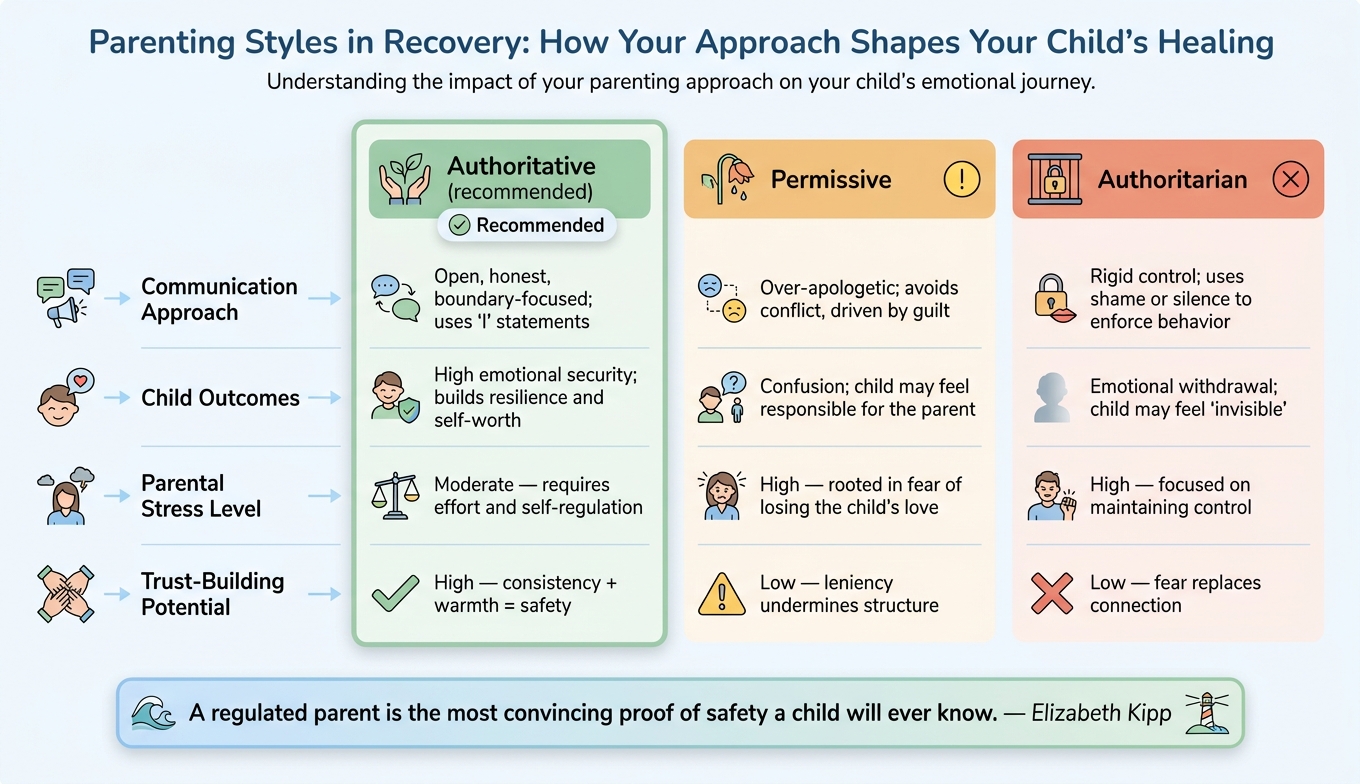
Parenting Styles in Recovery: Authoritative vs. Permissive vs. Authoritarian
The way you parent during recovery has a deep impact on your child’s ability to heal. Two main approaches often emerge during this time: authoritative parenting (high warmth, high structure) and permissive parenting (high warmth, low structure).
A structured environment with predictable routines and clear boundaries helps build emotional security. However, permissive parenting often arises from feelings of guilt. Parents might try to compensate for past mistakes by saying yes too often, avoiding rules, or replacing important conversations with gifts or leniency [1][9]. While this may seem like a way to reconnect, children recovering from the effects of a parent’s addiction thrive on consistency and clear expectations. On the other hand, the authoritative approach combines emotional warmth with firm, consistent boundaries. Research shows this balance fosters better emotional well-being in children [1][6].
"A regulated parent is the most convincing proof of safety a child will ever know." – Elizabeth Kipp [10]
Here’s a quick comparison of how these parenting styles influence communication and outcomes:
| Parenting Style | Communication Approach | Child Outcomes | Parental Stress Level |
|---|---|---|---|
| Authoritative | Open, honest, boundary-focused; uses "I" statements [1][7] | High emotional security; builds family resilience and self-worth [10] | Moderate; requires effort and self-regulation |
| Permissive | Over-apologetic; avoids conflict, driven by guilt [1][9] | Can cause confusion; child may feel responsible for the parent [10] | High; rooted in fear of losing the child’s love |
| Authoritarian | Rigid control; uses shame or silence to enforce behavior [10][9] | May lead to emotional withdrawal or feeling "invisible" [10][8] | High; focused on maintaining control |
When addressing addiction with your child, using age-appropriate language is critical. For younger children, you might say, "I was sick and got help, and now I’m getting better" [6]. Teenagers, however, can handle more direct discussions that acknowledge specific events. Regardless of age, the key message must remain clear: "Your addiction was not their fault." Repeating this message consistently can help lift the hidden burden many children carry [8].
Modeling emotional regulation, or "regulating out loud", can also teach your child healthy coping mechanisms [10]. For example, saying something like, "I’m feeling overwhelmed right now, so I’m going to take a slow breath," shows them that strong emotions can be managed without damaging relationships. As Kipp points out, "Strong emotions can move through us without destroying connection." [10]
Next, we’ll examine how professional support can further enhance these communication strategies during recovery.
How Professional Support Can Help
Navigating parenting during recovery requires a combination of resources – individual therapy, family counseling, and parent coaching – to address personal growth alongside how trauma impacts parent-child relationships. Let’s break down how each type of support contributes to your journey.
Individual therapy focuses on personal healing by using methods like EMDR (Eye Movement Desensitization and Reprocessing) and IFS (Internal Family Systems). These approaches help process trauma, reduce emotional triggers, and shift self-perception from blame to empowerment. This internal work strengthens your ability to be present and engaged as a parent [3].
"Recovery encourages accountability – taking responsibility while also believing you are capable of growth. Children benefit most from a parent who models change, not from one trapped in self-condemnation." – The Bergand Group [3]
Family counseling creates a space where children can openly share their emotions and start rebuilding trust. This process not only strengthens family bonds but also plays a key role in reducing relapse risks and improving treatment engagement [5][7].
Parent coaching equips parents with actionable tools, like establishing consistent routines and setting clear boundaries. These skills nurture "relational intelligence", fostering deeper connections and healthier parent–child relationships [11].
"Anything that goes from you to your child is way more meaningful and effective than anything that goes from any therapist to your child because you have the permanent relationship." – John Mark Kane, LMFT [11]
Growth and Change Counseling offers a comprehensive approach by combining individual therapy, family therapy, and parent coaching. Their philosophy treats behavioral and relational challenges as interconnected, emphasizing the importance of active parent involvement. Their parent–child therapy model typically involves 6 to 8 sessions and is designed to strengthen family relationships. For convenience, sessions are available via telehealth throughout California, making them accessible even for parents with demanding schedules. Individual therapy costs $150 for a 45-minute session, with sliding scale options available for those needing financial assistance. These professional services work alongside your daily efforts to rebuild trust and create a path toward healing.
Pros and Cons of Each Approach
Blending personal healing with trust-building is a cornerstone of recovery. Each approach – parent-focused healing and child-focused trust-building – plays a key role at different stages. Understanding their strengths and challenges helps families make informed decisions.
One of the main benefits of parent-focused healing is the stability it brings to the family dynamic. As Serenity Ranch Recovery explains:
"Protecting sobriety is not a selfish act – it is a necessary foundation for rebuilding family stability." [Serenity Ranch Recovery]
Without a solid personal foundation, efforts to rebuild trust can falter. However, in the early stages of recovery, focusing on self-healing might feel like emotional distance to children, even though it’s essential for long-term stability.
On the other hand, child-focused trust-building helps address a child’s immediate fears and confusion. Simple, consistent actions – like being there at bedtime, attending school events, or sharing meals – can provide comfort far beyond words. But without a stable foundation, this approach risks becoming an overcompensation driven by guilt. Offering excessive leniency or material gifts may soothe temporarily but often lacks the structure children need.
Here’s a comparison of the two approaches across different recovery stages:
| Feature | Parent-Focused Healing | Child-Focused Trust-Building |
|---|---|---|
| Primary Goal | Emotional regulation and sobriety maintenance | Restoring the child’s sense of safety and predictability |
| Key Advantage | Breaks generational trauma cycles and builds long-term resilience | Reduces the child’s immediate anxiety and confusion |
| Main Challenge | May feel like emotional absence | Risk of burnout or overcompensation from guilt |
| Best Stage | Early recovery – critical for preventing relapse | Ongoing recovery – effective once stability is established |
| Key Risk | Parental guilt undermining progress | Child resistance or boundary-testing overwhelming an unstable parent |
A well-rounded recovery plan incorporates both approaches in sequence. Personal healing should come first to create a stable foundation. Once that’s in place, rebuilding trust can proceed steadily, paving the way for lasting recovery and stronger family bonds.
Moving Forward in Recovery with Growth and Change Counseling
Recovery is a journey, and rebuilding trust takes patience, structure, and consistent effort. While sobriety lays the groundwork, trust grows through daily actions that demonstrate reliability and care.
As Design for Change Recovery explains:
"Trust is built through patterns – not promises." [12]
Children need to experience stability and consistency in their parent’s behavior over time to feel secure again. Grand gestures or apologies aren’t nearly as impactful as showing up day after day, even when mistakes happen. Owning up to those mistakes and learning from them strengthens trust far more than words ever could.
A key takeaway from the strategies discussed is this: focus on presence, not perfection. Children don’t need a flawless parent; they need one who is steady, accountable, and emotionally present. That’s what truly helps rebuild trust.
Additionally, professional support can play a crucial role in this process. Studies show that involving family in addiction treatment improves outcomes, including better treatment retention and reduced relapse rates [7]. Services like family therapy and parent coaching, such as those offered by Growth and Change Counseling, provide a safe environment for healing and rebuilding relationships. These resources are available both in-person and via telehealth throughout California.
"Recovery is not only about sobriety. It is about restoring stability, rebuilding credibility, and creating a healthier family environment." – Ray Recovery [7]
FAQs
How long does it take to rebuild trust with my kids?
Rebuilding trust within a family is a journey that unfolds at its own pace, often taking unexpected turns. It’s not about quick fixes or dramatic apologies but about showing up consistently with reliable actions over time. While some families might notice better communication within 30 to 60 days of steady effort, truly repairing deep bonds takes more time and patience. Growth and Change Counseling provides family therapy and parent coaching to guide families through this process, helping restore stability and strengthen connections with children.
What should I tell my child about my recovery?
When talking to your child about your recovery, it’s important to use clear, honest language that suits their age and understanding. This helps minimize confusion and ensures they don’t mistakenly blame themselves. Explain that addiction is a disease, and make it clear that they didn’t cause it, they can’t control it, and they can’t fix it. Let them know you’re dedicated to getting better and take full responsibility for your recovery journey.
Be sure to acknowledge and validate their emotions – whether they feel angry, sad, or even embarrassed – without any judgment. If you’re looking for extra help, Growth and Change Counseling provides family therapy and parent coaching to support you and your loved ones through this process.
How do I set boundaries without guilt during recovery?
Setting boundaries might sometimes feel like you’re pulling back affection, but it’s actually a way to build structure and demonstrate care. Think of boundaries as tools for clarity rather than control. For instance, you could say, "I care about you, but I’m not able to give you money right now." The key is to communicate in a calm and consistent manner, which helps create a sense of stability. Growth and Change Counseling provides individual and family therapy to guide you through these moments and help strengthen your relationships.
Related Blog Posts
- Ultimate Guide to Co-Parenting in Recovery
- Parenting Strategies For Addiction Recovery Support
- How Relapse Impacts Co-Parenting Dynamics
- Balancing Sobriety Goals with Parenting Duties
