Parenting shapes a child’s emotional and mental health. The way you were parented influences how you parent your own child – whether you realize it or not. Trauma-based parenting often stems from unresolved pain, leading to reactive and inconsistent behaviors. In contrast, resilience-based parenting focuses on emotional awareness, calm responses, and building secure connections.
Here’s the key difference: Trauma-driven parenting can create fear and instability in children, while resilience-based parenting helps them develop emotional regulation, trust, and confidence. Shifting from trauma to resilience is possible by addressing your own triggers, practicing self-awareness, and seeking professional support when needed.
Key Points:
- Trauma-based parenting often leads to impulsive reactions, strained bonds, and emotional instability in children.
- Resilience-based parenting emphasizes empathy, co-regulation, and teaching emotional skills.
- Children raised with resilience-based approaches are more likely to develop secure attachments, better emotional control, and higher self-esteem.
- Breaking cycles of trauma requires self-awareness, emotional regulation, and sometimes professional guidance.
Quick Comparison Table:
| Feature | Trauma-Influenced Parenting | Resilience-Based Parenting |
|---|---|---|
| Warmth | Inconsistent or conditional | High, unconditional |
| Discipline | Fear-based or avoidant | Clear, respectful boundaries |
| Emotional Regulation | Reactive or avoidant | Models self-regulation |
| Child Outcomes | Anxiety, low self-esteem | Confidence, emotional stability |
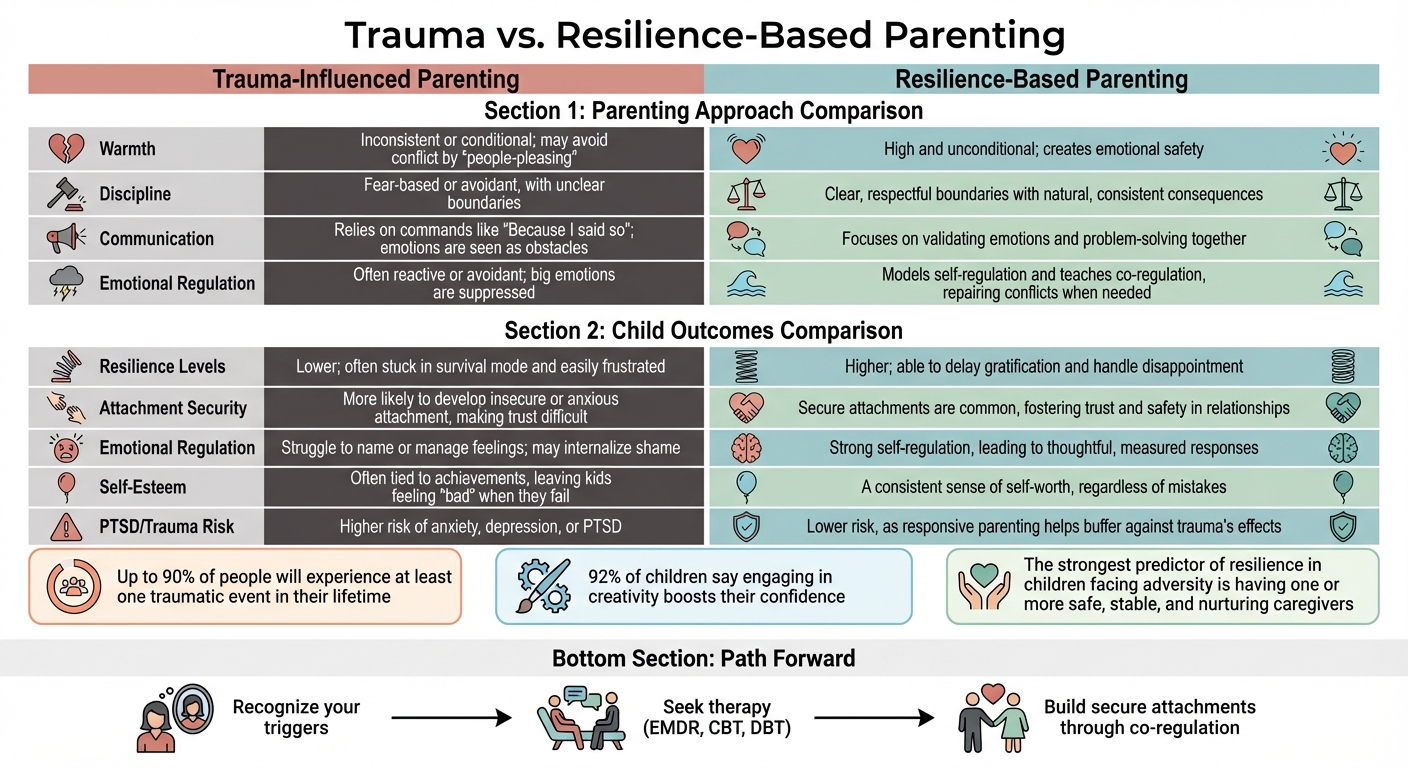
Trauma vs Resilience-Based Parenting: Key Differences and Child Outcomes
Parenting Influenced by Trauma
What Trauma Does to Parenting
When trauma is unresolved, it can hijack your ability to respond calmly during stressful parenting moments. Instead of pausing to consider your child’s behavior, you might find yourself reacting impulsively – yelling, shutting down emotionally, or swinging between extremes. As Casey Jackson, MS, LPC puts it:
"Unresolved trauma can be like a monster that creeps up and causes us to react when we would prefer not to." [1]
This can lead to parenting styles marked by aggression, passivity, or inconsistency. Sometimes, fear-driven leniency is mistaken for gentle parenting. These reactive patterns can erode the emotional connection between you and your child.
Effects on Parent-Child Bonds
Trauma has a way of distorting emotional responses, which can weaken your bond with your child. You might overinterpret their emotional struggles, seeing their frustration as a reflection of your own shortcomings. This fear can make it harder to practice emotion coaching – helping your child navigate tough feelings – because emotions start to feel like threats instead of opportunities to teach and connect.
One damaging cycle that can emerge is the shame spiral. After losing your temper, you might be consumed by guilt, thinking, "I’ve yelled and now I’ve ruined my child." This shame can prevent you from engaging in repair, the process of acknowledging mistakes and apologizing. Stacey Chillemi highlights the danger of avoiding repair:
"If silence follows emotional outbursts, they [children] may learn to assume blame." [2]
How Children Are Affected Long-Term
When the parent-child connection is strained, the effects on children can be long-lasting. Kids raised by parents navigating trauma are more likely to struggle with anxiety, depression, and emotional regulation. Harsh or inconsistent discipline can make the world feel unpredictable and unsafe, fostering instability that can affect their emotional health well into adulthood.
Research shows that up to 90% of people will experience at least one traumatic event in their lifetime, and a parent’s trauma history can increase the likelihood of physical discipline, psychological aggression, and punitive behavior [4]. These patterns can disrupt a child’s developing brain, particularly the circuits responsible for regulating emotions, leading to heightened stress responses that may persist throughout their life.
sbb-itb-596b85d
Parenting Built on Resilience
What Resilience-Based Parenting Looks Like
Resilience-based parenting is all about creating a nurturing environment where empathy and co-regulation take center stage. Instead of reacting with frustration or control, this approach encourages parents to stay calm and use challenging moments as opportunities to teach.
Joan Jeung, MD, MPH, MS, a Professor of Pediatrics at UCSF, explains it best:
"If a parent can stay calm and attuned while the child is experiencing distress, it helps the child become more calm and regulated. Over time, this kind of responsive caregiving helps the child develop self-regulation." [5]
This perspective shifts the focus from controlling behavior to understanding the emotional needs behind it. For example, if a five-year-old has a meltdown over a broken toy, resilience-based parenting encourages you to ask, "What unmet need is driving this reaction?" By replacing judgment with curiosity, you can set firm but kind boundaries, creating a predictable environment without resorting to harshness.
This calm and connected approach not only addresses the immediate issue but also strengthens the bond between you and your child.
Strengthening Parent-Child Relationships
A key element of resilience-based parenting is fostering secure attachment by making your child feel seen and understood. Active listening and validating their emotions show your child that relationships are safe and reliable. Research supports this, revealing that the strongest predictor of resilience in children facing adversity is having one or more safe, stable, and nurturing caregivers [5].
Your consistent presence becomes a buffer against stress, while warmth and understanding help reduce activity in the brain’s fear center. This, in turn, helps children manage anxiety more effectively.
The UCSF Resilience Clinic in Oakland, CA, has been applying these principles since April 2023. Families there use tools like "big feelings" flip books and mindfulness exercises to build co-regulation skills. In one inspiring case, a four-year-old learned to use "breath as an anchor" techniques to help her mother manage stress – showing how these practices benefit both parents and children [5].
How Children Benefit
When secure attachments are nurtured, children experience real developmental advantages. Resilience-based parenting equips kids with emotional regulation and coping skills. They learn to identify their feelings, handle disappointment, and solve problems on their own. The key is providing just enough support to help them grow without stepping in too quickly.
Joseph Laino, PsyD, a Psychologist and Assistant Director at Sunset Terrace Family Health Center at NYU Langone, highlights this balance:
"Resilience building isn’t about rescuing the child from challenges. If we do that, the child won’t develop the emotional muscle needed to face the challenges of life." [6]
These benefits extend far beyond childhood. Kids raised with this approach tend to have higher self-confidence, better impulse control, and a stronger ability to trust themselves and others. They learn that emotions aren’t something to fear but are instead valuable signals. Research also shows that 92% of children say engaging in creativity boosts their confidence [6]. This underscores how resilience-based parenting creates the emotional stability kids need to explore, grow, and thrive.
Trauma vs. Resilience: Key Differences
How These Parenting Styles Differ
Trauma-influenced and resilience-based parenting take very different approaches to handling emotions, setting boundaries, and responding to everyday challenges.
Parents influenced by trauma often find themselves at one of two extremes. On one side, there’s the authoritarian approach, where control is maintained through fear and commands like "Because I said so." On the other side, some adopt a permissive style, avoiding conflict entirely. Both approaches stem from survival instincts shaped by past experiences, where a child’s emotions are often misinterpreted as problems rather than signals needing attention.
Resilience-based parenting, on the other hand, strikes a balance between warmth and structure, following an authoritative approach. These parents focus on understanding their child’s emotions through techniques like emotion coaching. Instead of reacting from their own wounds, they see a child’s distress as a call for care, not a reflection of failure. Bryan Post, an expert on trauma, explains this approach perfectly:
"It’s not about changing the child; it’s about changing ourselves to meet the needs of the child." [3]
| Feature | Trauma-Influenced Parenting | Resilience-Based Parenting |
|---|---|---|
| Warmth | Inconsistent or conditional; may avoid conflict by "people-pleasing" | High and unconditional; creates emotional safety |
| Discipline | Fear-based or avoidant, with unclear boundaries | Clear, respectful boundaries with natural, consistent consequences |
| Communication | Relies on commands like "Because I said so"; emotions are seen as obstacles | Focuses on validating emotions and problem-solving together |
| Emotional Regulation | Often reactive or avoidant; big emotions are suppressed | Models self-regulation and teaches co-regulation, repairing conflicts when needed, often with the help of marriage counseling |
Trauma-driven parenting often avoids meaningful dialogue, while resilience-based parenting involves pausing to understand the present moment instead of reacting to past triggers. These approaches don’t just impact day-to-day interactions – they shape the way children grow and develop over time.
Different Outcomes for Children
The way parents approach their role has a profound impact on their children’s development. Trauma-influenced parenting often leaves kids preoccupied with managing fear, preventing them from focusing on personal growth. In contrast, resilience-based parenting helps children build adaptability and emotional regulation.
The effects of trauma on the brain are well-documented. It can interfere with seven key areas: sensory development, dissociation, attachment, emotional regulation, behavioral regulation, cognition, and self-concept [3]. When parents operate from unresolved trauma, children may develop insecure attachment styles, struggling to trust that relationships are safe.
Bessel van der Kolk, a leading voice in trauma research, emphasizes the importance of this dynamic:
"The parent-child connection is the most powerful mental health intervention in the world." [3]
| Outcome | Children of Trauma-Influenced Parenting | Children of Resilience-Based Parenting |
|---|---|---|
| Resilience Levels | Lower; often stuck in survival mode and easily frustrated | Higher; able to delay gratification and handle disappointment |
| Attachment Security | More likely to develop insecure or anxious attachment, making trust difficult | Secure attachments are common, fostering trust and safety in relationships |
| Emotional Regulation | Struggle to name or manage feelings; may internalize shame | Strong self-regulation, leading to thoughtful, measured responses |
| Self-Esteem | Often tied to achievements, leaving kids feeling "bad" when they fail | A consistent sense of self-worth, regardless of mistakes |
| PTSD/Trauma Risk | Higher risk of anxiety, depression, or PTSD | Lower risk, as responsive parenting helps buffer against trauma’s effects |
Children raised in resilience-based environments tend to have stronger self-esteem, better emotional control, and even improved academic outcomes [7]. These differences highlight whether children grow up seeing emotions as threats or as helpful signals guiding their personal growth.
Moving from Trauma to Resilience
Building Self-Awareness and Emotional Control
Shifting from trauma-based reactions to resilience in parenting starts with understanding your own behavior. Casey Jackson, MS, LPC, from Aspire Counseling, explains trauma responses as, "The best way to describe a trauma response is knowing we are doing a certain behavior, trying not to, but having it continue to happen impulsively out of emotional responses." [1]
Take a moment to reflect on the behaviors you may have inherited from your parents. Do you avoid conflict, lean toward aggressive reactions that create distance, or find yourself being passive-aggressive, perhaps unpredictable or manipulative? These patterns often emerge when your body slips into survival mode, driven by unresolved emotions.
To break these cycles, develop strategies to manage impulsive reactions. Techniques like calming exercises, positive reinforcement, and de-escalation can help you regain control. Pay attention to triggers in your environment that might spark these responses. By focusing on your growth, you can better meet your child’s needs. Over time, with consistent effort, your brain can rewire itself, replacing old, unhelpful neural pathways with healthier ones.
If this process feels overwhelming, seeking external guidance can provide clarity and accelerate your progress.
Getting Professional Help
Professional support can play a key role in addressing generational trauma through faith-based approaches. Therapies like EMDR (Eye Movement Desensitization Reprocessing), Dialectical Behavior Therapy (DBT), Cognitive Behavior Therapy (CBT), and Sensorimotor therapy offer tools to understand how unresolved trauma fuels impulsive reactions and disrupts nervous system regulation.
Nicole Arzt, a Licensed Marriage and Family Therapist, emphasizes the importance of self-care, saying, "Self-care is not selfish; it’s essential." [3] Taking care of your mental health isn’t just for you – it directly benefits your family. Services like those offered by Growth and Change Counseling in California, including locations in Campbell, San Jose, Los Angeles, and Roseville, as well as telehealth options, provide trauma recovery and parent coaching programs. These programs equip parents with practical tools to manage their own trauma while fostering their child’s emotional development.
Creating a Resilient Home Environment
A home built on resilience thrives on consistency and predictability. Establishing regular routines can provide your child with a sense of stability and psychological safety. When your child experiences intense emotions, meet them with empathy and help them name their feelings. This co-regulation approach shows children that emotions are signals to understand, not threats to fear.
Focus on strengthening your connection with your child rather than enforcing strict behavioral compliance. Dr. Karen Triesman highlights the healing power of relationships, noting, "Relationships heal relationship trauma." [3] Build trust through open and honest conversations, rather than relying on punitive methods. When conflicts arise, work together to repair them. This approach not only models emotional regulation but also reassures your child that mistakes are opportunities for growth, not permanent damage to your relationship. These changes align directly with the resilience-focused parenting strategies discussed earlier.
The Power of the Pause at Growth and Change Counseling
Conclusion
Parenting influenced by trauma often stems from unresolved triggers, leading to interactions shaped by fear and past wounds. This approach can keep both you and your child stuck in survival mode, making it harder to move forward [1]. On the other hand, resilience-based parenting focuses on cultivating a conscious connection, creating an environment where your child feels secure and capable of thriving [3].
When trauma drives parenting, children may develop hypervigilance and face challenges with emotional regulation. In contrast, resilience-based parenting equips children with the tools to understand that emotions can be handled, relationships can heal, and mistakes are opportunities to learn and grow.
Modern therapeutic methods like EMDR, CBT, and DBT provide effective ways to reshape negative thought patterns and encourage healthier behaviors [1]. Trauma expert Bessel van der Kolk emphasizes the importance of this connection:
"The parent-child connection is the most powerful mental health intervention in the world." [3]
This highlights the importance of taking actionable steps. Start by recognizing your triggers, practicing self-awareness, and reaching out for support when needed. Every step you take toward healing can positively impact your family, breaking harmful cycles and paving the way for a better future for your child.
As Deborah Gray wisely states:
"Every child is one caring adult away from being a success story." [3]
You have the ability to be that caring adult, even as you continue your own journey of growth and healing.
If you’re ready to make a change, consider seeking professional guidance. Growth and Change Counseling (https://johnmarkkane.com) offers parent coaching, family therapy, and trauma-informed care to support you every step of the way.
FAQs
How can I tell if my parenting is trauma-driven?
Trauma-driven parenting can manifest through automatic emotional responses such as elevated stress, anger, or being overly protective – often tied to unresolved past experiences. Some indicators include struggling to stay calm when reacting to your child’s emotions or finding it challenging to mend relationships after conflicts. Taking an honest look at your patterns is essential, and working with a mental health professional can provide insight and guidance to address how past trauma might be shaping the way you parent.
What should I do when I feel triggered by my child?
When emotions run high, pause and take a deep breath. This moment of reflection creates a gap between your feelings and your immediate reaction. Acknowledge that your response might be influenced by past experiences or trauma, and approach yourself with kindness and understanding. To manage stress, try calming techniques like deep breathing or grounding exercises. These practices help you stay composed and respond thoughtfully, leading to more positive and constructive interactions with your child.
When should I seek therapy or parent coaching for this?
If unresolved trauma is influencing how you parent or making it hard to meet your child’s needs, seeking therapy or parent coaching might be a good step. Watch for signs like being overly permissive, struggling to handle emotions, or reacting in ways connected to past experiences. Professional guidance can help you identify and break harmful cycles, replacing them with parenting approaches that build resilience and support your child’s emotional health.
Related Blog Posts
- How Trauma Impacts Parent-Child Relationships
- Trauma-Informed Family Therapy Techniques
- Relational Intelligence in Parenting: Lessons from Trauma Recovery
- How Family Therapy Improves Trauma Communication
