When relationships hit a rough patch, it’s common to focus on what’s wrong. Strengths-based marriage counseling flips this script, focusing on what’s already working in your relationship. This approach helps couples, especially neurodiverse ones, build stronger connections by highlighting each partner’s unique traits and contributions.
Key Takeaways:
- What It Is: A method that emphasizes your existing strengths rather than dwelling on flaws.
- Why It Works: Couples who focus on strengths report higher satisfaction and reduced conflict.
- For Neurodiverse Couples: It reframes traits like overthinking or analytical tendencies as assets, fostering understanding and empathy.
- Practical Tools: Techniques like “I” statements, mirroring, and regular check-ins improve communication and help manage emotions effectively. Utilizing emotional regulation tips can further stabilize the relationship during stressful moments.
- Results: Over 70% of couples who engage in marriage counseling see improvements, with strengths-based methods offering additional benefits.
This guide covers principles, tools, and benefits of this approach, with insights tailored for emotional growth in neurodiverse couples.
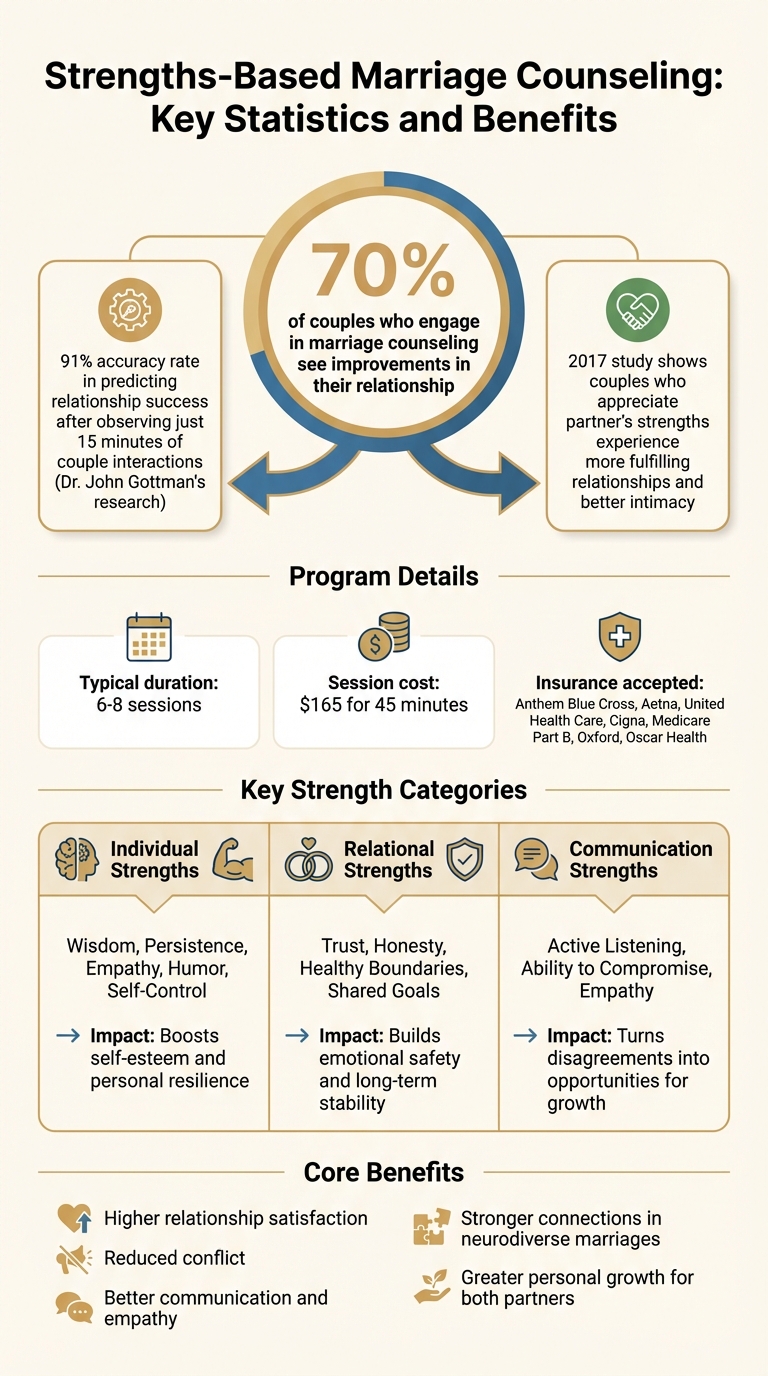
Strengths-Based Marriage Counseling: Key Statistics and Benefits for Couples
How Our Strengths Are Complementary | Strengths Based Marriage | Allan Kelsey
sbb-itb-596b85d
Core Principles of Strengths-Based Counseling
Strengths-based counseling is built on a straightforward yet impactful idea: you have the tools within you to thrive. This approach sees you as the expert in your own life and emphasizes your resourcefulness and resilience [4]. Studies reveal that high achievers use their strengths to tackle challenges effectively [4]. For couples, shifting the focus from "what’s wrong" to "what’s strong" can lead to meaningful and lasting changes. This mindset is especially beneficial for neurodiverse couples, as it highlights and celebrates the unique qualities each partner brings to the relationship.
Finding Individual and Relational Strengths
The first step in strengths-based counseling involves identifying the strengths each partner contributes to the relationship. This goes beyond simple compliments. A neurodiverse couples therapist helps uncover how these strengths show up in daily life – like staying calm in a crisis or sticking to routines with determination [2].
Research from 2017 shows that people who appreciate their partner’s strengths experience more fulfilling relationships and even better intimacy [5]. Todd Kashdan, a professor at George Mason University, explains:
"Greater appreciation of partner strengths is an asset. Too much recognition of costs associated with partner strengths is a problem in close relationships" [5].
Building the habit of noticing strengths can make a big difference. One effective way is to keep a daily log of three strengths you observe in your partner [1]. You can also ask open-ended questions like, "When did you feel you were at your best this week?" To deepen this practice, consider taking a formal strengths assessment together. This might include rating relationship qualities and listing attributes such as "how I show love best" and "my partner’s greatest strengths" [9].
| Strength Category | Examples | Impact on Relationship |
|---|---|---|
| Individual | Wisdom, Persistence, Empathy, Humor, Self-Control | Boosts self-esteem and personal resilience [2] |
| Relational | Trust, Honesty, Healthy Boundaries, Shared Goals | Builds emotional safety and long-term stability [9][10] |
| Communication | Active Listening, Ability to Compromise, Empathy | Turns disagreements into opportunities for growth [10] |
These insights not only enhance relationships but also set the stage for embracing neurodiversity.
Respecting Neurodiversity in Relationships
For neurodiverse couples, understanding and respecting neurological differences is key. These differences influence everything – from how conversations unfold to how life goals are set and children are raised [13]. Traditional relationship advice often assumes both partners process information the same way, which isn’t always the case. This is where tailored strategies come in [14].
Grace Myhill, a couples coach specializing in neurodiverse relationships, emphasizes:
"What each partner needed was first to be normalized and validated based on an understanding of their neurology, and second, they needed concrete tools and strategies to improve their communication and connection" [13].
Rather than judging a partner’s behavior, adopting a curious mindset – like asking, "How might their brain be processing this situation differently than mine?" – can create the emotional safety needed for a deeper connection [11][12].
Acknowledging these differences helps couples build understanding and resilience together.
Building Resilience Through Strengths
Resilience in a relationship isn’t about avoiding conflict; it’s about knowing how to repair and reconnect after disagreements. In fact, conflict can even strengthen intimacy. As one expert notes, if there’s no conflict in a relationship, it may mean one partner isn’t being fully authentic [6].
Practical tools like repair rituals – specific ways to reconnect after a fight – or using "I" statements to express feelings without blame (e.g., "I feel overwhelmed when…") can strengthen bonds. For neurodiverse couples, creating sensory-friendly environments – by agreeing on lighting or noise levels, for instance – can make a world of difference [11][12].
At Growth and Change Counseling, implementing a strengths-based approach typically takes six to eight sessions [8]. During this time, couples learn to identify and leverage their complementary traits – like one partner’s analytical mindset balancing the other’s social intuition. These differences often become the building blocks of a stronger partnership [9]. Research shows that about 70% of couples who participate in marriage counseling see improvements in their relationship [8], and focusing on strengths further enhances satisfaction [1].
These principles provide a solid foundation for the tools and strategies couples can use to nurture their connection.
Strategies and Techniques for Strengths-Based Marriage Counseling
Understanding the principles behind strengths-based counseling is just the beginning. The real impact comes from applying these ideas in ways that help neurodiverse couples communicate better, manage emotions, and maintain a strong connection. Below are practical approaches that have proven effective for many couples navigating their unique dynamics.
Communication Tools for Neurodiverse Couples
One of the most effective tools for improving communication is mirroring. This involves repeating back what your partner has said before responding. While it might feel a bit awkward initially, it’s particularly useful when one partner tends to interpret literal questions as criticisms. For example, if your partner asks, “Did you remember to pay the electric bill?” mirroring can help clarify whether they’re simply asking for information or expressing worry.
Another helpful approach is using softened startups – phrasing concerns gently to reduce the chance of defensiveness. Instead of saying, “You never help with the housework,” try, “I feel overwhelmed with the housework and could really use your help.” Research by Dr. John Gottman shows that softened startups can significantly improve the tone of a conversation. In fact, Gottman’s research demonstrates a 91% accuracy rate in predicting whether a couple will stay together after observing just 15 minutes of their interactions [15].
Shifting from “you” statements to “I” statements is another powerful technique. Saying, “I feel hurt when plans change without notice,” expresses your feelings without assigning blame, making it easier for your partner to respond without becoming defensive. As Dr. Gottman explains:
"Happily married couples aren’t smarter, richer, or more psychologically astute than others… In successful marriages, partners are more positive than negative about one another" [15].
Timing is also critical. Choosing the right moment for important conversations – like waiting until the kids are asleep instead of discussing issues during a chaotic moment – can make all the difference. Simple physical cues, such as a gentle hand on the shoulder, can also signal that a conversation is becoming unproductive and might need a pause.
Here’s a quick overview of these communication techniques:
| Technique | Purpose | Benefit for Neurodiverse Couples |
|---|---|---|
| Mirroring | Reflect back what was heard | Ensures clarity in communication |
| Softened Startups | Begin conversations gently | Reduces defensiveness |
| "I" Statements | Express needs without placing blame | Minimizes defensive reactions |
| Love Maps | Map the partner’s inner world | Builds empathy and connection |
| Strategic Timing | Choose the right moment for dialogue | Prevents discussions during high stress |
Once communication is on solid ground, the next step is learning to improve emotional intelligence and manage emotions effectively.
Managing Emotions and Resolving Conflicts
In neurodiverse relationships, emotional regulation can sometimes look different for each partner. When emotions escalate, productive conversations often shut down. One effective way to address this is by creating pre-agreed signals for when a break is needed. For instance, a hand gesture or saying, “I need 20 minutes to cool down,” can help both partners step back before things spiral. It’s important to establish these signals during a calm moment so they’re ready to use when tensions arise.
Another valuable technique is strength-spotting during conflict. Instead of focusing on “you versus me,” shift to “us versus the problem.” For example, if your partner is particularly skilled at logical problem-solving or persistence, recognize and appreciate those traits – even in the heat of conflict. Research shows that couples who consciously acknowledge each other’s strengths tend to feel more satisfied and are less likely to separate.
The first response principle also plays a key role in conflict resolution. The way the responding partner reacts often sets the tone for the entire discussion, making it essential to approach conflicts with calm and understanding.
Regular Check-Ins and Goal Setting
To maintain progress, regular check-ins are essential. These conversations can prevent small issues from turning into major problems. Setting aside time weekly for a check-in allows couples to address stressors – whether work-related or personal – without rushing to offer solutions. Instead, focus on simply listening and validating each other’s feelings.
Adding strength-based questions to these check-ins can foster meaningful goal-setting. Ask questions like, “What new opportunities do you see to use your strengths?” or “How can we use our strengths to tackle current challenges?” Before diving into goal-setting, take a moment to identify five of your partner’s strengths and share specific examples of when they’ve demonstrated them. This not only builds a positive atmosphere but also strengthens the foundation for tackling challenges together.
For neurodiverse couples, check-ins offer a chance to deepen relational understanding. Asking open-ended questions about each other’s current joys, concerns, or dreams helps couples stay connected and strengthens the friendship that forms the backbone of a healthy relationship. Regularly updating your understanding of your partner’s inner world ensures that both partners feel seen, valued, and supported.
Benefits and Applications of Strengths-Based Counseling
Better Communication and Empathy
Strengths-based counseling reshapes how couples communicate by encouraging them to focus on what’s already working well rather than fixating on problems. This shift in perspective allows partners to recognize and appreciate each other’s inherent strengths, which is particularly helpful for neurodiverse couples. In these relationships, differences in communication styles can often be misunderstood as issues rather than unique traits [4].
By fostering an understanding of each other’s perspectives, this approach enhances relational intelligence. Research from 2017 revealed a strong link between appreciating a partner’s strengths and higher levels of relationship satisfaction, intimacy, and personal growth [5]. As Professor Todd Kashdan from George Mason University explains:
"When somebody is aware and appreciative of another person’s strengths, communicates this, and provides opportunities for strengths to be used, this is when potential becomes realized." [5]
Stronger Connections in Neurodiverse Marriages
For neurodiverse couples, this counseling approach offers a way to celebrate differences rather than trying to smooth them out. A 2023 study (d = 0.48) highlighted how recognizing key strengths such as love, zest, and honesty is linked to greater satisfaction in relationships [16]. Additionally, the Journal of Marital and Family Therapy reports that around 70% of couples who participate in marriage counseling experience improvements in their relationships [8].
When partners focus on each other’s strengths, they feel more supported in their personal goals and experience greater growth. This creates a positive cycle that equips them to navigate future challenges and life transitions with confidence. Ultimately, this deeper connection becomes the foundation for more intensive programs designed to maximize these benefits.
How Intensive Counseling Programs Use This Approach
Intensive counseling programs have found strengths-based methods particularly effective for couples dealing with significant challenges. One example is the Marriage Rescue Institute, a 12-week program offered by Growth and Change Counseling. This program specializes in helping neurodiverse couples, including those where one partner has Asperger’s or High-Functioning Autism [3].
John Kane, the founder of Growth and Change Counseling, describes the program’s mission:
"The Marriage Rescue Institute, our 12-week marriage program, is in the habit of putting marriages in dire circumstances back together!" [3]
The program dives deep into resolving root issues rather than just addressing surface-level symptoms. It equips couples with the relational intelligence needed to replace harmful behaviors with healthier ways of interacting [3]. Sessions cost $165 for 45 minutes, and many insurance providers – including Anthem Blue Cross, Aetna, United Health Care, Cigna, Medicare Part B, Oxford, and Oscar Health – offer coverage. Services are available in Campbell, San Jose, Los Angeles, and Roseville, California, as well as statewide via telehealth.
Kane emphasizes the broader impact of this approach:
"The more relationally healthy people are, the less they struggle with mental health issues like anxiety, addiction, and depression." [3]
Strengths-Based Counseling at Growth and Change Counseling
Services for Neurodiverse Couples
Growth and Change Counseling tailors its strengths-based counseling approach to support neurodiverse couples, offering specialized care for relationships where one or both partners have neurodiverse traits , such as difficulty understanding emotional cues [6][19]. The practice boasts a team of professionals, including ABA-trained specialists like Arione Capolupo, who have extensive experience with Autism Spectrum Disorder [6][19].
The counseling process typically spans 6 to 8 sessions and follows a structured approach. Karin Wiese, LMFT, describes it as:
"At Growth and Change Counseling, we have a foundational process that we take couples… through. This process is tailored to your unique situation and helps you develop the relational intelligence to put your relationships and mental health back together." [6]
This approach combines evidence-based techniques like Emotion Focused Couples Therapy (EFT) and Cognitive Behavioral Therapy (CBT) with timeless principles. For those who request it, Christian Psychology can also be integrated into the sessions [6][8]. Instead of focusing on diagnostic labels, the goal is to build relational intelligence – equipping couples with the tools to move beyond toxic conflict and create meaningful connections [8][17]. These services are available to clients throughout California.
Locations and Telehealth Options
To make counseling accessible, Growth and Change Counseling offers both in-person and remote sessions. Physical offices are located in Campbell, San Jose, Los Angeles, and Roseville, California [17][19][20]. For those who prefer remote counseling or live elsewhere in the state, HIPAA-compliant telehealth services are available statewide [17]. This flexibility ensures clients receive consistent, high-quality care, whether they attend in person or online.
Pricing and Custom Options
Standard 45-minute sessions are priced at $165 [8][17]. The practice accepts in-network insurance from major providers like Anthem Blue Cross, Aetna, United Health Care, Oxford, and Oscar Health. For out-of-network providers such as Cigna, HealthNet, and Blue Shield of California, superbills are available [8][17].
In addition to couples counseling, Growth and Change Counseling offers individual, family, and parent coaching services to promote overall relational well-being [6][20]. Multilingual support is available in English, Spanish, Afrikaans, and Hmong [17][18].
Conclusion
Strengths-based marriage counseling takes a refreshing approach for neurodiverse couples, focusing on what works in the relationship rather than what feels "broken." This method equips partners with the skills needed to navigate differences in emotional regulation and communication styles, fostering a deeper understanding of one another’s unique needs and perspectives [6][7]. By reframing conflict as an opportunity for greater intimacy, couples can build resilience that lasts.
The impact of this approach is supported by research and articles on the subject. Around 70% of couples who engage in marriage counseling report noticeable improvements in their relationship [8]. Moreover, couples who actively acknowledge and appreciate each other’s strengths experience higher levels of satisfaction and are far less likely to separate or divorce [5][1]. As Todd Kashdan, a professor at George Mason University, puts it:
"When somebody is aware and appreciative of another person’s strengths, communicates this, and provides opportunities for strengths to be used, this is when potential becomes realized" [5].
For neurodiverse couples, this approach offers validation for neurological differences while introducing practical tools to bridge emotional gaps. Rather than attempting to "fix" traits associated with ADHD or autism, strengths-based counseling helps partners see how these differences can enrich their relationship when embraced and understood.
Turning these insights into action often requires expert guidance. Growth and Change Counseling specializes in supporting neurodiverse couples through a structured, evidence-based process that typically delivers meaningful progress within 6 to 8 sessions [8]. Whether you prefer in-person sessions in California or telehealth options, their services are designed to fit seamlessly into your life. Sessions are $165 for 45 minutes, and most major insurance plans are accepted [8].
A stronger, more connected marriage starts with recognizing and building on the strengths you already have – and with the right support, those strengths can truly shine.
FAQs
How does strengths-based counseling help neurodiverse couples improve their relationship?
Strengths-based counseling highlights the unique abilities that neurodiverse partners bring to their relationships. These might include talents like creative problem-solving, strong pattern recognition, vivid memories, or an intense ability to focus. By focusing on these positives, couples can move away from a deficit-focused mindset and instead cultivate mutual respect and appreciation, which helps build deeper connections and resilience.
This counseling approach also encourages couples to see how their different ways of thinking can complement one another. For example, what might initially seem like communication challenges can become opportunities to grow together. At Growth and Change Counseling, therapists provide a welcoming environment where both partners feel understood and valued. By focusing on strengths and offering practical strategies, neurodiverse couples can minimize misunderstandings, handle conflicts more effectively, and create a more fulfilling partnership.
What tools are used in strengths-based marriage counseling to help couples grow?
Strengths-based marriage counseling provides couples with practical, personalized tools to highlight and build upon their unique strengths. A popular activity in this approach involves each partner identifying the other’s key strengths and sharing specific examples of how those strengths shine in their relationship. This shift in focus – from challenges to positive traits – can be incredibly empowering. Therapists may also use tools like reflective questionnaires, guided discussions, and action plans to help couples weave these strengths into their daily lives.
Therapists often add practices like gratitude exercises, goal-setting activities, and brief moments of reflection to deepen connection and understanding between partners. At Growth and Change Counseling, these evidence-based techniques are adjusted to meet the unique needs of each couple, including those in neurodiverse relationships. Sessions are offered both in-person and via telehealth for couples across California, making support accessible no matter where you are.
How can focusing on strengths improve a marriage?
Focusing on what each partner does well shifts the spotlight from challenges to the qualities that already bring value to the relationship. This perspective helps build deeper intimacy, stronger emotional connections, and a greater sense of satisfaction. Studies show that when couples acknowledge and appreciate each other’s strengths, they tend to feel more supported, valued, and content in their partnership.
Strengths-based counseling encourages partners to identify and celebrate the traits they admire in one another, using these as a foundation to address conflicts and rebuild trust. By prioritizing positive interactions, couples often experience more stability and a lower chance of separation. Growth and Change Counseling integrates this approach into its 12-week couples coaching program, specifically designed to help neurodiverse partners enhance their bond and foster a more supportive, solution-oriented relationship.
Related Blog Posts
- Emotional Intelligence for Neurodiverse Couples
- Q&A: Supporting Neurodiverse Couples with Mental Health Issues
- Ultimate Guide to Emotional Growth for Neurodiverse Couples
- Ultimate Guide to Emotional Support in Autism-Neurotypical Marriages
