Building emotional connection in neurodiverse relationships requires understanding, clear communication, and mutual respect for each partner’s unique needs.
Here’s what you need to know:
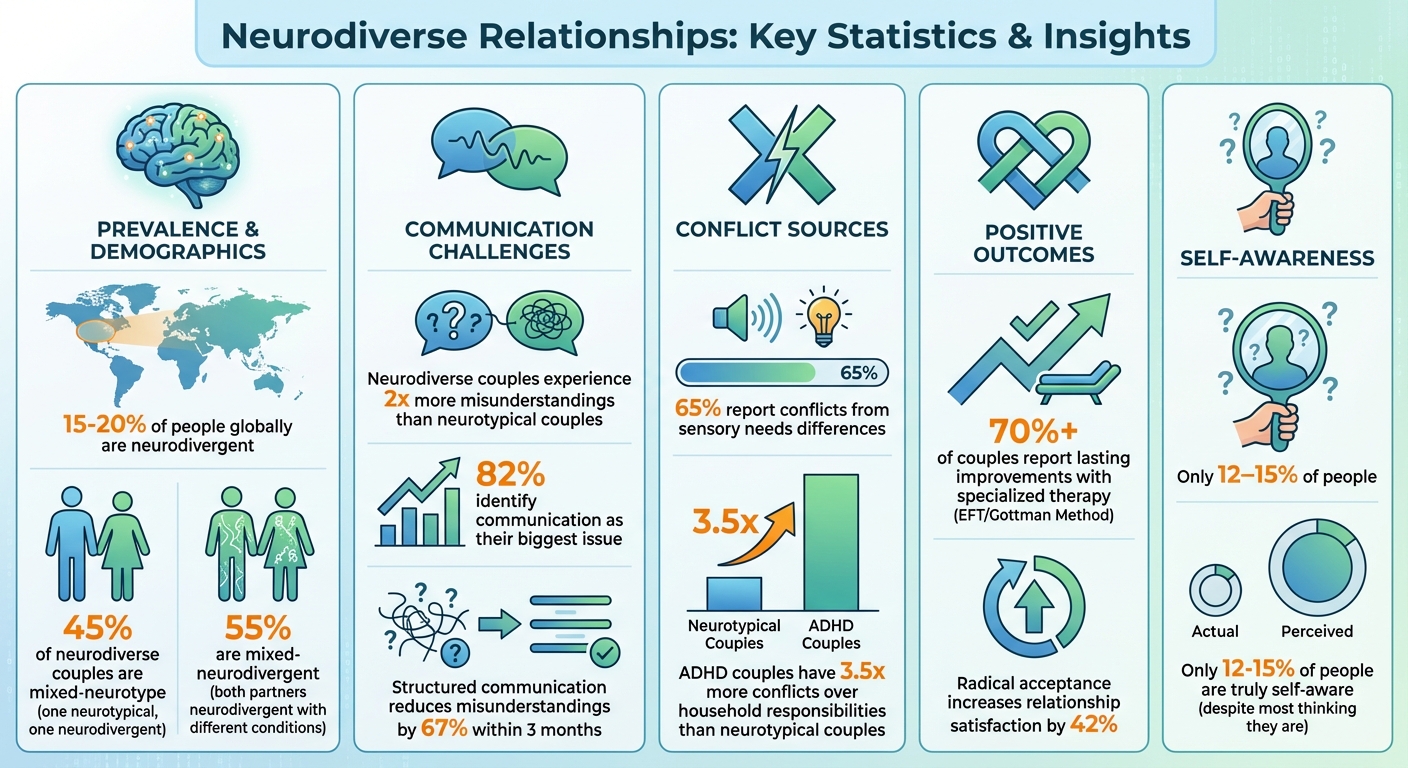
- Challenges: Neurodiverse couples face higher rates of misunderstandings (twice as many as neurotypical pairs) and communication hurdles, with 82% identifying this as their biggest issue.
- Key Insights:
- Emotional dynamics are influenced by neurological differences like alexithymia (difficulty expressing emotions) or Rejection Sensitivity Dysphoria (intense reactions to criticism).
- Sensory needs and executive functioning struggles often lead to conflicts over daily tasks or environments.
- Solutions:
- Develop self-awareness by recognizing emotional triggers and using tools like emotion mapping.
- Practice empathy by understanding neurological differences and using tools like emotional dictionaries or sensory profiles.
- Use clear communication techniques like “I” statements, written communication, and structured discussions.
- Professional Help: Neurodiverse couples counseling, such as the Gottman Method or Emotionally Focused Therapy (EFT), offers tailored strategies to improve understanding and reduce conflict.
Key Statistics and Challenges in Neurodiverse Relationships
Understanding Neurodiversity in Relationships
What is Neurodiversity?
Neurodiversity acknowledges that neurological differences – like autism, ADHD, dyslexia, and OCD – are natural variations in how human brains function, not flaws that need to be "fixed" [6]. Globally, about 15–20% of people are considered neurodivergent [4][6]. In relationships, these differences create unique dynamics, with partnerships often falling into one of two categories: mixed-neurotype relationships, where one partner is neurotypical and the other neurodivergent (45%), or mixed-neurodivergent relationships, where both partners are neurodivergent but have different conditions (55%) [6].
For instance, a mixed-neurodivergent couple might include one partner with ADHD and the other on the autism spectrum. These pairings bring a blend of strengths and challenges, as neurological differences influence not just individual traits but also how emotions and interactions unfold between partners.
"Neurodiverse couples therapy does not pathologize individuals or blame relationship issues on neurodivergence. Instead, it affirms the gifts of each neurotype." – Liz Zhou, Neurodivergent Therapist [5]
Emotional Dynamics in Neurodiverse Couples
Neurodiversity doesn’t just shape how people think – it also impacts the way emotions are expressed and understood in relationships. These emotional dynamics often look different from what traditional relationship advice might address. For example, alexithymia – difficulty identifying or describing emotions – can make conversations feel one-sided. A neurotypical partner might perceive this as emotional distance, even when love and care are present beneath the surface [3][10]. On the other hand, Rejection Sensitivity Dysphoria (RSD), which is common in ADHD, can cause intense emotional reactions to perceived criticism. This can lead to sudden defensiveness or withdrawal during conflicts, adding another layer of complexity [3][4].
Sensory differences also play a significant role. Around 65% of neurodiverse couples report conflicts stemming from sensory needs, like disagreements over noise levels or lighting [6]. What might seem like emotional detachment could actually be a partner withdrawing due to sensory overload – not pulling away from the relationship but trying to cope with overwhelming stimuli. Similarly, challenges with executive functioning – such as planning, organizing, or completing tasks – can cause friction. For example, couples where one partner has ADHD experience 3.5 times more conflicts over household responsibilities than neurotypical couples [6]. These misunderstandings are often misread as a lack of effort or care, when in reality, they stem from neurological differences.
Core Elements of Emotional Growth for Neurodiverse Couples
Self-Awareness and Emotional Regulation
Self-awareness is the cornerstone of emotional intelligence, but the reality is surprising: while most people think they are self-aware, only about 12% to 15% actually are [11]. For neurodiverse couples, developing this skill becomes even more crucial. When partners can identify their emotions and understand their root causes, they can avoid reactive behaviors that erode trust. As Dr. Sarah Schewitz puts it:
"Self-aware partners can say, ‘I’m feeling rejected right now,’ instead of lashing out or shutting down" [9].
Understanding your emotional triggers is key to avoiding impulsive reactions. These triggers might come from past trauma, daily stress like work demands, or neurological factors such as difficulty sensing internal states (known as interoception). For neurodivergent individuals, recognizing early signs of emotional or sensory overload – like a racing heart or tight chest – can help them use strategies to regain control before things escalate [1]. This distinction between inherent neurological traits and adjustable behaviors can also ease feelings of guilt or shame.
Practical tools like emotion mapping can help. By documenting how specific emotions – like anxiety or anger – manifest physically and behaviorally, couples can create a shared "emotional dictionary" that bridges communication gaps. Another helpful method is the "pause" technique: take a moment to breathe and name your emotion (e.g., "I feel unheard") before reacting. Monitoring your "window of tolerance" – the range of sensory or emotional input you can handle – can also help you communicate your needs before reaching a breaking point.
When self-awareness is in place, couples can shift their focus to empathy, deepening their understanding of each other’s emotional worlds.
Building Empathy and Understanding
Once you’ve identified your own triggers, the next step is empathy – learning to interpret and validate your partner’s emotional expressions. In neurodiverse relationships, empathy often involves recognizing that communication issues usually stem from neurological differences, not personal failings. This idea, known as the "double empathy problem", emphasizes that both partners may struggle to understand each other’s social cues and emotions [1][3].
Rather than viewing behaviors through a lens of judgment, empathy reframes them as differences in processing. For instance, a partner with alexithymia may find it hard to articulate emotions – not because they lack feelings, but because their brain processes emotions differently. Similarly, someone with ADHD might experience rejection sensitivity dysphoria, reacting strongly to perceived criticism. This isn’t an overreaction but rather a reflection of intense emotional pain [3][4]. Trauma therapist Yolanda Renteria explains:
"Defensiveness is more common in neurodiverse couples because while one person’s brain may view something as acceptable in the relationship…the other may not" [4][12].
Adopting radical acceptance allows couples to move away from trying to "fix" each other and instead focus on validating each other’s experiences. Tools like an emotional translation dictionary – where partners detail how their emotions show up ("When I’m anxious, I get very quiet and focus on tasks") – can bridge communication gaps [6]. Creating sensory profiles, which list environmental triggers and sensory preferences, can also foster a more accommodating environment [1]. Another strategy is the "I’m puzzled" approach: instead of blaming, use curious statements like "I’m puzzled by [behavior]" to encourage constructive dialogue [7].
Clear Communication Practices
Self-awareness and empathy are powerful, but they need clear communication to truly make a difference in daily interactions. For neurodiverse couples, explicit communication is especially important. Subtle hints or non-verbal cues may not work as effectively, so being direct is key. Using written communication – such as texts, emails, or letters – can give both partners time to process and prepare for emotionally charged conversations [6][12].
"I" statements are another essential tool. Saying "I feel lonely when we don’t talk" expresses your feelings without assigning blame [9][12]. Starting difficult conversations gently can also help prevent overwhelming your partner’s nervous system [4]. Clarifying questions like "Are you looking for advice or just someone to listen?" or "What do you mean by ‘support’ in this situation?" ensure that both partners are on the same page [1].
To further reduce misunderstandings – which neurodiverse couples report experiencing about twice as often as neurotypical couples [6] – agree on a non-judgmental signal to pause conversations when one of you feels emotionally or sensory overwhelmed [4][6]. Another effective tool is the Ladder of Integrity. This structured method involves prompts like "What am I feeling?", "What do I value?", and "What do I hope?" to help partners share their inner thoughts in a way that builds emotional intimacy, even amidst neurological differences.
Avoiding Burnout in Neurodiverse Couples at Growth and Change
Practical Strategies for Emotional Growth
Building emotional growth means focusing on key aspects like self-awareness, empathy, and clear communication. Below are some practical exercises and habits you can incorporate into your daily life to strengthen these areas.
Mindfulness and Perspective-Taking Exercises
Mindfulness is about noticing your emotions without letting them take over. For neurodiverse couples, this can create a pause between feeling and reacting. A simple way to start is with belly breathing: place one hand on your chest and the other on your stomach. Breathe deeply so only your belly moves. This technique helps lower stress levels [13].
When strong emotions surface, try "turning towards" them instead of shutting down. Take deep breaths and notice where you feel the emotion physically – maybe tightness in your chest or tension in your shoulders [13]. Practice labeling emotions rather than identifying with them. For example, say, "anger is present" instead of "I am angry." This subtle shift can provide emotional distance, making it easier to manage your feelings [13]. Yoga and meditation teacher Gillian Florence Sanger highlights the power of mindfulness:
"Mindfulness increases your sensitivity to your experience, which helps you to understand and respond in new ways" [13].
Another helpful practice is the Grounding Tree Meditation, which can bring you back to a calmer state when you’re overwhelmed [1]. To build empathy, share your feelings, values, and hopes as a way to deepen understanding [7]. You can also try twice-compassion: first, acknowledge your own struggles with kindness, then extend that same compassion to your partner [8]. Research shows that expressing gratitude in relationships strengthens connection and satisfaction for both partners the next day [13]. Write a thank-you note or share one thing you appreciate about your partner during dinner.
These mindfulness practices can be paired with daily rituals to build a stronger emotional connection.
Creating Rituals for Emotional Support
Rituals help establish predictable and meaningful moments of connection. Start by defining what emotional support means for each of you, as individual needs can vary [2]. One idea is the "Support or Strategy" ritual: use a simple code phrase to clarify whether you need validation or problem-solving, avoiding unnecessary confusion [2].
You can also implement task-shifting protocols by giving your partner a "heads up" before diving into emotional discussions. This allows them to transition from their current focus to being fully present [2]. Monthly operations meetings can help you evaluate what’s working emotionally and what might need tweaking [6]. For daily connection, consider check-ins where you briefly share your emotional state and immediate needs [5][6].
To manage overstimulation, create a sensory toolkit with items like noise-canceling headphones, weighted blankets, or fidget toys in shared spaces [6]. You might also develop an emotional dictionary, a personalized guide to each partner’s unique expressions, which can be referenced during check-ins [6]. Practicing nervous system co-regulation – like deep breathing or grounding exercises – together can help you stay calm during stressful moments [1][5]. Structured communication protocols, such as these, have been shown to reduce serious misunderstandings by 67% for neurodiverse couples within three months [6].
When conflicts arise and disrupt these routines, having strategies for repair becomes crucial.
Repairing Emotional Disconnect After Conflicts
Repairing emotional disconnect can be difficult, especially when one or both partners feel overwhelmed or shut down. It’s important to focus on regulation before attempting to resolve the conflict [16][18]. Understand that withdrawal is often a sign of emotional overload, not intentional stonewalling [16]. Therapist Barbara (Blaze) Lazarony explains:
"Not all silences are created equal. Some are weapons – stonewalling that communicates contempt. Others are shields – shutdowns that protect a nervous system on overload" [16].
To prevent escalation, establish a nonverbal signal, like a hand gesture, to indicate when someone is nearing shutdown [16][4]. If talking face-to-face feels overwhelming, consider using alternative communication methods, such as written notes or brief phone calls, to process the conflict [4][15]. When you’re ready to reconnect, use softened start-ups – begin the conversation with "I" statements and a gentle tone to avoid triggering defensiveness [4][17].
During the repair process, validate your partner’s emotions, even if you don’t completely agree with their perspective. This can help reduce feelings of shame or hypervigilance [15][17]. Incorporate sensory-friendly reconnection by creating a calm environment with tools like weighted blankets or quiet spaces to help regulate both partners’ nervous systems [1]. Practicing self-soothing rituals, such as placing a hand on your heart or belly, can also help shift from a defensive state to a calmer one [18]. Finally, create an inventory of challenges, listing common triggers like sensory overload or interruptions, to develop a plan for addressing these issues in the future [4][15].
sbb-itb-596b85d
Common Barriers to Emotional Growth
When it comes to emotional growth, recognizing the challenges that can arise is just as important as having the desire to improve. For neurodiverse couples, certain obstacles can make progress feel slow or even impossible at times. But understanding these barriers is a key step toward finding ways to work through them together.
One major challenge is known as The Double Empathy Problem. This concept highlights how both partners may struggle to understand each other’s emotional cues. Liz Zhou, a trauma therapist, explains it this way:
"Communication difficulties are not due to the deficits of either autistic or allistic people, but due to the differences in neurotype" [1].
Another common issue is alexithymia, which refers to having difficulty identifying or describing one’s own emotions. This can make emotional conversations feel one-sided. If one partner can’t articulate their feelings, the other might feel ignored or dismissed, even though it’s a neurological hurdle rather than a lack of care [3].
Executive functioning challenges – like trouble managing tasks or time – can also create friction. These struggles are often misunderstood as laziness, leading to frustration and resentment in the relationship [19].
For individuals with ADHD, Rejection Sensitivity Dysphoria (RSD) can add another layer of difficulty. RSD involves experiencing intense emotional pain in response to perceived criticism, which can result in defensive reactions or withdrawal [3].
Then there’s monotropism, which refers to intense focus on a specific interest. While this deep concentration can be a strength, it may cause someone to unintentionally overlook their partner’s emotional needs [3].
Finally, Theory of Mind deficits can make it harder for a neurodivergent partner to see things from their partner’s perspective. This doesn’t mean they don’t care – it simply means they might need more explicit communication about what kind of support is needed. Therapist Leslie A. Sickels puts it this way:
"The goal of providing emotional support is not to agree but rather to identify that something is ‘a difficult situation’ for a partner" [2].
The Role of Professional Support
When emotional growth hits a roadblock, professional guidance can provide structured strategies to help bridge the gap and foster understanding between partners.
Benefits of Neurodiverse Couples Counseling
For couples navigating the complexities of neurodiverse relationships, a therapist familiar with neurodiversity serves as a crucial intermediary. Therapist Jenni Hartwell perfectly captures this role:
"A therapist’s job here isn’t to ‘fix’ either partner. It’s to become a translator." [3]
Specialized counseling addresses challenges like alexithymia, Rejection Sensitivity Dysphoria, and sensory overload. Instead of framing the neurodivergent partner as the "problem", neurodiversity-affirming care emphasizes mutual understanding and adaptation [3][5].
Take, for example, a September 2025 case study shared by Leslie A. Sickels, LCSW. She introduced "talking tokens" to Tom (ADHD) and Maya (Autistic), helping them manage interruptions during conversations. These tokens – physical items representing turns to speak – improved their communication and active listening [21]. In another case, Laura and Nathan worked with their counselor to implement noise-canceling headphones and scheduled "quiet times" during meals, reducing sensory-related conflicts [21].
Tailored approaches like Emotionally Focused Therapy (EFT) and the Gottman Method have proven highly effective, with over 70% of couples reporting lasting improvements in their relationships [22]. Ruben Velazquez, LMFT, highlights why the Gottman Method works so well for neurodiverse couples:
"One reason the Gottman Method is so effective for working with neurodiverse clients is its focus on understanding and validating each partner’s unique needs." [14]
These specialized techniques offer a foundation for professional interventions, such as those provided by Growth and Change Counseling.
How Growth and Change Counseling Can Help
Building on self-help strategies, Growth and Change Counseling offers targeted support for neurodiverse couples. Led by John Mark Kane, LMFT, the practice serves clients across California, with locations in Campbell, San Jose, Los Angeles, and Roseville, plus telehealth options statewide [20].
For couples in crisis, the Marriage Rescue Institute offers an intensive 12-week program designed to rebuild relationships with practical, actionable tools. This structured program is especially effective for neurodiverse couples who benefit from clear guidance rather than open-ended discussions. Individual therapy is also available at $200 per 45-minute session with an LMFT or $150 per session with an Associate MFT, with sliding scale options starting at $100.
The practice specializes in helping clients navigate anxiety, depression, trauma, and the unique challenges of neurodiverse relationships. Whether the issue is communication breakdowns, sensory differences, or the emotional toll of feeling misunderstood, working with professionals who understand the neurological "why" behind behaviors allows couples to shift from blame to deeper understanding.
Conclusion
Emotional growth in neurodiverse relationships can bridge the gap between different ways of experiencing the world. When couples move beyond seeing neurodivergence as a flaw and start embracing it as a natural variation, they open doors to deeper connection and understanding [1][6].
Research shows that structured communication can cut misunderstandings by 67% in just three months, while radical acceptance increases relationship satisfaction by 42% [6]. These numbers highlight the power of practical, intentional strategies for fostering mutual growth. By focusing on the reasons behind behaviors, avoiding personalizing conflicts, and building clear systems for emotional support, couples can significantly transform their dynamics.
Simple yet effective approaches – like using a "support or strategy" code phrase, mapping out sensory preferences together, or taking time-outs during overwhelming situations – can make a world of difference [2][6]. Neurodiverse relationships thrive when both partners commit to truly listening, even if their emotional "language" feels unfamiliar.
For couples who find self-help strategies insufficient, professional guidance can provide a much-needed roadmap. Growth and Change Counseling, serving clients across California, offers tailored support for neurodiverse couples through options like the 12-week Marriage Rescue Institute or individual therapy, starting at $100 per session. Working with a therapist who understands the neurological dynamics of your relationship can help shift conflict into compassion.
The goal isn’t to become more alike – it’s about learning to understand and appreciate each other’s emotional "dialects" while celebrating the unique qualities that make your relationship extraordinary.
FAQs
How can neurodiverse couples communicate better when dealing with sensory overload?
For neurodiverse couples, navigating communication often begins with addressing sensory overload. Bright lights, loud noises, or chaotic surroundings can make calm conversations feel almost impossible. A low-stimulation environment – think dim lighting, minimal background noise, and a predictable setting – can help both partners stay centered and engaged. Introducing a simple "pause" signal, like a hand gesture or a quick written note, can give either partner the space to step away and self-regulate without fear of judgment, ensuring the conversation can continue more smoothly afterward.
Another important aspect is allowing extra time for processing. Neurodivergent individuals might need a little longer to transform their thoughts into words. Sharing discussion topics ahead of time or summarizing the key takeaways afterward can help prevent miscommunication. Tools like written notes, bullet points, or even visual aids can be incredibly helpful, easing the pressure of having to respond in the moment. Approaching these challenges with curiosity and patience, rather than blame, creates an opportunity for understanding and strengthens emotional bonds.
Growth and Change Counseling specializes in supporting neurodiverse couples, offering practical tools and strategies to enhance communication and build healthier relationships.
How can neurodiverse couples effectively manage emotional triggers?
Managing emotional triggers in neurodiverse relationships requires open communication, practical tools for understanding emotions, and a stable, predictable environment.
Start with clear and direct communication to avoid confusion. Instead of relying on subtle hints or nonverbal cues, say exactly what you mean. For example, try phrases like, "I feel upset when you don’t respond to my request for help." This approach ensures both partners understand each other’s feelings and needs. Tools like emotion charts, shared lists of triggers, or calming techniques can also make navigating emotional moments smoother.
It’s equally important to reduce sensory overload by identifying potential stressors such as loud noises, bright lights, or strong smells. Once you know the triggers, create a routine that includes calming strategies. Options like noise-canceling headphones, a quiet space, or scheduled sensory breaks can help manage overwhelm. These steps not only ease stress but also encourage empathy between partners, helping to prevent emotional escalation.
Lastly, having consistent routines and clear expectations can provide a sense of stability. If challenges arise, seeking neurodiversity-affirming support – such as the services offered by Growth and Change Counseling – can offer structured guidance to strengthen emotional connection and understanding in the relationship.
How can professional counseling help neurodiverse couples grow emotionally?
Professional counseling offers neurodiverse couples a compassionate and knowledgeable environment to address their specific challenges. With the guidance of an experienced therapist, partners can gain a clearer understanding of each other’s communication styles, sensory preferences, and emotional responses. This understanding paves the way for stronger connections and mutual respect.
Therapy designed for neurodiverse relationships provides actionable strategies to improve communication, resolve conflicts, and build emotional closeness. By emphasizing each partner’s strengths and differences, counseling helps couples move from frustration to teamwork, fostering greater empathy and minimizing misunderstandings. Growth and Change Counseling specializes in this type of support, offering both in-person and telehealth services throughout California to help couples grow and succeed together.
Related Blog Posts
- Emotional Intelligence for Neurodiverse Couples
- Trauma, Addiction, and Neurodiverse Relationships
- Understanding Emotional Cues in Neurodiverse Couples
- Q&A: Supporting Neurodiverse Couples with Mental Health Issues
