Couples recovering from addiction face unique challenges, but setting shared goals can strengthen their bond and support long-term sobriety. This guide covers how to rebuild trust, improve communication, and create a structured recovery plan together. Key takeaways include:
- Shared Goals: Aligning on values and priorities fosters teamwork and emotional safety.
- SMART Goals: Use specific, measurable, achievable, relevant, and time-bound objectives to stay focused.
- Boundaries and Accountability: Establish clear limits and mutual responsibility to protect the relationship.
- Professional Support: Therapy, like Behavioral Couples Therapy (BCT), can enhance recovery success.
- Relapse Prevention: Identify triggers, plan responses, and maintain regular check-ins to stay on track.
- Celebrate Milestones: Acknowledge progress to reinforce commitment and motivation.
5 Essential Steps for Couples Recovery Goals and Relapse Prevention
Couples Therapy with Addiction: What You Need to Know First
Creating a Shared Vision for Post-Recovery Growth
As couples begin to rebuild after recovery, having a shared vision becomes essential. This vision acts as a guiding compass, helping partners navigate challenges together[1].
"Setting goals in a marriage allows partners to work together for the betterment of their marriage. It allows each partner to know what the other wants, so the couple knows the direction that their marriage is heading towards."
– Ted Futris, Professor & Extension Specialist, University of Georgia[6]
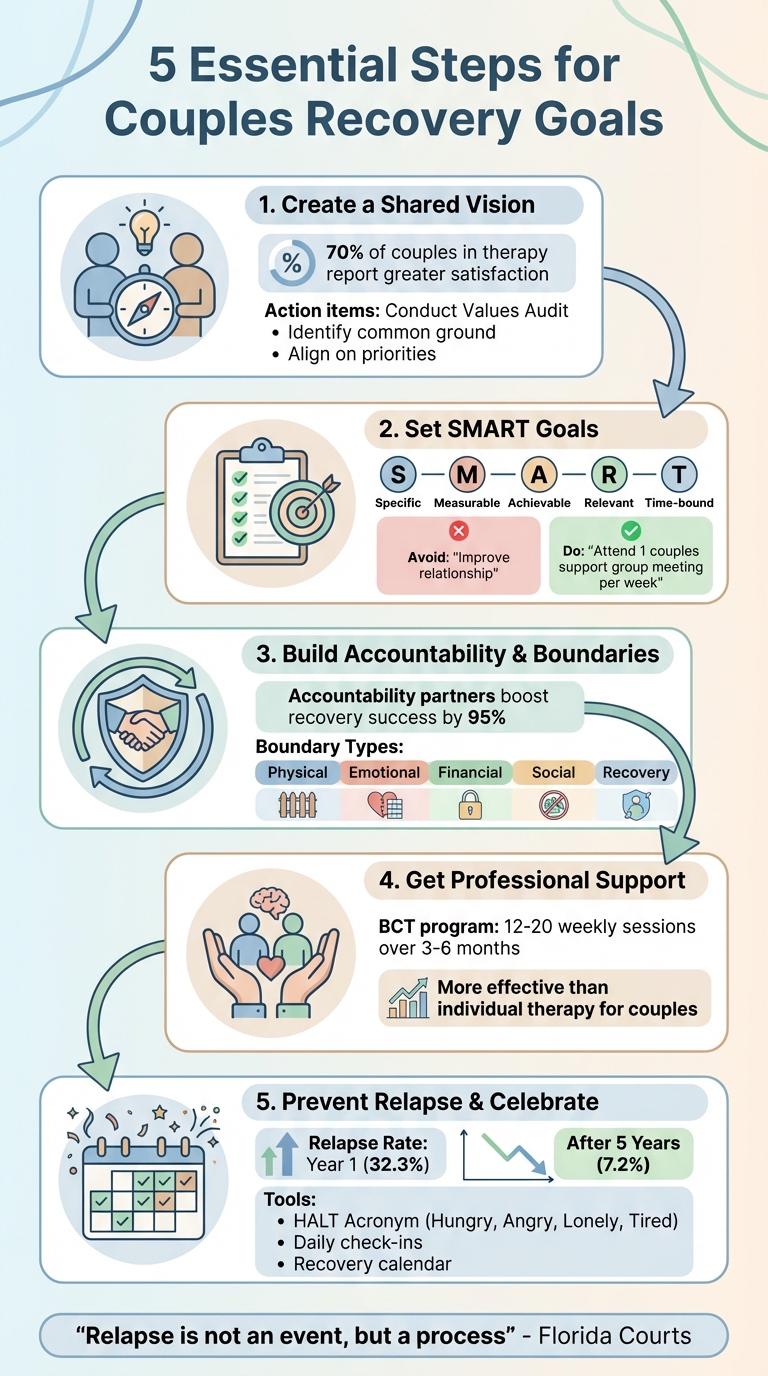
Craft this vision collaboratively. Studies reveal that 70% of couples who undergo therapy report greater satisfaction in their relationships[5]. Much of this improvement stems from working together to create shared goals.
Identifying Shared Values and Priorities
Start with a "Values Audit." This involves three steps: recognizing each partner’s expectations, understanding why each goal matters, and writing down clear, measurable goals to keep visible[6].
The key is finding common ground. For example, if one partner prioritizes saving money while the other dreams of traveling, the shared value might be "creating a life of adventure." This could lead to compromises like planning budget-friendly weekend trips or saving for one meaningful vacation each year[2]. When goals reflect shared values – like stability, family, or growth – they take on deeper significance.
Once shared values are clear, the next step is to define long-term goals that align with this vision.
Setting Long-Term Relationship Goals
Long-term goals typically stretch over three to six months or more[3]. These goals should address areas that addiction may have impacted, such as trust, emotional intimacy, daily routines, and future planning.
To organize your vision, break it into timelines:
- Immediate goals (one month to one year): Focus on foundational steps, like setting communication rules or completing initial treatment.
- Short-term goals (one to three years): Work on rebuilding trust and forming new, sober social connections.
- Long-term goals (three to five years): Aim for lasting lifestyle changes, deeper emotional bonds, and major life decisions – such as career shifts or starting a family[6].
Turn these ideas into actionable SMART goals.
| Vague Goal | SMART Long-Term Relationship Goal |
|---|---|
| Improve communication | Spend 20 minutes each night in distraction-free conversation[2]. |
| Rebuild trust | Use a shared calendar and check in daily about schedules and sobriety triggers for six months[1]. |
| Spend quality time | Plan one new sober activity or hobby together every other week for one year[2][1]. |
| Financial stability | Create a budget and save $500 monthly for six months[2]. |
The SMART framework – Specific, Measurable, Attainable, Relevant, and Time-bound – ensures goals are actionable and clear[1][2][5]. For instance, instead of vaguely stating, "we’ll communicate better", set a concrete goal like dedicating 20 minutes nightly to undistracted conversations[6].
Plan quarterly check-ins to evaluate progress and adjust goals as needed[2][1]. Life evolves, and so should your goals. Choose a consistent date, such as your anniversary or the start of a new season, to review and refine your shared vision[1][6].
"Relationship goals are the aspirations and intentions a couple has for their partnership. These goals reflect what matters most to the couple and what they want to create together."
– Mara Hirschfeld, LMFT, Holding Hope[2]
When couples are driven by intrinsic motivation, meaningful changes become more sustainable[2]. This shared vision lays the foundation for creating SMART recovery goals in the next phase.
Setting and Achieving SMART Recovery Goals
Once you’ve established a shared vision, the SMART framework can help turn your recovery goals into actionable steps. Each letter in SMART stands for a crucial element: Specific (clear and detailed), Measurable (trackable with numbers), Achievable (realistic given your current resources), Relevant (aligned with your recovery priorities), and Time-bound (set within a clear deadline) [7][8]. This structure eliminates confusion and keeps progress on track [9].
By using this framework, your intentions become more focused, and your path to success becomes clearer.
"SMART goals decrease procrastination and provide actionable steps on your road to recovery. It helps you by offering plans with clear paths and positive results."
– Jackson House Rehab [4]
For couples, it’s essential that both partners agree on each goal, a concept SMART Recovery calls "Agreeable" [7]. Start with short-term goals to build momentum, then gradually work toward longer-term objectives [9][3].
Breaking goals into smaller, manageable steps is key to maintaining progress. For instance, instead of vaguely stating, "improve our relationship", set a specific goal like "attend one couples support group meeting per week" [1]. Use tools like a shared journal or app to track milestones, such as therapy sessions attended or consecutive sober days logged [9].
Examples of Joint Recovery Goals
Joint goals can strengthen both sobriety and emotional connection. Practical goals should focus on rebuilding trust and healing your relationship. For example:
- Communication goals: Practice active listening during a 20-minute check-in three times a week.
- Social boundary goals: Agree to avoid environments tied to past substance use, like bars or certain social circles, for the next six months [1].
- Physical health goals: Commit to activities like a 30-minute walk three times a week or sign up for a 5K charity run [8].
- Financial stability goals: Reduce stress by creating a joint budget or setting spending limits to save for future sober plans.
A common recovery milestone is attending 90 12-step meetings in 90 days [10]. Couples can adapt this by committing to one joint therapy session and one support group meeting weekly for 12 weeks. Another idea is to read a recovery-related book together over 30 days, which can deepen your understanding and strengthen your bond [1].
Reviewing and Adjusting Goals
Consistency is important, but flexibility is equally crucial. Review your progress weekly to see what’s working and identify areas that might need tweaking [1]. Life is unpredictable, and rigid goals can sometimes feel overwhelming. Missing a goal isn’t a failure – it’s an opportunity to reassess and adjust your approach [4].
During these reviews, ask yourselves: Are we tracking measurable outcomes? Do these goals still align with our shared values? What challenges came up this week? Adjust timelines, break larger goals into smaller steps, or refocus on priorities as needed. For reference, couples therapy often spans 12 to 20 weekly sessions, offering a structured period to make these adjustments [1]. Regular check-ins ensure your recovery plan evolves alongside your relationship.
Building Accountability and Setting Boundaries
Once your SMART recovery goals are clearly defined, the next step is creating accountability and setting boundaries. Together, these elements strengthen your shared commitment to recovery.
Accountability and boundaries go hand in hand to provide a stable framework for healing. Accountability means both partners take ownership of their actions and support each other’s growth. Boundaries, on the other hand, establish what behaviors are acceptable and help protect the relationship. Without these safeguards, trust can remain fragile, and the chances of relapse may increase.
Interestingly, research indicates that having accountability partners can boost recovery success rates by as much as 95% [11]. But accountability isn’t about one partner keeping tabs on the other – it’s about fostering a culture of mutual responsibility. Both partners stay open about their challenges and celebrate their progress together.
Creating Accountability Agreements
A daily recovery contract can be a practical way to turn intentions into concrete commitments. For example, a couple might agree to attend therapy sessions as a team, schedule daily check-ins at a specific time, or use a shared sobriety tracking app [11].
"Creating a recovery plan for couples starts by setting shared goals and establishing boundaries that prioritize both sobriety and relationship healing."
– Britney Elyse, Clinical Director, Carrara Treatment [1]
Regular check-ins are key to reviewing recovery progress and emotional well-being. Using "I" statements during these conversations can help you express feelings without sounding accusatory. For instance, saying, "I feel anxious when we don’t talk about our day" is more constructive than, "You never communicate with me."
It’s also important to outline specific consequences for boundary violations and have a clear plan for managing relapse together. For example, if substances reappear in the home, you might agree to contact a therapist immediately or attend an emergency support group meeting as a couple. High-stress moments can also benefit from time-out protocols, allowing either partner to step back and cool off before continuing the conversation.
Financial boundaries are another critical area. Couples should consider setting spending limits, managing shared accounts with full transparency, and discussing major purchases beforehand. This approach not only reduces stress but also ensures financial resources are not misused.
Establishing Boundaries to Prevent Relapse
Boundaries aren’t about control or issuing ultimatums – they’re guiding principles that protect both partners. The table below highlights five essential boundary types for couples in recovery:
| Boundary Type | What It Protects | Practical Examples |
|---|---|---|
| Physical | Sobriety environment and personal space | Removing substances from the home; maintaining personal space during disagreements |
| Emotional | Mental well-being during interactions | Using time-outs; practicing active listening; avoiding manipulation |
| Financial | Shared resources and stability | Setting budgets; discussing large purchases; managing accounts transparently |
| Social | Minimizing relapse triggers | Avoiding certain people, venues, or events tied to past substance use |
| Recovery | Commitment to the healing process | Attending therapy sessions; joining support groups; conducting daily check-ins |
"A boundary is not an ultimatum; it is a decision that you make for yourself of what you choose to accept."
– Addiction Center [12]
Establishing substance-free zones is another essential step. This involves removing alcohol, drugs, or related items from your home and agreeing to steer clear of places or social settings associated with past substance use. In some cases, it may also mean limiting interactions with people who encourage unhealthy behaviors.
Write down your boundaries and revisit them regularly, as your needs may evolve over time. If a boundary is crossed, address it immediately by restating the limit and enforcing the agreed-upon consequence. Consistently following through builds trust and shows that both partners are serious about protecting the relationship.
sbb-itb-596b85d
Getting Professional Support for Recovery
Recovering as a couple can be tough, but professional guidance can turn that struggle into progress. Therapy provides a neutral space where both partners can openly communicate and work on replacing harmful habits with healthier ones that support long-term sobriety.
Studies have shown that Behavioral Couples Therapy (BCT) is more effective than traditional individual-based approaches when it comes to boosting abstinence rates and improving relationship health [13]. Typically, BCT involves 12 to 20 weekly outpatient sessions over a 3- to 6-month period [13]. This research underscores how structured therapy can play a key role in recovery.
"Relationship dysfunction is also associated with increased problematic substance use and increased rates of relapse."
– Recovery Research Institute [13]
Therapists often incorporate practical exercises, such as showing appreciation or performing small acts of kindness, to encourage positive interactions and rebuild the emotional closeness that addiction may have damaged.
Marriage Rescue Institute: A Lifeline for Couples in Crisis
For couples facing severe challenges, specialized programs can accelerate the healing process. Growth and Change Counseling offers the Marriage Rescue Institute, a 12-week intensive program tailored for couples in crisis. This program focuses on stabilizing relationships quickly, using evidence-based techniques alongside personalized coaching to address both substance use issues and relationship struggles.
Sessions are available in Campbell, CA; San Jose, CA; Los Angeles, CA; Roseville, CA, and through telehealth. Pricing is $200 for a 45-minute session, with sliding scale options starting at $100.
How Therapy Builds Goals and Emotional Connection
Therapy isn’t just about crisis management – it’s also a powerful tool for long-term growth. It helps couples clarify shared goals and strengthen their emotional connection. For example, a therapist can turn a broad goal like "being better partners" into actionable steps, such as committing to attend two support group meetings together each week for the next three months.
"The quality of an intimate relationship has a direct effect on the recovery prospects of a person suffering from an addiction or mental health condition."
– The Recovery Village [14]
Therapy also helps both partners process the emotional impact of addiction. By addressing trauma and validating each other’s feelings, couples can better understand one another. Therapists often guide partners in identifying their love languages, exploring childhood influences, and developing strategies to cope with stress. These tools create a foundation of trust and empathy, making it easier to tackle future challenges as a team instead of falling back into old, harmful habits.
Creating a Relapse Prevention Plan Together
When working toward sobriety as a couple, creating a relapse prevention plan together can be a game-changer. This written plan acts as a roadmap to navigate challenges, especially during those critical first years. Statistics show that 29.4% of people attempting sobriety never relapse, but the first year poses the highest risk, with 32.3% returning to substance use. After five years of sobriety, however, relapse rates drop to just 7.2% [15]. By developing a thoughtful plan together, you can improve your chances of long-term success. Start by reflecting on past substance use patterns and identifying triggers.
Write down specific people, places, or situations that have previously led to substance use. Relapse often happens in three stages: emotional (neglecting self-care, withdrawing), mental (cravings and rationalizing), and physical (actual use) [15][16]. Spotting these warning signs early can make all the difference.
"Relapse is not an event, but a process." – Florida Courts [18]
Your plan should include a list of healthy coping strategies and trusted people to contact when triggers arise – whether that’s a sponsor, family member, or close friend [15][18]. One helpful tool is an "If-Then" chart, which pairs specific triggers with actionable responses. For instance: If feeling stressed at work, take a 10-minute walk and call your partner [16]. Share this plan with your treatment team, sponsor, and family so everyone is on the same page and ready to support you [15][17].
Recognizing Triggers and Planning Responses
Triggers generally fall into two categories: external (like certain people, places, or objects associated with past use) and internal (emotions such as stress, loneliness, or boredom) [21][22]. Together, couples can identify high-risk situations – holidays, social gatherings, or old hangouts – and come up with "exit strategies" to handle them [20][21]. Practicing these scenarios through role-playing can also help build confidence in saying no [23].
A simple but effective tool is the HALT acronym: check if you’re Hungry, Angry, Lonely, or Tired before reacting to a craving [18][19]. Addressing these basic needs can often stop an urge before it grows stronger. Another technique is called "urge surfing", where you observe the physical sensations of a craving, allowing it to pass without acting on it [19]. Visualizing the full consequences of giving in to a craving can also reinforce your determination to stay sober [19].
A handy tip is to create a recovery wallet card. Write down your top three reasons for staying sober, three emergency contacts, and three immediate coping strategies [19]. For couples recovering from opioids, keeping naloxone kits nearby is crucial, as tolerance decreases during abstinence, increasing the risk of overdose in the event of a relapse [19].
Maintaining Regular Check-Ins
Once you’ve outlined responses to triggers, regular check-ins can help keep you both accountable and connected. A daily check-in might involve one partner confirming 24 hours of sobriety and sharing plans for the next day, while the other offers encouragement and support [24]. Research shows that 50% of men who participated in Behavioral Couples Therapy with these practices remained abstinent, compared to just 30% who received individual treatment [24].
A recovery calendar can help track progress visually, such as attending support meetings, adhering to medication schedules, or having daily trust-building conversations [24]. Weekly reviews are another valuable tool for addressing conflicts before they escalate [24]. When a craving strikes, you can use the SOBER meditation technique: Stop, Observe, Breathe, Expand, and Respond [19]. This five-step process helps break the cycle of impulsive reactions.
Regularly reviewing your relapse prevention plan is essential. Revisit it monthly for the first three months, then quarterly, to adjust for any new triggers or challenges [17]. Morning preparation and evening reflection – known as "inventory training" – can help maintain daily awareness and focus [17]. It’s also important to remember that Post-Acute Withdrawal Syndrome (PAWS) can bring mood swings, anxiety, and sleep issues for up to two years, often in waves [20]. Open communication and long-term planning will help you tackle these challenges together.
Celebrating Progress and Milestones
Recovery is about recognizing how far you’ve come. Celebrating milestones transforms your journey into something tangible and meaningful [27]. Whether it’s marking 30 days, a year, or any goal that feels important to you, every milestone deserves acknowledgment.
"A sober anniversary can symbolize not only the day you chose to take control of your life, but your overall decision to start the journey of recovery."
– Dr. Belis Aladag, MD, MPH, FASAM, First Steps Recovery [27]
These celebrations are more than just dates – they’re opportunities to reflect on your progress and find meaningful ways to honor it.
Recognizing Sobriety Milestones
Soberversaries, or sobriety anniversaries, play a key role in strengthening self-connection and motivation [26]. They remind you that your hard work matters and help reinforce the commitment to long-term sobriety.
"Celebrating your sober milestones – whether it’s your first day, your first year, or 12 years and beyond – is so important because it fuels your motivation. It reminds you that what you’re doing matters, and those wins, big or small, are worth honoring."
– Lori Massicot, Certified Life and Recovery Coach [26]
Consider creating a memory jar filled with notes of gratitude or tokens of achievement [25]. If your partner is in recovery, you can offer support with a heartfelt card, a meaningful gift like engraved jewelry, or even a simple question: "How would you like to celebrate today?" [26].
Beyond the big anniversaries, it’s just as important to celebrate the small, everyday victories. These moments highlight the daily strength it takes to stay on the path of recovery.
Rewarding Positive Changes and Growth
Growth isn’t just about the big milestones – it’s also about the small, everyday wins. Whether it’s resolving a conflict or managing a stressful situation without turning to old habits, these moments deserve recognition [31]. Celebrating these victories not only highlights your progress but also helps protect against relapse by focusing on the positive changes you’ve achieved together [31].
The best rewards often aren’t material but emotional.
"The secret to loving relationships and to keeping them strong and vibrant over the years… is emotional responsiveness."
– Sue Johnson, Clinical Psychologist [28]
Show appreciation daily by acknowledging something your partner did or a quality you admire in them [28]. Set aside time free from distractions to reconnect and reflect on your shared growth [29]. Simple acts like physical affection or words of encouragement can strengthen your bond in ways grand gestures cannot [30].
"Small things often."
– The Gottman Institute [28]
Conclusion
Reaching recovery goals as a couple takes careful planning, accountability, and support from experienced professionals. Start by creating a shared vision of what a healthy, addiction-free relationship means to both of you. Break that vision into SMART goals – specific, measurable, achievable, relevant, and time-bound – that you can track together. At the same time, each partner should focus on their own recovery steps, like attending therapy or support groups. This approach not only prevents codependency but also strengthens your connection.
Setting clear boundaries is another key step. Define physical, emotional, financial, and social limits that protect the relationship and reduce triggers. A strong relapse prevention plan ensures that setbacks can be addressed as a team without resorting to blame or defensiveness. Regular check-ins, like a weekly coffee chat or an unplugged dinner, help you stay connected and monitor progress. These practices lay the groundwork for creating a solid recovery plan as partners.
While personal efforts are essential, professional guidance can provide the structure and expertise needed for long-term success. At Growth and Change Counseling, the Marriage Rescue Institute offers a 12-week couples coaching program designed to rebuild and strengthen relationships with tailored strategies and focused support. Professional help not only offers a clear framework but also fosters trust and healing. Research highlights the importance of family involvement in recovery, showing that collective efforts improve outcomes. With over 100 million adults impacted by addiction[32], working together can transform both individual and relationship recovery.
"Therapy without setting goals first more often than not leads to a dead end."
– House of Zen LA
Recovery is a journey you take together. Through shared goals, consistent accountability, and expert guidance, you can build a strong, supportive partnership ready to face challenges and thrive.
Taking the Next Step with Growth and Change Counseling
How can couples discover and align their core values during recovery?
Couples can strengthen their bond and align their core values during recovery by engaging in open and honest conversations. These discussions should focus on what truly matters to each partner – key beliefs, relationship priorities, and personal goals. By understanding each other’s perspectives, couples can work together toward a shared vision of the future.
Establishing mutual goals and boundaries plays a vital role in this process. For instance, partners might decide to maintain a sober environment, communicate respectfully, and prioritize each other’s emotional well-being. Such agreements provide a solid foundation for growth and help both individuals stay connected and committed to their recovery journey. Regular, meaningful conversations and a dedication to mutual understanding are key to building a stronger, healthier relationship.
What are some practical steps for setting and achieving SMART recovery goals as a couple?
Setting and working toward SMART recovery goals as a couple takes teamwork and a clear plan. SMART goals are Specific, Measurable, Achievable, Relevant, and Time-bound, which makes them easier to follow and track.
Start by identifying specific goals that you both agree are important. For instance, you might decide to attend weekly couples counseling or establish a shared self-care routine. These goals should be measurable, so you can track progress – like counting the therapy sessions you’ve completed or the number of days you’ve stuck to your routine.
Keep your goals achievable by considering what’s realistic for your current situation. Instead of trying to fix everything at once, focus on manageable steps, such as gradually rebuilding trust or improving communication. Make sure the goals are relevant to your shared recovery journey, supporting your vision of a healthier and stronger relationship.
Lastly, set time-bound milestones to stay on track and maintain momentum. For example, you might aim to reach a specific goal within three months. This kind of structure helps both partners stay committed and work together toward meaningful progress.
How can professional support like Behavioral Couples Therapy help couples in recovery?
Professional help, like Behavioral Couples Therapy (BCT), can be a game-changer for couples working through recovery. This therapy tackles both substance use issues and relationship challenges, aiming to improve communication, rebuild trust, and create a supportive atmosphere that promotes sobriety while lowering the risk of relapse.
BCT includes activities like recovery contracts and setting shared goals, giving couples a clear, structured path toward healing. By working as a team, partners can strengthen their connection, define boundaries, and come up with strategies to support lasting recovery. This teamwork not only boosts emotional and relationship health but also improves the chances of staying on track in the fight against addiction.
Related Blog Posts
- How Couples Build Accountability After Addiction
- Addiction Recovery and Marriage: What Works
- How Marriage Counseling Supports Addiction Recovery
- Study: How Shared Goals Improve Sobriety for Couples
