Parental conflict can affect kids more than divorce itself. If you co-parent, the goal is simple: keep conflict low, keep routines steady, and keep your child out of adult problems.
Here’s the short version:
- Use short, calm messages that stay focused on your child
- Set rules for contact like one main app or email and a 24- to 48-hour reply window
- Write things down after calls, schedule changes, and agreements
- Keep handoffs simple with a set place, set time, and no side arguments
- Treat small issues and big decisions differently
- Use mediation or legal help when direct talks stop working
- Get coaching or counseling early if conflict keeps spilling into daily life
A few facts stand out. Written records may help in court if disputes get worse. Mediation is often required before custody hearings in some states. And a clear parenting plan can cut down on repeat fights because fewer details are left open to argument.
If I had to boil the whole article down to one line, it would be this: protecting your child’s stability matters more than winning any single disagreement.
| Issue type | Common examples | Best next step |
|---|---|---|
| Everyday issues | Pickup times, homework, minor schedule swaps | Short written communication |
| Bigger decisions | School, medical care, relocation, custody changes | Mediation, stronger parenting plan, or legal help |
| High-conflict patterns | Hostile messages, repeated plan violations, denied parenting time | Written records, low-contact structure, outside help |
The rest of this guide shows how I’d keep communication clear, set limits, document decisions, and know when to stop arguing and bring in support.
Overcoming High-Conflict Co-Parenting: Protecting Your Kids (and Yourself)
sbb-itb-596b85d
Communication rules that lower conflict
Good communication between co-parents doesn’t depend on warmth or friendship. It depends on consistency and a clear focus on your child. When messages feel more like business notes – brief, factual, and purposeful – they’re less likely to spiral.
Keep messages brief, factual, and focused on the child
Keep messages short, child-focused, and informative. Stick to schedules, health updates, school matters, and your child’s immediate needs. Leave out frustration about the past relationship, personal complaints, and side issues.
If you need to bring up a concern, use "I" statements instead of "you" accusations. "I’m concerned about the homework routine on weekdays" lands very differently than "You never make sure the homework gets done." One opens the door to a discussion. The other lights a match.
Before you hit send, ask yourself: Would this read as calm, factual, and child-focused?
"Parenting messages are often most effective when they stay brief, child-focused, and calm enough that a judge could read them later without misunderstanding the intent." – Zach Anderson, Attorney [2]
Set communication boundaries and response expectations
Once the content of your messages is in good shape, set rules for how and when you communicate. Choose one main channel for all non-emergency communication and stick with it. A separate email address or a co-parenting app keeps everything in one place and helps keep parenting logistics apart from personal texts.
It also helps to set hours for non-urgent messages and a fair response window – 24 to 48 hours [2][5]. That gives both parents space to respond without feeling pushed into fast, emotional replies.
Document agreements and use written communication during tense periods
If a conversation starts getting tense, move to written follow-up. After any verbal discussion, send a short summary of what was agreed to. It can be as simple as: "Following up on our call: we agreed on the pickup time and location." Small step, big payoff. It cuts down on later disputes over who said what.
Keep all messages in chronological order, and don’t delete them. Courts generally treat written records as admissible evidence, which makes documentation useful if a dispute escalates [2][4]. A co-parenting app can help when you need one shared record for messages, calendars, and expenses. Clear records help protect your child’s routine and reduce repeat conflict.
Boundaries, exchange routines, and a step-by-step process for disagreements
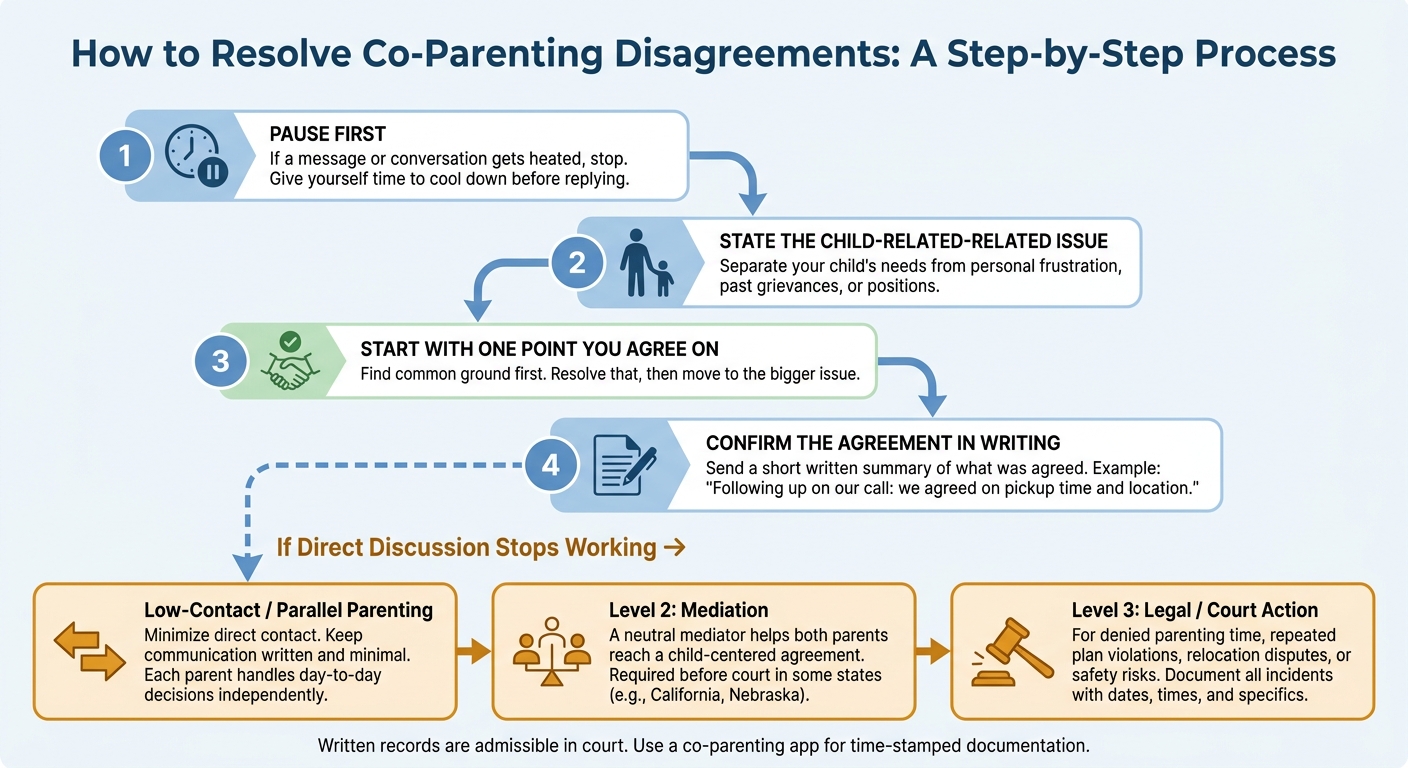
Co-Parent Conflict Resolution: Step-by-Step Process
Set boundaries for topics, timing, and in-person exchanges
Once messages are short and factual, exchanges should follow the same pattern. Written communication can be focused, but in-person handoffs can still go sideways if there’s no clear routine. A set plan makes things more predictable and cuts down on avoidable conflict.
Pick a neutral, public place for pickups and drop-offs when you can. A school or daycare can also work well as the handoff point if direct contact tends to spark conflict. Predictable exchanges help shield the child from last-minute tension.
During the exchange, keep the conversation centered on the child. Don’t bring up money disputes, relationship problems, or old fights. And the child should never be put in the middle as a messenger.
It also helps to set rules ahead of time for after-hours contact and last-minute changes. Be clear about what counts as a real emergency, and use the same response window you already set for routine child-related questions.
Follow a calm, step-by-step process to resolve disagreements
When a disagreement still happens, use the same process every time:
- Pause first. If a message or conversation starts getting heated, stop and give yourself time to cool down before you reply [3][7].
- State the child-related issue. Separate the child’s needs from personal frustration, positions, or past grievances [3][1].
- Start with one point you already agree on. Deal with that first, then move to the bigger issue [1].
- Confirm the agreement in writing. [2][4]
Recognize when direct discussion is no longer productive
Some conflicts don’t get better by talking more. Circular arguments that go nowhere, hostile messages, repeated violations of the parenting plan, or one-sided decisions on major issues all point to the same thing: direct discussion is no longer working [2].
At that stage, changing the structure usually works better than having the same argument again. If the conflict is spilling into the household, parent coaching or family therapy may help.
In high-conflict situations, parallel parenting may be a better fit. This low-contact setup gives each parent separate day-to-day decision-making. It also cuts direct interaction, keeps communication written and minimal, and lets each parent manage day-to-day choices during their own parenting time [2].
If direct coordination still breaks down, the next step is a stronger parenting plan or mediation.
Parenting plans, mediation, and legal considerations
When direct communication stops doing the job, put the rules in writing.
What a strong parenting plan should include
A strong parenting plan cuts down on conflict because it leaves less room for guesswork. It should say where the child lives, who handles major decisions, and exactly when exchanges happen. That means listing pickup and drop-off times, naming the exchange location, and stating which parent is responsible for transportation each time. It should also lay out holidays, school breaks, birthdays, and days like Mother’s Day and Father’s Day with specific dates, not vague wording [2].
The plan should also cover relocation rules, how parents split shared costs like school fees and medical expenses, and when reimbursement requests must be submitted.
It also needs to explain how schedule changes work and how parents should handle emergency contact.
One part people often skip is the dispute-resolution clause. This section spells out the steps both parents agree to follow when a disagreement comes up, such as going to mediation before filing in court [5][2]. Putting that process in writing makes it easier for both parents to follow the same path.
When the details are fuzzy, conflict comes roaring back. When the plan is specific, mediation tends to go much more smoothly.
When mediation helps and when court may be necessary
Mediation tends to work best when both parents still want to solve the problem but are stuck on one issue, like school choice, a medical decision, or a schedule change. A neutral mediator helps both sides work toward an agreement without leaving the decision to a judge. In states like California and Nebraska, mediation is generally required before a judge will decide custody or visitation [1][2].
Major decisions and court-level disputes are usually handled in different ways:
| Issue Level | Examples | Resolution Method |
|---|---|---|
| Major Decisions | School placement, non-emergency healthcare, religious upbringing, extracurriculars | Joint discussion; mediation if parents cannot agree |
| Court-Level Disputes | Denied parenting time, repeated plan violations, relocation, safety risks | Family law attorney, contempt proceedings, or a formal modification petition |
Court usually enters the picture when conflict starts interfering with parenting time, decision-making, or safety.
If that happens, documentation matters. Write down dates, times, and missed exchanges. A note showing that one parent arrived 45 minutes late on three specific dates carries far more weight than saying someone is "always being late" [2]. A co-parenting app can also help by creating time-stamped records of messages and expenses, which may support enforcement or modification if the dispute gets worse [4][2].
If the same fights keep coming back, outside coaching or therapy may help parents stick to the plan more consistently.
Getting support and building a more stable co-parenting system
When direct communication and written agreements still don’t fix the issue, it’s time to bring in outside help. If the same fights keep coming back, outside support can keep that conflict from spilling into the child’s day-to-day life. And before those disputes turn into a legal fight, counseling or coaching can help parents reset how they work together.
When counseling or parent coaching can help
Counseling can help when normal parenting topics keep turning into the same argument, when a child starts showing stress, or when past trauma is fueling reactive communication [3][6].
Parent coaching is more hands-on. It focuses on day-to-day routines and transitions, like schedules, exchanges, and tough handoffs [6].
Growth and Change Counseling offers parent coaching and family therapy for co-parents who need help building calmer communication and steadier routines.
When conflict is already affecting daily life, the focus changes. At that point, it’s less about fixing every single disagreement and more about steadying the co-parenting system.
Key points to carry forward
The main lesson is simple: lower conflict early, document decisions, and move to formal support when direct communication stops working. If direct communication breaks down, mediation can help parents reach a child-centered agreement. If conflict keeps going or starts affecting the child, bring in professional support early.
The goal is not a perfect co-parenting relationship. It is a stable one that protects the child from adult conflict.
FAQs
What counts as a co-parenting emergency?
A co-parenting emergency means the child’s health or safety is in immediate danger.
That can include self-harm, aggression, domestic abuse, stalking, coercive control, or other credible safety threats.
A parent’s substance abuse relapse also counts if it puts the child at risk.
In situations like these, getting emergency help comes first. Contact local authorities or seek urgent legal protection before worrying about parenting-plan communication.
How do I handle a co-parent who ignores the parenting plan?
Stay steady, and keep your child out of the middle.
If the conflict keeps happening, write down each issue in plain terms. Use calm, written messages through child-focused channels so you have a neutral, time-stamped record. That matters. It helps you track patterns without turning every exchange into an argument.
A few ground rules can help:
- Note specific plan violations, not general frustrations
- Keep messages brief, calm, and about your child
- Don’t use your child to pass messages back and forth
- Don’t let the conversation drift into blame or old fights
If the pattern continues, talk with a legal professional about mediation, clarifying the plan, or asking the court to enforce it. A counselor can also help you manage your own response and keep your child’s well-being first.
When should I switch to parallel parenting?
Consider switching to parallel parenting when your co-parenting relationship stays stuck in conflict and working things out together just isn’t realistic anymore.
If even basic communication keeps turning into tension, arguments, or custody fights, this setup can cut down on direct contact, reduce friction, and help you stay involved in your child’s life.
Related Blog Posts
- Ultimate Guide to Co-Parenting in Recovery
- 5 Steps to De-Escalate Co-Parenting Arguments
- How to Communicate Effectively in High-Stress Co-Parenting
- Managing Triggers in High-Stress Co-Parenting Situations
