When co-parenting conflicts arise, they can harm not only your relationship with your co-parent but also your child’s emotional well-being. Prolonged tension may lead to stress that affects children’s development, behavior, and health. To reduce arguments and protect your child, focus on these five practical steps:
- Pause and Breathe: Calm your emotions before responding. Use techniques like the 4-2-6 breathing method or take a short break to regain focus.
- Use ‘I’ Statements: Replace blame with neutral language to express your feelings and needs without escalating the conflict.
- Practice Active Listening: Show understanding by paraphrasing and validating your co-parent’s perspective to keep conversations productive.
- Set Clear Boundaries: Establish rules for communication, like defined times or using apps for written exchanges, to avoid unnecessary tension.
- Focus on Child-Centered Solutions: Keep discussions about your child’s needs and work collaboratively to address them.
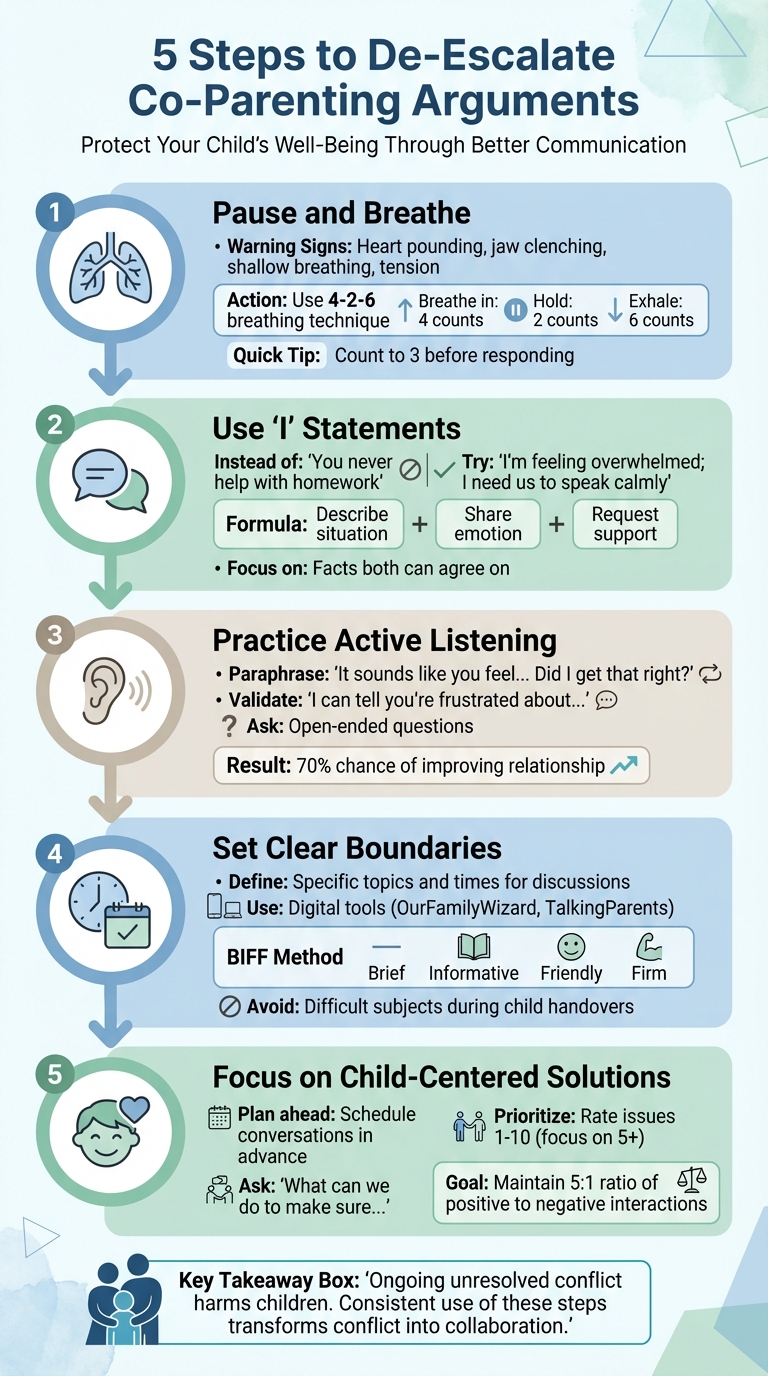
5 Steps to De-Escalate Co-Parenting Arguments
Co-Parenting Without Chaos: What Kids Need You To Know
Step 1: Pause and Breathe
When your co-parent’s tone sharpens or their words feel like an attack, your brain’s alarm system – the amygdala – kicks into high gear. It scans for danger in their facial expressions, tone, or body language, triggering a fight-or-flight response[9]. Your heart pounds, your jaw clenches, and the logical part of your brain, the prefrontal cortex, starts to shut down. This makes it much harder to think clearly or focus on your child’s needs[9]. The good news? You can take steps to regain your calm.
"The key to maintaining emotional regulation during disagreements is catching your stress response early, before your amygdala fully takes control."
Pay attention to physical signals that your body is entering defense mode: shallow breathing, a flushed face, tension in your shoulders, or a tight chest[9]. The moment you notice these signs, pause. Count to three before saying anything – this brief delay can help you stay grounded and slow down the conversation[1]. Another effective tool is the 4-2-6 breathing technique: breathe in through your nose for 4 counts, hold for 2, and exhale slowly for 6 counts[11]. Repeat until your heart rate steadies.
If your emotions feel overwhelming, try naming them out loud: "I’m feeling overwhelmed and reactive right now"[1]. If the discussion becomes too intense, suggest a structured time-out. Be clear about when you’ll revisit the conversation – like in two hours or the next morning[10]. This lets your co-parent know you’re not avoiding the issue but simply taking time to cool off.
Step 2: Use Neutral ‘I’ Statements
After regaining your composure, the next step is choosing your words carefully to keep the conversation constructive. What you say – and how you say it – sets the tone for the entire discussion. Statements like "You never help with homework" or "You’re always late" can make the other person defensive, effectively shutting down any chance of a productive dialogue [12]. Shifting your language can open the door to a more balanced and rational exchange.
This is where "I" statements come in. They allow you to express your feelings and needs without assigning blame. For instance, instead of saying, "You make me so mad", you could say, "I’m feeling overwhelmed; I need us to speak calmly" [8]. Dr. John Gottman explains this approach well: "Your future together can be bright even if your disagreements tend to be very negative. The secret is learning the right kind of damage control" [8].
"I" statements help you describe the situation objectively, share your emotions, and request specific support. For example, instead of accusing with "You never watch the kids", try saying, "I’m really exhausted. Could you help out with the kids?" [13]. Or, rather than asking, "Why didn’t you answer my call?" you might say, "We agreed to speak at 1 p.m. Can you help me understand why I couldn’t reach you?" [2]. These phrasing adjustments invite dialogue instead of escalating conflict.
"Love is saying ‘I feel differently’ instead of ‘you’re wrong.’"
- Ellie Lisitsa, PhD, The Gottman Institute [13]
Staying calm and sticking to the facts is essential. Focus on points that both of you can agree on, like "When you arrived at 2 p.m. instead of 1 p.m.", rather than subjective judgments such as "When you were being irresponsible" [6]. While this approach may not guarantee a perfect response from your co-parent, it significantly improves the chances of being heard and understood [12]. These subtle changes help keep the conversation focused on what truly matters – your child’s well-being.
Step 3: Practice Active Listening
Once you’ve mastered using neutral "I" statements, the next step is to focus on truly listening to your co-parent. Active listening isn’t just about waiting for your turn to speak – it’s about fully understanding their perspective. To make this work, eliminate distractions like phones or the TV, and pick a time when both of you are rested and not dealing with immediate stress.
The heart of active listening lies in paraphrasing what your co-parent shares to ensure you’re on the same page. For example, you could say, "It sounds like you feel unimportant when I check my phone during drop-off. Did I get that right?" This approach not only helps avoid misunderstandings but also shows your co-parent that their feelings matter, which can ease tensions and reduce the likelihood of arguments.
"Real listening – what therapists call active listening – is different. It’s about truly receiving your partner’s experience, even when it’s hard to hear."
- The Gottman Institute [14]
Equally important is validation, which doesn’t mean agreeing with everything they say. Instead, it’s about acknowledging their emotions. For instance, you might say, "I can tell you’re really frustrated about the schedule change." This recognizes their feelings without assigning blame or agreeing to fault. Instead of defending your actions right away, ask open-ended questions like, "Can you explain how that feels for you?" This keeps the conversation constructive and shows genuine curiosity.
If things get heated, take a moment to pause. A few deep breaths can help you regain focus and approach the discussion with more clarity. Research shows that couples who consistently use these communication techniques have about a 70% chance of improving their relationship [14]. By sharpening your listening skills, you not only resolve current conflicts more effectively but also set a strong example of respectful communication for your children.
sbb-itb-596b85d
Step 4: Set Clear Boundaries for Communication
After establishing calm and attentive communication strategies in previous steps, it’s time to focus on setting clear boundaries. These boundaries help keep conversations centered on what truly matters: your children’s well-being [16]. Think of co-parenting as a professional partnership where the "business" is raising happy, healthy kids. This means leaving personal grievances, past arguments, and blame out of the equation.
Define specific topics and times for discussions. For example, avoid bringing up difficult subjects during child handovers. Instead, try solutions like curbside pickups or meeting at neutral locations, such as a school parking lot. You can also agree on specific times for phone calls – like Tuesdays and Thursdays between 7:00 and 7:30 p.m. [15]. These structured boundaries create a more predictable and peaceful environment, aligning well with the active listening methods covered earlier.
Digital tools can play a big role in maintaining these boundaries [4][15]. Apps like OurFamilyWizard and TalkingParents provide a secure way to communicate, offering features like read receipts and timestamps. These tools eliminate "he said/she said" disputes and ensure there’s a clear, unalterable record of conversations. As Guardian ad Litem Elle Barr explains:
"It’s best practice to keep all your co-parenting communications in writing. Then there’s a very clear track record. It gets rid of the arguments about ‘who said what, when?’"
- Elle Barr [5]
When crafting messages, consider using the BIFF Method: keep them Brief, Informative, Friendly, and Firm [15]. Avoid "Why" questions, which can sound accusatory, and instead use discovery questions like "What", "How", or "When" (e.g., "What time will the kids be ready?") [2]. If unrelated issues from the past are brought up, acknowledge them briefly and suggest discussing them at a different time [1].
Comparison Table: Verbal vs. Digital Communication
| Method | Pros | Cons |
|---|---|---|
| Verbal | Allows for quick resolution of simple logistics; can feel warm and personal if the relationship is cooperative [4]. | High potential for escalation; no record of what was said; children might overhear conflicts [4][15]. |
| Digital | Creates a documented record useful for legal or mediation purposes; allows time to manage emotions; keeps children away from disputes [4][15]. | Tone can be misunderstood; not ideal for emergencies; may lead to "text wars" if boundaries aren’t respected [4][15]. |
This comparison highlights the strengths and limitations of both verbal and digital communication. Choosing the right method for each situation can make a significant difference in maintaining a peaceful co-parenting relationship.
Step 5: Redirect to Child-Focused Solutions
With clear communication boundaries established, it’s time to shift the focus entirely to what matters most: your child’s well-being. This step builds on the foundation of mutual respect by keeping every discussion centered on your child’s needs and interests. The goal here is to foster a collaborative approach that prioritizes solutions over disagreements.
Plan ahead for smoother discussions. Instead of catching your co-parent off guard, schedule conversations in advance. For example, you might say, “Can we talk about Johnny’s summer schedule soon?” Preparing ahead allows both of you to come to the table with a clear understanding of the topic and a willingness to work together. Create a list of your child’s needs and shared goals – it’s a great way to find common ground and identify areas where compromises can be made.
Stay solution-focused with discovery questions. Asking questions like, “What can we do to make sure school updates reach us both?” keeps the conversation productive and forward-looking. If old conflicts resurface, acknowledge them briefly and redirect the focus by saying something like, “Let’s circle back to that later. Right now, let’s concentrate on the kids.”
Frame discussions to avoid defensiveness. Instead of pointing out past mistakes, focus on how to improve moving forward. For instance, rather than saying, “You always forget to pack her medication,” try asking, “What can we do to make sure she has her medication at both houses?” This approach not only diffuses tension but also encourages teamwork and practical problem-solving.
Prioritize what truly matters. Not every issue requires the same level of attention. Rate the importance of a problem on a scale from 1 to 10. If it’s a 4 or lower, consider saving your energy for decisions that significantly impact your child’s health, safety, education, or emotional well-being [7].
Seek help if needed. If finding common ground remains challenging, don’t hesitate to reach out for support. Growth and Change Counseling offers professional guidance to help you stay focused on solutions and maintain a positive co-parenting dynamic.
Conclusion
Following these five steps consistently can transform your co-parenting dynamic, moving it away from conflict and toward collaboration – always prioritizing what’s most important: your child’s well-being. Research shows that ongoing, unresolved conflict is detrimental to children of divorce [1]. By implementing these strategies, you can reduce arguments and protect your child from the harmful effects of toxic stress [5].
This shift doesn’t just ease immediate tensions – it also lays the groundwork for better communication in the long run. These techniques encourage relational intelligence, turning a "me versus you" mindset into a cooperative "we." This approach supports the proven 5:1 ratio of positive to negative interactions [3][17]. Each time you successfully de-escalate a conflict, you’re contributing to that positive balance and teaching your kids valuable lessons about healthy conflict resolution.
Consistency is key, and professional support can speed up progress. If co-parenting feels overwhelming, seeking guidance from a professional can offer clarity and practical tools. As John Mark Kane, LMFT, from Growth and Change Counseling, explains:
"Supporting parents directly yields more lasting results than working with children alone."
- John Mark Kane, LMFT [3]
Growth and Change Counseling provides specialized parent coaching in Campbell, San Jose, Los Angeles, Roseville, and across California through telehealth. Their approach empowers parents to break harmful patterns and regain control of their parenting journey. With their help, you can refocus on what truly matters – your child’s happiness and well-being. Let them support you in creating a healthier, more balanced co-parenting relationship.
Moving Forward with Growth and Change Counseling
What is the 4-2-6 breathing technique, and how can it help during a co-parenting argument?
The 4-2-6 breathing technique is simple yet effective: breathe in deeply for 4 seconds, hold your breath for 2 seconds, and then exhale slowly over 6 seconds. It’s a practical way to regain control during a tense co-parenting discussion.
This technique helps soothe your nervous system, lower stress levels, and bring clarity to your thoughts. If emotions start to run high, take a moment to pause the conversation, practice this breathing method a few times, and return to the discussion feeling more centered and composed.
What are some effective ‘I’ statements for better co-parenting communication?
Using "I" statements is a simple yet effective way to express your feelings and needs without assigning blame. This approach helps keep conversations calm and centered on your children’s well-being. Here are a few examples to illustrate:
- "I’m concerned Ava might feel disappointed when she isn’t picked up from school on time." This focuses on the child’s feelings rather than pointing fingers at the other parent.
- "I feel overwhelmed when I don’t get reminders about our son’s medical appointments." By sharing your emotions, you can open the door to better understanding without sounding accusatory.
- "I need a clear holiday schedule so I can plan work around it." A straightforward statement like this emphasizes finding a solution rather than creating conflict.
For tailored guidance on improving co-parenting communication, Growth and Change Counseling offers parent coaching to help you and your co-parent build healthier, more productive dialogue for your family.
How can digital tools help co-parents set healthy boundaries and reduce conflict?
Digital tools such as secure messaging apps, shared calendars, and co-parenting platforms can simplify communication and help avoid misunderstandings. Keeping messages short and to the point – like "Pick-up at 6:00 PM on Friday" or "Doctor’s appointment on March 12 at 10:00 AM" – can help parents steer clear of emotional triggers and stick to a neutral tone. Plus, these tools create a written record of plans and decisions, which can make it easier to avoid revisiting old disagreements.
Some platforms also offer features like limiting message times or muting notifications, which can help set healthy boundaries. This gives both parents the space to focus on their own time while prioritizing their child’s needs. For parents who find it challenging to maintain respectful communication, Growth and Change Counseling offers tailored strategies to encourage more effective, child-centered interactions.
Related Blog Posts
- Ultimate Guide to Co-Parenting in Recovery
- Top 5 Techniques for High-Conflict Couples
- Mental Health and Co-Parenting: Problem-Solving Strategies
- How Couples Manage Anger During Parenting Conflicts
