If co-parenting conflict keeps pulling me into anger, shutdown, or panic, the fix starts before I reply. The core move is simple: spot my trigger, calm my body, and answer only the child issue. That matters because once stress spikes, my ability to listen and solve problems drops fast, and research shows repeated parental conflict is linked to more emotional and behavior problems in children.
Here’s the short version:
- My body reacts first. A text, schedule change, or accusation can trigger a stress response in seconds.
- My history can make it worse. Old wounds, control struggles, addiction history, and family patterns can intensify the reaction.
- I need to track patterns. For 2 weeks, I can note what happened, the story I told myself, body signals, emotion, and what I did next.
- Early body signs matter. Jaw tension, shallow breathing, chest heat, and a flushed face often show up before I act.
- The first wave passes fast. The first emotional surge often fades in about 90 seconds if I don’t keep feeding it with rumination.
- A pause works best. Wait 30 minutes, regulate, strip the message down to facts, draft a brief reply, then wait another 30 minutes before sending.
- Keep messages tight. Use BIFF-style replies: brief, informative, friendly, and firm, with a simple What + When + Action needed format.
- Reply only to child-related issues. I do not need to answer bait, blame, or side arguments.
- Boundaries lower conflict. Written-only contact, one topic per message, set response times, neutral exchange spots, and clear records can reduce flare-ups.
- Parallel parenting may fit better. If direct teamwork keeps breaking down, less contact and stricter structure may help protect the child.
- Outside help can help. Parent coaching or therapy can help me build steadier habits when the same pattern keeps repeating.
A few facts stand out: stress can cut into empathy and problem-solving, children often pick up tension even when adults hide it, and repeated conflict – not separation alone – is one of the strongest predictors of child distress.
Bottom line: I can’t control my co-parent, but I can control my pause, my tone, my boundaries, and my next move.
Mastering Co-Parenting Triggers: Growth and Change Counseling
sbb-itb-596b85d
Common Trigger Patterns in High-Stress Co-Parenting
In high-stress co-parenting, triggers often show up in the same ways again and again. A hostile text that starts with “You always do this” or “My attorney will hear about this” can send your stress response through the roof in seconds. Last-minute schedule changes, fights over house rules, money pressure, and fear about your child’s safety or well-being are some of the most common flashpoints. If addiction is part of the family history, fear of relapse can add even more strain and make a routine exchange feel loaded. Once you can name the pattern, you have a better shot at stopping it before it takes over.
A trigger is anything that sets off your threat response when there is no immediate danger. The message itself may seem small, but your body may not treat it that way. And when your body stays highly activated, clear thinking gets a lot harder.
Children pick up on this tension, even when parents do their best to hide it. Repeated conflict can leave kids anxious, restless, or even physically unwell [2].
How Past Wounds and Family Roles Make Reactions Worse
Co-parenting conflict rarely stays in the present. If your past relationship involved control, gaslighting, or betrayal, even a simple request to swap a schedule can feel like another move in the same old game. Your nervous system reads that person’s behavior through old pain, and it reacts fast.
Family roles matter too. If you grew up in a home where criticism or unpredictability were common, you may have learned to read silence as abandonment or a firm boundary as rejection. Then a co-parent pulls the kids into adult conflict during a custody exchange or starts a fight over household rules, and those old patterns can flare up in an instant. What looks like “too much” from the outside is often a conditioned response to something much older than the custody schedule.
Trigger Mapping: Identifying the Words, Situations, and Behaviors That Set You Off
One of the most useful things you can do is track your own trigger cycle for two weeks. Each time you have a strong reaction, write down five things:
- What happened
- The story you told yourself about it
- What you felt in your body
- The emotion that came next
- What you did after that
Do this for two weeks so you can spot patterns and catch your early warning signs.
These categories can help you see what tends to set you off:
| Trigger Category | Co-Parenting Example |
|---|---|
| Respect | Being accused of parenting incompetence in a text |
| Certainty | A last-minute custody schedule change with no explanation |
| Autonomy | A co-parent making a major medical decision without your input |
| Belonging | Being excluded from a child’s school event or milestone |
| Fairness | Following the court order while the other parent ignores it |
Start with your body. A flushed face, a clenched jaw, or shallow breathing are often the first signs that you’re escalating [3]. If you catch those signals when you’re only at a 2 or 3 out of 10, you still have a window to pause before your thinking brain starts to shut down. When you know your trigger pattern, it gets easier to stop, breathe, and hold off on a reaction.
Self-Regulation Skills to Use Before You Respond
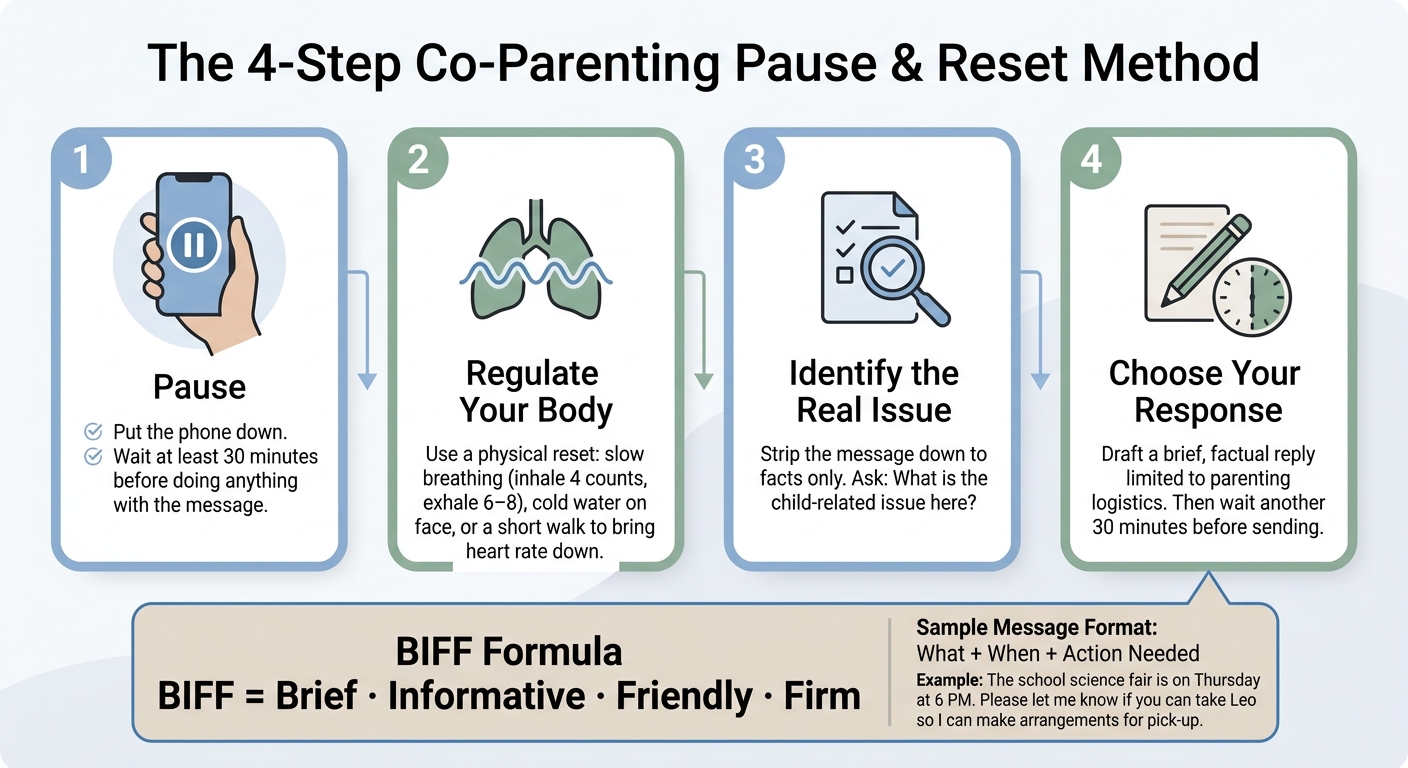
Co-Parenting Trigger Response: 4-Step Pause & Reset Process
The first emotional surge usually fades in about 90 seconds. What sticks around after that is often rumination. And when your heart rate jumps, your ability to listen, show empathy, and solve problems drops [3].
Your body usually gives you a heads-up before things go sideways. Maybe your jaw tightens. Maybe your breathing gets short. Maybe you feel heat in your chest. If you catch those signs early, before a text, call, or custody exchange, you give yourself a much better shot at stepping in before the reaction takes over.
Some of the fastest physical resets are simple. Try an extended exhale: inhale for 4 counts, then exhale for 6–8. You can also splash cold water on your face, which may trigger the dive reflex and lower heart rate [3]. Another tool is affect labeling – silently name what you feel. That small move can help engage the prefrontal cortex and calm the amygdala [3].
It also helps to step back a bit and watch the reaction instead of acting from it. Strip away the story and stick to the facts. For example: a text arrived with a schedule change request.
Use these tools before you reply to a text, answer a call, or walk into an exchange.
A Short Reset Plan for Texts, Calls, and Custody Exchanges
When a provocative message comes in, the impulse is to fire back right away. Don’t.
This four-step sequence gives you a way to use the pause instead of wasting it:
- Pause: Put the phone down and wait at least 30 minutes before doing anything with the message [1].
- Regulate: Use a physical reset like walking, cold water, or slow breathing to bring your heart rate down.
- Identify: Boil the message down to facts only and ask what the child-related issue is.
- Choose: Draft a reply that is brief, factual, and limited to parenting logistics. Then wait another 30 minutes before sending it [1].
Custody exchanges work the same way. If you already know a certain handoff tends to escalate, plan your reset ahead of time so you arrive steady, not reactive. One helpful anchor statement is:
"What they are saying is a projection of their emotions and does not determine my outcome" [7].
When Outside Support Is Part of the Solution
If the same message, exchange, or custody issue keeps setting you off, outside support may help you respond in a different way. When the same patterns keep showing up, Growth and Change Counseling can help with therapy or parent coaching for trauma and addiction recovery.
That kind of steadiness makes low-trigger communication and firm boundaries much easier to use.
Low-Trigger Communication and Boundaries That Protect Everyone
After you reset your body, the next job is simple: keep the next exchange from blowing up.
A good rule here is BIFF: brief, informative, friendly, and firm. Stick to one plain format: What + When + Action needed. For example: "Emma has a doctor’s appointment Friday at 3 p.m. Can you confirm pickup?" [4]
That structure helps for a reason. It keeps the message on the child, the timing, and the next step. No side comments. No old arguments. No bait.
Just as important, reply only to the child-related issue. If a message doesn’t include a child-related question, you don’t have to answer it. [5][8]
Once you know what to say, the next part is how to send it. Texts can spiral fast. They’re easy to misread, and even a short line can come off harsher than you meant. A co-parenting app can help because it creates timestamped records and slows the back-and-forth. Email is often a better fit for longer, non-urgent updates.
Reactive Communication vs. Regulated Communication
The gap between reactive and regulated communication isn’t just about tone. It’s also about timing, focus, and intent.
Reactive messages are fast and impulsive. Regulated messages come after a pause. They’re deliberate, steady, and aimed at keeping life stable for the child.
| Feature | Reactive Communication | Regulated Communication |
|---|---|---|
| Timing | Immediate and impulsive | Paused and deliberate |
| Focus | Past wounds, blame, and "you" statements | Future logistics and "the issue" statements |
| Tone | Accusatory, sarcastic, or defensive | Neutral, business-like, and child-focused |
| Goal | Immediate emotional relief or "winning" | Problem-solving and child stability |
When direct cooperation keeps falling apart, parallel parenting is often a better fit than close collaboration [6]. In that setup, each parent handles their own parenting time on their own, with minimal written-only contact and strict compliance with the parenting plan.
Put plainly, it’s a boundary decision. It cuts down exposure to high-conflict contact and lowers the number of trigger points that can set off another fight.
Emotional, Time, and Physical Boundaries in High-Risk Situations
Boundaries work best when they’re specific, repeatable, and easy to enforce. If a boundary is fuzzy, it usually won’t hold when stress hits.
Here are some common pressure points and how to handle them the same way each time:
| Boundary Type | Why It Matters | How to Apply Consistently |
|---|---|---|
| One topic per message | Prevents looping in old arguments that cannot be resolved | Use one topic per message: the child’s schedule, health, or school needs |
| Response windows | Removes constant on-call pressure and reduces hypervigilance | State clearly: "I check messages once daily at 7 PM and will respond then" |
| Neutral exchange locations | Reduces face-to-face tension during handoffs | Use a public parking lot or school/daycare as the transition point in the parenting plan |
| Written documentation | Creates a clear record for accountability | Log exchanges and schedule changes factually |
| Sobriety routines | Helps keep the child out of the middle | Follow any court-ordered sobriety terms |
Before every exchange or call, use one filter: Would I want a judge to read this? [10]
That question can stop a lot of damage before it starts.
Parent Coaching, Family Systems Work, and Next Steps
Parent coaching helps turn trigger awareness into action. A coach can help you build a trigger map: the body cues that show up first, like jaw clenching or a racing heart, and the thoughts that tend to come right after. When you know your own pattern, you have a better shot at catching yourself at a 2 or 3 on a 10-point scale instead of waiting until you’re already at a 9. Coaching can also help you prepare a clean exit for tense moments, such as: "I need to pause and revisit this at 8 p.m." [3]
Once you can spot your own pattern, family systems work can help explain why the same conflict keeps looping. It shifts the focus away from blame and toward pattern. That change can ease some of the stress children carry after conflict.
If these patterns keep pulling you back in, coaching or therapy can help you practice a steadier response. Growth and Change Counseling offers parent coaching, family therapy, and trauma- and addiction-focused support for California families, both in person and by telehealth.
Conclusion: Focus on the Patterns You Can Control
The goal is not to win each exchange. The goal is to interrupt the pattern before it reaches your child. You can’t control what the other parent does. You can control your nervous system, your communication, and your boundaries. Map your triggers, regulate before you respond, keep each message child-focused, and set boundaries that are specific enough to hold under pressure.
"You should set a good example, use those skills, because you’re setting a good example for your children regardless of what the other co-parent does." – Dr. Don Gordon, Executive Director of the Center for Divorce Education [9]
FAQs
How do I know if I’m being triggered or just upset?
Being triggered can feel like old pain has barged into the present. Your body reacts as if the threat is happening right now, which is why the response can feel way bigger than the moment in front of you.
It’s different from simply being upset. When you’re triggered, your nervous system can swing into fight, flight, freeze, or fawn. That might look like a racing heart, sweaty palms, shallow breathing, chest tightness, frantic texting, or completely shutting down.
What should I say when my co-parent sends a hostile text?
Don’t answer on the spot. If a message gets under your skin, step back, take a breath, and give yourself time – 30 to 60 minutes, or even 24 hours if you need it – before you reply.
When you do reply, use BIFF: brief, informative, friendly, and firm. Keep it focused on facts and child-related logistics. Skip the bait, blame, and rehashing of old fights.
If the message is just venting and doesn’t call for any action, you may not need to answer at all.
When is parallel parenting a better choice than co-parenting?
Parallel parenting is often the better path when working together keeps turning toxic, sparks intense arguments, or just can’t be worked out in a calm way.
It tends to work best when parents can’t communicate with basic respect and each interaction adds more conflict. In that kind of high-conflict situation, kids often feel the strain.
The main goal is simple: cut down direct contact while still letting both parents stay active in their children’s lives.
Related Blog Posts
- Mental Health and Co-Parenting: Problem-Solving Strategies
- 5 Steps to De-Escalate Co-Parenting Arguments
- How to Communicate Effectively in High-Stress Co-Parenting
- Parenting Styles: Trauma vs. Resilience
