Trauma in a family does not stay with one person. It can change trust, roles, conflict, and even simple choices at home. In one ACE study of more than 17,000 adults, people with 6 or more adverse childhood experiences had a life expectancy nearly 20 years shorter than those with none.
If I had to sum up trauma-informed family therapy in plain English, I’d say this:
- It treats the family as a system
- It builds safety before hard conversations
- It views blowups, shutdown, and rigid rules as stress responses
- It helps families slow down, regulate, and repair
- It often works in phases: safety, processing, then reconnection
This matters when:
- a child changes after a hard event
- a parent’s PTSD affects the home
- conflict keeps looping
- one person’s therapy is not enough because the family pattern stays the same
A few patterns often show up in trauma-hit homes:
- hypervigilance: reading threat into tone, silence, or facial expressions
- withdrawal: emotional distance that can look like rejection
- parentification: a child takes on adult emotional duties
- toxic stress: chronic stress that hurts regulation and clear thinking
- unspoken rules like “don’t talk about it” or “keep the peace”
Here’s the big difference from standard family therapy: trauma-informed work does not rush to solve conflict first. It starts by asking, “Does this family feel safe enough to do this work?” That slower pace can lower the chance of making things worse.
A therapist may use approaches like TF-CBT, CPP, PCIT, EMDR, or narrative therapy, based on the family’s age, trauma history, and needs. The goal is not a perfect home. The goal is a family that can pause, repair, and stay connected under stress.
Healing Together – Trauma Informed Family Therapy
sbb-itb-596b85d
Quick Comparison
| Area | Standard Family Therapy | Trauma-Informed Family Therapy |
|---|---|---|
| Main focus | Communication and conflict | Safety, attachment, and stress responses |
| Pace | Faster | Slower, based on regulation |
| View of the problem | May center one person | Looks at the whole family pattern |
| Hard topics | May come up early | Usually waits until safety is built |
| Goal | Solve family problems | Help the family regulate, then work through them |
If you’re trying to figure out whether this type of therapy fits your family, a marriage therapist in Roseville CA can help you decide: it often makes sense when trauma is shaping daily life, not just one person’s symptoms.
How Trauma Affects Family Dynamics and Decision-Making
Those survival responses don’t stay with one person. They ripple through the whole family system. Trauma shifts how a family reads risk, hands out roles, and makes everyday choices. You often see it in quiet, stubborn patterns: unfinished conversations, unspoken rules, and children who learn to read a parent’s mood before they say a word.
Effects on Communication, Trust, and Family Roles
Many families shaped by trauma fall into rigid rules: don’t bring it up, keep the peace, don’t show emotion. On the surface, those rules may seem like a way to avoid conflict. In practice, they shut down honest conversation and make even simple choices feel tense or unsafe.
Trust also starts to fray in very specific ways. Hypervigilance can make a neutral look, tone, or pause seem threatening. Numbness can come across as rejection, even when it’s actually a protective response.
Then roles begin to blur. When a parent is struggling, children may move into the role of emotional caretaker. They watch moods, manage siblings, and push aside their own needs. This is called parentification: the child takes on an adult role, with adult responsibility placed on the child.
When these patterns stick around, they often pass from one generation to the next.
Intergenerational Trauma in Parenting and Partnership
A parent’s childhood trauma often carries into adult parenting and partnership. It can shape discipline, distress tolerance, and conflict with a partner. Partners may also develop secondary traumatic stress through long-term exposure to a survivor’s symptoms [1].
Why Stress Distorts Family Problem-Solving
That’s why family decisions under trauma can feel urgent but leave almost no room to think things through. Stress narrows attention, speeds up reactions, and makes working together harder. A talk about a child’s school schedule or the household budget can blow up fast – not because the topic is huge, but because everyone’s nervous system is already primed for threat.
Researchers call this toxic stress: chronic body-based stress that disrupts emotional regulation and memory formation. Decisions made in that state are usually reactive, not thoughtful.
Hypervigilance, withdrawal, parentification, chronic stress, and rigid rules each chip away at trust, blur family roles, and weaken problem-solving.
Core Principles of Trauma-Informed Family Therapy
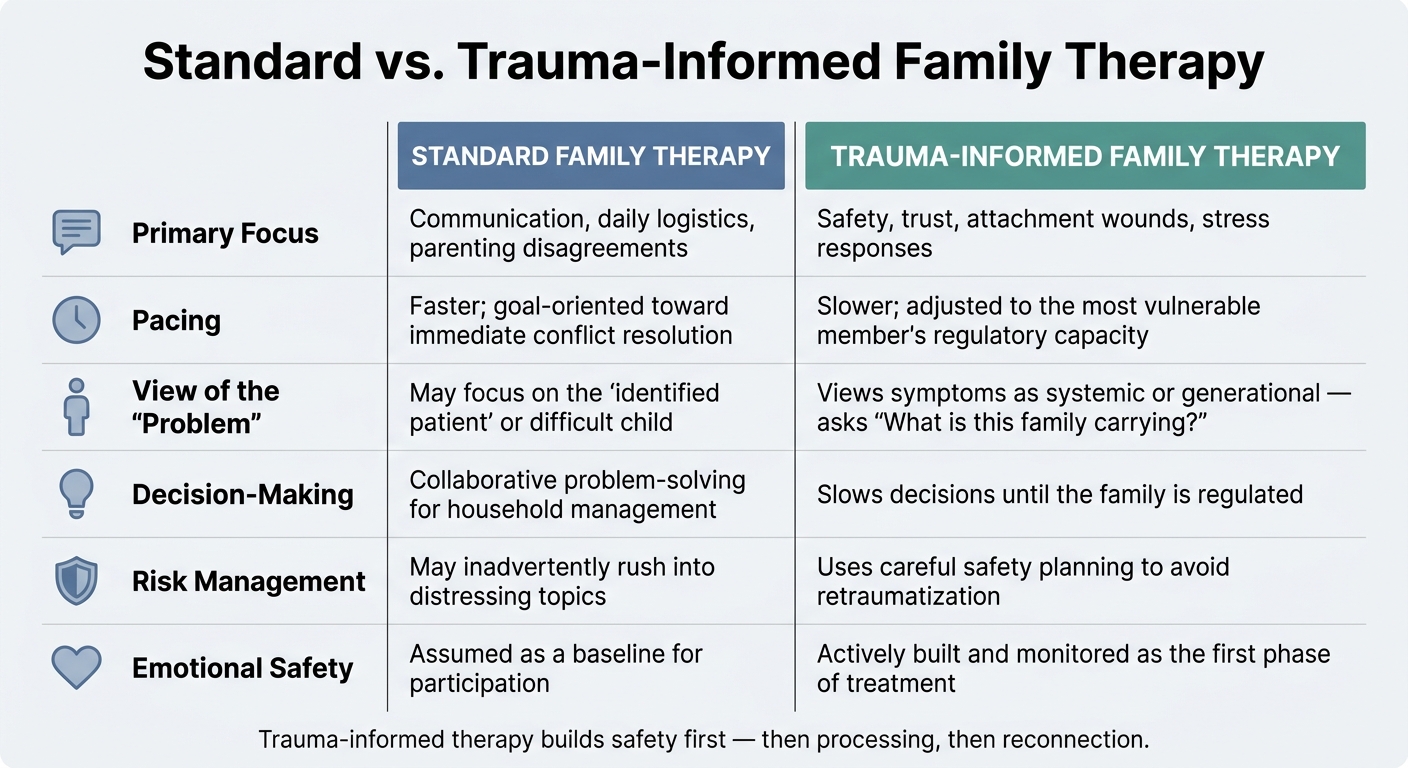
Standard vs. Trauma-Informed Family Therapy: Key Differences
Trauma-informed family therapy is a framework that shapes how sessions are set up and paced. In plain terms, these principles help families think more clearly and make decisions together instead of reacting from stress. They keep trauma work from turning messy or too heavy, too fast.
Safety, Trustworthiness, and Transparency
Before any deep work can happen, the family needs emotional and physical safety. That usually means the therapist builds a steady structure, sets clear expectations, and keeps a predictable rhythm in sessions. Trauma work starts only after safety is in place.
Transparency matters just as much. A trauma-informed therapist explains confidentiality limits, mandatory reporting duties, and how disclosures will be handled before hard topics come up. When the ground rules are clear, family members can spend less energy bracing for surprises and more energy staying present in the room.
Therapists also talk openly about power dynamics. No one in the family should feel trapped, pushed to speak, or made to sit with material they are not ready for. If someone starts showing signs of distress, like a tense posture or shallow breathing, the therapist slows down or shifts direction.
Once safety is in place, the family can start working together in a more steady way.
Collaboration, Voice, and Choice
In trauma-informed work, the therapist acts as a guide, not someone who just hands over a plan. Treatment goals are shaped with the family, not for them. Parents, caregivers, and children all get a say in what progress looks like. That tends to build buy-in and makes uneven progress easier to understand. Shared choice also helps families pause impulsive reactions and make decisions with more intention.
This matters even more in families where trauma has already stripped away a sense of control. Giving each person real input in the room, even on small things like session topics or pacing, starts to rebuild that sense of agency.
Empowerment and Avoiding Retraumatization
The aim is simple: the family should leave sessions more regulated than when they walked in. When people leave calmer, they are in a better place to talk, plan, and solve problems at home.
Therapists use regulation skills and narrative work to help families stay calm and separate the trauma from who they are. Families learn co-regulation tools, such as shared breathing and mindfulness, so they can manage distress together instead of depending only on the therapist to de-escalate. Parents also learn to regulate themselves first, because children often mirror the adult’s state.
These principles shape the assessment, goals, and methods described next.
What the Therapy Process Looks Like
These principles shape how the therapist checks for safety, sets goals, and picks the right kind of support.
Assessment and Goal Setting
Before the first joint session, the therapist will often meet with each family member on their own. These one-on-one meetings give people room to talk about their history, current symptoms, and concerns without feeling watched by the rest of the family. Therapists may use tools like the Adverse Childhood Experience (ACE) Questionnaire and the Conflict Tactics Scale to map family history and spot trauma-related patterns [2]. They also pay close attention to how stress can shrink a person’s sense of choice and lead to reactive decisions.
A big part of assessment is noticing what isn’t always said out loud: the family’s unspoken rules. Rules like “don’t talk about it” or “keep the peace” often start as ways to survive hard situations. Therapists may also watch for physical signs of stress, like guarded posture or shallow breathing, because the body often says what words don’t [1].
From there, goals are set together and kept concrete. For example, a parent might work on noticing dysregulation before reacting. The point is to create behavior-based goals that help the family pause, regulate, and choose with more care [1]. Therapy often follows a three-phase structure: safety and stabilization first, trauma processing second, and rebuilding connection last [1].
Those goals then help guide which family approach makes the most sense.
Methods Used in Trauma-Informed Family Work
The method depends on the family’s age, needs, and trauma history. Here are some common options:
| Method | Best For | How It Works |
|---|---|---|
| TF-CBT (Trauma-Focused Cognitive Behavioral Therapy) | Children and adolescents ages 3–18 with caregivers | Child and caregiver work in separate sessions, then together [2] [1] |
| CPP (Child-Parent Psychotherapy) | Children ages 0–5 with caregivers | Focuses on repairing attachment [1] |
| PCIT (Parent-Child Interaction Therapy) | Children ages 3–7 with parents | Coaches parents in real time [2] |
| EMDR (Eye Movement Desensitization and Reprocessing) | Individuals within a family system | Helps process traumatic memories [2] |
| Narrative Therapy | All ages | Separates trauma from identity [1] |
The same method can look very different when trauma, not just conflict, is shaping the family system.
Standard Family Therapy vs. Trauma-Informed Family Therapy
| Feature | Standard Family Therapy | Trauma-Informed Family Therapy |
|---|---|---|
| Primary Focus | Communication, daily logistics, and parenting disagreements [1] | Safety, trust, attachment wounds, and stress responses [1] |
| Pacing | Generally faster; goal-oriented toward immediate conflict resolution [1] | Slower; adjusted to the most vulnerable member’s regulatory capacity [1] |
| View of the "Problem" Member | May focus on the "identified patient" or difficult child [1] | Views that person as a symptom of something systemic or generational [1] |
| Decision-Making | Collaborative problem-solving for household management [1] | Slows decisions until the family is regulated [1] |
| Risk Management | May inadvertently rush into distressing topics [1] | Uses careful safety planning and individual work to avoid retraumatization [1] |
| Emotional Safety | Assumed as a baseline for participation [1] | Actively built and monitored as the first phase of treatment [1] [2] |
This changes the frame in a big way. Instead of asking, “Who is the problem?” the therapist looks at, “What is the family carrying?” You can see that shift most clearly in how decisions get made when stress is high.
When It Fits, What Progress Looks Like, and Final Takeaways
Families Who May Benefit Most
Once the framework is in place, the next step is figuring out fit: which families tend to get the most from this approach, and what change can look like at home.
This approach tends to fit best when trauma has shaken safety, trust, or attachment in the family. That often includes families dealing with abuse, domestic violence, sudden loss, substance use, or managing PTSD in family systems. In these cases, the strain rarely stays with one person. The whole household starts adjusting around fear, stress, or instability.
It can also help when a child’s behavior changes sharply after one specific event. In that kind of situation, the behavior may be less about "acting out" and more about what the family has been trying to survive.
Families that include a veteran with PTSD may also benefit. Partners of veterans with PTSD can develop secondary traumatic stress at rates approaching 30% to 40% [1]. That’s a big reason trauma can touch more than one person in the home, even when only one person seems to be at the center of it.
Signs of Progress in Daily Family Life
Progress usually doesn’t arrive with one dramatic moment. More often, it shows up in small, steady changes that start to make daily life feel less tense.
| Sign of Progress | What It Looks Like at Home |
|---|---|
| Consistent repair | Family members apologize and reconnect quickly after conflict. |
| Reduced blame | The family shifts from personal attacks to recognizing trauma-driven triggers. |
| Improved attunement | Parents respond more accurately to their child’s underlying emotional needs. |
| Flexible rules | The household moves away from "don’t talk about it" toward honest, open conversation. |
| Less day-to-day distress | There are fewer nightmares, less hypervigilance, better sleep, and improved academic functioning. |
Those shifts may look small from the outside, but they matter. They show that the family is getting better at regulating first and reacting less on impulse. And that changes a lot.
Conclusion: Key Points Families Should Remember
When trauma shapes the whole household, decisions often become reactive instead of deliberate. If treatment focuses only on the person who looks most distressed, progress can stall once that person returns to the same family dynamic [1]. Trauma-informed family therapy tries to change that pattern by building safety first, then processing, then connection – in that order.
Healing usually unfolds over months and years, not weeks. Families often move in and out of different phases as readiness grows. That’s normal. It doesn’t mean the process isn’t working.
As regulation improves, choices tend to get slower, clearer, and less reactive. The aim isn’t a home with zero conflict. It’s a family that can repair faster, pause before responding, and stay connected when stress hits.
That change in viewpoint – from who is the problem to what is this family carrying – is what sets this approach apart, and for many families, that’s why it works.
Choosing the Right Therapy Path at Growth and Change Counseling
How do I know if my family needs trauma-informed therapy?
Your family may need trauma-informed therapy when emotional ups and downs start showing up again and again. That can look like frequent outbursts, shutting down, or mood shifts that seem to come out of nowhere. In many cases, those reactions aren’t intentional defiance. They may be responses to trauma.
You might also notice routines falling apart, relationships feeling tense, and everyday communication getting harder. Often, that points to a deeper loss of trust and safety at home. A trauma-informed approach shifts the focus from “What’s wrong with this person?” to “What happened?”. That change can help families build empathy and work together toward healing.
What happens in the first few sessions?
In the first few sessions, trauma-informed family therapy centers on understanding the family’s history, structure, and trauma experiences. Therapists may use tools like trauma timelines and genograms to see how past events have shaped the way the family relates to each other.
At the same time, they focus on safety and stability, help the family spot triggers, and set clear, actionable goals together.
Can trauma-informed family therapy work if only one person has trauma symptoms?
Yes. Trauma-informed family therapy can still help even if only one person shows symptoms. That’s because trauma rarely stays neatly contained in one person’s life. It often changes daily routines, strains emotional bonds, and affects how people in the family talk, react, and relate to each other.
Bringing the family into therapy can help build support, repair trust, and show loved ones how to offer steadiness at home. The goal isn’t to treat everyone as if they have trauma. It’s to help the whole family respond in a healthier way so healing has a better chance to take hold.
Related Blog Posts
- Trauma-Informed Family Therapy Techniques
- Family Therapy for Trauma Recovery: What Works
- How Family Therapy Improves Trauma Communication
- 5 Ways Trauma Impacts Family Systems
