When families face the sudden loss of a loved one, the emotional and physical toll can be overwhelming. Trauma-informed care (TIC) offers support by addressing both grief and trauma, focusing on safety, emotional regulation, and gradual healing. Unlike traditional grief approaches, TIC prioritizes understanding the biological stress responses triggered by loss and provides practical tools for recovery.
Key Takeaways:
- Grief vs. Trauma: Grief stems from love and loss, while trauma involves flashbacks, avoidance, and heightened stress responses.
- Core Principles of TIC: Focus on safety, choice, collaboration, and clear communication to help stabilize families.
- Practical Steps: Establish routines, use grounding techniques, and provide clear language when talking to children about death.
- Therapy Approaches: Structured interventions like family therapy, EMDR, and tailored counseling can address deeper emotional wounds.
- Warning Signs: Look out for prolonged emotional numbness, disrupted daily life, or substance use as indicators for professional help.
Trauma-informed care helps families recover by creating a safe environment, addressing immediate needs, and guiding them toward long-term healing.
Exploring Strategies for Providing Trauma-Informed Grief Support
sbb-itb-596b85d
Core Principles of Trauma-Informed Care
Trauma-informed care focuses on creating an environment of safety, choice, collaboration, trustworthiness, and empowerment to help families stabilize after experiencing sudden loss. Each principle addresses the upheaval caused by such events, fostering conditions where healing can unfold naturally rather than feeling forced. This approach not only acknowledges the immediate turmoil but also sets the stage for meaningful recovery.
Safety, Choice, and Control in the Healing Process
Sudden loss often strips families of their sense of control, leaving them feeling powerless. This can lead to heightened states of hypervigilance, emotional numbness, or overwhelming feelings. Establishing a sense of safety is the first step, focusing on calming these physiological responses before exploring the emotional impact of the loss.
Restoring a sense of agency, even through small choices, can be transformative. Allowing families to set the pace of their therapy with a marriage therapist, decide on meaningful details for memorials, or manage practical tasks gives them a renewed sense of control. As Funeral.com explains:
"In trauma, agency is medicine. One small decision you choose – one detail you control – can matter more than people realize." [1]
Transparency also plays a critical role. When families know what to expect during the healing process, it can bring a sense of predictability, helping to ease an overwhelmed nervous system.
Providing Culturally Sensitive Support
Acknowledging and respecting cultural differences in mourning practices is vital. Validating all forms of grief and recognizing disenfranchised grief – such as that experienced by stepchildren or estranged relatives – ensures every family member feels acknowledged and supported. By honoring these cultural nuances, support teams can help avoid inadvertently causing additional distress during the recovery process.
How to Avoid Re-Traumatization
A key aspect of trauma-informed care is understanding what not to do. Forcing individuals to disclose their feelings prematurely can overwhelm their nervous system, causing more harm than good. As Funeral.com emphasizes:
"Trauma-informed care should leave you feeling more equipped over time, not repeatedly flooded." [1]
Preventing re-traumatization involves minimizing unnecessary triggers and preparing for unavoidable ones, such as anniversaries or significant dates. The goal isn’t to erase grief but to help individuals build resilience with each step forward.
Practical Steps for Immediate Stabilization
The days following a sudden loss can feel overwhelming and chaotic. Therapist Brian Sharp describes this period perfectly:
"Early grief is not the time for perfect. It is the time for basic stabilization." [6]
Right now, the goal isn’t to analyze or make sense of everything – it’s simply to help the family avoid staying in a constant state of alarm. Focus on the essentials: drink water, eat snacks with protein, and rest whenever you can.
Creating Predictable Daily Routines
Having a routine can be a lifeline during early grief. When life feels out of control, small, predictable habits remind the brain that some things remain steady. A basic routine – consistent wake times, regular meals, and quiet moments like sipping coffee or listening to calming music – can make a difference.
For children, maintaining familiar patterns around school, meals, and bedtime is especially grounding. As the Grief Support Center explains:
"Routines don’t eliminate grief, but they give grief a place to land." [8]
To conserve mental energy, try reducing decisions to two simple options or delegate tasks to someone you trust. This helps you focus on what truly matters during this time.
Talking to Children and Teens About Loss
How you talk to children about death is incredibly important. Avoid vague phrases like "we lost him" or "she went to sleep", which can confuse kids or even make them fearful of everyday activities like sleeping or traveling. Psychologist Dr. Lisa Damour suggests a kinder but clear approach:
"It’s more useful for adults to warmly and tenderly say: ‘I have some very sad news to share. Your grandparent has died. That means his body stopped working, and we won’t get to see him again.’" [7]
Children’s understanding of death varies by age, and their reactions will differ too. Here’s what to expect:
| Age Group | Understanding of Death | Common Reactions |
|---|---|---|
| Under 5 years | Don’t grasp permanence; may ask if the person is coming back | Clinginess, regressive behaviors (e.g., bedwetting) |
| 6 to 11 years | Understand death is final; may worry about others dying | Questions, anger, physical complaints |
| 12+ years | Fully understand death is irreversible and universal | Withdrawal, sadness, poor focus, or curiosity about "why" |
One crucial step is to ask younger children directly if they think they caused the death. Kids often experience "magical thinking", where they believe their actions or thoughts might have led to the loss. A straightforward, reassuring conversation can prevent feelings of guilt from taking root. For teens, watch for less obvious signs of struggle, like irritability, withdrawal, or a sudden drop in school performance.
Grounding and Emotion-Regulation Techniques
When emotions feel overpowering, grounding techniques can bring focus back to the present moment. One simple method is the 5-4-3-2-1 technique: name 5 things you can see, 4 things you can touch, 3 sounds you hear, 2 smells, and 1 taste. [4] This helps break the cycle of fear and reconnects you to the here and now.
For moments of intense panic, try the "4-6" breathing method: inhale for 4 seconds, exhale for 6. The longer exhale activates the body’s natural calming system. Younger children often respond well to physical comfort, like cuddling, rocking, or holding a favorite toy.
The key mindset to adopt is this: treat big emotions like passing storms. You don’t need to "fix" them immediately – just focus on weathering them. [4] These strategies can help create a foundation for the more tailored therapies that come later in the healing process.
Trauma-Informed Family Therapy Interventions
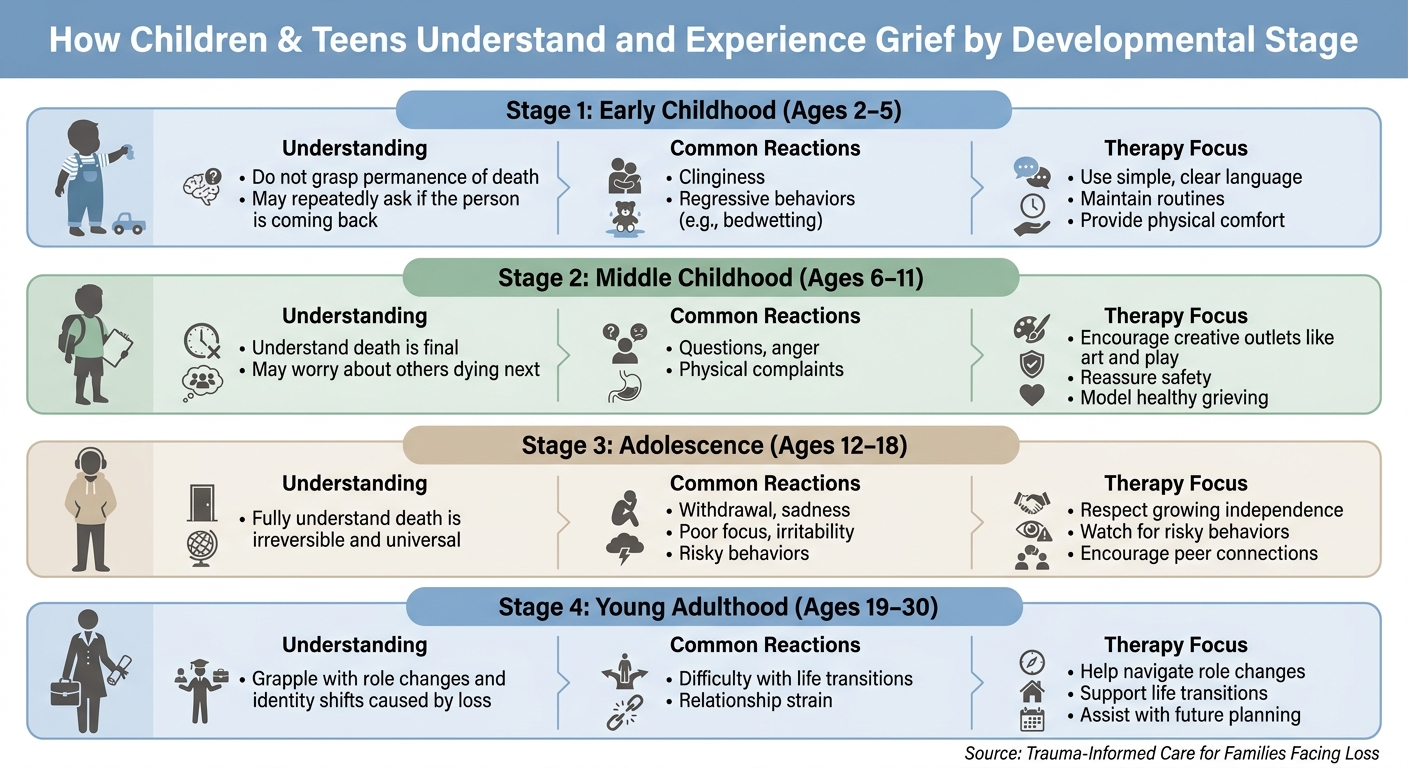
Children’s Understanding of Death by Age: Reactions & Therapy Focus
When the initial shock of loss begins to subside, structured therapy becomes a critical step in the healing process. While grounding techniques and daily routines can offer some stability, addressing deeper relational wounds requires more focused interventions. These approaches aim to mend broken connections and help families rebuild their collective strength.
Rebuilding Attachment and Communication in Families
Grief often creates distance within families. The weight of loss can drive individuals into what therapist Figs O’Sullivan, Founder of Empathi, calls "private oceans of pain" – isolated spaces where suffering separates rather than unites.
"The family is not separated because love failed. The family is separated because grief is heavier than any single body was built to carry alone." [3]
A common dynamic seen in grieving families is the pursue-withdraw cycle, a concept from Emotionally Focused Therapy (EFT). In this pattern, one person seeks connection while another pulls away, not out of indifference but as a survival response. EFT helps families recognize these cycles and uncover the emotions fueling them. Another challenge is the tendency to assign blame during grief, creating narratives like "she’s cold" or "he’s selfish." Therapists guide family members to move beyond these labels and focus on their own vulnerabilities. As O’Sullivan explains:
"You can be right and alone for the rest of your life, or you can be in repair and have a chance at family again. You probably cannot have both." [3]
Tailoring Therapy to Each Family Member’s Needs
Grief affects everyone differently, and this is especially evident across generations. Therapy must adapt to the unique needs of each family member:
| Developmental Stage | Therapy Focus |
|---|---|
| Early Childhood (2–5) | Use simple, clear language, maintain routines, and provide physical comfort |
| Middle Childhood (6–11) | Encourage creative outlets like art and play, reassure safety, and model healthy grieving |
| Adolescence (12–18) | Respect their growing independence, watch for risky behaviors, and encourage peer connections |
| Young Adulthood (19–30) | Help navigate role changes, support life transitions, and assist with future planning |
A key focus is preventing children from quietly stepping into roles left vacant by the deceased, as this can lead to long-term emotional strain [10]. Internal Family Systems (IFS) therapy is particularly effective here, helping individuals explore conflicting internal feelings – such as relief after a loved one’s prolonged illness paired with guilt over that relief. By addressing these emotions, IFS fosters honesty and reduces shame, paving the way for healthier family dynamics [5].
Addressing Anxiety, Depression, and Addiction After Loss
Families dealing with loss often face increased risks of suicide, substance misuse, and domestic violence [10]. When the death is sudden or traumatic, therapies like EMDR (Eye Movement Desensitization and Reprocessing) can help by directly processing painful memories. This reduces their emotional grip and allows the natural grieving process to take its course [5].
Research underscores the importance of structured family interventions. For instance, the Family Bereavement Program (FBP), led by Irwin Sandler at Arizona State University, followed 131 spousally bereaved parents through a 12-session program. Six years later, participants showed significantly lower levels of depression, psychiatric distress, and alcohol misuse compared to those who didn’t participate. Positive parenting improvements were a key factor in maintaining these mental health benefits [9].
The message is clear: early, structured family therapy not only alleviates immediate grief but also builds a foundation for long-term emotional well-being.
Planning for Long-Term Healing and Resilience
Building a Support Network for Ongoing Recovery
The journey of recovery is different for everyone, and having a well-rounded support network can make a world of difference. This network might include a mix of family, friends, faith groups, and professionals – each playing a role in lightening the emotional load.
Shared rituals can be a meaningful way to process grief together. For instance, you could take a weekly walk to share memories or light a candle on important dates. Therapist Figs O’Sullivan, LMFT, of Empathi, captures this idea perfectly:
"When grief has a home, it does not need to take over the whole house." [2]
Another helpful approach for families is updating "Love Maps." This concept, rooted in Gottman research, refers to understanding the evolving emotional needs of loved ones. Alexander Elguren of The Gottman Institute highlights the importance of staying curious:
"Curiosity, in these seasons, tends to serve couples better than certainty." [12]
Rather than making assumptions about how someone is coping, take the time to check in with genuine curiosity. These small efforts can nurture lasting emotional connections. However, it’s also essential to recognize when professional help might be necessary for deeper healing.
Warning Signs That More Clinical Support Is Needed
While a strong support system plays a key role in recovery, there are times when professional intervention becomes critical. Watch for these signs that may indicate a need for clinical support:
- Disruptions in sleep or appetite that last for weeks.
- Emotional numbness or the inability to process feelings related to the loss.
- Difficulty managing daily responsibilities, such as skipping work or neglecting routine tasks.
- Substance use or compulsive behaviors, like overworking or excessive screen time, to avoid dealing with grief [13][11].
- Relational shutdown, where one family member consistently avoids or reacts intensely to discussions about the loss [2].
Another red flag is when family members experience "asymmetrical healing." This happens when one person seems to move forward while another remains stuck in overwhelming grief, creating tension that can quietly strain relationships [2].
Growth and Change Counseling Services for Families

If these warning signs persist despite a strong support system, professional therapy can provide the guidance needed to move forward. Growth and Change Counseling, led by John Mark Kane, LMFT, specializes in trauma-informed family therapy techniques across California – serving areas like Campbell, San Jose, Los Angeles, and Roseville, as well as offering telehealth options. Their services include individual therapy, family therapy, grief counseling, and trauma treatments like EMDR, all within a relational and solutions-focused approach.
The practice emphasizes its commitment to supporting those navigating grief:
"At Growth and Change Counseling, we help you deal with grief in healthy ways by providing an empathetic ear and guiding you towards exploring the impact the events that you went through had on you." [11]
Session rates start at $150 for a 45-minute session with an Associate MFT and $200 for a 45-minute session with a Licensed MFT. Sliding-scale options are available for those with financial constraints. For couples whose relationships have been significantly strained by loss, the Marriage Rescue Institute offers a structured 12-week coaching program designed to rebuild and strengthen partnerships.
Common Questions About Grief and Growth and Change Counseling
How do I know if this is trauma, not just grief?
Grief is a normal reaction to loss, but when a death is sudden, violent, or deeply overwhelming, it can lead to trauma. This might show up as flashbacks, constant alertness, or even physical reactions like a racing heart when something triggers the memory of the event.
If you’re feeling stuck, emotionally numb, or struggling to function, Growth and Change Counseling provides support to help you navigate grief and trauma in a safe way. They offer both in-person and telehealth services throughout California.
What can we do in the first week to feel steadier?
In the immediate aftermath of a sudden loss, it’s crucial to focus on calming your nervous system and addressing your basic needs. Grief takes a physical toll, so make rest, staying hydrated, and eating – even if you don’t feel hungry – a priority. If possible, lean on friends or family to help with practical tasks like handling paperwork or running errands.
To find some balance, consider gentle practices such as breathing exercises, light stretching, or grounding techniques that connect you to the present moment. Therapy, like the kind offered by Growth and Change Counseling, can also provide guidance and support during this difficult time.
When should our family get professional help?
Seeking support from a professional can be crucial when grief becomes too heavy to bear or lingers for an extended period. Watch for signs like deep feelings of hopelessness, emotional numbness, or a sense of being "stuck" for six to twelve months. Other indicators might include disrupted sleep patterns, changes in appetite, withdrawing from others, or struggling with daily responsibilities. If grief is causing tension, mood swings, or isolation within your family, a professional can offer guidance to rebuild emotional bonds and create a safe, compassionate environment for healing together.
Related Blog Posts
- Trauma-Informed Family Therapy Techniques
- Family Therapy for Trauma Recovery: What Works
- How Family Therapy Improves Trauma Communication
- Short-Term Trauma Interventions for Families
