- ADHD and Autism Increase Risk: Adults with ADHD are nearly twice as likely to develop substance use disorders, while 1 in 3 autistic adults struggles with addiction. For those with both conditions (AuDHD), the risk climbs even higher.
- Substance Use as Coping: Many neurodiverse individuals turn to substances not for recreation but to manage sensory overload, impulsivity, or the strain of masking their traits.
- Standard Treatment Gaps: Traditional addiction programs often fail neurodiverse people, relying on rigid schedules, group therapy, and verbal processing that can feel overwhelming or inaccessible.
- Tailored Approaches Work Better: Adjusting therapies to neurodiverse needs – like shorter sessions, sensory-friendly environments, and trauma-focused care – can significantly improve outcomes.
Quick Comparison
| Feature | Standard Treatment | Neurodiverse-Sensitive Care |
|---|---|---|
| Group Therapy | Heavy reliance; often overwhelming | Modified or individual options |
| Environment | Sensory overload common | Designed for sensory comfort |
| Focus | Behavior change | Root causes like trauma and regulation |
| Success Rates (Autistic) | Lower engagement | Higher with tailored methods |
Neurodiverse-sensitive programs offer real solutions but remain less accessible. Addressing this gap requires more specialized training and resources for clinicians. This is especially critical when supporting neurodiverse families dealing with multi-generational trauma.
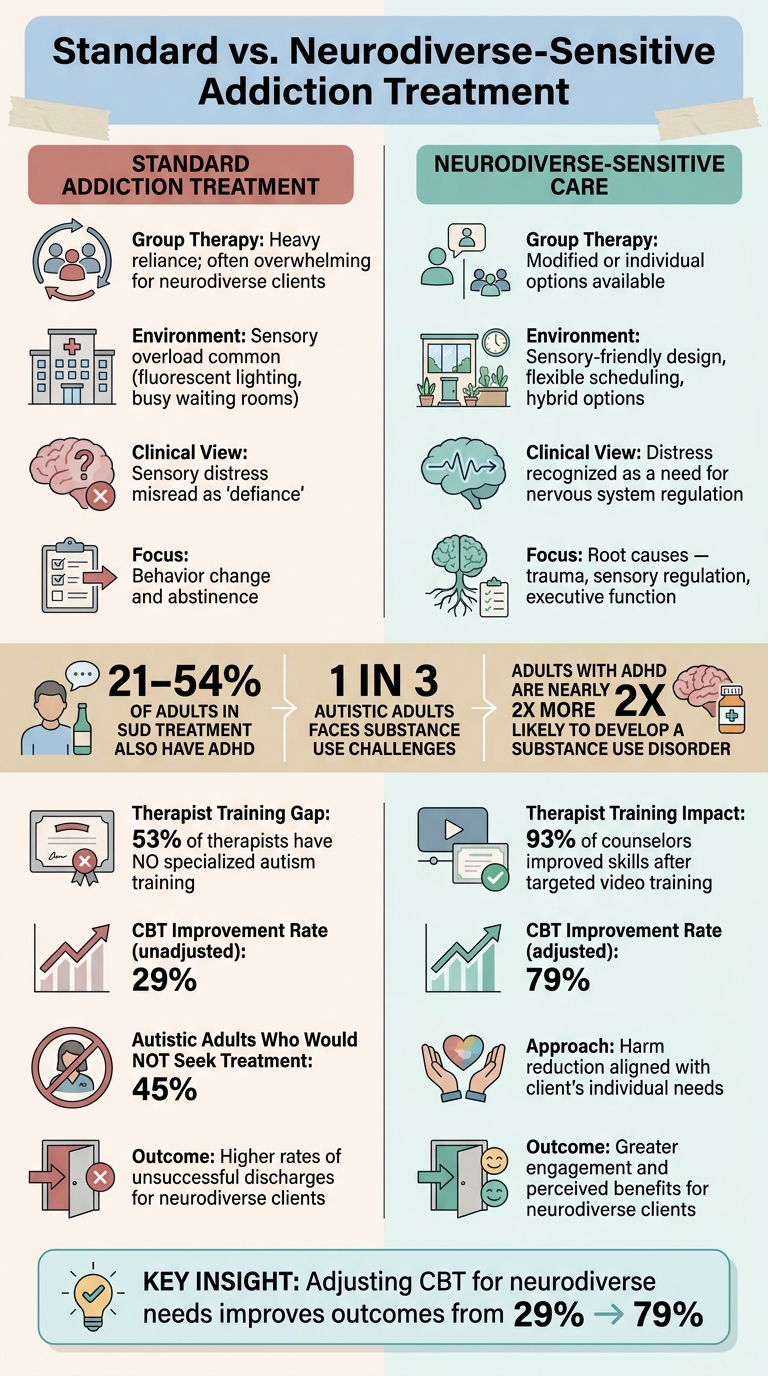
Standard vs. Neurodiverse-Sensitive Addiction Treatment: Key Differences & Outcomes
The Tricky Relationship Between Addiction and Neurodiversity
sbb-itb-596b85d
1. Standard Addiction Treatment Approaches
In the U.S., addiction treatment often follows a uniform model, heavily reliant on group sessions, verbal discussions, and predefined behavioral goals. While this approach may work adequately for neurotypical individuals, it poses significant challenges for those who are neurodiverse.
Effectiveness
The data paints a stark picture of inequality in outcomes. Studies show that treatment results are often less successful for autistic clients compared to others [6]. Shockingly, 53% of therapists admit they have received no specialized training to address autism-specific needs [6]. However, when therapeutic methods like Cognitive Behavioral Therapy (CBT) are adjusted to better align with neurodiverse requirements, improvement rates soar – from 29% to 79% [7]. This gap highlights how much potential is being overlooked in standard treatment formats.
"The focus stays on stopping the behavior, without addressing the underlying regulation issues driving it." – Brandi Ganz, Lead Editor, Recovery Unplugged [4]
These disparities emphasize the pressing need to rethink and adapt traditional approaches.
Accessibility
The physical and procedural aspects of treatment environments can be overwhelming for neurodiverse individuals. Factors like fluorescent lighting, busy waiting rooms, rigid schedules, and the expectation of quick verbal responses often create sensory overload before therapy even begins [7][8]. For individuals with alexithymia – difficulty identifying and describing emotions – verbal therapy can feel nearly impossible [4][9]. This isn’t about resistance; it’s about a mismatch between the individual’s neurological needs and the treatment format.
"A protocol may be strong in the research literature, but if the session format assumes quick verbal processing, tolerance for sensory load, or a ‘good patient’ style built around eye contact and fast emotional labeling, some people will spend most of therapy trying to survive the format instead of using it." – Dr. Kiesa Kelly, Clinical Psychologist and Founder, ScienceWorks Behavioral Healthcare [8]
These environmental and procedural barriers often prevent neurodiverse individuals from fully engaging with therapy.
Fit for Neurodiverse Needs
Standard addiction treatment frequently misinterprets neurodiverse behaviors. For example, a client stepping away from an intense group discussion might be labeled as "avoidant" or "resistant", when in reality, they could be experiencing sensory overload or burnout [8]. Such misjudgments can erode trust, discouraging individuals from seeking help. This might explain why 45% of autistic adults who recognize an issue with alcohol use report they would not seek professional treatment [6].
Impact on Relationships
Group therapy, a cornerstone of many addiction programs, often proves particularly challenging for neurodiverse individuals. The social and sensory demands of group settings can lead to exhaustion rather than connection [6]. In response, clients may mask their true feelings or experiences to meet counselors’ expectations, which, over time, undermines both the therapeutic relationship and the recovery process [9]. These issues highlight the urgent need for approaches that genuinely accommodate neurodiverse needs.
| Challenge | Impact in Standard Treatment |
|---|---|
| Sensory sensitivity | Overload from clinical environments leads to disengagement [6][11] |
| Alexithymia | Difficulty naming emotions makes verbal therapy feel impossible [4][9] |
| Social masking | Exhaustion from appearing "normal" increases relapse risk [4][11] |
| Executive function | Rigid schedules are misinterpreted as "non-compliance" rather than a neurological barrier [4][11] |
2. Neurodiverse-Sensitive Treatment Approaches
Traditional treatment programs often expect neurodiverse individuals to conform to a set framework. Neurodiverse-sensitive care flips this approach, tailoring programs to fit the individual’s unique needs. This shift redefines how assessments are conducted, sessions are structured, and progress is measured.
Effectiveness
For neurodiverse individuals, trauma and addiction are often closely linked. These approaches start by refining assessments to address this connection. Instead of diving straight into behavioral goals, clinicians perform detailed evaluations that consider executive functioning, sensory profiles, alexithymia (difficulty identifying emotions), and even aphantasia (difficulty visualizing mentally). Addressing these factors early helps prevent triggers from escalating into crises [3].
One major shift is the understanding of addiction. It’s not seen as a moral failing but as a response from the nervous system. As Matt Finch, Founder of Strategic Recovery, puts it:
"Addiction rarely begins as recklessness. It begins as regulation – a relief strategy for overstimulation, intensity, and no instruction manual." [12]
Therapies like EMDR (Eye Movement Desensitization and Reprocessing) are particularly effective here. By engaging sensory input and internal processing, it addresses trauma in ways that traditional talk therapy often cannot. Adaptations to EMDR for sensory and visualization differences make it even more effective for neurodiverse individuals [1].
Accessibility
The format of therapy sessions is just as important as the content. Neurodiverse-sensitive programs typically offer shorter, more focused sessions, flexible scheduling, and hybrid options (both in-person and virtual). These adjustments help reduce sensory overload and logistical challenges that might otherwise discourage participation [4][10]. Communication is simplified – avoiding abstract language or rapid verbal exchanges – and supported with written or visual aids [4][6].
In November 2025, Fraser, a nonprofit based in Minnesota, launched a specialized substance use disorder program tailored for neurodiverse individuals. This program replaces rigid group rules with personalized guidelines and focuses on harm reduction to lower rates of unsuccessful discharges. Jessie Morriss, SUD Program Manager at Fraser, explains:
"Over the years, the highest rate of unsuccessful discharges I saw were with people on the autism spectrum… We don’t try to fit people into a box here." [10]
This focus on accessibility creates an environment where neurodiverse strengths can be recognized and utilized.
Fit for Neurodiverse Needs
Rather than treating neurodiverse traits as problems, these approaches build on them. For example, high sensation-seeking behaviors can be redirected into structured physical challenges or creative outlets. Matt Finch describes this as replacing "imposed" intensity with "earned" intensity [12].
Executive function coaching is another key element, especially for individuals with ADHD or autism. This coaching helps develop planning and task-management skills needed to maintain recovery [3]. Additionally, tools like Internal Family Systems (IFS), or "Parts Work", help individuals identify and understand protective responses that might otherwise be seen as resistance in traditional treatment models [9]. Aligning treatment with neurodevelopmental profiles helps address both trauma and addiction more effectively.
Impact on Relationships
Relationships are often strained by addiction, and standard group therapy can sometimes make things worse for neurodiverse individuals. Neurodiverse-sensitive programs include support for rebuilding these connections. Couples and families are taught co-regulation strategies – practical ways to stabilize two nervous systems during moments of stress [13].
Research backs this up: Patients who participate in Behavioral Couples Therapy (BCT) for addiction report greater reductions in substance use and improved relationship satisfaction compared to those in individual therapy [13]. For neurodiverse individuals, who often face communication challenges and the exhausting burden of masking, this relational support is vital for long-term recovery.
At Growth and Change Counseling, specialized care for addiction and neurodiverse relationships is available throughout California, with telehealth options for those seeking flexible, accessible support.
Comparing Treatment Approaches at Growth and Change Counseling
Weighing the advantages and limitations of each approach is crucial when aiming to improve treatment outcomes for trauma and addiction in neurodiverse individuals. While standard addiction treatment provides broad, research-backed frameworks, its effectiveness often falls short for neurodiverse individuals. For instance, statistics reveal that 21%–23% of individuals with substance use disorder (SUD) also have ADHD [2], and autistic clients face notably lower success rates [6].
"Neurodivergent individuals are often labeled as treatment resistant when, oftentimes, treatment has been resistant to them." – Christina Bradley, MS Ed., Gateway to Solutions [1]
Neurodiverse-sensitive approaches tackle these challenges head-on but introduce their own hurdles. These methods demand more specialized clinician training, adaptable resources, and tailored planning – elements that are difficult to scale. A 2026 study on the SkillFlix for SUD Counselors prototype, developed by dfusion and Dr. Laura Graham Holmes, highlighted this gap. It found that 93% of counselors improved their skills after targeted video training that focused on identifying sensory sensitivities and implementing neurodiverse-affirming practices, underscoring that while the training gap is real, it is also addressable [5].
The table below provides a side-by-side comparison of the key features and outcomes of each approach:
| Feature | Standard Addiction Treatment | Neurodiverse-Sensitive Approach |
|---|---|---|
| Availability | Widely accessible | Still relatively rare [2][10] |
| Sobriety Goal | Often requires total abstinence [10] | Focuses on harm reduction; aligns with the client’s needs [10] |
| Group Work | Heavy reliance on group therapy [6] | Acknowledges group settings can be overwhelming; offers individual or modified options [6][10] |
| Clinical View | Sensory distress may be misinterpreted as "defiance" [5] | Recognizes distress as a need for regulation [5] |
| Outcome Perception | Higher rates of "unsuccessful discharges" for neurodiverse clients [10] | Greater engagement and perceived benefits for neurodiverse clients [10] |
The main trade-off is clear: standard treatments are widely available but often unsuitable for neurodiverse individuals. In contrast, neurodiverse-sensitive approaches are better tailored to individual needs but remain less accessible. As Aric Jensen, Vice President for Behavioral Health at Fraser, explained:
"What it comes down to is we are serious about creating a culture that normalizes people showing up in whatever way feels comfortable for them to be able to fully participate." [10]
Conclusion
Traditional addiction treatment often misses the mark for neurodiverse individuals. Studies show that between 23% and 54% of adults in substance use disorder treatment also have ADHD [3], and about 1 in 3 autistic adults may face substance use challenges [5]. These statistics highlight how many people seeking help are underserved by generalized, one-size-fits-all approaches.
A more effective solution lies in integrated, trauma-informed care tailored to neurodiverse needs. This model shifts the focus from viewing addiction as a behavioral issue to understanding it as a way of managing an overstimulated nervous system. As Matt Finch, Founder of Strategic Recovery, explains:
"You didn’t need thicker skin. You needed language. You were never defective – you were wired. And wiring can be trained." [12]
This perspective informs practical changes in treatment. Instead of labeling addiction as a failure of willpower, this approach recognizes it as a response to dysregulation, aligning care with the lived experiences of neurodiverse individuals. It starts with thorough assessments that consider executive functioning, sensory needs, and trauma history. Therapy environments and pacing are adjusted to match each person’s abilities, while families gain tools to better understand and support their loved ones.
FAQs
How can I tell if my substance use is actually a coping strategy for sensory overload or masking?
Substance use can sometimes become a way for individuals to cope with overwhelming situations or the fatigue that comes from masking. This might look like using substances to dull sensory overload in loud, bright, or crowded spaces, ease social anxiety, suppress natural behaviors to blend in, or recover from the exhaustion of constantly monitoring one’s actions. Growth and Change Counseling provides trauma-informed care, offering personalized support to help navigate and address these challenges effectively.
What should I ask a rehab or therapist to confirm they’re neurodiverse-affirming and trauma-informed?
To find out if a therapist or rehab program is genuinely supportive of neurodivergent individuals and trauma-informed, consider asking these key questions:
- How do you adjust your approach for neurodivergent clients? Check if they use flexible methods and create sensory-friendly environments.
- Do you address co-occurring conditions simultaneously? Make sure they handle trauma and addiction together while considering neurodivergent needs.
- How do you approach masking or social misattunement? Confirm they recognize these behaviors as adaptive strategies rather than signs of resistance.
Growth and Change Counseling provides customized, integrative therapy for trauma, addiction, and neurodiverse relationships throughout California.
What are practical accommodations that make addiction treatment easier for ADHD, autism, or AuDHD?
Effective addiction treatment for neurodiverse individuals focuses on personalized and adaptable care rather than one-size-fits-all approaches. This often means offering accommodations like one-on-one sessions to address sensory sensitivities or difficulties with engagement. Treatment plans are also adjusted to fit each person’s unique communication style.
For individuals with ADHD, approaches such as psychoeducation and behavioral therapy are particularly effective. Meanwhile, autism-affirming care emphasizes sensory awareness, clear communication, and collaborative efforts to ensure all needs are met. Growth and Change Counseling provides therapy specifically designed to address the intersection of neurodiversity, trauma, and addiction recovery, ensuring support is tailored to each individual’s journey.
Related Blog Posts
- Trauma, Addiction, and Neurodiverse Relationships
- Trauma Recovery in Neurodiverse Relationships: 7 Steps
- Trauma vs. Neurodiversity: Key Counseling Differences
- Trauma and Self-Esteem in Neurodiverse Kids
