Parents of neurodiverse children often face significant challenges when advocating for their kids in schools, largely due to trauma caused by exclusion, judgment, and misunderstanding. This trauma affects both children and parents, making advocacy emotionally and cognitively overwhelming. Key takeaways include:
- Trauma’s Impact on Families: Neurodivergent children experience higher rates of trauma, often leading to anxiety, mistrust, and avoidance behaviors. Parents, in turn, face burnout, depression, and difficulty navigating school systems.
- Barriers to Advocacy: Emotional distress, cognitive overload, and systemic biases hinder parents’ ability to secure accommodations.
- Effective Support Strategies: Trauma-informed counseling, parent coaching, and collaborative advocacy plans help families manage stress, build resilience, and improve school interactions.
Addressing trauma can transform advocacy efforts, enabling families to support their children more effectively in educational settings.
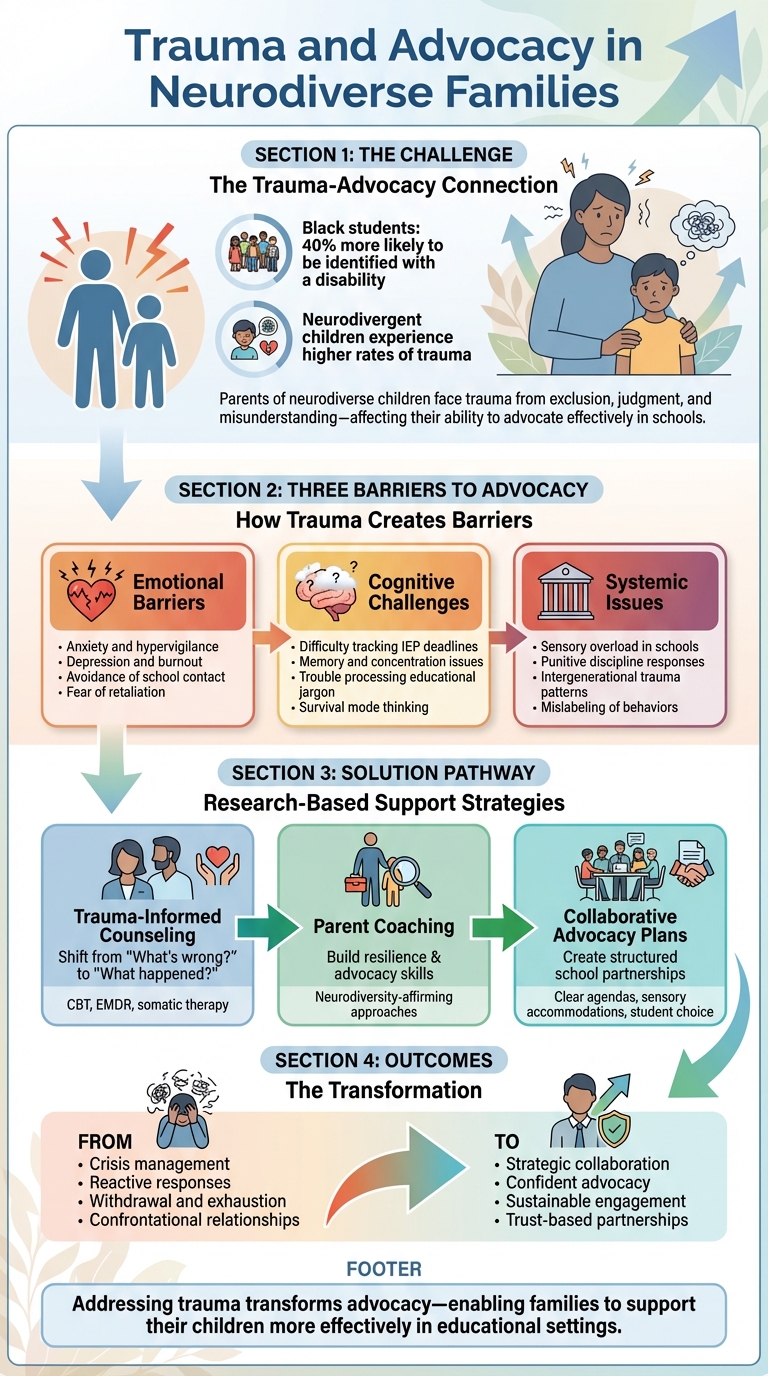
How Trauma Affects Advocacy in Neurodiverse Families: A Visual Guide
How Trauma Affects Advocacy Efforts
Emotional and Mental Health Barriers
Parents with a history of trauma often approach IEP meetings or school conferences bracing for conflict. Their bodies respond with anxiety, hypervigilance, and heightened emotions, interpreting even neutral comments as potential threats due to a heightened stress response[1][4]. For example, one parent might avoid answering school calls entirely because the sound of the phone triggers a flood of panic tied to past crisis situations. This avoidance can lead to missed opportunities for collaboration[5][7]. Another parent might withdraw during meetings, offering minimal eye contact and quickly agreeing to plans – even when those plans fall short of their child’s needs – just to escape the discomfort of the interaction[4][7].
For many caregivers of neurodivergent children, the chronic stigma, blame, and misunderstanding they face adds layers of ongoing trauma[1][2]. Over time, this can lead to feelings of depression, hopelessness, and burnout, making it even harder to navigate the complex advocacy process. Some parents, after repeated denials or dismissals of their requests, disengage entirely. They may oscillate between aggressively challenging the system and withdrawing for months, worn down by shame, exhaustion, or fear of retaliation[2][4][7]. Beyond the emotional toll, trauma also impacts the mental clarity and focus needed for effective advocacy.
Cognitive and Decision-Making Challenges
Trauma doesn’t just stir emotions – it disrupts the very cognitive abilities parents rely on during advocacy. Concentration, working memory, and executive functioning often suffer, making it harder to keep track of IEP deadlines, compare draft plans to final versions, or organize crucial documents like evaluations and behavior logs[5][7]. In high-stress situations, the brain shifts into survival mode, limiting the ability to think creatively, ask strategic questions, or weigh the pros and cons of different service options presented by school teams[4][7].
Sleep disturbances and fatigue, both common among trauma survivors, add to these challenges. The resulting mental fog makes it nearly impossible to process educational jargon, service plans, or data charts during lengthy meetings – all while battling physical symptoms like a racing heart or tense muscles. This overload can lead some parents to agree to school recommendations just to end the distress, potentially delaying evaluations or services their child urgently needs[2][7]. These struggles highlight how deeply trauma can interfere with the advocacy process.
Research Findings on Trauma and Advocacy
Studies published in respected journals highlight the high levels of trauma and chronic stress experienced by caregivers of autistic children. These challenges are linked to increased mental health struggles and the heavy burden of caregiving[4][7]. Parents frequently report intense parenting stress, invalidating or stigmatizing interactions with professionals, and repeated negative experiences with schools – patterns that align with cumulative, relational trauma. These stressors often lead to reduced participation in school activities, strained relationships with educators, and dissatisfaction with educational services[4][7].
Although many studies focus on stress rather than trauma specifically, the evidence points to a strong connection between caregiver psychological distress and difficulties navigating special education systems. This research underscores the importance of trauma-informed, family-centered advocacy support. Shifting the narrative from "What’s wrong with you?" to "What happened to you?" can help parents feel understood rather than judged in school settings[1]. Services like Growth and Change Counseling (https://johnmarkkane.com) provide individual and family therapy, parent coaching, and specialized trauma treatment. These resources aim to help caregivers process past school-related trauma, improve co-parent communication, and develop self-regulation techniques like grounding and paced breathing – essential tools for staying engaged and effective throughout the demanding U.S. special education process.
How Trauma Works Differently in Neurodiverse Families
Sensory Overload and Trauma
For children with autism or ADHD, everyday school environments can feel like an ongoing assault on their nervous systems[1][6]. Imagine loud bells ringing, crowded hallways buzzing with chatter, glaring fluorescent lights, and the unexpected touch of a passing student. These aren’t just annoyances – they can repeatedly activate fight-or-flight responses, embedding themselves as trauma over time[1][4][6]. For example, an autistic child who has been restrained during a meltdown might later panic at the sound of a staff member’s voice or the click of a door lock – sensory cues that recall the original harm[4]. Unlike the classic PTSD flashbacks we often hear about, these trauma responses can look very different. They might show up as shutdowns, emotional explosions after school, increased stimming, or behaviors that teachers mistakenly label as "school refusal"[4][6][8].
The relationship between sensory processing and trauma creates a vicious cycle. Trauma heightens sensory sensitivities, making ordinary stimuli feel unbearable, while sensory overload leaves these children more vulnerable to experiencing further trauma[4][6][10]. For ADHD students, difficulties with impulse control and regulating emotions often lead to highly visible reactions, like running away or having outbursts. Unfortunately, disciplinary actions in response to these behaviors can make things worse[5]. Trauma-informed educators are beginning to understand that punishing sensory-driven behaviors – like covering ears, leaving the room, or stimming – doesn’t just fail to address the root cause. It piles on relational trauma and shame, compounding the sensory trauma itself[1][4][8].
But sensory triggers aren’t the whole story. Trauma in neurodiverse families often carries a deeper, generational weight.
Intergenerational Trauma in Neurodiverse Relationships
In neurodiverse families, trauma frequently spans generations, rooted in shared experiences of institutional harm and misunderstanding[1][2][3]. Autistic or ADHD parents often recall being punished as children for traits their kids now exhibit – things like sensory sensitivities, struggles with executive functioning, or social differences[1][4]. Many of these adults carry vivid memories of being bullied, excluded from general education settings, or forced into compliance-based programs. When they see similar patterns happening to their children, their advocacy can become understandably urgent, and sometimes mistrustful or avoidant[1][2][4]. These intergenerational dynamics not only shape how families respond to trauma but also complicate their interactions with school systems.
When neurodivergence goes unrecognized or unsupported, parents often internalize advocacy challenges as personal failures rather than systemic issues[1][2][3]. For instance, difficulties with executive functioning, sensory overload during meetings, or struggles with social communication can make navigating IEP processes overwhelming[2][9]. Compounding this, many parents have been conditioned to doubt their perceptions, believing professionals "know better", because they were taught to see their learning or social differences as flaws[1][3]. For parents who receive a late diagnosis or come to self-identify as neurodivergent, this realization can be a double-edged sword. Past experiences in school or work often take on a new light, reinterpreted as traumatic. This can spark a mix of grief, anger, and relief, all of which require thoughtful support to channel into effective advocacy.
Growth and Change Counseling (https://johnmarkkane.com) offers trauma treatment, family therapy, and parent coaching tailored to neurodiverse relationships. Their approach helps parents separate past trauma triggers from present realities, providing tools to break intergenerational cycles. By validating the harm caused by institutions, teaching regulation strategies for neurodivergent needs, and creating a safe space to practice advocacy, these services empower families to navigate challenges with greater confidence and clarity. This highlights the importance of customized support for neurodiverse families in school advocacy settings.
Research-Based Strategies for Supporting Advocacy
Trauma-Informed Counseling Approaches
Trauma-informed counseling shifts the focus from asking, "What’s wrong with you?" to "What happened to you?" This perspective is especially valuable for neurodiverse families navigating school systems, where children’s behaviors are often misunderstood as defiance rather than responses to trauma. By prioritizing principles like safety, trust, collaboration, empowerment, voice, and choice, these approaches create environments that encourage healing instead of triggering further trauma.
For neurodivergent students dealing with sensory overload, exclusion, or punitive discipline, trauma-informed therapies such as Cognitive Behavioral Therapy (CBT) can help develop coping skills and improve self-esteem. When parents start viewing their child’s behaviors as communication shaped by stress or trauma, they can move away from reactive responses rooted in their own negative school experiences. Instead, they can become more informed advocates for accommodations that meet their child’s needs. This shift not only improves emotional regulation and reduces anxiety but also helps children engage more confidently in educational planning. Parent coaching models build on these therapeutic strategies, providing practical tools for advocacy.
Parent Coaching Models
Parent coaching programs take a neurodiversity-affirming approach, helping parents understand trauma responses, build resilience, and secure appropriate school accommodations. Research highlights the benefits of these programs, including reduced parental stress, stronger family relationships, and improved collaboration with schools. A central element of these models is promoting choice and autonomy for children – allowing them to decide how much they want to participate or when they need breaks. This approach counters compliance-based methods that can unintentionally retraumatize neurodivergent children.
These programs also tackle systemic biases. For instance, Black students are 40% more likely to be identified with a disability than their peers[2]. Parent coaching helps families recognize when behaviors are mislabeled, empowering them to advocate for support that emphasizes a child’s strengths rather than focusing solely on deficits. Practical strategies, like setting predictable routines, offering sensory-friendly spaces, and viewing meltdowns as communication, make advocacy more effective and compassionate.
Specialized Counseling Services
Specialized counseling services combine trauma-informed practices and parent coaching to further support neurodiverse families. Growth and Change Counseling, for example, offers trauma-informed therapy and coaching tailored to the unique needs of these families. Operating across California through in-person and telehealth sessions, their solutions-focused approach addresses both relational and emotional challenges tied to school advocacy.
Therapists like Arione Capolupo, LMFT, who specializes in Autism Spectrum Disorder and Applied Behavioral Analysis, and April Silva, LMFT, who uses Cognitive Behavioral Therapy, attachment theory, somatic therapy, and EMDR, provide targeted support for complex trauma and dissociation. The practice acknowledges school trauma as a widespread issue, particularly for children with ADHD, ODD, and Asperger’s, and understands the struggles parents face in navigating school systems.
Their parent coaching services aim to help families regain authority, strengthen relationships, and address behaviors often rooted in unacknowledged trauma. By teaching regulation strategies tailored to neurodivergent needs and fostering safe spaces for advocacy, Growth and Change Counseling equips families to break intergenerational cycles and face educational challenges with clarity and confidence.
sbb-itb-596b85d
Practical Applications and Research Needs
School-Based Advocacy Strategies
Families can create a collaborative advocacy plan that outlines their child’s sensory and emotional triggers, preferred regulation techniques, and communication needs. Sharing this plan with the IEP or 504 team ensures that meetings remain focused on effective strategies[1][2]. To further support this process, parents can request structured meetings with clear agendas, scheduled breaks, and opportunities for written input. This approach helps reduce stress and avoids re-traumatization for both caregivers and students[1][2].
Schools can also adopt co-advocacy training, bringing together educators, school counselors, and caregivers to develop a shared understanding of concepts like sensory overwhelm, masking, hypervigilance, and trauma-informed communication[2][9][10]. Using unified language and expectations fosters collaboration. Trauma-sensitive educational plans should include predictable routines, visual schedules, quiet or low-sensory spaces, and options for how students participate. These strategies promote safety and self-regulation for neurodivergent learners[1][2][6][10]. For example, students could help design their accommodations, such as selecting seating arrangements, creating break signals, or adapting assignment formats. These choices can then be formally incorporated into IEPs or 504 plans[1][2][5].
To address school-induced trauma, punitive responses to absences or challenging behaviors need to be replaced with approaches that view "school refusal" as a signal of distress requiring adjustments in the environment[2][8]. Gradual re-entry plans that respect the student’s pace, allow partial school days, and emphasize relationship-building before academics can help restore a sense of safety[5][8]. When external providers like Growth and Change Counseling are involved, coordinated care plans can align therapeutic goals with school strategies, creating a consistent support system for the student[1][2].
While these strategies show promise, there is still much to learn through further research.
Research Gaps
Despite the availability of actionable strategies, there is limited research on their long-term impact. For instance, there’s a lack of longitudinal studies examining how trauma histories influence advocacy patterns, educational outcomes, and mental health for neurodivergent students and their families[2][4][10]. Additionally, research often fails to address the intersections of race, disability, and socioeconomic status. This omission is critical, as biases – such as Black students being 40% more likely to be identified with a disability – intersect with trauma and advocacy experiences[2].
Few studies have systematically evaluated trauma-informed, neuro-affirming school models to determine their effects on advocacy success, family–school relationships, and post-school outcomes[2][9][10]. Similarly, there’s limited evidence on interventions for school-induced trauma or on how to support neurodivergent parents and caregivers, particularly those who are also trauma survivors, in sustaining advocacy efforts[5][8].
Future research should prioritize developing and testing trauma-informed, neurodivergent-affirming advocacy training for educators, school counselors, and families, with a focus on scaling these programs for public schools[2][9][10]. Comparative studies between traditional special education models and inclusive, trauma-informed approaches could shed light on how different environments impact cumulative trauma and the advocacy burden on families[2][10]. Research into community–school partnerships involving trauma and neurodiversity specialists could also reveal the most effective ways to coordinate support across home, school, and clinical settings[1][2][5].
Bridging Brains and Hearts: Trauma and Neurodiversity
Finding Support Through Growth and Change Counseling
Unresolved trauma can significantly hinder advocacy efforts, eroding confidence and reducing effectiveness. When fear, withdrawal, and exhaustion take the place of clarity and persistence, families often find it difficult to navigate the complexities of educational systems. For neurodivergent children, school itself can be a source of trauma, marked by exclusion and the mislabeling of behaviors. These struggles frequently extend to their families, particularly during challenging IEP meetings[1][2].
Addressing these challenges requires a shift in approach. Tackling trauma not only alleviates its symptoms but also lays the groundwork for more sustainable advocacy[2]. Trauma-informed, neurodiversity-affirming strategies focus on understanding individual needs rather than attempting to "fix deficits." By prioritizing safety and trust, these approaches empower families to advocate from a place of strength rather than crisis. When schools and families emphasize psychological safety, predictability, and collaborative problem-solving, advocacy becomes less confrontational and far more effective[1][2].
Specialized counseling services, such as those provided by Growth and Change Counseling (https://johnmarkkane.com), offer families the tools to process chronic stress, manage emotions, and engage with schools more confidently. These services address the root causes of anxiety, depression, and relational challenges that often accompany advocacy struggles. With the right resources, families can better navigate the educational system and advocate for their children’s needs effectively[1][11].
When trauma is acknowledged and addressed through coordinated efforts across home, school, and clinical settings, families can transition from reactive crisis management to strategic, values-driven collaboration. This shift benefits everyone involved, creating a more constructive and supportive environment for advocacy. While there are still gaps in research – particularly regarding long-term outcomes – the strategies currently available provide a meaningful way forward for neurodiverse families striving to meet their children’s needs[2].
FAQs
How does trauma-informed counseling support neurodiverse families in advocating for their children at school?
Trauma-informed counseling provides neurodiverse families with a safe space to work through past trauma while strengthening emotional resilience. It gives parents and caregivers practical tools for better communication and strategies to approach school systems with more confidence and understanding.
By tackling the emotional and relational challenges linked to trauma, families can more effectively advocate for their children, build stronger partnerships with educators, and ease the stress that often accompanies these interactions.
What challenges do neurodiverse families face when advocating for their children in schools?
Families with neurodiverse children often face an uphill battle when navigating the education system to ensure their kids get the support they need. One major hurdle is communication challenges – parents may find it tough to clearly articulate their child’s specific needs or advocate effectively. On the flip side, school staff may lack a solid understanding of neurodiversity, which can result in inadequate accommodations or missed opportunities to provide meaningful support.
Beyond these interpersonal struggles, broader systemic problems add to the burden. Many schools simply don’t have enough resources to meet every student’s needs, leaving families feeling like they’re constantly fighting an uphill battle. On top of that, the emotional strain of repeatedly advocating for their child can take a significant toll on parents and caregivers. Addressing these obstacles is key to creating a more welcoming and supportive environment for neurodiverse students.
How does intergenerational trauma impact neurodiverse families’ ability to advocate in schools?
Intergenerational trauma can deeply impact how families advocate for their neurodiverse children in schools. Emotional scars from past experiences often create obstacles to open communication, making it challenging for families to navigate the often-complicated education system or establish trust with teachers and school administrators.
These emotional hurdles can spiral into frustration, mistrust, or even withdrawal, which might reduce the level of support a neurodiverse child receives. By identifying and addressing these challenges, families can strengthen their ability to advocate and build more collaborative relationships with schools.
Related Blog Posts
- Trauma, Addiction, and Neurodiverse Relationships
- Q&A: Supporting Neurodiverse Couples with Mental Health Issues
- Trauma Recovery in Neurodiverse Relationships: 7 Steps
- Trauma Therapy for Immigrant Families: Challenges
