Relapse and recovery are not the same parenting problem. In relapse, the first concern is usually child safety, supervision, routines, and judgment. In recovery, the work shifts to trust, emotional repair, honesty, and steady follow-through.
If I had to sum up the whole article in a few lines, I’d put it this way:
- Relapse often leads to less supervision, harsher discipline, more conflict, and broken routines.
- Recovery is about showing change through repeated actions, not promises.
- Children still need the same things in both phases: safety, structure, and clear communication.
- Research cited in the article links active substance use with more neglect risk, slower response to a child’s distress, and more family strain.
- In the short term, families may need backup caregiving plans, school coordination, and firm rules about substance use at home.
- In the long term, repair often depends on steady routines, honest talks, co-parenting in recovery, therapy, and parent coaching.
The core point is simple: relapse calls for crisis steps, while recovery calls for repair steps.
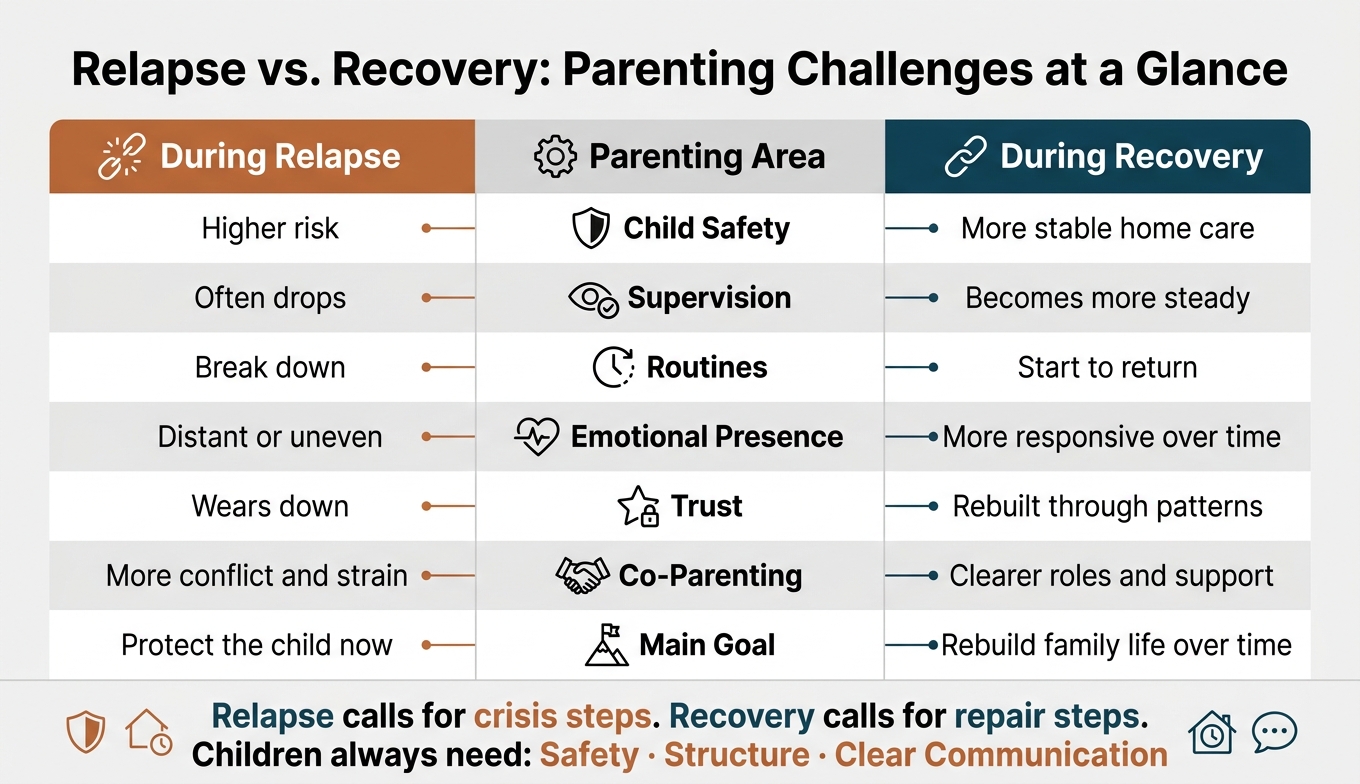
Relapse vs. Recovery: Parenting Challenges Side-by-Side
Parenting in Recovery
For families facing severe strain, intensive therapy for couples in crisis can provide the focused support needed to rebuild trust.
sbb-itb-596b85d
Quick Comparison
| Area | During Relapse | During Recovery |
|---|---|---|
| Child safety | Higher risk | More stable home care |
| Supervision | Often drops | Becomes more steady |
| Routines | Break down | Start to return |
| Emotional presence | Distant or uneven | More responsive over time |
| Trust | Wears down | Rebuilt through patterns |
| Co-parenting | More conflict and strain | Clearer roles and support |
| Main goal | Protect the child now | Rebuild family life over time |
If you’re reading this as a parent, partner, or caregiver, the main question is not “Are things better in theory?” It’s “What does the child need today?” That answer changes a lot depending on whether the home is in relapse or recovery.
Parenting During Relapse: What Gets Harder at Home
During relapse, the first things to slip are usually safety and structure. Home life can change fast: routines fall apart, follow-through gets shaky, and kids pick up on it almost right away.
How Relapse Affects Supervision, Routines, and Judgment
One of the earliest changes is reduced supervision. Children often end up with less day-to-day oversight, and simple routines like meals and bedtimes can become inconsistent [3].
That gap can be hard to spot from the outside because the parent may still be in the house. But being physically present isn’t the same as being emotionally available. There’s a brain-based side to this too: parents in active addiction have been shown to respond more slowly to a child’s cries and have trouble reading different levels of a child’s distress [1].
Judgment also starts to shift. Discipline may move away from calm, steady responses and toward harsher, fear-based reactions. In relapse, parents often lose the ability to respond with consistency and self-control, and children feel that change fast [3].
How Children Respond to Instability at Home
When routines keep changing and promises aren’t kept, trust starts to wear down. Some children grow anxious or pull back. Others react with aggression or impulsive behavior. Research shows these responses are more common in homes affected by active substance use [3].
Kids often sense what’s happening before they have the words to explain it. They may not say, "Things feel unstable." But they show it in their mood, behavior, and need for reassurance.
How Relapse Strains Co-Parenting and Marriage
Relapse also puts pressure on the adults in the home. The sober partner may face challenges like covering missed pickups, broken commitments, and more of the daily care work. At the same time, conflict tends to build. Tension between adults can keep simmering instead of settling down cleanly [3].
Money problems can make things worse. Addiction-related spending can throw off a household budget fast, which adds stress to an already strained home [3]. And when adults are stretched that thin, steady and emotionally present parenting gets a lot harder.
Relapse breaks the structure children count on. Recovery means putting that structure back piece by piece, with trust and consistency at the center.
Parenting During Recovery: What Rebuilding Requires
Sobriety is a big step, but trust at home usually comes back slowly. Children who lived through active use may still seem guarded, and that’s a normal response. Family instability can shake a child’s sense of safety and trust. In recovery, trust comes back through steady behavior over time. After safety starts to return, the work moves toward repair.
Rebuilding Trust Through Consistency and Honesty
Children believe patterns, not promises. Showing up for school pickups, keeping bedtime routines, and following through on small daily commitments does more to rebuild trust than one talk about change [1][3].
Children rebuild trust through repeated, reliable behavior, not reassurance.
Age-appropriate honesty matters too. Be honest without saying too much: name what happened, avoid false promises, and use words a child can grasp.
Taking clear responsibility helps a child feel grounded again. It shows that the parent sees what happened and isn’t asking the child to act like nothing went wrong.
Once trust starts to come back, the next step is rebuilding emotional closeness.
Restoring Emotional Connection With Children
Early recovery can feel emotionally far away. Addiction can make it harder to read a child’s cues, and that skill often comes back little by little [1].
Use calm, one-on-one talks, and let children express anger, confusion, or fear without correcting them or putting blame back on them. A child who saw a parent miss family events, break promises, or seem emotionally absent may carry real resentment. That resentment needs room.
These habits also help protect recovery by making day-to-day parenting steadier.
Protecting Progress With Relapse-Prevention Habits
Parenting in recovery is easier to keep up when the parent’s own day-to-day functioning is steady. Self-care matters because it can lower relapse risk and reduce parenting stress [2].
Parent coaching and family therapy can help parents stay consistent, handle stress, and respond more calmly at home. Therapy, parent coaching, and family support – such as what is available through Growth and Change Counseling – can reduce parenting stress and make recovery routines easier to keep going. Structured daily routines also help bring back predictability for children [3].
These recovery habits differ from relapse-day parenting, which is why the next section compares the two side by side.
Relapse vs. Recovery: A Side-by-Side Parenting Comparison
The same parenting jobs can feel like two different worlds in relapse and recovery. On paper, the tasks may look identical. In daily life, they don’t play out the same way.
Comparison Table: Daily Parenting Realities in Each Phase
| Parenting Task | Relapse Phase | Recovery Phase |
|---|---|---|
| Emotional Climate | Emotional distance and more conflict; emotionally absent parents [3] | Rebuilding emotional attunement [1][4] |
| Caregiving Consistency | Missed pickups, broken promises, disrupted daily routines [5] | Reliable transportation, consistent follow-through, restored household structure [5] |
| Child Safety | Less supervision; higher neglect risk [3] | More predictable home safety [2] |
| Parental Availability | Slower response to a child’s distress; emotional distance [1] | Increased emotional availability and responsiveness to the child’s distress [1] |
| Co-Parenting Dynamics | Strained relationships, high conflict, and loss of trust with partners or caregivers [5] | Shared support and clearer division of responsibilities [2][5] |
| Long-Term Stability at Home | Chronic household dysfunction; fear of child placement [5] | Long-term family repair through consistent, predictable care [5] |
The sharpest contrast shows up in safety, responsiveness, and follow-through. In relapse, daily care often becomes reactive and uneven. In recovery, the same duties start to look steadier, calmer, and more dependable.
What Stays the Same in Both Phases
Even under very different pressures, the core needs do not change. Children still need safety, structure, and honest communication [2][3].
That’s the key difference: relapse often pushes parents into crisis response, while recovery makes more room for steady care.
Adapting as a Family and Knowing When to Get Help
Short-Term Safety Steps and Long-Term Family Repair
After the comparison, the next step is simple: decide what the family needs right now and what needs to happen later.
During relapse, the focus is on short-term safety. That can mean making temporary caregiving plans with a trusted relative, coordinating with the child’s school, and setting non-negotiable rules about substance use in the home. The goal is to steady the household and cut down chaos.
Once the immediate crisis is under control, the work changes. Recovery moves the focus from crisis control to repair. That’s when family meetings, co-parenting agreements, and rebuilt daily routines start to matter. During relapse, parents are often emotionally absent – physically in the home, but disconnected from what their children feel and need. In recovery, parents begin to rebuild the ability to notice a child’s emotions and respond with sensitivity [1]. That change doesn’t happen overnight. It grows through small, steady actions.
How Therapy and Parent Coaching Support Recovery-Stage Parenting
As life at home becomes more stable, outside help can keep that progress from slipping. Relapse calls for containment. Recovery calls for repair.
Family therapy, individual therapy, and parent coaching can help parents:
- spot relapse triggers before they turn into bigger problems
- talk with children in age-appropriate ways
- build co-parenting plans that can last
That’s why parent coaching, therapy, and family support – such as what is available through Growth and Change Counseling – can be so helpful for families working through recovery-stage parenting.
Conclusion: Stability Over Time Is What Children Need Most
Relapse adds stress to the home, breaks routines, and puts children at higher emotional and physical risk. Recovery can start to reverse that, but not through good intentions alone. What matters is dependable action over time. Children measure progress by what happens again and again – not by promises.
FAQs
How can I explain relapse to my child?
Use honest, age-appropriate language and keep your message steady and calm. With young children, say it simply: you are sick, you are getting help, they are safe, and this is not their fault.
With older children and teens, be a bit more direct. Explain that a relapse is part of an illness and that it calls for professional help. Make room for hard feelings too, like anger, confusion, or distrust. Those reactions are normal.
No matter their age, children need to hear two things again and again: recovery is possible and they are loved.
Growth and Change Counseling offers support for families moving through these changes.
When should another caregiver step in?
Another caregiver should step in if a co-parent seems impaired or the situation starts turning hostile. The goal is simple: protect the children’s safety and well-being. Have an exit plan worked out ahead of time, and leave right away if things feel unsafe.
If a co-parent is in early recovery or still struggling with addiction, supervised visitation may be needed. That can happen through a professional visitation center or with a trusted family member present. A detailed co-parenting plan should spell out each person’s role and set clear safety rules.
How long does trust take to rebuild?
Rebuilding trust takes time. It usually doesn’t happen overnight, and it rarely comes from one big gesture.
Instead, trust comes back through steady, honest, reliable actions over time. That often starts with accountability and small, everyday commitments to your family. Patience matters here. If your family seems skeptical at first, that’s normal.
Growth and Change Counseling offers individual and family therapy to support this process.
Related Blog Posts
- Parenting Strategies For Addiction Recovery Support
- How Relapse Impacts Co-Parenting Dynamics
- Balancing Sobriety Goals with Parenting Duties
- Parenting in Recovery: Balancing Trust and Healing
