If co-parenting keeps turning into conflict, parallel parenting may be the better fit. I’d sum it up like this: keep contact low, put rules in writing, follow the custody order, and protect the child from adult disputes.
Here’s the short version:
- I switch from co-parenting to parallel parenting when communication keeps breaking down
- I review the custody order before changing anything
- I sort changes into daily practice vs. court-order changes
- I deal with safety issues first, especially if there are threats, stalking, abuse, or fear
- I put the plan in writing with exact rules for:
- exchanges
- holidays
- notice deadlines
- school updates
- medical care
- travel
- emergency contact
- I use one written communication channel
- I keep messages short, factual, and about the child only
- I let each home handle its own daily routine
- I track patterns and review the plan after 30 to 60 days
A key point: parallel parenting does not change parenting time by itself. The custody order controls that. And in California, a new parenting plan usually is not enforceable until the court signs and files it.
The article also makes two facts clear. First, conflict between parents and mental health struggles can affect a child’s emotional and behavioral adjustment. Second, one bad exchange does not mean the whole model has failed. I look for a pattern, not one rough day.
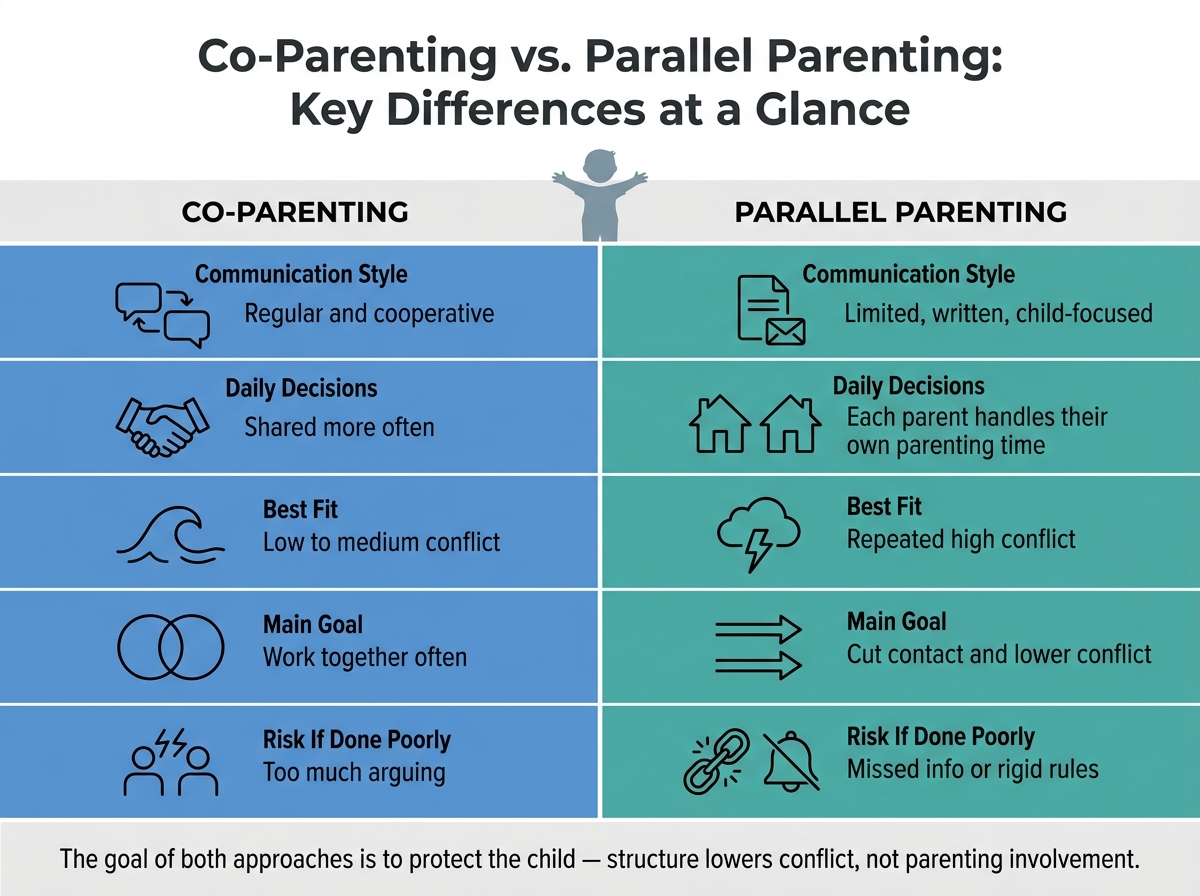
Co-Parenting vs. Parallel Parenting: Key Differences at a Glance
Co-Parenting With a Difficult Ex: Strategies That Actually Work
sbb-itb-596b85d
Quick Comparison
| Area | Co-Parenting | Parallel Parenting |
|---|---|---|
| Communication | Regular and cooperative | Limited, written, child-focused |
| Daily decisions | Shared more often | Each parent handles their own parenting time |
| Best fit | Low to medium conflict | Repeated high conflict |
| Main goal | Work together often | Cut contact and lower conflict |
| Risk if done poorly | Too much arguing | Missed info or rigid rules |
If I had to boil the full article down to one line, it would be this: use structure to lower conflict, not to cut the other parent out.
Review Custody Orders, Safety, and Support Needs First
Before you change the way you communicate or handle parenting issues, pull every custody-related document and read them closely. That includes the custody order, parenting plan, separation agreement, temporary orders, and any protective order, along with any later updates. A private agreement between parents does not override a court order. In California, a revised parenting plan becomes enforceable only after the court signs and files it.[9][10][11]
Treat the current order as your starting point. Then look at each change you’re thinking about and sort it by one simple test: does it fit inside the order, or does it change the order?
Custody rules can differ by state and county. So before making any move that might conflict with an order, check with a family-law attorney or your local court self-help center.
Identify What Can Change and What Must Stay the Same
One of the simplest ways to work through your paperwork is to sort each proposed change into two buckets: day-to-day or order-changing.
Day-to-day changes stay within the current order. For example, switching to written-only communication may fit. Order-changing moves affect legal terms, like parenting time, decision-making, or the exchange location.[7][8][11]
Read the order line by line. Pay close attention to wording about:
- Parenting time
- Holiday rotation
- Pickup and drop-off locations
- Advance notice rules
- Phone or video contact
- Travel
- How disputes must be handled
If you and the other parent have been doing things differently on an informal basis, don’t assume that pattern has legal force. Lots of parents fall into that trap. If the routine has drifted from the written order, ask an attorney or court self-help center whether it should be formally documented.
Address Safety Concerns Before Anything Else
If your case involves domestic violence, stalking, threats, abuse, coercive control, or any credible fear of harm, safety comes first. Not later. Not after one more meeting. First.[4][5][6]
If there’s an immediate threat, call 911. If the danger isn’t immediate but abuse or threats are happening, contact a domestic-violence advocate or local law enforcement for confidential safety planning and information about protective orders. Save threatening texts, voicemails, emails, and incident dates in a secure place.
A safety plan may include a trusted contact, a code word, supervised or public exchanges, school notification, and account-security steps. That plan should be built with an advocate based on your own situation. Do not use joint mediation when intimidation or coercive control is present.
If a protection order is already in place, that order controls. Any proposed parenting setup needs to match its exact limits on contact, distance, and communication. Before signing anything that might seem to conflict with it, talk to an attorney.
Once safety is handled, the next step is figuring out what kind of help fits the kind of conflict you’re dealing with.
Get Professional Support When Conflict Keeps Escalating
Different problems call for different people. A family-law attorney helps with enforceability and modification. A mediator helps with voluntary agreements. A parenting coordinator helps when disputes keep coming back. A therapist or parent coach can help with trauma, regulation, and communication. Same conflict area, different jobs.
Growth and Change Counseling offers parent coaching and family therapy in California and via telehealth to help parents set boundaries and reduce escalation.
The aim is to lower direct conflict without weakening the parenting plan.
Write a Parallel Parenting Plan
Start with the custody order, then turn each repeat problem into a written rule. A parallel parenting plan works best when it swaps vague wording for exact directions. Phrases like "reasonable parenting time" or "as needed" sound simple, but they leave a lot of room for fights. The point is to make the document specific enough that no one has to guess. Once the ground rules are set, add the details that stop the same arguments from popping up again.
Set the Schedule, Exchanges, and Notice Rules
Write out each parenting block with the day, time, and place. Don’t rely on a loose pattern alone. For example: "Parent B’s time begins Friday at 6:00 p.m. and ends Sunday at 6:00 p.m. Parent A handles the pickup; Parent B handles the drop-off." If school is closed on an exchange day, spell out the backup time and place too.
Exchanges need that same level of detail. Say who drives, where each parent waits, and what happens if someone runs late. A useful delay rule might say: "The delayed parent sends written notice within 15 minutes of the scheduled time. The receiving parent waits 30 minutes." If face-to-face contact tends to set things off, use a neutral exchange spot like a library parking lot or the school.
Holidays and school breaks need a clear order of priority so there’s no confusion about which schedule controls when rules overlap. List exact start and end times for each holiday instead of loose labels. For vacation requests, include a written notice deadline, the required details – such as travel dates, destination, lodging, and emergency contact information – and a rule that no response does not mean approval – the change begins only after written acceptance.
Document School, Medical, and Emergency Procedures
Exact rules cut down on arguments. Don’t just say who has access to information. Say who must share it. A useful rule could be: "The parent who receives a school notice uploads it to the app within 24 hours." Include the school’s name, teacher and office contact details, portal access, permission slips, activity schedules, and who handles supplies at each home.
For medical care, list each child’s providers, insurance, pharmacy, allergies, medications, and dosing directions. For routine appointments, require written notice with the date, time, provider name, address, and phone number. Emergencies are different. The parent with the child gets needed care right away and tells the other parent as soon as reasonably possible. It also helps to separate routine choices made during one parent’s time from major decisions controlled by the custody order.
Use a Planning Worksheet to Cut Down on Disputes
A worksheet helps turn scattered choices into one clear system. Fill it out separately first, then work through differences with a marriage therapist, mediator, attorney, or parenting coordinator. Each row should cover one narrow issue. "School emergency closure" is much better than "school matters."
| Topic | Parent Responsible | Required Notice | Communication Method | Backup Procedure |
|---|---|---|---|---|
| Regular weekday exchange | Receiving parent handles transportation | Written notice of delay within 15 minutes of scheduled time | Parenting app | Designated neutral site if the usual location is unavailable |
| Holiday schedule | Parent whose holiday period begins confirms plans | Written confirmation 14 days before the holiday | Parenting app | Regular schedule applies if the provision is unclear; seek legal advice |
| Vacation travel | Traveling parent provides itinerary and emergency contacts | Written notice by the deadline in the custody order | Parenting app with attachment | Follow the existing order; seek court guidance if notice is disputed |
| School forms and activity notices | Parent who receives the notice uploads it | Within 24 hours | Parenting app or shared portal | Contact the school directly; both parents retain independent access |
| Routine medical appointment | Parent scheduling the appointment | Date, time, provider, address, and phone number within the specified period | Parenting app | Parent may obtain details directly from the provider if legally permitted |
| Medication transfer | Parent ending the parenting period sends the required medication | Before the exchange; immediate notice if medication is missed or damaged | Written message; emergency phone contact | Use the backup supply or contact the prescribing provider |
| Emergency medical care | Parent supervising the child | Notify the other parent as soon as reasonably possible | Phone or text, followed by written record | Follow emergency-services instructions and the custody order |
| Schedule-change request | Parent requesting the change | Submit by the stated advance-notice deadline | Parenting app | Existing schedule remains in effect unless the request is accepted in writing |
The worksheet is a drafting tool, not a court order. Before using it, have an attorney check that it matches your custody order and state law.
Switch to Structured Communication and Separate Household Management
Once the plan is in writing, the next step is simple: use it the same way every time. That means one routine communication channel, clear reply rules, and a clean split between what gets discussed and what each home handles on its own. The point is to keep daily contact low, steady, and easier to manage.
Pick One Communication Channel and Stick to a Clear Message Format
Use one communication channel for routine communication, ideally the one named in the court order or parenting plan. A court-approved co-parenting app or a dedicated email address usually works well. What you want to avoid is bouncing between text, email, and app messages for the same issue. One channel creates a clear record and cuts out the usual “I didn’t see it” problem. [16][18]
Each message should cover one subject only. That alone can cut down a lot of friction. It also helps to follow a simple four-part format: Inform, Request, Deadline, Close.
Inform: "The school moved Friday’s dismissal to 1:00 p.m." Request: "Please confirm whether you will pick up Sam." Deadline: "Please reply by Wednesday at 6:00 p.m." Close: "Thank you."
That format works because it gets to the point. Short. Factual. Done. Skip accusations, sarcasm, and side comments about the other home. Use a neutral subject line such as "School pickup – October 8" so the message is easy to find later. Brief, factual, and firm is the right lane here. [14][15]
Set Rules Around Topics, Response Times, and Phone Calls
The parenting plan should spell out what belongs in the written channel. Usually that includes:
- Health
- School
- Schedule
- Activities
- Medications
- Expenses
Everything else stays out. Old arguments, personal life updates, and criticism about the other parent don’t belong there. If the issue does not affect the child’s health, safety, education, schedule, or a legal right, leave it alone.
The plan should also set reply windows. A common rule is 24 to 48 hours for routine matters. Urgent issues may call for an immediate phone call or text, followed by a written summary afterward. [12][13][17] That follow-up matters. It keeps a record of what was said and what was agreed to.
Phone calls should be the exception, not the default. If one has to happen, keep it short and focused on the child. And a plain disagreement is not an emergency just because someone wants an answer faster.
Once these message rules are in place, both homes should use them the same way. If one parent treats every small issue like a five-alarm fire, the whole system starts to wobble.
Let Each Home Run Its Own Day-to-Day Parenting
Parallel parenting does not mean both homes need the same bedtime, dinner routine, or screen time rules. Each parent can make ordinary day-to-day decisions during their own parenting time. [19][20][22] That’s a big part of the point. Less overlap usually means less conflict.
What still needs to be shared is anything that directly affects the child’s health, safety, education, legal rights, or a major scheduled obligation. Outside of that, each home handles its own business.
The child also should not be used as a go-between. Keep that line clear. A steady statement such as "You do not need to choose sides; both parents are responsible for adult communication" does the job without dragging the child into a bigger talk. [20][21]
Pay attention to whether these rules lower conflict. If they don’t, revise the plan instead of slipping back into the same old patterns.
Put the Plan Into Practice, Track Issues, and Reassess
Once the plan is on paper, the next step is simple to say and harder to do: both homes need to use it the same way.
Start the New System in a Set Order
Parallel parenting works when each home follows the same written rules without constant back-and-forth. Before the first exchange under the new setup, make sure the plan is complete and matches the current custody order. If the order needs to be changed, get legal approval first. An informal agreement does not override a court order.
Then put the system in motion in a fixed order:
- Identify one approved channel and use it from day one.
- Add every schedule detail – exchanges, holidays, notice deadlines, and decision-making responsibilities – to a shared calendar or written worksheet.
- Follow the exchange procedure exactly every time. Arrive on time, keep the handoff short, and don’t argue in front of the child. If direct handoffs tend to blow up, use a school drop-off or a neutral public location.
- Log deviations in private, using facts only. A useful entry looks like this: "October 6, 2026, 3:15 p.m. – exchange occurred at the library at 3:12 p.m.; child arrived with backpack and prescribed medication; no discussion occurred." Log facts only.
A detailed schedule should leave as little as possible open to interpretation, because ambiguity can create more conflict.[1]
If the same problems keep showing up, that usually points to a problem in the plan itself – not a lack of effort.
Know When the Arrangement Needs to Be Reviewed
Review the plan when it stops reducing conflict for the child. Look for patterns, not one bad day.
Reassessment makes sense when any of these problems keep happening:
- The child shows fear, anxiety, physical symptoms, or behavior changes around exchanges
- Communication becomes threatening, harassing, or intimidating
- Exchanges are missed again and again, or the plan is ignored as a matter of course
- Medical, school, or emergency information is withheld or delayed
- The schedule no longer fits the child’s age, school demands, health needs, or activities[24]
One serious safety incident may call for immediate legal or professional action instead of waiting for a planned review.[24] It also helps to set a review date in advance – 30 to 60 days after launch, then at regular intervals.
If the plan keeps falling apart even when the communication rules are being followed, don’t try to fix it with longer and longer messages. Pull together the specific repeat problems and use the agreed process – parenting coordination, mediation, attorney consultation, marriage counseling, or court review.[23] Outside help does not replace legal advice or emergency action, but it can help when the written system stops being enough.
Key Takeaways for a Lower-Conflict Transition
Use the plan as written, watch what happens, and make changes only when the pattern shows a change is needed. Parallel parenting works only when it is used with consistency.
| What to do | Why it matters |
|---|---|
| Choose parallel parenting deliberately | It’s a structured response to persistent conflict, not a default |
| Review legal and safety limits before changing anything | Court orders control what is enforceable |
| Put every detail in writing | Vague rules produce repeated disputes |
| Use one documented communication channel | Creates a clear record and limits unnecessary contact |
| Let each household manage its own daily routine | Less overlap means less conflict |
| Preserve the child’s relationship with both parents | The goal is less conflict, not less parenting |
| Track patterns, not isolated irritations | Patterns show whether the system is working |
| Use the agreed escalation process | Skipping it usually makes things worse |
Parallel parenting is not automatically the better option in every case. Outcomes depend on factors such as the level and length of the conflict, parenting quality, the child’s age and needs, and whether the setup actually limits the child’s exposure to conflict.[2][3] That means the plan should be reviewed and revised when it stops doing that job, not kept in place just because it’s already there.
Parallel Parenting Explained by Growth and Change Counseling
How do I know when co-parenting is no longer working?
Co-parenting may stop working when nearly every conversation turns into an argument, a guilt trip, or shouting. It can also show up in the day-to-day pattern: missed pickups, canceled visits, and broken promises that leave you tense and waiting for the next problem.
When contact feels hostile, safety starts to slip, or your attempts to keep life steady for your child get undercut again and again, it may be time to shift to parallel parenting.
Do I need a court order to start parallel parenting?
It depends on your legal situation and your current custody setup. A court order can help by putting expectations in writing, but parallel parenting is also often used on its own as a day-to-day way to handle high-conflict co-parenting.
If custody issues are more involved, or you need to change an existing arrangement, it’s smart to talk with a legal professional. Growth and Change Counseling offers parent coaching and family therapy to help support that shift.
What should I do if the other parent ignores the plan?
Prioritize safety and keep clear, steady boundaries. Treat the relationship as a professional partnership centered on the children’s well-being.
Use email, text, or a co-parenting app so communication is documented and easier to track. That can help cut down on conflict and limit back-and-forth. If an interaction turns hostile, or the other parent seems impaired, leave right away.
For repeated problems, Growth and Change Counseling may help through parent coaching or family therapy.
Related Blog Posts
- 5 Steps to De-Escalate Co-Parenting Arguments
- How to Communicate Effectively in High-Stress Co-Parenting
- Managing Triggers in High-Stress Co-Parenting Situations
- Ultimate Guide to Conflict Resolution for Co-Parents
