If trauma is hitting one person hardest, I’d start with individual therapy. If trauma is tearing up life at home, I’d bring in family therapy early. In many cases, the best path is both: first stabilize the person, then work on the family pattern.
Here’s the short version:
- Individual therapy is usually the better first step for PTSD symptoms, panic, shame, depression, sleep problems, or private trauma details.
- Family therapy fits best when trauma is driving arguments, role confusion, parenting conflict, or stress across the household.
- Safety comes first. If there is abuse, intimidation, blame, or someone involved in the trauma, joint sessions may not fit yet.
- Both can work together. A common path is one-on-one therapy first, then family sessions later.
- Research in the article points to family therapy helping reduce caregiver strain (g = 0.68) and improve family functioning (ES = 0.46).
Addiction, Trauma, and Family Recovery with Dr. Michael Barnes
sbb-itb-596b85d
Quick Comparison
| Approach | Best starting point when… | Main focus | Main upside | Main limit |
|---|---|---|---|---|
| Individual therapy | One person has strong symptoms | Trauma symptoms, coping, private processing | More privacy and direct symptom care | Does not fix home conflict by itself |
| Family therapy | The home feels tense or unstable | Communication, roles, routines, conflict | Helps the household work better day to day | Not a fit when the family setting feels unsafe |
I see the choice as simple: where is the pain showing up most right now – inside the person, inside the family, or both? That answer usually tells you where to begin.
What Individual Therapy and Family Therapy Each Address After Trauma
When trauma shows up mostly as personal symptoms, individual therapy usually comes first. When the bigger problem is strain at home, family therapy can matter more. The two approaches help at different levels of recovery.
Individual Therapy After Trauma: Privacy, Symptom Relief, and Personal Processing
Individual therapy treats one person as the patient. The focus stays on that person’s thoughts, emotions, triggers, and coping patterns. It gives them a private, one-on-one space to talk about shame, fear, or traumatic memories without having to watch how a parent, partner, or other family member might respond[2][6].
Therapists often use evidence-based methods such as Trauma-Focused Cognitive Behavioral Therapy (TF-CBT), EMDR (Eye Movement Desensitization and Reprocessing), and Acceptance and Commitment Therapy (ACT). These approaches help people work through what happened and build coping tools they can use day to day[4][5]. Research shows that individual therapy can significantly reduce depression and anxiety symptoms[2].
That makes it a strong fit for symptom relief. But it doesn’t do much on its own when the home system also needs work.
Family Therapy After Trauma: Communication, Roles, and Shared Recovery
Family therapy treats the family system as the unit of care[4]. Instead of centering on one person’s symptoms, it looks at how people in the home are relating to each other – who’s withdrawing, who’s getting reactive, and who’s carrying more than they can handle. This can help a lot when several family members were affected by the same event, or when one person’s trauma symptoms are creating tension across the household[4][7].
The work is practical. Sessions often focus on communication in the moment, clearer roles, healthier boundaries, and getting the adults in the home on the same page about routines and expectations[7][1]. Research shows family therapy leads to a meaningful drop in caregiver burden, with an effect size of g = 0.68, and moderate gains in overall family functioning, with an effect size of ES = 0.46[7].
Still, shared work helps only when the family setting is safe enough for it.
Limits and Risks of Each Approach
Neither option covers everything. Individual therapy can make a big difference in a person’s symptoms, but it does not change family dynamics[1][2].
Family therapy has limits too. It’s not the best place for processing private trauma memories, and it can do harm if someone in the family is unsafe, dismissive, or involved in the trauma[3][2]. That’s why therapists need to screen for safety before bringing people together for joint sessions. The best fit depends on the main barrier: inner processing for one person, or strain within the home.
Family Therapy vs. Individual Therapy After Trauma: Direct Comparison
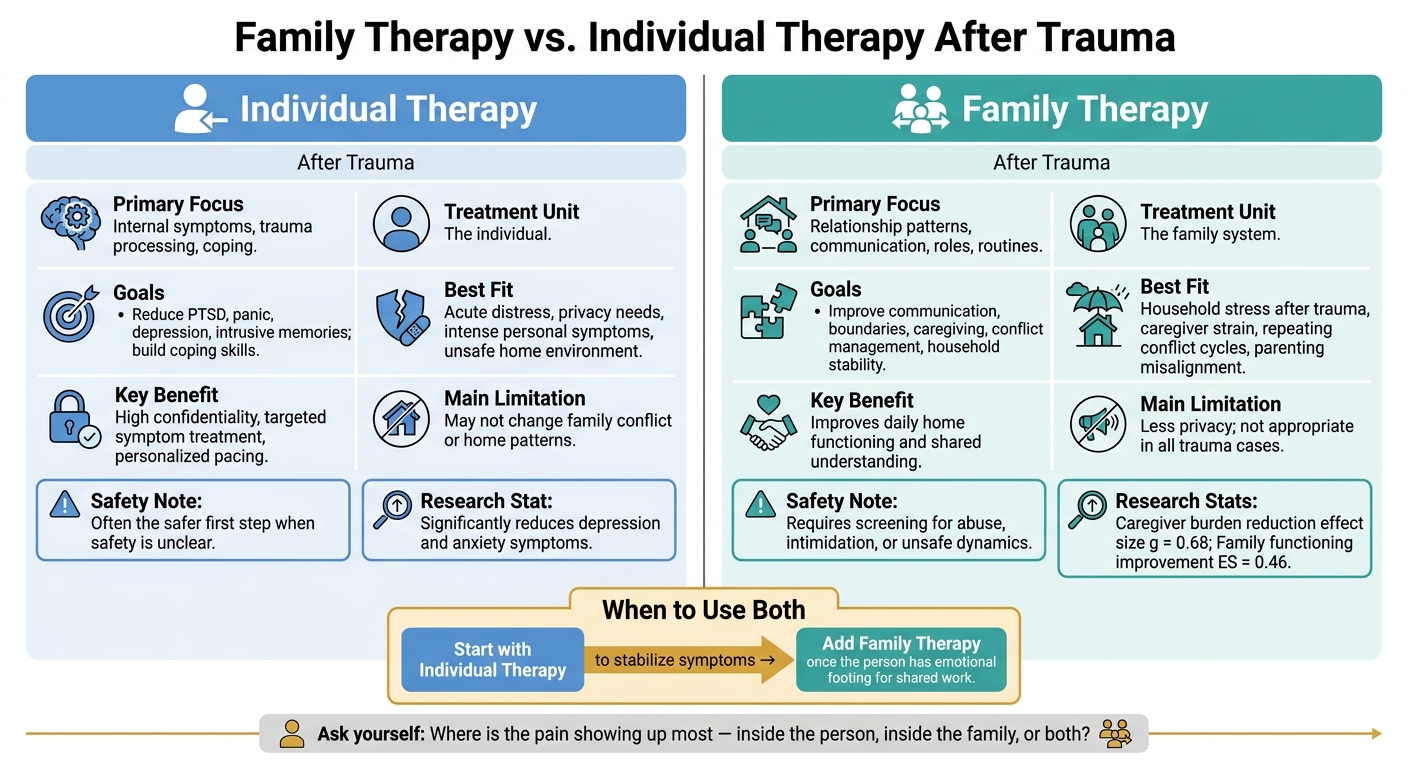
Family Therapy vs. Individual Therapy After Trauma: Side-by-Side Comparison
The core difference is simple: individual therapy centers on one person’s symptoms and coping, while family therapy centers on the patterns shaping life at home.
So the main issue isn’t which option is better in general. It’s which one lines up with the biggest barrier to recovery right now.
| Approach | Primary Focus | Treatment Unit | Goals | Best Fit Situations | Major Benefits | Main Limitations | Safety Considerations |
|---|---|---|---|---|---|---|---|
| Individual Therapy | Internal symptoms, trauma processing, coping | The individual | Build coping skills and self-awareness; reduce PTSD symptoms, anxiety, depression, and intrusive memories | Acute distress, privacy needs, intense personal symptoms | High confidentiality, targeted symptom treatment, personalized pacing | May not change family conflict or home patterns directly | Often the safer first step when safety is unclear |
| Family Therapy | Relationship patterns, communication, roles, routines | The family system | Improve communication, boundaries, caregiving, conflict management, and household stability | Household stress after trauma, caregiving strain, repeating conflict cycles, parenting misalignment | Can improve daily functioning at home and shared understanding | Less privacy because multiple people attend, harder scheduling, not appropriate in all trauma cases | Requires screening when there is abuse, intimidation, or unsafe dynamics |
Primary Focus, Goals, and Who Participates
Individual therapy keeps the attention on one person’s inner experience: triggers, thought patterns, emotional reactions, and day-to-day coping. The therapist and client work in private to reduce symptoms and build tools that help the person feel more steady.
Family therapy works from a different angle. It treats the family as the unit of care, not just one person in isolation. After trauma, that can matter a lot. Tension at home, poor communication, or unclear roles can keep stress going even when one person is trying hard to heal. Family therapy looks at the setting around the problem, not just the person carrying the pain.
Best Fit by Trauma Scenario and Recovery Phase
Individual therapy often makes the most sense when someone is dealing with anxiety, intrusive memories, sleep problems, or intense inner strain. It also fits when a person needs space to talk through details they aren’t ready to share with family members.
Family therapy tends to make more sense when the whole household feels off balance. Maybe a teenager’s behavior is throwing the home into chaos. Maybe co-parents aren’t on the same page. Maybe the same fight keeps coming back in slightly different clothes. In those cases, working on the family pattern can help more than focusing on one person alone.
It can also help when children show trauma through behavior instead of words. A calmer, more predictable home can support recovery in ways that one-on-one work sometimes can’t.
In many cases, individual therapy comes first, and family sessions are added later once the person feels ready for shared work.
That sets up the next issue: which signs suggest starting with one approach, using both, or doing them in sequence.
Benefits, Drawbacks, and Outcomes to Weigh
| Factor | Individual Therapy | Family Therapy |
|---|---|---|
| Symptom reduction | Often stronger for direct treatment of PTSD, panic, depression, and intrusive memories | May help indirectly when family stress is part of the trigger cycle |
| Communication improvement | Limited unless family issues are addressed elsewhere | Often stronger for repeated arguments, blame, and misunderstandings |
| Home stability | May improve gradually through the individual’s coping gains | Often stronger for routines, boundaries, caregiving, and role clarity |
| Confidentiality | Higher privacy for sensitive trauma details | Less privacy because multiple people attend |
The next step is to match that tradeoff to what the family needs most at this stage.
How to Choose the Right Approach for Your Situation
The key choice is pretty simple: where is the damage showing up most right now – inside the person, or inside the relationships around them?
If the main problem is internal, such as intrusive memories, panic attacks, shame, or depression, individual therapy is usually the best place to start. If the main problem is relational, such as repeated arguments, parenting conflict, or household chaos, family therapy should move into the plan early.
Signs Individual Therapy Should Come First
Individual therapy should come first when the symptoms are intense and deeply personal. That includes suicidal thoughts, self-harm risk, severe depression, or shame that feels too hard to talk about in front of family members. The same goes for trauma that is affecting sleep, appetite, or day-to-day functioning.
It should also come first when the family setting does not feel safe enough for open work. Maybe relatives minimize what happened. Maybe they refuse to take part. Maybe every hard conversation turns into denial or blame. In that kind of setting, family sessions are not likely to help yet. If one person’s experience is being brushed aside, shared work tends to stall fast.
Once symptoms are more steady, family therapy can step in to work on the pattern at home.
Signs Family Therapy Should Be Part of the Plan
Family therapy should be part of the plan when the home dynamic is helping keep the crisis alive. If a teenager is acting out through defiance or school avoidance, if co-parents are in constant conflict, or if enabling behavior around addiction has turned into a household pattern, the problem is not only about one person’s symptoms. It’s also about the relationship system around them.
This kind of therapy matters when stress keeps getting fed by the way people interact at home. If the whole household feels unstable, working with only one person usually won’t go far enough. In cases like that, the family pattern needs direct attention.
When a Combined or Staged Approach Makes the Most Sense
Sometimes both layers need care: the person and the family system. When that happens, timing matters.
Many trauma cases need both approaches, usually one after the other. The best move is often to start with the most urgent layer first. A common sequence is to begin with individual therapy to help stabilize symptoms, then add family sessions once the person has enough emotional footing for shared work.
This staged approach often fits the post-crisis period, when one person is ready to do deeper personal work, but the family still needs more structure and support around them.
Conclusion: Choosing Care That Supports Recovery and Family Stability
After trauma, the best kind of therapy depends on where the strain is showing up most: inside one person, inside the family, or in both places at once. Trauma rarely stays boxed into one life. It often spills into relationships, daily routines, and the overall stability of the home.
Individual therapy is often the better fit for severe or private symptoms. Family therapy makes more sense when home dynamics are helping keep the problem going. If routines, roles, or patterns in the household are stuck, working with just one person often doesn’t go far enough.
When family stress is part of the issue, relational work can help support recovery in ways individual therapy alone may not reach. Research shows that family therapy can improve caregiver strain and overall family functioning.
The right fit comes down to three questions:
- Is the family environment safe enough for shared work?
- How severe are the symptoms?
- Is everyone willing to participate?
Growth and Change Counseling offers individual therapy and family therapy in Campbell, San Jose, Los Angeles, and Roseville, CA, plus telehealth across California.
Finding the Right Path at Growth and Change Counseling
Can I do both individual and family therapy at the same time?
Yes. A lot of people find this combined approach helpful because it supports personal trauma recovery in individual therapy while also helping repair relationships and communication in family therapy.
Growth and Change Counseling offers both individual and family therapy, so care can be shaped around your specific emotional and relationship needs.
How do I know if family therapy will feel safe for me?
A good family therapist creates a sense of safety by leading sessions in a neutral, steady way that protects each person’s well-being and supports the family’s stability.
They also watch the pace of trauma work, help keep things from becoming too overwhelming, and create a steady, supportive space where you can speak about your needs without fear of judgment or blame.
When should a child start family therapy after trauma?
A child should start family therapy after trauma once emotional and physical safety is in place at home and a therapist has ruled out problems that may need individual stabilization first.
Family therapy can help when trauma has strained family bonds, hurt communication, disrupted routines, or changed behavior. Starting early can support healing and help bring back stability.
Related Blog Posts
- Family Therapy for Trauma Recovery: What Works
- How Family Therapy Improves Trauma Communication
- Trauma Recovery: Role of Family Systems
- Trauma-Informed Family Therapy Explained
