Healthy communication doesn’t just improve relationships – it directly impacts sobriety. Research shows that couples who resolve conflicts constructively experience higher abstinence rates, stronger relationships, and lower relapse risks. Programs like Behavioral Couples Therapy (BCT) and "OurRelationship" teach practical skills like active listening, using "I" statements, and creating recovery plans. These strategies help break the harmful cycle of substance use and relationship struggles.
Key takeaways:
- Higher abstinence rates: Couples in BCT achieve 50% abstinence compared to 30% in individual therapy.
- Stronger relationships: Techniques like "Catch Your Partner Doing Something Nice" build trust and reduce defensiveness.
- Lower relapse risks: Addressing relationship issues alongside addiction reduces triggers and improves long-term outcomes.
Conflict isn’t just a challenge – it’s an opportunity for growth in recovery. With the right tools, couples can rebuild trust, maintain sobriety, and create healthier connections.
E76: Conflict Resolution: Improving Communication Skills in Recovery
How Conflict Resolution Improves Recovery Outcomes
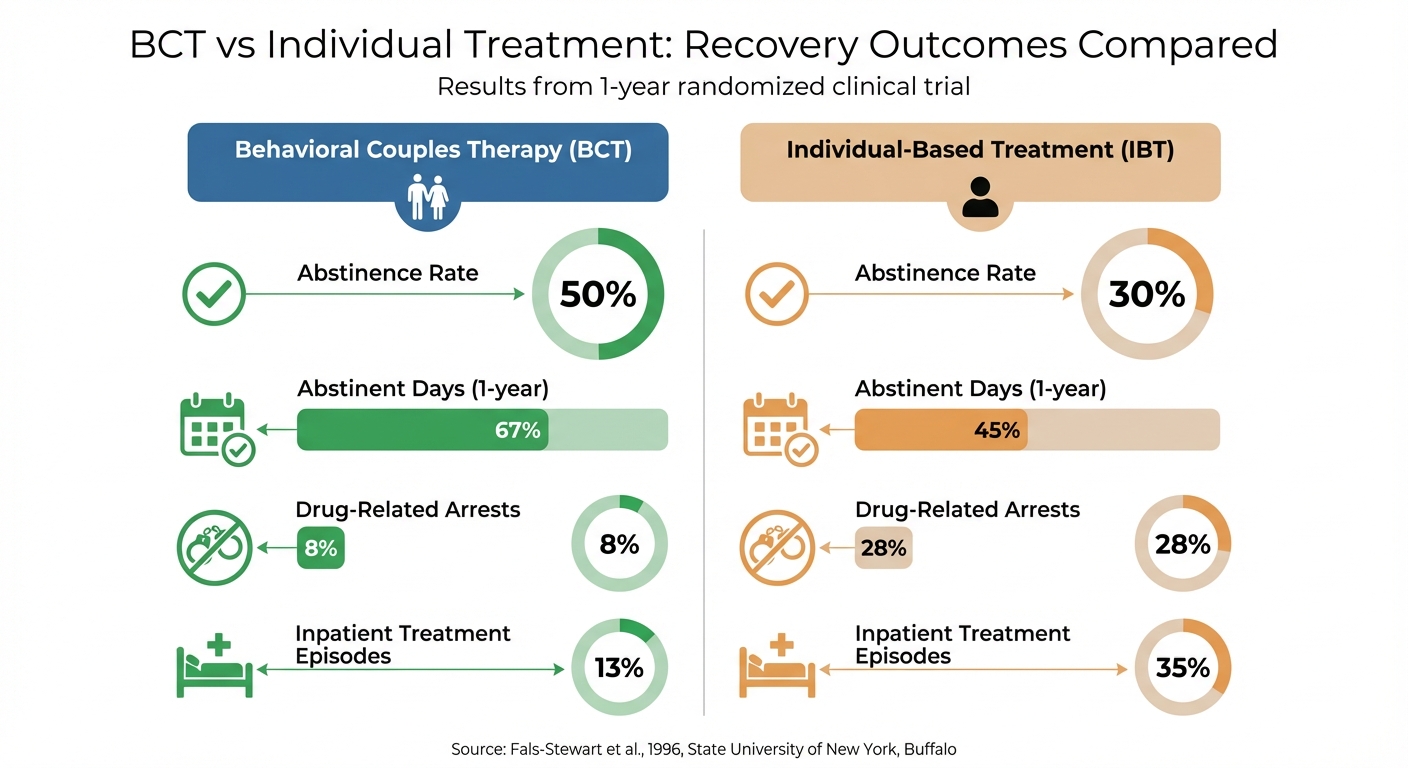
Behavioral Couples Therapy vs Individual Treatment Recovery Outcomes
Studies reveal that couples who practice conflict resolution skills achieve better outcomes in recovery. The link between healthy relationships and sobriety is well-supported by evidence from randomized clinical trials. This sets the stage for understanding how conflict resolution specifically benefits recovery.
Better Substance Abstinence Rates
A 1996 randomized clinical trial led by William Fals-Stewart, Ph.D., and his team at the State University of New York, Buffalo, found a striking difference in abstinence rates. Among patients receiving Behavioral Couples Therapy (BCT), 50% remained abstinent from alcohol and drugs, compared to only 30% of those undergoing individual-based therapy. Over a year-long follow-up, BCT participants maintained 67% abstinent days, while those in individual therapy achieved only 45% [2].
Relationship conflict often fuels substance use. By learning to handle disagreements calmly, couples can eliminate one of the most common triggers for relapse. Incorporating daily sobriety trust discussions through recovery contracts adds a layer of accountability that goes beyond what individual therapy offers [2].
Improved communication also contributes to a more satisfying relationship dynamic.
Stronger Relationship Satisfaction
Conflict resolution can disrupt the negative cycle where substance use and relationship discord feed into one another [2]. Techniques like using "I" statements help reduce defensiveness, while exercises such as "Catch Your Partner Doing Something Nice" shift attention from past grievances to positive actions in the present [2].
"Alcoholic and drug abusing patients from happier, more cohesive relationships with better communication have a lower risk of relapse."
– Timothy J. O’Farrell, Ph.D., Harvard Medical School [3]
Programs like OurRelationship show measurable improvements in conflict management. These programs have reported effect sizes ranging from 0.33 to 0.77 for constructive conflict responses, along with reductions in destructive behaviors and anger [1]. Such progress fosters emotional closeness and trust, which are key ingredients for long-term relationship satisfaction.
Lower Relapse Risk
Legal and medical data further highlight the advantages of conflict resolution. The same study found that participants in BCT programs had significantly lower rates of drug-related arrests (8% versus 28%) and fewer inpatient treatment episodes (13% versus 35%) compared to those in individual therapy [2].
Addressing both substance use and relationship challenges simultaneously proves to be more effective. For instance, couples who agree to avoid discussing past substance use outside of therapy sessions can minimize potential relapse triggers [2]. Clinicians have long observed that reducing relationship distress directly lowers the risk of relapse [4].
| Outcome Metric | Behavioral Couples Therapy (BCT) | Individual-Based Treatment (IBT) |
|---|---|---|
| Abstinence Rate | 50% [2] | 30% [2] |
| Abstinent Days (1-year follow-up) | 67% [2] | 45% [2] |
| Drug-Related Arrests | 8% [2] | 28% [2] |
| Inpatient Treatment Episodes | 13% [2] | 35% [2] |
These findings emphasize the importance of addressing relationship dynamics alongside addiction treatment. Effective conflict resolution not only strengthens relationships but also plays a crucial role in maintaining long-term recovery.
Conflict Resolution Techniques in Behavioral Couples Therapy (BCT)
Behavioral Couples Therapy (BCT) offers practical methods to strengthen recovery by improving how couples handle conflicts. By addressing the connection between substance abuse and relationship struggles, BCT focuses on breaking this harmful cycle. The approach emphasizes that effective conflict resolution is key to avoiding relapse. Instead of isolating addiction treatment, BCT provides couples with tools to navigate disagreements and rebuild trust as a team. These strategies not only help resolve disputes but also reinforce recovery by fostering emotional connection alongside sobriety.
Teaching Communication Skills
BCT introduces techniques like paraphrasing, empathizing, and validating to keep arguments from escalating and to create a recovery-friendly environment. Couples practice active listening by repeating back what they’ve heard to confirm understanding.
"The therapist should highlight skill-building goals and focus consistently on the present and future rather than the processing of emotional reactions to past problems."
– William Fals-Stewart, Ph.D., State University of New York, Buffalo [2]
A critical guideline in BCT is conflict containment – avoiding discussions about past substance use outside therapy sessions. If such conversations begin to intensify, couples are encouraged to pause and revisit the topic during their next session, where a therapist can guide them.
These communication skills lay the groundwork for creating shared strategies that support recovery.
Creating Collaborative Recovery Plans
At the heart of BCT is the Sobriety Trust Contract, where the recovering partner commits daily to 24 hours of abstinence, supported by their partner’s encouragement [2].
Couples also use a Recovery Calendar to document daily achievements, such as abstinence commitments, attendance at 12-step meetings, and adherence to medication plans. This visual tracker not only highlights progress but also shifts the partner’s role from one of suspicion to one of support and encouragement. For couples where both partners are in recovery, Dual Recovery Contracts allow them to make mutual promises, promoting shared accountability and a united focus on sobriety.
sbb-itb-596b85d
Research-Backed Practices for Resolving Conflict in Recovery
Beyond Behavioral Couples Therapy (BCT), couples can use proven strategies to strengthen their emotional bond and maintain accountability. These methods build on the communication skills and recovery agreements mentioned earlier, giving couples additional tools to tackle the challenges of staying sober while rebuilding their relationship. The aim? To shift conflict from being a relapse risk to a chance for growth and deeper connection. Below are two evidence-based approaches that turn conflict into a stepping stone for intimacy.
The Gottman Method for Managing Conflict

The Gottman Method offers practical techniques to help couples keep disagreements from spiraling out of control. For example, softened startups teach partners to express concerns gently, avoiding criticism or blame. This approach reduces defensiveness and keeps discussions constructive. If emotions start to run high, cooling-off breaks allow couples to step away before arguments escalate into harmful fights. These time-outs give both partners the chance to calm down before returning to the conversation.
After conflicts, emotion-focused repair helps couples reconnect by addressing hurt feelings and rebuilding trust. This step is especially crucial during recovery, as lingering resentment can become a trigger for relapse. Research has shown that couples who engage in relationship programs using these techniques experience fewer destructive conflicts and more productive resolutions [1].
In addition to these strategies, principles from 12-step programs can also play a key role in resolving disputes.
Using 12-Step Principles in Conflict Resolution
The guiding principles of 12-step programs can reshape how couples handle disagreements. Accountability involves taking responsibility for your actions in a conflict instead of shifting blame onto your partner. Making amends goes beyond simply saying "sorry" – it requires taking meaningful steps to repair the harm caused by past behaviors, whether related to substance use or relationship issues.
Healthy conflict can foster intimacy by encouraging genuine engagement.
These principles align with the daily commitment structure of BCT’s Recovery Contract, reinforcing the importance of accountability in everyday interactions. Therapists often recommend that the non-using partner attend Al-Anon meetings. These meetings provide tools to manage personal stress and set healthy boundaries, reducing conflicts driven by fear or control [3]. By focusing on individual growth while supporting each other, couples can create a strong foundation for resolving disputes without endangering sobriety.
How Growth and Change Counseling Supports Couples in Recovery
The strategies highlighted earlier truly come to life when couples work with therapists experienced in addiction recovery. Growth and Change Counseling, based in California, helps couples apply these methods to resolve conflicts during recovery. Instead of just managing symptoms, the focus is on addressing the deeper issues within the relationship. This approach reflects a commitment to blending relationship support with addiction recovery.
The Marriage Rescue Institute‘s 12-Week Program
Expanding on these strategies, the Marriage Rescue Institute offers a 12-week intensive program designed to help couples build relational skills. The program emphasizes using conflict as an opportunity to strengthen connection.
"Conflict is a pathway to intimacy. If there’s no conflict in a relationship, at least one person isn’t being genuine."
- John Mark Kane, LMFT, Growth and Change Counseling
The program includes daily relationship exercises for couples to practice between sessions, helping them internalize communication techniques like softened startups and cooling-off periods. Therapists provide hands-on coaching to disrupt harmful patterns and guide couples in developing collaborative recovery plans. This program has even helped couples who were separated reconcile and rebuild their lives together [5].
Customized Therapy for Individual and Couple Needs
In addition to the 12-week program, Growth and Change Counseling offers customized therapy sessions tailored to individual and couple-specific challenges. These sessions draw on various therapeutic methods, including Emotionally Focused Therapy (EFT), Cognitive Behavioral Therapy (CBT), attachment theory, and EMDR. This adaptability is crucial, as addiction recovery often requires a personalized approach.
The practice also caters to unique circumstances that can complicate recovery, such as supporting neurodiverse couples or addressing specific addictions like media or sex addiction. Therapist Arione Capolupo, LMFT, explains their goal:
"We don’t believe in endless therapy. Our goal is to get you in and out as quickly as reasonably can be done and do it in a way that hopefully you will never need to come back!"
- Arione Capolupo, LMFT
Services are available in multiple California locations, including Campbell, San Jose, Los Angeles, and Roseville, as well as through telehealth statewide [5]. This comprehensive support underscores the importance of effective conflict resolution in improving recovery outcomes.
Lasting Recovery Through Growth and Change Counseling
Research clearly shows that healthy conflict resolution can significantly improve recovery outcomes. Couples who move away from harmful habits like yelling or criticism and adopt constructive communication methods experience better abstinence rates, stronger relationship satisfaction, and a reduced risk of relapse. Time and again, studies highlight that Behavioral Couples Therapy outperforms individual treatment approaches. Recovery isn’t just about achieving sobriety – it’s about rebuilding trust and creating a deeper, more meaningful connection.
These findings emphasize how crucial conflict resolution is in the recovery process. Substance use and relationship discord often fuel one another in a destructive cycle, but that cycle can be broken. When couples view conflict as an opportunity to connect rather than divide, they begin addressing the core issues behind both addiction and relationship struggles. As John Mark Kane, LMFT, explains:
"The more relationally healthy people are, the less anxious, addicted, and depressed they are" [5].
To turn these insights into action, professional support plays a key role. Structured programs offer the tools and safe spaces couples need to develop new skills, handle triggers, and sustain recovery over the long term. For couples navigating these challenges, expert guidance from Growth and Change Counseling can make all the difference. With their intensive programs and personalized therapy, they help restore both sobriety and relational health. Visit Growth and Change Counseling to explore how mastering conflict resolution can transform your recovery journey.
FAQs
How does Behavioral Couples Therapy help couples achieve better recovery outcomes compared to individual therapy?
Behavioral Couples Therapy (BCT) takes a different approach to recovery by involving both partners in the treatment journey. Instead of focusing solely on the individual, BCT addresses relationship stress – a common trigger for relapse – and encourages the non-using partner to actively participate in supporting sobriety.
Studies show that couples who go through BCT are more likely to maintain abstinence, face fewer substance-related challenges, and enjoy better relationship satisfaction compared to those who rely on individual therapy. The process equips couples with tools to reward sober behavior, handle conflicts in a healthy way, and set shared goals for recovery.
At Growth and Change Counseling, these principles are woven into a 12-week structured couples coaching program. This program helps partners rebuild trust, strengthen their connection, and work together toward lasting recovery.
What conflict resolution skills are taught in Behavioral Couples Therapy?
Behavioral Couples Therapy aims to equip couples with practical tools to handle conflicts and build a stronger bond. It emphasizes:
- Encouraging positive changes in behavior to create healthier, more supportive interactions.
- Improving communication skills, such as practicing active listening, using "I" statements to express feelings without blame, and stepping away temporarily to cool down when emotions run high.
- Adopting structured approaches to problem-solving so couples can tackle issues together in a calm and effective manner.
By focusing on these techniques, couples can work through disagreements in a way that deepens their emotional connection and supports the growth of their relationship over time.
How can resolving relationship conflicts help prevent relapse during addiction recovery?
Resolving conflicts in relationships is a key part of addiction recovery. Intimate relationships can either act as triggers for substance use or serve as a powerful source of support during recovery. Studies highlight that when couples shift from harmful conflict patterns to healthier communication, it not only lowers stress but also creates an environment that supports sobriety. This kind of positive change can help reduce cravings and reinforce recovery efforts.
Therapists often guide couples in developing shared recovery plans, participating in enjoyable activities together, and creating strategies to prevent relapse. These steps not only ease emotional strain but also help build a stronger, more supportive relationship. Growth and Change Counseling offers a 12-week couples coaching program that uses proven methods to rebuild trust, improve communication, and support lasting recovery.
Related Blog Posts
- Ultimate Guide to Couples Communication in Addiction Recovery
- Addiction Recovery and Marriage: What Works
- How Marriage Counseling Supports Addiction Recovery
- Study: How Shared Goals Improve Sobriety for Couples
