Communication in mixed-neurotype families – those with both autistic and neurotypical members – can be challenging due to differences in how individuals express and interpret social cues. Research shows that these challenges often stem from mismatched communication styles rather than deficits in any one group. Families can improve their interactions by focusing on mutual understanding, using structured communication strategies, and valuing each member’s unique perspective.
Key takeaways:
- Mixed-neurotype families include autistic and neurotypical individuals, such as parents, children, or partners.
- Challenges arise from differences in timing, body language, and conversational flow.
- The double empathy problem highlights that both autistic and neurotypical individuals may struggle to understand each other’s social cues.
- Studies show that shared communication styles improve understanding, while mixed styles can lead to misunderstandings.
- Parental self-efficacy is crucial; higher confidence in parenting correlates with better family communication and lower stress.
- Strategies like active listening, clear communication, and sensory-friendly environments can help bridge gaps.
Practical steps for better communication include assuming competence, using multiple communication methods, and creating shared cues for emotional regulation. Families can also seek professional support, such as therapy for neurodiverse couples, to strengthen connections and reduce stress.
The Double Empathy Problem in Family Communication
Understanding the Double Empathy Problem
Dr. Damian Milton’s concept of the double empathy problem sheds light on why communication in families with mixed neurotypes can sometimes feel like a struggle. It isn’t just one-sided – both neurotypical and autistic family members can have difficulty understanding each other. For example, a neurotypical parent might misread an autistic child’s behavior, while the child might simultaneously misinterpret the parent’s social cues [4][5].
This isn’t about one group lacking social skills. Instead, it’s about differences in how social cues and intentions are expressed and understood. A 2016 study highlighted this by showing that neurotypical adults often had trouble interpreting the mental states of autistic individuals through animations and videotaped interactions [4]. The issue lies in differing "social languages", not a deficit in either group [4].
These insights provide a foundation for looking at research that dives deeper into these communication challenges.
Research on Communication Differences
Studies have backed up the idea of mutual misunderstandings with solid data. Take the 2020 "game of telephone" experiment by Crompton and colleagues, for instance. Researchers found that both all-neurotypical and all-autistic groups could relay stories effectively. However, when the groups were mixed, the ability to communicate and pass along information dropped significantly [4].
Another study from 2025 used a Jenga tower collaboration task to explore these dynamics further. The findings revealed that autistic participants communicated more comfortably and effectively when paired with other autistic individuals compared to mixed-neurotype groups [4]. This aligns with the idea that shared communication styles improve understanding.
Paulina E. Rachanska’s 2025 research at Queen’s University Belfast adds another layer to this discussion. Her work showed that both autistic and non-autistic adults recognize that successful interactions rely on both sides making an effort, rather than placing the responsibility solely on one group [5]. Together, these studies highlight how shared communication styles can foster better understanding and suggest ways families can navigate neurotype differences more effectively, often with the support of marriage counseling.
sbb-itb-596b85d
Research Findings on Mixed-Neurotype Family Dynamics
Maternal Self-Efficacy and Family Communication
Parental self-efficacy – essentially a parent’s confidence in their ability to tackle parenting challenges – has a significant impact on how mixed-neurotype families communicate and function. In August 2024, a study published in the Journal of Autism and Developmental Disorders by Jankowska and colleagues analyzed responses from 145 parents of autistic children and 239 parents of neurotypical children (ages 7–11). The findings showed that child characteristics explained 21% of the variation in parental self-efficacy and 27% in parental satisfaction among parents of autistic children, compared to 3% and 17%, respectively, for parents of neurotypical children [6].
Parents with higher self-efficacy tend to approach challenges as opportunities for growth. They are more attuned to their children’s needs and promote collaboration rather than relying on avoidant coping strategies. On the other hand, low self-efficacy is linked to heightened parenting stress and an increased risk of depressive symptoms [6].
Interestingly, the study found that the severity of a child’s behavioral difficulties was the strongest predictor of parental self-efficacy, accounting for 18% of its variation. This highlights the importance of mental health programs that not only teach practical strategies for managing behavior but also address negative thought patterns surrounding parenthood. These self-efficacy dynamics directly influence how child behaviors shape the broader family system [6].
How Child Behaviors Affect Family Dynamics
In mixed-neurotype families, the impact of child behaviors can amplify existing communication challenges. Externalizing behaviors, like disobedience, and internalizing behaviors, such as anxiety, tend to lower parental self-efficacy. Conversely, prosocial behaviors – like sharing, comforting, or helping others – can boost it [6].
These effects ripple through the entire family, influencing more than just the parent-child relationship. A qualitative study conducted in August 2025 in Canberra, Australia, explored these dynamics by interviewing 24 parents. The study identified two distinct patterns in partner relationships, often requiring specialized support for neurodiverse couples with mental health issues: "Relational Strain" and "Relational Growth." Dennis, a father in the study, shared his experience of the relentless pressure:
"Having a son with autism and intellectual disability, there’s the stress on the bonds that I have with my wife, and it’s that constant stress that means I’m having to work harder" [2].
Another parent, Greg, reflected on the challenges of bridging communication gaps within his family:
"My wife cannot understand how we think some of the time… She’s the only neurotypical in the house, so it’s a fairly big strain on her. This is a strain on our relationship" [2].
Additionally, research from May 2025 by Romney and colleagues demonstrated the benefits of targeted sibling communication and autism education. These efforts were shown to improve sibling adaptation, providing a buffer against the strain that child behaviors can place on family relationships [1]. This underscores the importance of intentional communication strategies in supporting neurodiverse families.
Research-Based Strategies for Better Communication
Assume Competence and Use Multiple Communication Methods
One of the first steps toward improving communication in mixed-neurotype families is to start with the belief that every family member is capable of understanding and contributing. This mindset helps avoid dismissive attitudes and encourages open, inclusive interaction. To support this, it’s helpful to use a variety of communication methods. For instance, jotting down key points or using visual aids before discussions can provide extra processing time and make abstract ideas easier to grasp. Research highlights that sensory-friendly environments – quiet spaces without harsh lighting or loud noises – can significantly improve communication. Establishing ground rules, like a "no interruptions" policy and setting specific times for discussions, also minimizes distractions and accommodates different communication styles while providing the structure neurodiverse families need to thrive [7]. These combined strategies create a stronger foundation for mutual understanding.
Build Mutual Understanding and Empathy
Effective communication in mixed-neurotype families thrives on mutual effort. Misunderstandings often arise not from deficits but from differing communication styles. In fact, studies show that mixed-neurotype pairs experience lower rapport compared to matched-neurotype pairs (p = .023) [3].
Practicing active listening – like nodding or summarizing what the other person says – can help bridge these gaps. Acknowledging emotions is another powerful tool; for example, saying, "I can see you’re feeling overwhelmed", can build empathy and lower defensiveness. Families can also benefit from creating shared regulation cues, such as code words or signals, to express when someone needs a pause during stressful situations. These small but meaningful steps can ease communication challenges and strengthen emotional connections [7].
Value Differences Over Conformity
Once competence and empathy are established, families can go a step further by embracing and celebrating neurological differences. Instead of expecting neurodiverse members to adapt to neurotypical norms, families can focus on the strengths that come with those differences. Couples therapist Daniel Dashnaw explains it well: "Instead of forcing one another to fit a certain mold, they can celebrate their differences and use them as opportunities for growth" [7].
Simple adaptations can make a big difference. For example, using literal language avoids confusion by steering clear of sarcasm or figurative expressions. For individuals who find direct eye contact overwhelming, focusing on someone’s nose, chin, or forehead can be a practical alternative that still conveys engagement. These adjustments respect neurological diversity and encourage a communication style that works for everyone, without requiring anyone to conform to rigid expectations.
Navigating "The Double Empathy Problem": Tips for Neurodiverse Couples/Mixed-Neurotype Couples
Applications for Parenting, Counseling, and Family Support
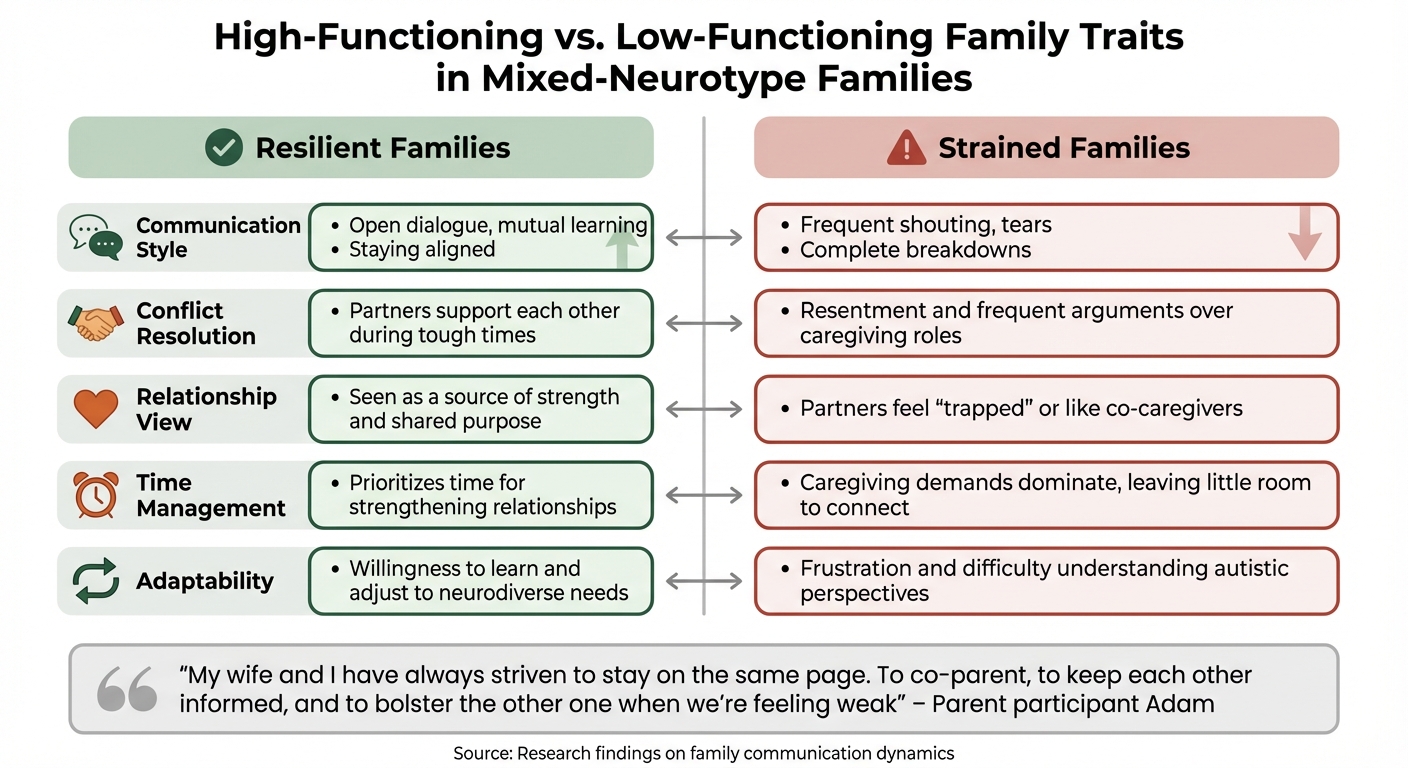
Resilient vs Strained Mixed-Neurotype Family Traits
Family-Level Interventions for Communication
Addressing communication challenges within families requires strategies that strengthen connections and build resilience. A family systems approach, such as Bowen Family Systems Theory, helps clarify how autism influences family dynamics. Combining this with psychoeducation and Solution-Focused Brief Therapy can empower every family member to navigate these challenges together [1].
One effective strategy is scheduling dedicated communication sessions. For example, neurotypical siblings may feel neglected when parents are heavily focused on caregiving. Setting aside one-on-one time with each child can help balance attention and strengthen bonds. Similarly, reserving time for couples to connect can prevent caregiver burnout and nurture intimacy in relationships [2].
Another key approach involves meaning-making. Instead of assigning blame, families can work on adjusting their expectations to align with their unique circumstances. As one parent, Francene, put it: "If the parents aren’t willing to adapt and learn, you need to change… your expectations" [2]. This mindset allows families to focus on growth and understanding, fostering both individual and collective well-being.
High-Functioning vs. Low-Functioning Family Traits
Research highlights clear differences between families that thrive and those that struggle, focusing on how they communicate, resolve conflicts, and adapt to challenges. These traits, rather than the severity of autism, often determine whether families feel resilient or strained.
| Trait Category | Resilient Families | Strained Families |
|---|---|---|
| Communication Style | Open dialogue, mutual learning, and staying aligned | Frequent shouting, tears, or complete breakdowns —often requiring intensive therapy for couples in crisis |
| Conflict Resolution | Partners support each other during tough times | Resentment and frequent arguments over caregiving roles |
| Relationship View | Seen as a source of strength and shared purpose | Partners feel "trapped" or like co-caregivers |
| Time Management | Prioritizes time for strengthening relationships | Caregiving demands dominate, leaving little room to connect |
| Adaptability | Willingness to learn and adjust to neurodiverse needs | Frustration and difficulty understanding autistic perspectives |
Source: Research findings on family communication dynamics [2]
Parent participant Adam shared his experience: "My wife and I have always striven to stay on the same page. To co-parent, to keep each other informed, and to bolster the other one when we’re feeling weak" [2]. This focus on teamwork, combined with realistic expectations and open communication, helps families build resilience even during tough times.
Growth and Change Counseling: Support for Neurodiverse Families

Therapy for Neurodiverse Relationships
Growth and Change Counseling specializes in helping families choose a neurodiverse couples therapist to navigate their unique communication challenges. Instead of focusing on "fixing" one individual, their approach supports the relationship as a whole. Using the Neurodiverse Couples Therapy model (MIT/Brugha Model), they treat the relationship as a "third entity", combining both neurotypical and autistic perspectives to foster understanding [8].
A key tool in their therapy sessions is Capacity and Boundaries Mapping. This method uses visual scales to help partners identify their emotional, cognitive, and physical limits. By promoting a structured way to understand each other’s needs, this approach minimizes misunderstandings that often arise from differing communication styles. These techniques also lay the groundwork for their broader parent coaching and family therapy programs.
Parent Coaching and Family Therapy Programs
Their parent coaching and family therapy programs incorporate well-researched techniques to strengthen family bonds. Inspired by the Gottman method, they emphasize strategies like soft start-ups, active listening, and meta-communication to improve mutual understanding [8]. Coaching sessions help families set realistic expectations, create space for individual needs, and address challenges like sibling dynamics, caregiving, and relationship stress. These programs are designed to be practical and accessible, even for those who prefer remote support.
Telehealth Services Across California
To make their services more accessible, Growth and Change Counseling provides telehealth options throughout California, including Campbell, San Jose, Los Angeles, and Roseville. This format is particularly beneficial for neurodivergent individuals, as studies suggest that many people with autism prefer digital communication. It reduces social anxiety, simplifies interactions, and allows families to control sensory and environmental factors more effectively [9].
Telehealth sessions are available at the following rates: $200 for 45 minutes with Licensed Marriage and Family Therapists, $150 with Associates, and sliding scale options starting at $100. This flexibility ensures that specialized support is within reach for families across the state.
Conclusion: Building Better Connections in Mixed-Neurotype Families
Communication challenges in mixed-neurotype families often come down to understanding and respecting different ways of processing the world. A 2024 study published in Frontiers in Psychology revealed that couples who openly discuss their cognitive differences tend to experience higher relationship satisfaction compared to those who avoid the topic [8]. The takeaway? Let go of assumptions about non-verbal cues and instead lean into clear, direct communication.
Research consistently shows that structured and intentional communication improves relationship dynamics. By embracing each family member’s natural communication style, families can create a stronger foundation. Skills like precision, pattern recognition, and directness become powerful tools for connection when paired with empathy and thoughtful communication strategies. Couples therapist Daniel Dashnaw puts it perfectly:
"The real secret of mixed-neurotype relationships isn’t how they survive – but how they expand our idea of what intimacy can look like" [8].
Practical steps can make a real difference in reducing stress and fostering connection. For instance, Wilkinson et al. found that when partners work together to create supportive environments, both individuals show lower stress levels and greater intimacy [8]. These shared efforts are a tangible way to demonstrate care and consideration for everyone involved.
Professional support can also play a pivotal role. Studies highlight how specialized counseling can bridge communication gaps [3]. Services like those offered by Growth and Change Counseling use neurodiverse-affirming approaches to help families navigate these challenges. Therapists trained in these methods teach meta-communication skills – helping families not only understand what someone feels but also how they process those emotions. This deeper understanding can transform everyday interactions and prevent minor misunderstandings from spiraling into bigger issues.
Strengthening connections in mixed-neurotype families takes patience, education, and a commitment to valuing differences over conformity. Whether through personal learning or professional guidance, families that invest in understanding their unique communication styles build stronger, more resilient relationships. The goal isn’t to make everyone communicate the same way but to create a shared language that respects and celebrates each person’s natural way of connecting.
Better Communication for Couples at Growth and Change Counseling
How can we tell if a conflict is a communication mismatch or a behavior problem?
A communication mismatch occurs when differences in how people process or express themselves lead to misunderstandings or feelings of being ignored. On the other hand, a behavior problem involves specific, noticeable actions, such as interrupting during conversations or losing focus. To figure out which one you’re dealing with, ask yourself: Is the issue rooted in differing communication styles, or is it tied to behaviors that can be directly addressed and adjusted?
What are some ‘structure’ tools for difficult family conversations?
Clear communication tools can make challenging family conversations more manageable. For instance, setting rules for taking turns ensures everyone has a chance to speak without interruptions. Incorporating visual aids or written agendas can help guide the discussion, keeping everyone on track and focused. Additionally, scheduling specific times for these conversations creates a structured environment, reducing the chances of misunderstandings and promoting smoother communication within the family.
When should a mixed-neurotype family seek therapy or coaching for communication?
Mixed-neurotype families can find therapy or coaching helpful when ongoing misunderstandings, emotional gaps, or differences in processing styles lead to tension. For instance, a neurodivergent partner – such as someone with ADHD or autism – might face challenges in communicating effectively with their neurotypical partner. Professional guidance can bridge these gaps. By addressing these issues early, couples can strengthen emotional intimacy, build trust, and improve daily interactions through strategies that respect and accommodate each partner’s unique needs.
Related Blog Posts
- Ultimate Guide to Emotional Communication in Marriage
- Study: Trust Dynamics in Neurodiverse Relationships
- How to Balance Emotional Needs in Neurodiverse Marriages
- Q&A: Common Challenges in Neurodiverse Partnerships
