- Communication Gaps: Neurodivergent partners may prefer direct communication, while neurotypical partners often rely on subtle cues. This mismatch can lead to misunderstandings.
- Task Management Conflicts: Executive functioning differences, such as struggles with planning or remembering tasks, can create imbalances in household responsibilities.
- Sensory Sensitivities: Disagreements over noise, lighting, or touch are common, as one partner may find certain environments overwhelming.
Key Solutions:
- Use tools like shared calendars and written reminders to manage tasks.
- Establish clear boundaries and sensory-friendly spaces at home.
- Practice structured communication methods, like paraphrasing and pre-scheduled check-ins.
Specialized counseling tailored to neurodiverse couples can help bridge these gaps by addressing neurological differences rather than assigning blame. Services like Growth and Change Counseling offer support designed to meet these specific needs.
Neurodiverse Relationship Tips by Growth and Change Counseling
Common Challenges in Neurodiverse Relationships
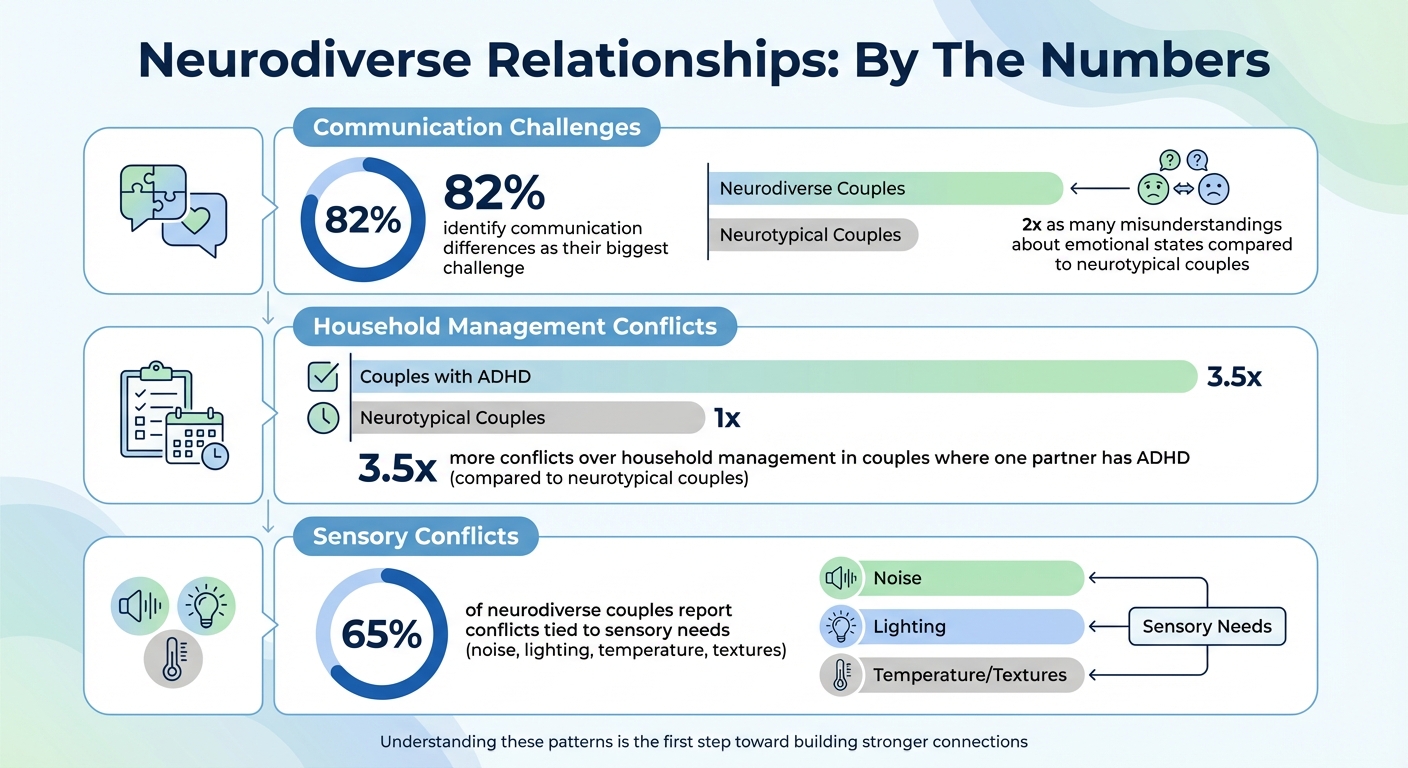
Key Statistics on Neurodiverse Relationship Challenges
Communication Differences and Misunderstandings
Communication is often the core struggle in neurodiverse relationships. In fact, 82% of neurodiverse couples identify communication differences as their biggest challenge [6]. The issue isn’t about one partner being better at communicating – it’s about speaking in fundamentally different ways.
For example, autistic individuals often prefer clear, direct communication, while neurotypical partners may rely on subtle hints, social cues, or implied meanings [6][2]. This can create confusion when, say, one partner says, “I’m fine,” but secretly hopes the other will notice their distress. The neurodivergent partner may take the words at face value, leaving the neurotypical partner feeling unseen or unsupported. These misunderstandings often stem from the different ways their brains process social interactions [1].
Even processing speed can complicate things. One partner might need extra time to think before responding, which the other could interpret as disinterest or avoidance [1][2]. Neurodiverse couples experience twice as many misunderstandings about emotional states compared to neurotypical couples [6]. A pause for internal reflection might be mistaken for anger, or a need for personal space could be read as rejection.
"Neurodiverse relationships tend to grow apart due to the deep resentment of not being able to understand each other." – Yolanda Renteria, LPC [5]
These communication challenges often spill over into other aspects of the relationship, like dividing responsibilities.
Imbalanced Distribution of Responsibilities
Differences in executive functioning – how individuals plan, organize, and handle tasks – are another common source of tension. Couples where one partner has ADHD report 3.5 times more conflicts over household management compared to neurotypical couples [6]. The neurodivergent partner may struggle with remembering tasks or getting started on them, leaving the neurotypical partner feeling overburdened.
This imbalance can lead to resentment on both sides. One partner may feel like they’re doing everything, while the other feels unfairly judged or labeled as lazy [6][2]. The reality, however, is that executive functioning challenges make task initiation and follow-through difficult, not impossible.
Instead of pushing harder, the solution lies in creating systems that align with how each partner’s brain works. Tools like written reminders, shared digital calendars, and regular check-ins can help distribute responsibilities without constant verbal reminders or nagging [4].
But even with systems in place, sensory differences can add another layer of complexity to daily life.
Sensory Sensitivities and Shared Experiences
Sensory differences are another major hurdle for neurodiverse couples. 65% of these couples report conflicts tied to sensory needs, such as disagreements over noise levels, lighting, temperature, or even the textures of food [6]. What feels normal or pleasant to one partner might overwhelm the other.
These differences often extend beyond the home. For instance, one partner might love the excitement of a concert, while the other finds it overstimulating and anxiety-inducing [4][5]. Even physical affection can be tricky – one partner might crave spontaneous touch, while the other finds unexpected contact overwhelming [1][2].
"Sensory mismatches can create confusion, tension, and even hurt feelings if no one explains what’s really going on." – A G, Sagebrush Counseling [2]
It’s important to understand that these are not just preferences or habits – they stem from neurological differences in how each person’s nervous system processes sensory input. When one partner becomes overwhelmed, they might withdraw, which the other could misinterpret as emotional detachment [1][5]. Recognizing these differences is the first step toward finding balance.
How to Build Balanced Neurodiverse Relationships
Setting and Maintaining Healthy Boundaries
Establishing healthy boundaries starts with identifying each partner’s sensory triggers and comforts. The aim is to build a mutual understanding of what soothes or strains each person’s nervous system [1][4].
It’s best to discuss boundaries during calm, neutral moments. Agreeing on nonverbal cues to signal when limits are reached can help avoid misunderstandings. For instance, withdrawal during sensory overwhelm might be misinterpreted as rejection, but it’s often a coping mechanism [4][7].
"Understanding that withdrawal during overwhelm is a coping mechanism, not rejection, helps maintain connection while respecting individual needs." – Crystal I. Lee, Psychologist [7]
Creating sensory-friendly spaces at home – quiet, comforting areas where either partner can retreat – offers a way to self-regulate without the other feeling abandoned [7]. It’s also worth noting that many neurodivergent individuals face co-occurring challenges like anxiety, depression, or C-PTSD, which can make emotional regulation and boundary-setting even more essential [7].
Clear boundaries lay the groundwork for smoother communication.
Developing Better Communication Skills
Communication challenges often arise from differences in neurotypes [1]. Neurotypical partners may rely on subtle emotional cues and expect quick resolutions, while autistic partners often need explicit communication and more time to process complex emotions [7].
Practical tools can help bridge this gap. For example, structured check-ins – pre-scheduled times for discussing larger issues – can ease the pressure of spontaneous emotional processing [4]. Tools like chore calendars, visual reminders, and text messages cater to different processing styles and reduce the strain on executive functioning [1][4]. If verbal communication feels overwhelming, using written notes or visual aids can help clarify needs [7].
Another effective technique is paraphrasing – repeating your partner’s point in your own words to ensure you’ve understood correctly [4]. Asking clarifying questions like, “Do you want advice or just someone to listen?” can also prevent miscommunication [1]. For ADHD partners who may experience rapid emotional shifts, and autistic partners who value routine, "planned spontaneity" – structured plans with room for flexibility – can meet both needs [7].
These strategies foster clearer communication and help both partners feel heard.
Moving from Codependence to Interdependence
Interdependence involves each partner learning to regulate their emotions independently, shifting the focus from blame to understanding how neurological differences contribute to conflicts [7][3].
Partners can act as "translators" for each other’s unique emotional frameworks, recognizing they may not naturally speak the same emotional language [8][3]. Using "emotional pause signals" – agreed-upon cues to pause a conversation – can prevent situations from escalating and allow time for self-regulation [7].
"The work should never center on ‘fixing’ one partner. It’s about creating mutual understanding and shared strategies that support both individuals in feeling safe, seen, and supported." – Ashley Brilliant, Neurodiverse Couples Counselor [3]
The goal isn’t to “fix” the neurodivergent partner but to collaborate on strategies that respect both partners’ needs [3]. This could include creating scripts – pre-prepared phrases for common emotional situations – to reduce stress during tense moments [7]. By depersonalizing conflicts and focusing on shared solutions, couples can build a stronger, more balanced relationship [3].
sbb-itb-596b85d
How Counseling Supports Neurodiverse Couples
Benefits of Specialized Neurodiverse Couples Counseling
Standard therapy often falls short for neurodiverse couples, especially when therapists lack an understanding of neurodivergence. Many couples in these situations report leaving sessions feeling worse – neurodivergent partners may feel unfairly blamed, while neurotypical partners feel emotionally overlooked [3]. Specialized counseling takes a different path, recognizing neurological differences as natural variations rather than deficits [3].
"If the therapist doesn’t understand how neurodivergence impacts connection, communication, and emotional regulation, they risk reinforcing exactly what these couples are working so hard to repair." – Counseling Center Group [3]
Therapists experienced in neurodiverse relationships help bridge the gap between partners who may seem to be speaking entirely different emotional languages [3]. They address what’s known as the "double empathy problem", which suggests that communication breakdowns stem from mismatched neurotypes rather than personal failings [1]. This approach shifts the focus from blame to understanding. For instance, a partner withdrawing during an argument might be experiencing sensory overload, not rejecting the other emotionally [3].
Specialized therapists often adapt well-known methods like the Gottman Method, Emotionally Focused Therapy (EFT), and Cognitive Behavioral Therapy (CBT) to fit the unique needs of neurodiverse couples. These approaches help couples recognize sensory triggers, develop strategies for co-regulation, and create routines that reduce stress tied to executive functioning [5][9]. Training programs, such as those offered by the Association for Autism and Neurodiversity (AANE), equip therapists with the skills to better support these couples [3].
With these tailored techniques, couples can find the understanding and tools they need to strengthen their relationships. Growth and Change Counseling offers a closer look at how these methods are applied in practice.
Growth and Change Counseling Services

Growth and Change Counseling provides specialized support for neurodiverse couples across California [10]. Their Marriage Rescue Institute offers a targeted 12-week coaching program designed to help couples facing significant challenges, including those related to neurodiversity [9]. They serve clients in Campbell, San Jose, Los Angeles, and Roseville, with telehealth options available statewide.
Their approach combines EFT, Internal Family Systems (IFS), and Behavioral Couples Therapy to address issues like sensory overload, improve co-regulation, and develop healthy conflict resolution strategies [9]. Costs for therapy sessions vary: Licensed Marriage and Family Therapist (LMFT) sessions are $200 for 45 minutes, while Associate Marriage and Family Therapist (AMFT) sessions are $150, with sliding scale options starting at $100 [9]. In addition to couples counseling, the practice offers individual therapy, family therapy, parent coaching, and treatment for issues such as anxiety, depression, addiction, and trauma.
Conclusion
Neurodiverse relationships come with their own set of challenges, but these often stem from differences in neurological wiring rather than shortcomings in either partner. As Liz Zhou, a Holistic Therapist, puts it: "Communication difficulties are not due to the deficits of either autistic or allistic people, but due to the differences in neurotype" [1]. Understanding this concept, known as the double empathy problem, encourages partners to focus on building a shared language instead of assigning blame.
Addressing sensory sensitivities is a key step in fostering both emotional and physical closeness. By identifying sensory triggers and practicing co-regulation techniques, partners can avoid the overload that often disrupts their connection. Beyond that, structured communication, clear boundaries, and predictable routines help minimize anxiety and open the door to deeper understanding.
These strategies create a solid foundation for professional guidance. Specialized therapists can help couples navigate these dynamics and, as psychologist Crystal I. Lee describes, develop "emotional bilingualism" – a skill that enables partners to bridge the gap between differing neurological patterns [7].
For those seeking support, Growth and Change Counseling provides tailored services for neurodiverse couples through the Marriage Rescue Institute and dedicated counseling programs. Flexible pricing options make therapy accessible for couples statewide.
FAQs
What are some effective ways for neurodiverse couples to improve communication?
Neurodiverse couples can improve their communication by adopting strategies that honor and adapt to their unique ways of thinking and interacting. A key first step is understanding how each partner processes information, expresses emotions, and picks up on social cues. This shared understanding can go a long way in reducing confusion and building mutual respect.
Giving each other time to process thoughts and emotions is another effective tactic. For instance, discussing topics ahead of time or setting aside moments for reflection can make conversations flow more smoothly. Using clear and straightforward language – like starting with "I feel" statements – and incorporating tools like visual aids can also help close communication gaps, ensuring both partners feel truly heard.
When more guidance is needed, professional counseling designed for neurodiverse relationships can be incredibly helpful. Techniques such as emotion mapping and sensory-aware communication can create a safe and supportive environment, allowing both partners to express themselves while deepening their connection.
How can neurodiverse couples manage sensory sensitivities effectively?
Managing sensory sensitivities in neurodiverse relationships calls for understanding and thoughtful strategies. Start by pinpointing specific sensory triggers – things like loud noises, bright lights, or certain textures – and work together to reduce or avoid these stressors. For instance, creating a quiet, soothing spot at home or using tools like noise-canceling headphones can go a long way in easing sensory overload.
Good communication plays a big role here. Partners can come up with shared signals or phrases to let each other know when they need a break or a shift in environment. Regular check-ins to talk about sensory needs and building routines around sensory regulation can make both partners feel more supported and prepared.
By showing empathy, respecting each other’s sensory boundaries, and customizing strategies to fit individual needs, couples can tackle sensory sensitivities more effectively and build a stronger connection.
Why is it important for neurodiverse couples to seek specialized counseling?
Relationships involving neurodiverse partners – such as those with autism or ADHD – can come with unique challenges. Differences in how each partner processes emotions, communicates, or handles daily routines can sometimes lead to misunderstandings or conflict.
This is where a therapist with expertise in neurodiverse relationships can make a real difference. They can guide couples in developing communication strategies that work for both individuals, help decode emotional cues, and find ways to establish routines that suit their needs. Counseling also offers a safe, judgment-free environment where partners can openly discuss their differences, leading to deeper understanding and respect.
With the right tools and support, neurodiverse couples can overcome challenges and build stronger, more harmonious connections.
Related Blog Posts
- How Sensory Processing Affects Neurodiverse Relationships
- Understanding Emotional Cues in Neurodiverse Couples
- Q&A: Supporting Neurodiverse Couples with Mental Health Issues
- Study: Trust Dynamics in Neurodiverse Relationships
