In neurodiverse marriages, partners often process emotions, communication, and sensory input differently. This can lead to misunderstandings, but with the right strategies, couples can build stronger connections. Here’s a quick summary of how to navigate these relationships:
- Understand Emotional Needs: Clarify your own and your partner’s emotional patterns to avoid assumptions.
- Address Sensory Sensitivities: Identify triggers like loud noises or bright lights and create calming spaces.
- Improve Communication: Use clear, direct language and active listening techniques to reduce misinterpretations.
- Practice Co-Regulation: Develop shared strategies to manage stress and support each other emotionally.
- Set Routines and Boundaries: Create predictable structures that respect both partners’ needs.
- Translate Neurotypes: Learn to interpret each other’s emotional cues through the lens of neurodiversity.
These steps help bridge differences and create a supportive, understanding partnership. If challenges persist, professional counseling tailored to neurodiverse couples can provide additional tools and guidance.
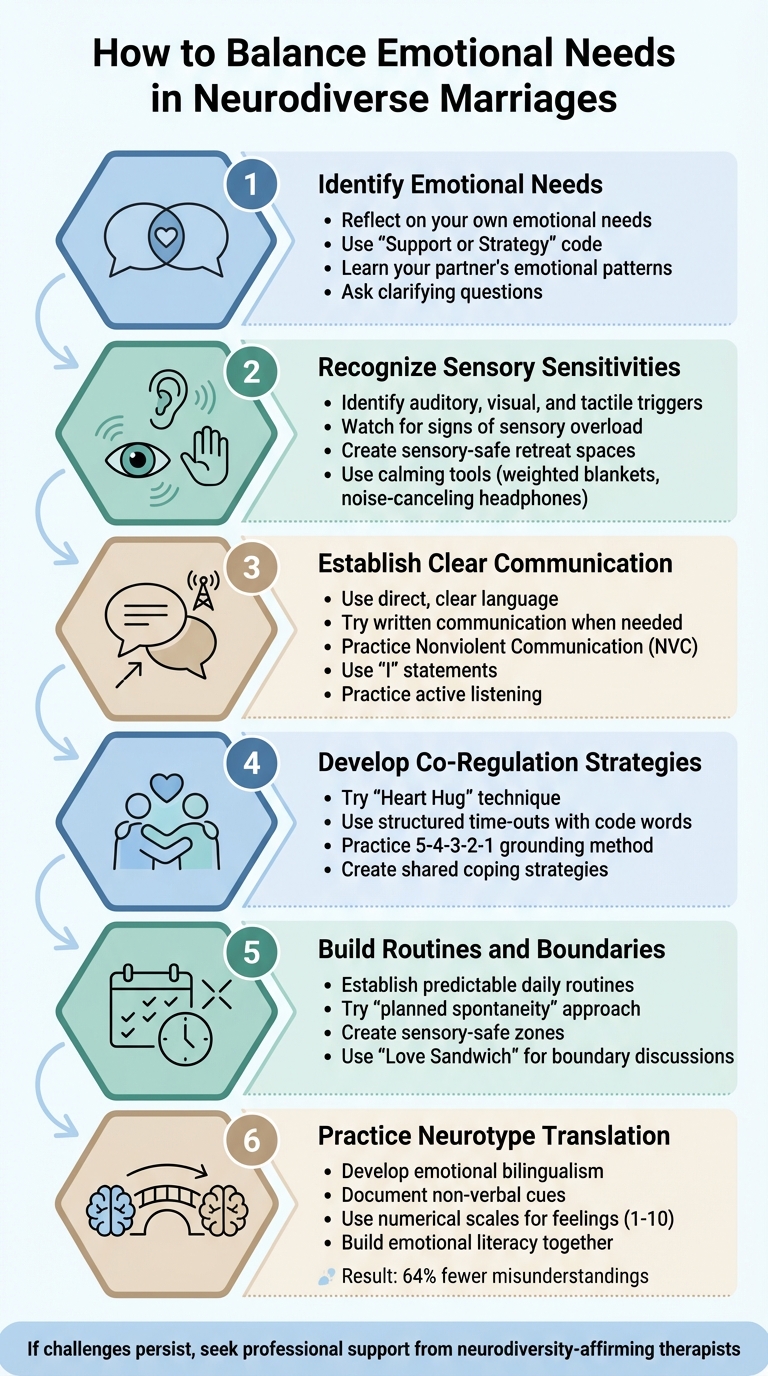
6 Steps to Balance Emotional Needs in Neurodiverse Marriages
“I’m Okay”: Emotional Regulation in Neurodiverse Relationships
Step 1: Identify Your Own and Your Partner’s Emotional Needs
Before finding balance in your relationship, it’s crucial to understand both your emotional needs and those of your partner. Expecting your partner to instinctively know what you need can lead to unnecessary tension – especially in neurodiverse marriages, where partners may process emotions in very different ways [5]. Emotional support isn’t one-size-fits-all. What feels comforting to one person might feel overwhelming to another. For example, one partner might need verbal reassurance during a stressful time, while the other might need solitude to process their emotions. Miscommunication often stems from assumptions, so start by clarifying your own emotional needs.
Reflect on Your Own Emotional Needs
A helpful tool for this is an Emotional Needs Worksheet [6]. Use it to pinpoint specific needs like reassurance, personal space, physical touch, or practical help. Then, finish a statement like: "I know my need is met when my partner [specific action]." Instead of saying, "I need support", try specifying, "I feel supported when my partner listens to me for 10 uninterrupted minutes." This kind of detail eliminates guesswork, which is especially important for neurodiverse partners who may not pick up on unspoken cues [4].
Another strategy is using a "Support or Strategy" code. When discussing a challenge, make it clear whether you’re looking for emotional validation ("support") or practical advice ("strategy"). Leslie A. Sickels, LCSW, explains:
"The goal of providing emotional support is not to agree but rather to identify that something is ‘a difficult situation’ for a partner" [4].
Pay attention to your body as well – it often signals emotional needs before you’re fully aware of them. Notice early signs of stress, like jaw tension, sweaty palms, or a racing heart. These physical cues can indicate that you’re nearing your limit, or leaving your "window of tolerance" – the range of emotional input you can handle before becoming overwhelmed [3]. Recognizing these signals can help you communicate when you need a break to reset, which can improve both self-regulation and mutual understanding in your relationship.
Learn Your Partner’s Emotional Patterns
Once you’ve identified your own needs, take time to understand how your partner processes emotions. Instead of assuming, ask clarifying questions like, "Do you want advice or just someone to listen?" or "What does ‘support’ look like to you in this situation?" [3].
Pay attention to how your partner reacts when they’re stressed or overwhelmed. Do they prefer visual aids or written lists? Do they need to move around or stim to stay engaged in a conversation? For instance, an autistic partner might feel emotions intensely but need extra time to process them, while a partner with ADHD might experience rapid emotional shifts and struggle to focus on your needs when deeply absorbed in a task [5].
Giving a "heads up" before starting an emotional conversation can also help [4]. This gives your partner time to shift from their current activity and be fully present. What might seem like disinterest could actually be their need to mentally transition – a neurological process of switching gears. Additionally, work together to identify your partner’s sensory preferences and triggers [3]. Create a list of comforting stimuli, like weighted blankets or white noise, and note sensory inputs that might overwhelm them. What appears as irritability or emotional withdrawal might actually be their response to sensory overload [2]. By understanding these nuances, you can create a stronger foundation for emotional connection.
Step 2: Recognize Sensory Sensitivities and Overload Triggers
Sensory sensitivities stem from differences in how the brain processes the environment. For many neurodiverse individuals, something that might barely register as a nuisance to a neurotypical partner can feel overwhelming – like physical pain or deep discomfort [2]. Recognizing these triggers is a key step in adjusting your surroundings to meet everyone’s needs.
Common Sensory Sensitivities in Neurodiverse Individuals
Sensory triggers can differ from person to person, but there are some common patterns. For instance, auditory sensitivities might include discomfort with loud music, crowded spaces, constant chatter, or even specific noises like chewing – a phenomenon known as misophonia [2][3]. Visual sensitivities often involve issues with fluorescent or overly bright lighting and cluttered spaces [2][3]. Tactile sensitivities can make physical touch feel overwhelming, and even something as small as a clothing tag or certain fabrics can cause discomfort. Similarly, strong smells or particular tastes may be difficult for those with olfactory and gustatory sensitivities [3][1]. Other common challenges include sensitivity to temperature changes or discomfort with direct eye contact [1][3].
When sensory input becomes too much, it can lead to emotional dysregulation, which may show up as irritability, anxiety, frustration, or withdrawal [2][3]. For example, one couple found that loud music and harsh lighting during a dinner outing led to sensory overload. They later chose quieter, more soothing venues, which allowed them to stay connected [2]. What might look like moodiness or avoidance is often a natural response to overstimulation.
Transform Your Space Into a Comfort Zone
Making thoughtful changes to your environment can significantly reduce sensory overload. Start with lighting: swap out harsh overhead lights for dimmers, warm-toned bulbs, or blackout curtains. Soft lighting options like salt lamps or LED fairy lights can create a calming atmosphere [7].
To manage noise, consider adding thick rugs, soft furnishings, or acoustic panels to absorb sound. White noise machines or nature soundtracks can also help mask unpredictable noises that might otherwise trigger anxiety [7].
Designate a sensory-safe retreat for moments of overwhelm. This could be a quiet, dimly lit room with minimal distractions, cozy seating like bean bags, and soothing tools such as weighted blankets or noise-canceling headphones [2][5]. Keeping sensory aids easily accessible in shared spaces ensures they’re ready when needed most [2][3]. Trauma therapist Yolanda Renteria highlights the importance of these adjustments:
"Honoring and meeting these basic needs for nervous system regulation can play a huge role in developing intimacy and bringing the relationship closer" [1].
Finally, keep visual clutter to a minimum by using labeled storage bins and neutral wall colors. If strong smells are a trigger, opt for unscented cleaning products [7]. These small but impactful changes can help turn your home into a calming space where both partners feel supported and connected.
Step 3: Establish Clear Communication Methods
Miscommunication often arises not from intentional actions but from differences in how people process and interpret the world. Liz Zhou, a holistic therapist, describes this as the "double empathy problem":
"Communication difficulties are not due to the deficits of either autistic or allistic people, but due to the differences in neurotype" [3].
By recognizing this, partners can move away from assigning blame and instead focus on working together to bridge these differences. This mindset creates a foundation for adopting strategies that improve understanding.
Use Clear Communication Techniques
Being direct is key. Neurotypical partners may rely on subtle hints, but neurodivergent individuals often find clear, straightforward language more effective. For example, instead of saying, "It would be nice if someone did the dishes", try, "Please wash the dishes after dinner tonight." Avoid sarcasm or vague comments, as they can lead to misunderstandings.
When tensions rise, written communication can be incredibly helpful. Writing allows both partners time to process and respond without the pressure of an immediate reaction.
Nonviolent Communication (NVC) is another useful tool, providing a framework to express observations, feelings, needs, and requests. For instance: "When plans changed without notice (observation), I felt anxious (feeling) because I need predictability to feel settled (need). Could we agree to discuss schedule changes at least a day ahead when possible? (request)."
Using "I" statements can also make a big difference. Instead of saying, "You always play music too loud", try, "I felt overwhelmed when the music got loud." This approach keeps the conversation focused on personal feelings and avoids putting the other person on the defensive.
Just as important as speaking clearly is ensuring your partner feels genuinely heard.
Practice Active Listening
Active listening builds on earlier efforts to understand emotional needs. It requires giving your full attention to your partner and being aware that some neurodivergent individuals may process emotions differently. For example, someone with alexithymia might experience emotions more as thoughts than physical sensations, making questions like "How does that make you feel?" difficult to answer.
Ask clarifying questions to better understand your partner’s perspective. Leslie A. Sickels, LCSW, explains:
"The goal of providing emotional support is not to agree but rather to identify that something is a difficult situation for a partner" [4].
Reflective listening can help ensure clarity. Saying things like, "What I hear you saying is…" allows your partner to confirm or adjust their message. Additionally, having a pre-agreed code word to pause conversations when someone feels overwhelmed can prevent conflicts from escalating.
As Barbara (Blaze) Lazarony, LMFT, emphasizes:
"Communication isn’t just about talking more – it’s about the importance of building emotional safety and shared meaning" [8].
Step 4: Develop Co-Regulation Strategies for Emotional Support
Building on clear communication, couples can strengthen their relationship by providing mutual emotional support through co-regulation.
What Co-Regulation Is and Why It Matters
Co-regulation is a shared process where partners help each other manage emotions and stress by tapping into their natural biological connection. Research by James Coan revealed a fascinating insight: when married women held their partner’s hand during a potential electric shock, their stress responses in the hypothalamus were almost completely eliminated [9]. This highlights just how impactful a partner’s presence can be in reducing stress at a neurological level.
In neurodiverse relationships, customized approaches to co-regulation are especially important. For example, an autistic partner might withdraw or become quiet when overwhelmed, while a partner with ADHD might experience rapid emotional shifts or intense reactions to small triggers [5]. Crystal I. Lee, a psychologist, describes emotional regulation as:
"the ability to manage, respond to, and modulate emotional experiences in socially appropriate and personally effective ways" [5].
By learning to recognize each other’s stress signals, partners can work together to strengthen their emotional connection and support.
Create Shared Coping Strategies
Understanding the neurological foundation of co-regulation is just the beginning – what truly matters is turning that knowledge into practical strategies. Developing shared techniques to handle stressful moments can make a big difference. For instance, try the "Heart Hug", where you maintain heart-to-heart contact until your breathing syncs up, or the ball toss activity, where you toss a soft ball back and forth while talking to help align your nervous systems during tense situations [9].
Another helpful technique is using structured time-outs to prevent conflicts from escalating. Agree on a code word or hand signal to pause a conversation when one of you feels overwhelmed. Take a short break – about 30 minutes – to allow your nervous systems to calm down [10]. During this time, grounding exercises like the 5-4-3-2-1 method can be effective. This involves noticing 5 things you see, 4 things you can touch, and 3 things you can hear, which helps deactivate the fight-or-flight response [10].
These shared strategies lay the groundwork for creating sensory-friendly routines and setting healthy boundaries in your relationship.
sbb-itb-596b85d
Step 5: Build Sensory-Friendly Routines and Boundaries
Once co-regulation is in place, the next step is creating predictable structures that support both partners’ sensory and emotional needs.
How Routines Reduce Stress
Having consistent routines helps ease mental strain and fosters trust. When couples develop structured habits for recurring situations, they build a dependable framework that simplifies daily interactions and reduces stress. As Rodgers Christian Counseling explains:
"Establishing small daily or weekly rituals… creates stability and shared experiences. These routines reinforce connection and trust in the relationship" [13].
For couples navigating Autistic-ADHD dynamics, routines don’t need to be rigid. Instead, try planned spontaneity – schedules that include room for flexibility. This approach balances one partner’s need for variety with the other’s preference for predictability. Regular check-ins can help fine-tune these routines to ensure they meet both partners’ needs [5][8].
Once routines are established, they create a foundation for setting personal boundaries that safeguard individual well-being.
Establish Clear Boundaries
Predictable routines set the stage for introducing clear boundaries, which further enhance a supportive environment. One effective strategy is creating sensory-safe zones – spaces with adjustable lighting, soundproofing, or other calming features where either partner can retreat when needed [2][5]. Daniel Dashnaw, a couples therapist, highlights the importance of these spaces:
"Sensory-friendly environments significantly reduce stress in partners with sensory sensitivities" [2].
When discussing boundaries, choose calm moments and use the Love Sandwich approach: start by affirming the relationship, clearly state the boundary, and end by reaffirming your commitment [12]. Agree on self-regulation breaks, allowing a partner to step away and regroup when emotions run high [11]. These boundaries not only protect individual well-being but also support mutual emotional balance [11][12].
Step 6: Practice Empathy Through Neurotype Translation
Once you’ve set boundaries and routines, the next step is to dive deeper into how different neurotypes influence emotional expression. This understanding builds on earlier co-regulation strategies, helping you and your partner expand your emotional toolkit.
What Neurotype Translation Means
Neurotype translation is all about interpreting emotional cues through the lens of neurodiversity. Think of it as developing emotional bilingualism – a way to communicate effectively across different neurological patterns [5]. Dr. K, a licensed psychologist and Gottman-certified therapist, describes it well:
"A neuroscience-informed couples therapist is a good-faith translator between the Neurodivergent and their NT spouse" [15].
Instead of viewing communication differences as flaws, this approach reframes them as shared challenges to overcome together [3]. For example, one partner might naturally excel at empathizing and navigating emotional experiences, while the other may shine at logistics and processing information [4]. Recognizing these strengths allows couples to shift from blame to teamwork.
Build Emotional Literacy Together
Using neurotype translation, you can strengthen your ability to communicate emotional states clearly and effectively. This shared emotional literacy helps avoid common misunderstandings. For instance, a neurotypical partner might misinterpret an autistic partner’s need for extra processing time as emotional withdrawal [5]. Similarly, ADHD partners might struggle with emotional object permanence, where hyperfocus can cause them to temporarily lose sight of their partner’s needs [5].
To make this process part of your daily interactions, develop tools that complement your existing communication strategies. For example:
- Document non-verbal cues and tones to better understand each other’s emotional signals.
- Use numerical scales to express feelings (e.g., "My anxiety is at an 8").
- Apply the "Support or Strategy" code to clarify whether a partner needs emotional validation or practical solutions [4].
These tools can make a big difference. Research shows that couples who learn to identify and respond to their autistic partner’s unique emotional signals experience 64% fewer misunderstandings [14].
Crystal I. Lee, a psychologist who specializes in neurodiverse relationships, highlights why this work is so important:
"Understanding these differences isn’t just about tolerance; it’s about building bridges of comprehension that strengthen relationships and create deeper intimacy" [5].
Get Professional Support from Growth and Change Counseling
How Growth and Change Counseling Can Help
Sometimes, personal efforts to improve a relationship just aren’t enough. That’s where professional guidance can make all the difference. Growth and Change Counseling offers neurodiversity-affirming therapy that focuses on strengths rather than weaknesses, helping couples develop a shared language to overcome communication challenges [3]. Building on strategies like creating sensory-friendly environments, improving communication clarity, and practicing co-regulation, their therapists customize these approaches to fit each couple’s specific needs.
The counseling team recognizes that communication struggles often arise from differences in neurotypes, not personal shortcomings. They help couples navigate what’s known as the "double empathy problem", where misunderstandings are rooted in neurological differences rather than a lack of effort [3]. Therapists also guide couples in distinguishing between behaviors driven by neurological patterns, such as ADHD-related emotional intensity, and actual relationship issues, helping to prevent unnecessary conflicts [5]. Growth and Change Counseling provides a range of services, including couples counseling, individual therapy, and support tailored for mixed-neurotype relationships. With offices in Campbell, Los Angeles, and Roseville, California, as well as telehealth options statewide, their expertise is accessible to many. Their goal is to provide structured, practical support that helps couples reconnect and strengthen their bond.
The Marriage Rescue Institute: Rebuilding Connections
For couples experiencing serious challenges, the Marriage Rescue Institute offers a focused, 12-week program designed to help rebuild and restore marriages. This intensive approach includes detailed assessments, actionable tools, and the establishment of predictable routines to minimize relationship stress [16].
What sets this program apart is its effectiveness for neurodiverse couples. It incorporates neurotype translation, which helps partners articulate their emotional experiences in ways the other can better understand [5]. Instead of the slower pace of traditional therapy, the Marriage Rescue Institute offers a results-oriented path for couples in crisis. If you’re ready to explore whether this program is right for you, you can contact Growth and Change Counseling at +1 408 461 9658 or email them at support@johnmarkkane.com.
Conclusion: Balance and Connection in Neurodiverse Marriages
Navigating emotional needs in a neurodiverse marriage is about understanding different ways of processing the world – not about fixing flaws or questioning the presence of love [8][13]. When couples recognize that communication challenges stem from neurological differences, it opens the door to deeper, more authentic connections [3]. This perspective lays the groundwork for using the practical strategies discussed earlier.
The steps outlined in this guide aim to create a sense of emotional safety. As Barbara (Blaze) Lazarony, LMFT, wisely notes:
"Repair is more important than perfection. Small, consistent practices can dramatically shift the emotional climate of your relationship" [8].
Consistency and mindfulness are key to fostering engagement.
It’s also important to remember that sensory overload is a physical response from the nervous system, not a sign of rejection. Strategies like using the "Support or Strategy" phrase, implementing emotional pause signals, and scheduling regular check-ins can help couples navigate these moments with greater understanding [4][8][5]. If progress feels out of reach, professional help can make a difference. Growth and Change Counseling offers neurodiversity-affirming therapy, providing tailored tools and a shared language to enhance communication and co-regulation. For couples facing significant challenges, The Marriage Rescue Institute offers an intensive 12-week program designed for situations where traditional methods haven’t worked.
Building a thriving neurodiverse marriage takes patience, practice, and sometimes expert guidance. By embracing these strategies and valuing your differences, you can shift from misunderstanding to meaningful connection. The journey is worth the effort, and support is always available.
FAQs
How can I better understand and express my emotional needs in a neurodiverse marriage?
Understanding and sharing your emotional needs in a neurodiverse marriage begins with self-awareness. Take a moment to think about what helps you feel supported, connected, or perhaps even what leaves you feeling overwhelmed. Maybe you value quality time, need personal space, or find reassurance essential – recognizing these specific needs is key to maintaining your emotional well-being.
Once you’ve pinpointed what you need, the next step is to communicate this clearly to your partner. Use straightforward and direct language to express yourself. For instance, you could say, “When I’m feeling stressed, I need some quiet time to recharge.” Adjust your communication approach to fit the dynamics of your relationship. Whether it’s through structured routines, visual aids, or even agreed-upon code words, finding methods that work for both of you can make a big difference in bridging gaps in emotional understanding.
Focusing on open dialogue and mutual respect helps build a stronger emotional connection and creates a more supportive space for you and your partner to thrive together.
How can we create a home environment that supports sensory sensitivities?
Managing sensory sensitivities at home begins with pinpointing what triggers discomfort and making thoughtful changes to minimize overstimulation. You might try setting up a calming area featuring soft lighting, gentle sounds, or comforting items like weighted blankets to provide relief during sensory overload.
It’s also helpful to establish clear boundaries regarding sensory needs. Tools like visual cues or written reminders can make communication smoother and reduce the chances of feeling overwhelmed. These small adjustments can go a long way in creating a more supportive and understanding atmosphere for everyone at home.
How can we communicate better and avoid misunderstandings in a neurodiverse marriage?
Improving communication in a neurodiverse marriage begins with understanding and valuing each partner’s unique way of processing emotions and expressing themselves. Using straightforward and direct methods – like "I" statements, written notes, or even visual aids – can help clarify messages and reduce the chances of miscommunication. Giving your partner extra time to process what’s been said and respond thoughtfully can also go a long way in avoiding unnecessary frustration.
Developing shared emotional cues, such as specific code words or signals, can make it easier to convey feelings or needs without misunderstanding. Professional support, like neurodiverse couples counseling, can offer strategies tailored to help navigate emotional and sensory differences. By practicing patience, showing empathy, and maintaining structured routines, couples can strengthen their bond and work through challenges more effectively.
Related Blog Posts
- Understanding Emotional Cues in Neurodiverse Couples
- Top Strategies for Emotional Regulation in Neurodiverse Couples
- How ADHD and Autism Impact Emotional Regulation in Relationships
- Study: Trust Dynamics in Neurodiverse Relationships
