Neurodiverse relationships – where one partner is neurodivergent (e.g., autistic, ADHD) and the other is neurotypical – face unique challenges in building and maintaining trust. Key takeaways from the study include:
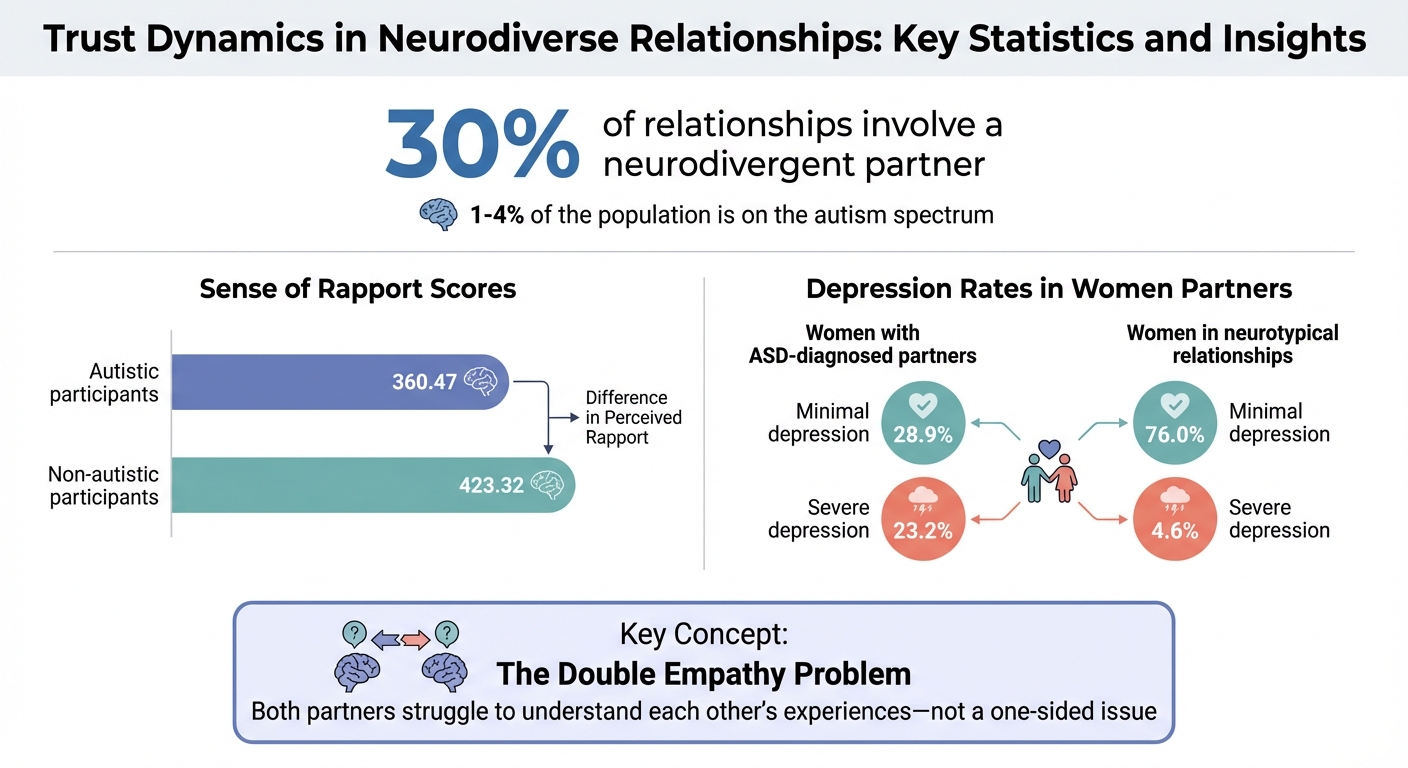
- 30% of relationships involve a neurodivergent partner.
- Communication differences, like slower response times or misinterpreted behaviors, often lead to misunderstandings.
- The "Double Empathy Problem" explains how both partners struggle to understand each other’s experiences, rather than it being a one-sided issue.
- Trust is often weakened by emotional distance, sensory overload, or mismatched expectations in emotional expression.
Practical solutions include:
- Using clear, direct communication (e.g., written notes or structured conversations).
- Recognizing and respecting sensory and emotional needs.
- Seeking professional guidance from neurodiverse couples therapists.
Trust Dynamics in Neurodiverse Relationships: Key Statistics and Mental Health Impact
A New Mindset for Navigating Neurodiverse Relationships
sbb-itb-596b85d
How Communication Differences Affect Trust
Communication challenges in neurodiverse relationships go beyond mere frustration – they can actively weaken trust. When partners process information differently, even straightforward conversations can spiral into a web of misunderstandings. Research shows these aren’t isolated incidents but consistent patterns that demand deliberate effort to navigate. These differences, outlined below, often lead to misinterpretations that strain trust between partners.
Processing Information and Misunderstandings
On the surface, a conversation might seem ordinary, but deeper processing differences can quietly disrupt trust. For instance, many autistic individuals have advanced language skills, which can mask slower cognitive processing. Researcher Edwards points out:
"The more sophisticated the person’s language is, the greater the problem may be… leading to much misunderstanding, confusion and stress." [6]
Neurological factors, such as reduced grey matter in areas responsible for interpreting social signals, make reading facial expressions and tone more challenging.[6] This isn’t due to a lack of effort or care – it’s simply how their brains work. Tracy, a neurotypical participant, described the emotional toll of these differences:
"Reactions and lack of reaction set up barriers which erode emotional reciprocity. If, when you speak to someone, the person does and says nothing, one gradually stops speaking to that person; so, no emotional connection." [6]
The gap in rapport is measurable. Autistic participants reported a significantly lower sense of connection (Mean = 360.47) compared to non-autistic participants (Mean = 423.32).[1] These numbers reflect a real and substantial disconnect in how partners perceive their interactions. This mismatch in processing often leads to deeper emotional divides, as explored below.
Different Expectations and Emotional Distance
The challenges don’t stop with language. Differing emotional needs between partners can further erode trust. Neurotypical individuals may seek frequent interaction and reassurance, while neurodivergent partners often require solitude to manage sensory overload.[6] Neither approach is inherently wrong, but when these needs clash, it can create a damaging cycle of pursuit and withdrawal.
A concept known as the prompt dependency cycle highlights how couples attempt – and often fail – to bridge this gap. Neurotypical partners may resort to giving explicit instructions to elicit emotional responses: "Can you hug me?" or "Did you notice I’m upset?" Dawn, a neurotypical participant, shared her perspective:
"I have to ask, knowing I may sound like a nosy nag, because silence means no emotional response." [6]
For the neurodivergent partner, this dynamic can feel overwhelming. They may either become reliant on these prompts or withdraw entirely to preserve their peace, which leads to emotional distance and surface-level interactions.
Rachelle, a neurodivergent participant, explained:
"I don’t answer the way he expects emotionally…I simply don’t know how." [6]
This isn’t about withholding affection – it stems from challenges with emotional regulation and understanding social expectations. Unfortunately, without recognizing this difference, neurotypical partners might interpret the lack of response as waning affection or even a breach of trust. Wilhelmina, another neurotypical participant, described the outcome:
"Our day-to-day conversations are superficial. They revolve around chores and how your day has been…so there’s no exploration of in-relationship interaction." [6]
These dynamics, left unaddressed, can create emotional walls, making it harder for partners to feel connected and secure in their relationship.
Emotional Regulation and Trust
Emotional regulation often adds another layer of complexity to trust in neurodiverse relationships, especially following communication challenges. It’s not just about managing emotions; it’s also about how emotions are identified and expressed. When one partner struggles to articulate their feelings, the other might mistake the silence for indifference. This disconnect often stems from differences in how emotional and sensory input is processed, creating fertile ground for misunderstandings and tension.
Strong Emotions and Sensory Overload
For autistic individuals, emotional dysregulation is often closely linked to sensory overload[9]. Research by Kelly B. Beck, PhD, from the University of Pittsburgh‘s Department of Psychiatry, highlights how many autistic individuals fail to catch early signs of emotional distress, only recognizing their feelings when they’re already overwhelmed[9]. By the time they realize they’re emotionally flooded, they might withdraw or shut down, which can be misconstrued by their neurotypical partner as avoidance or disinterest. Without understanding the sensory triggers involved, the neurotypical partner may interpret these reactions as a lack of effort or care, leading to conflict and feelings of rejection[9].
Dennis, a participant in one study, shared his experience:
"Having a son with autism and intellectual disability, there’s the stress on the bonds that I have with my wife, and it’s that constant stress that means I’m having to work harder."[2]
Environmental factors like loud noises, harsh lighting, or sudden changes can amplify emotional dysregulation[9]. This often forces neurodivergent individuals to mask their authentic reactions, which can erode trust over time.
Attachment Styles and Reliability
Attachment styles also play a significant role in shaping trust within relationships. For individuals with high attachment anxiety, trust decisions are often based on emotional closeness rather than a rational assessment of their partner’s reliability[8]. This means that someone with heightened fear of abandonment may place trust in a partner who doesn’t consistently meet their needs. Compounding this, high attachment anxiety is linked to weaker cognitive-control abilities, making it easier to overlook warning signs in favor of emotional impressions of the relationship[8].
Greg, another study participant, described how these dynamics manifest in his household:
"My wife cannot understand how we think some of the time… She’s the only neurotypical in the house, so it’s a fairly big strain on her."[2]
These mismatches in emotional needs and expectations can create significant relational imbalances. The mental health toll is clear: studies show that only 28.9% of women with ASD-diagnosed partners report minimal depression, compared to 76.0% of women in neurotypical relationships. On the other hand, 23.2% of women with ASD-diagnosed partners experience severe depression, versus just 4.6% in neurotypical relationships[7].
These statistics highlight the profound impact that challenges in emotional regulation and reliability can have over time. By understanding these patterns, couples can begin to explore strategies for emotional growth to rebuild trust and strengthen their connection.
How to Build and Restore Trust
Rebuilding trust in neurodiverse relationships requires approaches that respect natural neurological differences rather than pushing neurotypical standards onto one partner. This perspective allows both individuals to feel valued and understood, creating a stronger foundation for trust. These strategies build on earlier discussions about communication and emotional intelligence, offering practical ways to repair and strengthen bonds.
Clear and Direct Communication
Strong communication is the cornerstone of trust repair. The ATTUNE model provides a helpful guide, focusing on Awareness, Turning toward, Tolerance, Understanding, Non-defensive responding, and Empathy [10]. Zach Brittle, a Certified Gottman Therapist, describes this process as:
"The work of attunement and trust building is a single conversation spread out over the many seasons of a marriage" [10].
For many couples, face-to-face conflict can feel overwhelming. Alternatives like written notes, video calls, or brief phone check-ins can ease the pressure and improve clarity. Another helpful tool is creating a shared "inventory of struggles." This list identifies common triggers – such as interruptions, sensory overload, or emotional withdrawal – and outlines strategies for addressing them proactively. Starting tough conversations with a softened approach, where you assume good intentions from your partner, can also reduce defensiveness and build trust [5].
Setting Achievable Expectations
It’s important to acknowledge that both partners may find it challenging to understand each other’s inner experiences. This is part of what researchers call the "double-empathy problem." Andrea Stafford highlights this dynamic:
"Rather than viewing autistic traits as inherently disordered, these affirming viewpoints emphasise the context and dynamics of two-way communication" [11].
Building trust also means recognizing and respecting sensory needs. Neurodivergent partners should openly share their sensitivities to things like light, sound, or touch, while neurotypical partners strive to understand how these factors impact their partner’s nervous system [5][4]. Research shows that feeling supported, cared for, and validated – known as partner responsiveness – is a key predictor of relationship satisfaction for both autistic and non-autistic individuals [3]. By setting realistic expectations around emotional expression and daily routines, couples can create a foundation of mutual respect.
Getting Professional Help
Sometimes, communication and sensory challenges can feel too complex to navigate alone. Professional guidance can play a critical role in bridging these gaps. As Benjamin Meyer, LCSW, explains:
"The truth is that working with somebody who understands neurodiversity… can be critical in building understanding, communication, and a positive relationship" [4].
Therapists familiar with neurodiversity can act as interpreters, helping partners who may feel like they’re speaking entirely different languages due to neurological differences [4][11].
Growth and Change Counseling offers specialized services tailored to neurodiverse couples. Their offerings include individual therapy, couples counseling through The Marriage Rescue Institute, and telehealth options for clients in California. With a neurodiversity-informed approach, they help couples work through trust issues while respecting each partner’s unique neurological makeup. Individual therapy sessions are priced at $200 for 45 minutes, with sliding scale options starting at $100. For couples in crisis, a 12-week intensive program provides focused support.
Conclusion: What Neurodiverse Couples Should Know
Trust in neurodiverse relationships isn’t about trying to "fix" one partner or forcing neurotypical expectations on someone whose brain works differently. Studies highlight that partner responsiveness – the sense of feeling supported, cared for, and validated – is a key predictor of relationship satisfaction for both autistic and non-autistic partners[3]. When couples move away from seeing differences as deficits and instead embrace them as natural variations, it fosters a healthier dynamic. This perspective aligns with the concept of the double-empathy problem, which emphasizes the mutual difficulties both partners may face in understanding each other.
Considering that around 1%–4% of the population is on the autism spectrum, understanding these dynamics is crucial for building lasting trust[11].
Practical steps like explicit communication, reflective listening, structured time-outs, and respecting sensory needs create a solid foundation for trust. These strategies are especially effective when paired with professional guidance. Therapists well-versed in neurodiversity can make a significant difference by addressing unique challenges such as differing communication styles, sensory sensitivities, and processing differences. As Benjamin Meyer, LCSW, explains:
"Working with somebody who understands neurodiversity… can be critical in building understanding, communication, and a positive relationship."[4]
For couples seeking tailored support, Growth and Change Counseling provides neurodiverse couples counseling and various mental health services designed to tackle the unique challenges these relationships face.
Trust in neurodiverse relationships is absolutely possible. With patience, clear communication, respect for neurological differences, and professional support when needed, these relationships can flourish despite their unique challenges.
FAQs
What are effective ways for neurodiverse couples to improve communication and build trust?
For neurodiverse couples, building trust and improving communication often begins with acknowledging and appreciating their distinct neurological traits. Misunderstandings can stem from differences in how each partner processes information or expresses emotions, making it essential to understand and adapt to each other’s communication preferences.
Some practical approaches include practicing active listening, expressing needs clearly, and fostering an environment where both partners feel safe to share without fear of judgment. Techniques like using "I" statements, relying on written communication for clarity, or scheduling structured times for discussions can make conversations more effective and reduce potential conflicts.
Additionally, seeking professional counseling tailored to neurodiverse relationships can offer valuable, customized strategies. This guidance helps couples build better communication habits and nurture a deeper emotional connection.
How does sensory overload affect trust in neurodiverse relationships?
Sensory overload is a frequent challenge in neurodiverse relationships, often influencing trust by affecting emotional regulation and communication. It happens when overwhelming sensory inputs – like loud noises, bright lights, or chaotic surroundings – trigger intense stress or anxiety. This can result in behaviors, such as withdrawal or irritability, that may be misinterpreted by the other partner as emotional distance or lack of support.
When sensory sensitivities go unaddressed, they can create ongoing strain in everyday interactions, sometimes leading to feelings of rejection or emotional disconnection. Understanding and addressing these sensory needs with personalized approaches is key to fostering trust and ensuring emotional safety in neurodiverse relationships.
Why is therapy helpful for neurodiverse couples?
Therapy can play a crucial role in helping neurodiverse couples navigate the unique challenges that often arise in their relationships. For instance, conditions like autism can influence how emotions are expressed or how social cues are interpreted, which might lead to misunderstandings or a sense of disconnection between partners.
With the help of a therapist, couples can explore these dynamics in a supportive environment. A professional trained in neurodiverse relationships can guide partners toward better communication, helping them understand each other’s needs and perspectives. This personalized approach often leads to deeper connections and greater satisfaction in the relationship, laying the foundation for a healthier and more rewarding partnership.
Common Questions for Growth and Change Counseling
- Trauma, Addiction, and Neurodiverse Relationships
- Understanding Emotional Cues in Neurodiverse Couples
- Q&A: Supporting Neurodiverse Couples with Mental Health Issues
- Ultimate Guide to Emotional Growth for Neurodiverse Couples
