If I take over my partner’s recovery, that’s codependency. If I set clear limits and let them own their choices, that’s accountability.
In trauma, addiction, and recovery relationships, both can look like “help.” But they work in very different ways. Codependency means I start managing my partner’s sobriety, feelings, money problems, or missed commitments. Accountability means I support recovery without doing their job for them.
Here’s the short version:
- Codependency = I over-function for my partner and under-function for myself.
- Accountability = each person owns their actions, recovery plan, and follow-through.
- The dividing line is boundaries: what I will do, not how I will force my partner to change.
- When relapse risk goes up, codependency often leads to secrecy, shame, burnout, and resentment.
- When limits are clear, accountability makes more room for trust, safety, and self-respect.
- Research behind CRAFT-style support shows that calm, boundary-based responses work better than pressure and control.
A few signs help me tell the difference fast:
- If I’m covering for missed meetings, paying for the fallout, or making excuses, I’m likely crossing the line.
- If I’m using phone checks, constant location demands, or threats, I’m not building accountability, I’m policing.
- If I’ve written clear agreements, named my limits, and let consequences stand, I’m closer to healthy support.
The main point: I can care deeply about someone in recovery without becoming their manager, parent, or rescue plan.
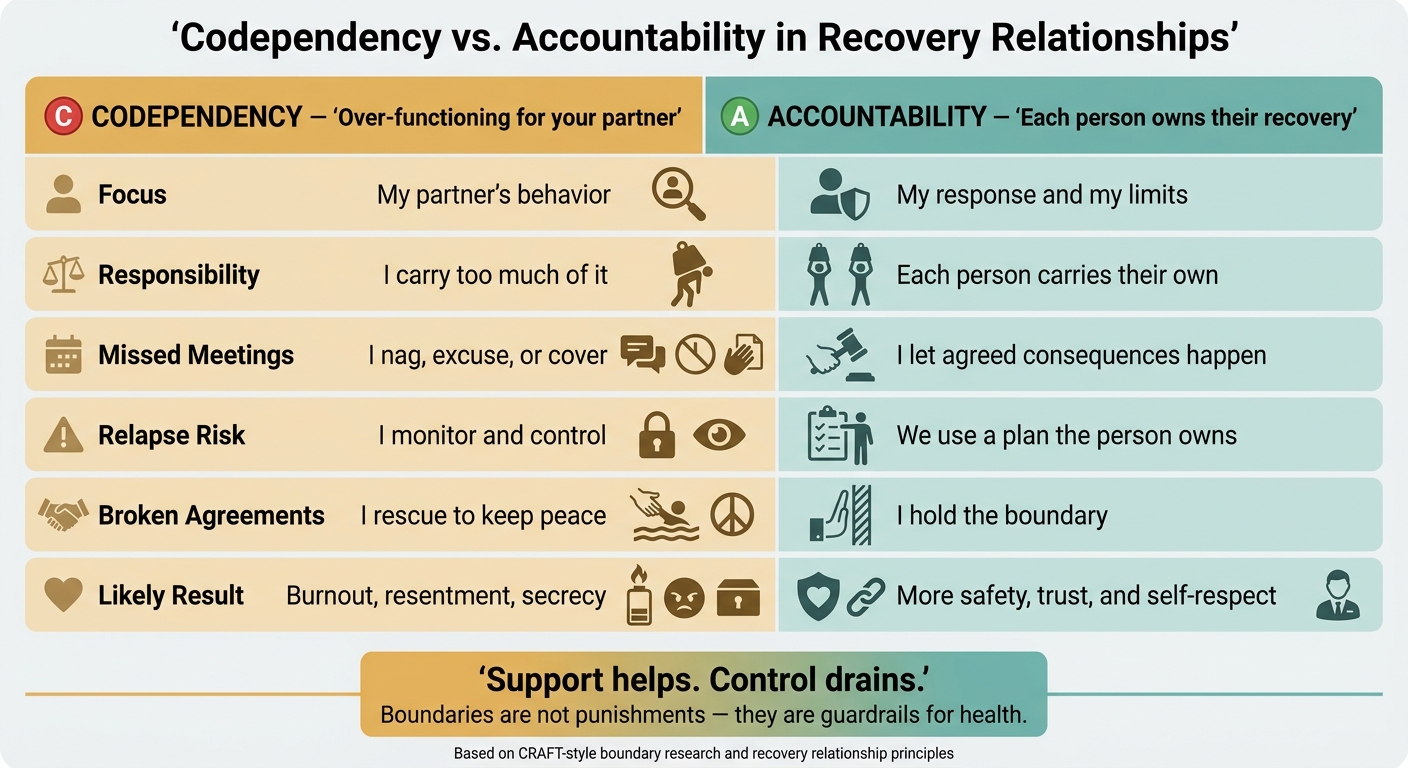
Codependency vs. Accountability in Recovery Relationships
Accountability vs Control: Supporting Without Codependency as you Recover Your Soul
sbb-itb-596b85d
Quick Comparison
| Area | Codependency | Accountability |
|---|---|---|
| Focus | My partner’s behavior | My response and my limits |
| Responsibility | I carry too much of it | Each person carries their own |
| Missed meetings | I nag, excuse, or cover | I let agreed consequences happen |
| Relapse risk | I monitor and control | We use a plan the person owns |
| Broken agreements | I rescue to keep peace | I hold the boundary by setting healthy boundaries |
| Likely result | Burnout, resentment, secrecy | More safety, trust, and self-respect |
Put simply: support helps; control drains. The rest of this piece breaks down how I can spot the difference and shift from over-helping to clear, steady accountability.
Codependency in recovery: when helping becomes over-functioning
Codependency in recovery is over-functioning. One partner starts carrying the other person’s addiction, emotions, and day-to-day responsibilities. It often starts with losing yourself in your partner’s addiction, until your own well-being gets tied to managing their substance use [4][2]. Licensed Professional Counselor Nancy L. Johnston puts it in plain terms:
"Codependency is… overfunctioning for others and underfunctioning for self." [4]
The pattern is pretty clear. One partner keeps taking on more, while their own needs get pushed aside. That’s the line where support stops being healthy and starts taking over someone else’s job.
Common signs of codependency between partners
At first, these signs can look like love or loyalty. In practice, they often mean covering up missed meetings, paying for problems caused by substance use, lying to protect the relationship, or reshaping your whole life around the other person’s sobriety [2].
At the center of it is one idea: I’m responsible for keeping my partner sober. As author Melody Beattie says:
"We rescue. We fix other people’s problems. We do their work. We do things for them they can and should do for themselves. Then, we get mad at them for being irresponsible." [7]
Once that pattern settles in, it doesn’t just wear down the relationship. It also chips away at recovery.
How codependency damages both recovery and the relationship
When you protect a partner from the results of their actions, the line between support and enabling gets muddy [2][5]. That kind of over-helping can lead to resistance, secrecy, or dropping out of recovery when outside pressure disappears [5]. Trust gets weaker. Accountability slips. Relapse prevention gets harder [4].
The partner doing all the over-functioning pays a price too. Burnout, resentment, and constant anxiety are common [2][7]. Hobbies fade. Friendships drift. Support systems shrink. Little by little, the relationship stops being about two people sharing responsibility and starts revolving around sobriety alone.
Accountability in recovery: support without control
If codependency means doing too much for someone else, accountability means shared responsibility. Each person owns their own actions, recovery plan, and commitments. One partner doesn’t run the other’s life.
As Melody Beattie puts it:
"The only person you can now or ever change is yourself. The only person that is your business to control is you." [7]
That’s the starting point. Accountability can support sobriety without turning one partner into a monitor, parent, or therapist.
What healthy accountability looks like day to day
Day to day, accountability works best when it’s based on clear agreements, not guesswork. A couple might agree to regular recovery check-ins on a set schedule. Those talks aren’t meant to feel like interrogations. They’re simple, honest conversations about how things are going. Using a couples communication guide can help keep these check-ins productive.
Money is another common area. If addiction has hurt household finances, shared access to bank accounts and spending can help protect both people. That doesn’t have to be a punishment. It’s just one way to put guardrails in place while restoring trust in the marriage is underway. The point is to support sobriety without making one partner the other’s supervisor.
The difference between accountability and policing
There’s a big difference between checking in and keeping watch. Asking a direct question after a rough day, talking openly about relapse risk, or holding a boundary you both agreed on, that’s accountability. Going through a partner’s phone without permission, demanding location updates all day, or using threats to force compliance is something else. That’s policing. And it pushes the relationship toward control instead of trust.
Psychotherapist Michelle Farris says it plainly:
"A healthy boundary is what determines how I spend my time and energy and what I participate in and what I remove myself from. It’s about what I choose to do to protect myself. It’s not about getting the other person to change." [3]
Policing tries to force change from the outside. Accountability asks the person in recovery to choose it for themselves. You see that difference most clearly when relapse risk goes up, meetings are missed, or agreements get broken.
Codependency vs. accountability: differences couples can recognize
The real test is what happens day to day. On the surface, both codependency and accountability can look like love. The split shows up in what each pattern leads to.
As psychotherapist Michelle Farris puts it:
"The hardest part of codependency in relationships is that from the outside, it can look like love." [3]
You see the gap most clearly during stress. Relapse risk, missed meetings, and broken agreements tend to make the pattern obvious.
How each pattern plays out during relapse risk, missed meetings, and broken agreements
| Situation | Codependent Response | Accountability Response | Likely Result |
|---|---|---|---|
| Relapse risk | Monitoring, policing, and trying to control the partner’s environment | A safety plan the partner owns | Codependency: secrecy and shame / Accountability: dignity and safety |
| Missed meetings | Making excuses for the partner or nagging them to attend | Letting missed meetings have consequences | Codependency: enabling and stagnation / Accountability: self-correction |
| Broken agreements | Rescuing the partner from the fallout to save the relationship | Enforcing agreed-upon boundaries | Codependency: resentment / Accountability: emotional safety |
This lines up with what challenges in partner support aim to address. Research on CRAFT backs it up: boundary-based, nonconfrontational support works better than pressure. [5]
Why boundaries are the dividing line between the two patterns
Boundaries are the line between support and control. As Bill Rodman, founder of Grace Point Treatment Center, puts it:
"Protective boundaries are not punishments; they are guardrails for health." [5]
Codependency tries to manage the other person’s behavior. Accountability defines your response. That’s the key shift. It moves from “you need to stop” to “here’s what I’ll do if this happens again.”
That change matters because boundaries protect both people. They give the person in recovery a clear, steady structure. And they help protect the non-using partner’s emotional stability.
When boundaries are missing or keep changing, the relationship can become enmeshed. One partner’s relapse or missed meeting knocks both people off balance. Healthy accountability keeps each person separate, with their own job to do, even when they’re working toward the same goals. Accountability protects boundaries. Codependency wears them down.
How to move from codependency to accountability
Once you can spot the pattern, the next step is to change how you respond. The shift from codependency to accountability usually comes down to three moves: notice over-functioning, set limits, and write agreements.
First, look at where you’re doing too much. Ask yourself: Am I taking care of things my partner can handle on their own – managing their schedule, making excuses for them, or dealing with the fallout of their choices? If someone asks for a favor and your gut says no, but you say yes anyway, that pause matters. It often points to a boundary before you even say it out loud.
Second, state your limits clearly, and keep them focused on your own actions. A boundary is about what you will do to protect your time, energy, and safety. Start small if you need to. One first step might be leaving the room when a conversation turns hostile or when your partner is intoxicated. [3] You’re not trying to control their behavior. You’re deciding how you’ll respond.
Third, put agreements in writing. Write out the recovery agreement, including each partner’s commitments and what happens if those commitments are broken. This helps create clear limits, especially when relapse patterns keep showing up. [5]
If this pattern has been in place for a long time, outside help can make it easier to stay steady. Emotionally Focused Therapy (EFT) can help couples move out of blame cycles and toward vulnerability and repair in the attachment bond. [1] Individual therapy can also help with trauma, anxiety, depression, or attachment wounds that feed codependent patterns. [6]
Key points for couples to keep in mind
In day-to-day life, the difference comes down to responsibility. Codependency takes on another person’s responsibility. Accountability leaves that responsibility with the person in recovery. Boundaries are not punishments. They’re guardrails that protect health and make each person’s role plain, which helps reduce enabling.
FAQs
How do I know if I’m enabling?
Ask yourself if your actions help your partner stand on their own or keep them leaning on you. True support pushes responsibility forward. Enabling often shows up as doing too much, making excuses, or fixing problems your partner should deal with themselves.
You may be enabling if you take on responsibilities that aren’t yours, jump in when no one asked for help, or spend so much time trying to fix your partner that your own well-being takes a back seat. Growth and Change Counseling can help you sort through these patterns.
What should a recovery boundary sound like?
A recovery boundary should sound firm, respectful, and centered on your own needs not on trying to control your partner.
Use I-statements like: “I feel overwhelmed when plans change at the last minute, so I need to step away.”
Say the boundary clearly. Don’t over-explain, justify, or apologize for it. If the boundary gets crossed, state the consequence in a calm, direct way: “If this continues, I will leave the room for 30 minutes to take care of myself.”
What if my partner refuses accountability?
If your partner refuses accountability, stop putting your energy into trying to change them. Put that energy into protecting your own well-being instead. You can’t control your partner, but you can control how you respond.
Set clear, firm boundaries and stick to them. That might mean stepping away from conversations that go nowhere instead of getting pulled into the same argument again. Keep your focus on your own growth, and get professional support if you need it so you can handle the situation without losing yourself.
Related Blog Posts
- Boundaries for Addiction Recovery and Healthy Love
- How Couples Build Accountability After Addiction
- Accountability vs. Enabling in Addiction Recovery
- Codependency vs. Healthy Support in Relationships
