Trauma doesn’t just affect one person – it impacts entire families. When someone experiences trauma-induced stress, their behaviors, emotions, and even physical health can ripple through their household, creating challenges for everyone involved. Here’s what you need to know:
- Trauma-induced stress vs. everyday stress: Unlike general stress, trauma-induced stress is long-lasting, deeply affecting the body and mind.
- Family-wide effects: Stress spreads through families via subtle cues, leading to emotional disconnection, strained relationships, and even physical health problems like sleep disturbances and chronic fatigue.
- Impact on children: Kids are particularly vulnerable, with trauma in the home linked to anxiety, developmental delays, and long-term health risks.
- Health consequences: Prolonged exposure to trauma-induced stress can lead to heart disease, weakened immunity, and even changes in brain development.
- Communication breakdowns: Trauma often disrupts family communication, creating tension and misunderstandings that weaken bonds.
Seeking professional help, such as therapy or counseling, can help families rebuild trust, improve communication, and manage the effects of trauma. For those in the Roseville area, a marriage therapist can provide specialized support for couples navigating these challenges. Early intervention is key to preventing long-term damage and fostering recovery.
How Childhood Trauma Affects the Brain and Body Across a Lifetime- The ACES Study
sbb-itb-596b85d
What Is Trauma-Induced Stress?
Trauma-induced stress is the physical and emotional response to events that provoke intense fear for one’s own safety or the safety of loved ones. These events can range from car accidents and assaults to natural disasters or witnessing acts of violence [4]. Unlike ordinary stress, which is temporary, trauma-induced stress fundamentally alters how the body and mind react to perceived threats [5][2].
The Center for Substance Abuse Treatment describes these reactions as "normal reactions to abnormal circumstances", not a sign of personal weakness [5]. However, this type of stress can disrupt daily life, making it difficult to maintain routines or a sense of normalcy [4]. People often feel as though their safety and future have been deeply compromised [5].
Common Symptoms and Behaviors
Trauma-induced stress typically shows up in three main ways. First, hyperarousal keeps the nervous system in a constant state of high alert. This can lead to being easily startled, feeling perpetually tense, or experiencing frequent nightmares. These feelings can linger for years after the traumatic event [5]. Second, avoidance causes individuals to steer clear of anything – places, people, or activities – that might remind them of their trauma. Finally, emotional numbing disconnects emotions from thoughts and memories, acting as the body’s way of shielding itself from pain [5].
These symptoms don’t just affect the individual – they ripple out to family dynamics. For instance, hyperarousal can create an atmosphere of tension and unpredictability, as irritability can flare up without warning [1]. Avoidance may lead to missing social events or family gatherings, leaving loved ones feeling isolated. Emotional numbing, meanwhile, can make family members feel as though the person is emotionally absent, even when they’re physically present [1]. Together, these behaviors can strain relationships and disrupt family harmony.
How Trauma Affects Multiple Family Members
Trauma-induced stress doesn’t stop with the individual; it often spreads through families via a phenomenon called stress contagion. This means family members can "absorb" stress by picking up on subtle cues like facial expressions, tone of voice, or body language [2]. As a result, one person’s trauma can become a shared burden for the entire family.
Studies of Vietnam Veterans highlight how this ripple effect plays out. Veterans with PTSD had higher rates of marital conflict and family violence compared to those without PTSD. Their partners reported elevated levels of distress, while their children faced increased behavioral challenges [6]. In families where the veterans’ symptoms were most severe, overall family functioning was significantly worse [6]. Children, in particular, are highly vulnerable, as exposure to toxic stress can alter their brain development and immune systems, leaving long-term effects that extend well beyond the initial trauma [2].
Physical Health Effects on Family Members
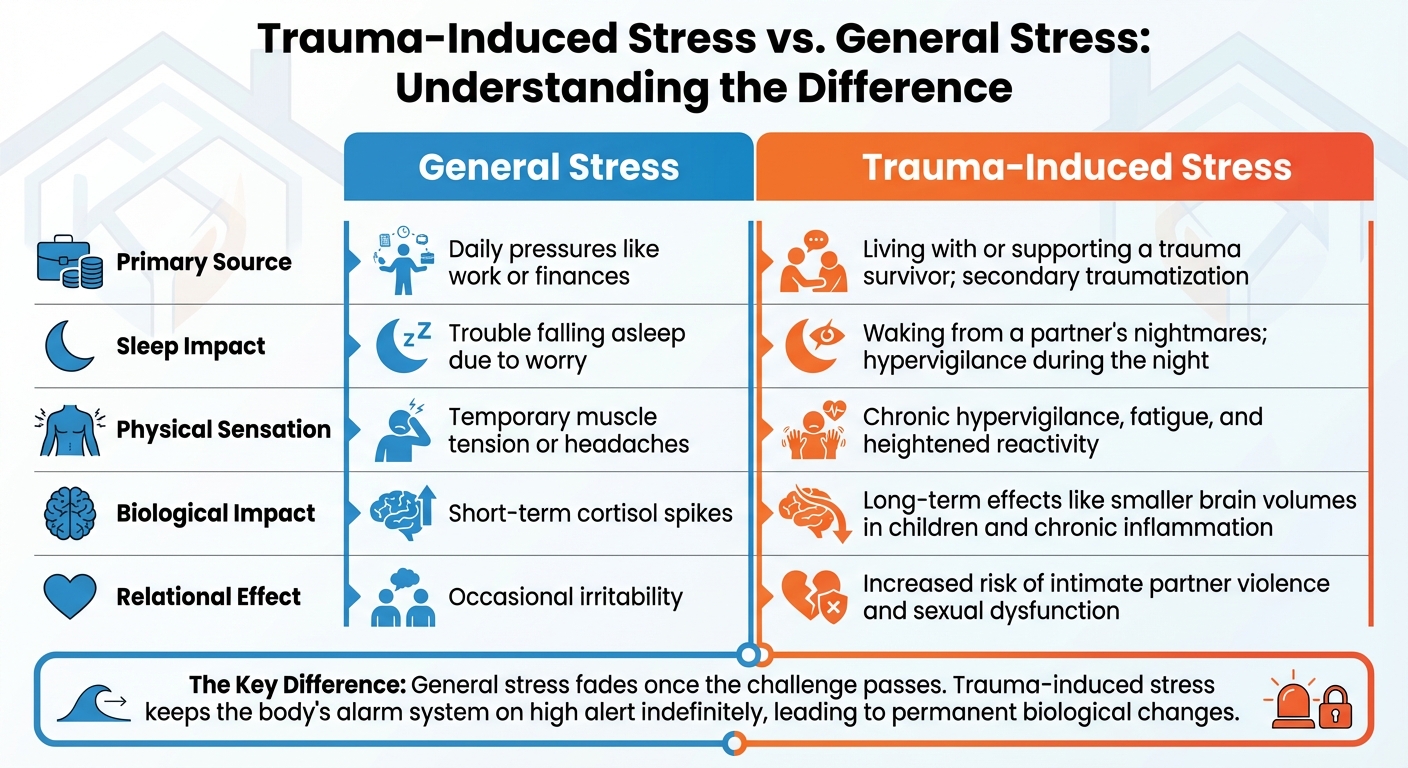
Trauma-Induced Stress vs General Stress: Key Differences and Family Impact
Trauma-induced stress doesn’t just affect the mind – it takes a toll on the body too, spreading its impact across the entire family. Partners and children often experience what’s known as "caregiver burden", which can lead to chronic fatigue, exhaustion, and persistent physical strain [1]. This overwhelming fatigue arises from constant vigilance, unpredictable emotional responses, and the sacrifice of personal needs. The physical toll manifests in several measurable ways.
Common Physical Health Problems
The physical effects of trauma ripple through the family in various ways. Sleep disturbances are among the most common issues. Family members may wake frequently due to a loved one’s nightmares or struggle to sleep beside a partner prone to reactive episodes. This keeps stress hormones elevated, setting off a chain reaction of health problems [1]. Partners of trauma survivors often report chronic pain and a general decline in their overall physical health [7]. For children living in these high-stress environments, the consequences can be even more severe. Studies link household trauma-induced stress to higher rates of asthma and obesity in children [8].
These immediate physical struggles often lead to more serious long-term health risks. A review of 75 years of research, covering 153 studies, found that prolonged exposure to high-stress environments significantly raises the likelihood of developing heart disease and cancer later in life [8]. Dr. Nicki Bush, a Psychiatry and Pediatrics Professor at UCSF, underscores the urgency of addressing these issues early:
"Let’s not wait until adults have heart disease, cancer, or end up in jail or on the streets to ask whether early childhood stress impacted their outcome." [8]
For children, the biological effects of stress can be particularly damaging. Chronic stress has been linked to smaller brain volumes, which can delay development and lead to behavioral problems [8]. Dr. Bush highlights that "many of the same stress-induced biological processes that predict asthma and obesity are also associated with anxiety, ADHD, and worse academic performance" [8]. Even sexual health within relationships suffers, with trauma-induced stress contributing to lower sexual satisfaction and dysfunction [1].
Trauma-Induced Stress vs. General Stress
To understand why trauma-induced stress is so harmful, it’s important to distinguish it from everyday stress. While general stress might lead to temporary discomfort, trauma-induced stress creates a state of chronic hyper-reactivity, where family members feel like they’re constantly "walking on eggshells" [1]. A comparison helps illustrate the differences:
| Feature | General Stress | Trauma-Induced Stress |
|---|---|---|
| Primary Source | Daily pressures like work or finances | Living with or supporting a trauma survivor; secondary traumatization [1][7] |
| Sleep Impact | Trouble falling asleep due to worry | Waking from a partner’s nightmares; hypervigilance during the night [1] |
| Physical Sensation | Temporary muscle tension or headaches | Chronic hypervigilance, fatigue, and heightened reactivity [1] |
| Biological Impact | Short-term cortisol spikes | Long-term effects like smaller brain volumes in children and chronic inflammation [8] |
| Relational Effect | Occasional irritability | Increased risk of intimate partner violence and sexual dysfunction [1] |
The defining difference lies in the duration and intensity. General stress fades once the immediate challenge passes. Trauma-induced stress, however, keeps the body’s alarm system on high alert indefinitely. This leads to what researchers call "biological embedding", where the body undergoes permanent changes in how it responds to perceived threats [8]. This helps explain why family members of trauma survivors often develop chronic health issues that seem disproportionate to their direct experiences.
Mental Health Effects on Family Members
Trauma-induced stress can take a heavy toll on the mental health of family members. Supporting someone dealing with trauma often leads to what experts call caregiver burden – a state of chronic stress, frustration, and emotional exhaustion caused by the added responsibilities of caregiving [1]. This ongoing strain can disrupt daily routines, relationships, and even the sense of safety within the household. Family members may also experience secondary distress, as constant exposure to trauma can create a sense of hypervigilance. Over time, this heightened alertness can increase the likelihood of anxiety, depression, and even substance abuse. These challenges are especially pronounced for both partners and children living in these circumstances.
Emotional Strain on Partners
Partners of trauma survivors face distinct emotional and mental health struggles. When survivors exhibit emotional numbness or avoid intimacy, their partners often feel isolated and disconnected [1]. This emotional distance can diminish relationship satisfaction, leaving partners feeling profoundly lonely despite being physically present. Many partners also struggle with helplessness as they witness their loved one’s recurring nightmares, which often disrupt their own sleep. In some cases, partners may turn to alcohol or drugs as a way to cope, which can worsen their mental health and destabilize the family environment [5].
Impact on Children’s Mental Health
Children in homes affected by trauma-induced stress are particularly vulnerable, as they often absorb the emotional weight of their environment. They witness their parent’s distress and live with the constant tension that trauma brings. According to the Adverse Childhood Experiences (ACE) Study, nearly 64% of participants reported experiencing at least one form of childhood trauma, and 69% of those individuals faced two or more incidents [10]. These experiences can disrupt the development of a child’s stress response systems, leading to long-term challenges that can span generations.
Children in these situations frequently develop anxiety, depression, or behavioral issues by mimicking the traumatized responses they observe. For instance, a child exposed to a parent avoiding social interactions or reacting with excessive anger might come to view the world as unpredictable and unsafe. Kristen Holderle, Clinic Director of the HEAL Collaborative, explains:
"Early trauma affects stress response. Your fight or flight response and neurodevelopment become disrupted" [4].
This disruption can lead to further issues in adulthood, such as substance abuse, as individuals seek to numb feelings of constant threat [5]. The financial burden of child maltreatment is staggering, with the total lifetime cost over a 12-month period estimated at $124 billion. On average, the lifetime cost per non-fatal victim is $210,012 [10].
Effects on Family Relationships and Dynamics
Trauma-induced stress doesn’t just impact individuals – it ripples through families, altering interactions, communication, and overall dynamics. The National Child Traumatic Stress Network highlights this reality:
"Trauma changes families as they work to survive and adapt to their circumstances and environment" [3].
When one family member experiences trauma, the effects are felt throughout the household. Daily routines can break down, cherished traditions may fade, and emotional connections often weaken. These shifts disrupt the stability families rely on, making it harder to maintain the bonds and shared experiences that foster connection. Communication, in particular, often suffers, creating deeper relational challenges.
Communication Problems
Trauma-related stress can severely hinder healthy communication within families. Research shows that childhood trauma negatively affects communication and conflict resolution skills, especially when emotional neglect is involved [11]. Comparatively, individuals without trauma histories tend to exhibit stronger communication abilities than those with moderate or high trauma exposure.
Parents dealing with trauma often fall into harmful communication patterns, including nonverbal cues or blame-filled interactions. These behaviors can unintentionally place emotional burdens on their children. A study conducted in February 2021 by Dr. Sarah Lowe of the Yale School of Public Health and Jessica Bonumwezi examined 251 adult children of survivors of the 1994 Rwanda genocide. The study revealed that maternal PTSD indirectly contributed to children’s PTSD symptoms, particularly through damaging communication patterns. Interestingly, paternal PTSD in the same group manifested in different ways, such as abusive or indifferent parenting styles rather than communication issues.
The National Child Traumatic Stress Network explains:
"When coping resources are stretched too thin and the stress is too high, partners can have problems communicating, managing emotions, and remaining close" [3].
Parenting Challenges and Caregiver Burnout
Trauma doesn’t just disrupt communication – it reshapes parenting roles and intensifies caregiver fatigue. When communication falters, parenting challenges often increase, leaving caregivers overwhelmed. In many cases, one partner absorbs additional responsibilities to compensate for the symptomatic parent, leading to caregiver burnout. This dynamic can also result in secondary traumatic stress for family members, who may experience hypervigilance, anxiety, and sleep issues simply from living with a trauma survivor [12].
The home environment often becomes tense and unpredictable. Trauma-affected caregivers may be quick to react or constantly on edge, leaving others in the household feeling like they’re walking on eggshells [1]. U.S. Army Veteran Chris Antonio shared his personal struggle:
"I had distanced myself for quite some time from relationships and family. I had to go through a divorce" [13].
This experience is not uncommon – studies show that 5% to 10% of trauma survivors face long-term relationship difficulties [13].
Parents dealing with trauma may unintentionally pass on their sense of fear and hypervigilance to their children, conveying that the world is inherently unsafe [12]. This emotional disconnect can make it difficult to provide the warmth and stability children need, further straining family relationships. Family members often try to compensate for the trauma survivor’s struggles, but this can unintentionally reinforce trauma symptoms [1]. Additionally, trauma can impair a parent’s ability to listen, collaborate, or work effectively with their partner, making it challenging for parents to function as a team [13].
Long-Term Consequences for Family Well-Being
When trauma goes unaddressed, its effects can ripple through families, leaving behind physical, emotional, and relational challenges. These impacts often linger for years and, in some cases, extend across multiple generations.
Intergenerational Transmission of Trauma
Trauma doesn’t just affect the individual experiencing it – it can also influence future generations. This happens through a combination of biological factors, such as epigenetic changes, and learned behaviors. In fact, research suggests that children can be shaped by their parents’ trauma, even if it occurred before they were born. This includes exposure during pregnancy or through the behaviors and coping mechanisms modeled by parents[16]. Merissa Nathan Gerson, an Inherited Trauma Consultant, highlights this phenomenon:
"We inherit pain. When it’s not coped with, it gets passed again."
Unresolved pain often shows up in children as behaviors like extreme independence or a tendency to constantly seek approval[16]. The concept of historical trauma first gained attention in 1966, focusing on the children of Holocaust survivors. Later studies, such as one conducted in 1997, revealed that descendants of Japanese-American internment camp survivors faced higher risks for conditions like cardiovascular disease[16]. Mark Wolynn, a leading voice on inherited trauma, underscores the importance of addressing family pain:
"Remaining silent about family pain is rarely an effective strategy for healing it. The suffering will surface again at a later time, often expressing in the fears or symptoms of a later generation."
This inherited trauma can disrupt families’ ability to function and thrive in their daily lives.
Barriers to Daily Functioning
Trauma can leave families stuck in a constant "survival mode", making it difficult to maintain routines, plan for the future, or create the stability that children need to feel secure[16]. Parents dealing with unresolved trauma may swing between overprotectiveness and emotional detachment, which can interfere with forming healthy attachments[15]. Patterns like denial, silence, or overreacting often become ingrained, further destabilizing family relationships[15]. Beyond the emotional toll, chronic trauma is linked to serious health issues, including heart disease, diabetes, and substance use disorders[16].
When trauma remains unprocessed, its effects become a heavy burden, reshaping family dynamics and well-being for years to come.
Getting Professional Help for Families
Professional guidance plays a key role in helping families restore balance and overcome trauma. Whether it’s communication breakdowns, emotional disconnection, or the weight of intergenerational trauma, therapists offer the tools and support needed to heal. This kind of intervention not only addresses individual struggles but also helps rebuild and strengthen family relationships.
Services Offered by Growth and Change Counseling

Growth and Change Counseling provides a range of services designed to address trauma and its impact on families. Their trauma therapy helps individuals process difficult experiences, while family therapy focuses on rebuilding trust and repairing strained relationships. Couples counseling aims to improve communication and foster deeper connections.
For caregivers, parent coaching offers strategies to manage burnout while supporting both parents and children. The practice also addresses individual challenges like anxiety, depression, and addiction – issues often tied to unresolved trauma. For couples in crisis, The Marriage Rescue Institute offers an intensive 12-week program to help restore marriages.
Services are available in-person at locations in Campbell, San Jose, Los Angeles, and Roseville, as well as through telehealth across California. This accessibility ensures that families can receive support no matter where they are. These tailored services create a foundation for long-term stability, as highlighted in the benefits of professional counseling.
Benefits of Professional Counseling
Counseling provides families with strategies to confront trauma and improve communication. Therapists guide families in breaking harmful patterns of avoidance and developing effective ways to handle challenges, especially during times of heightened stress.
The benefits of professional support extend far beyond immediate relief. For example, reducing Adverse Childhood Experiences (ACEs) could lead to a 44% decrease in depression rates and a 24% decrease in heavy drinking [9]. Dr. Angela Seabright, Care Management Physician at Blue Cross Blue Shield of Michigan, underscores the importance of supportive relationships:
"Nurturing relationships with caring adults who are positive role models can prevent ACEs and help children reach their full potential."
Understanding Trauma and the ACEs Study at Growth and Change
Trauma has a profound impact on family dynamics, influencing both physical and emotional well-being [1][14]. Physically, it can lead to weakened immunity, heart-related issues, and chronic pain. Emotionally, families may experience strained relationships and struggles with parenting [5][1]. Understanding that trauma-driven behaviors often arise from physiological stress responses – not deliberate choices – is a crucial step in breaking these cycles.
Despite the challenges, many trauma survivors demonstrate incredible resilience. Healing becomes possible through open communication, emotional connection, and seeking professional guidance [5][2][4]. As Kristen Holderle, Clinic Director of the HEAL Collaborative, puts it:
"We can’t change our past, but we can change our relationship to it" [4].
By leaning into that resilience, families can take meaningful steps toward recovery. Early intervention is key – professional therapy can help identify triggers, create crisis plans, and teach grounding techniques to separate past trauma from the present [1][5].
Growth and Change Counseling offers a range of services, including trauma therapy, family counseling, and specialized support for navigating the challenges trauma introduces. Whether you’re dealing with communication barriers, caregiver fatigue, or patterns of distress across generations, help is available. Services are accessible throughout California in locations like Campbell, San Jose, Los Angeles, and Roseville, as well as through telehealth options.
FAQs
How can I tell if my family is experiencing trauma stress, not just everyday stress?
Trauma-related stress can manifest in various ways, including ongoing emotional struggles, unresolved conflicts, or lingering feelings of fear, shame, or helplessness tied to past experiences. It often shows up as chronic anxiety, depression, or even physical symptoms that feel difficult to cope with. Unlike the stress of daily life, this type of stress tends to be more deeply rooted and harder to navigate. If any of this feels familiar, it may be helpful to seek professional guidance to better understand and address its effects on your family’s relationships and overall well-being.
What are early warning signs of trauma stress in children at home?
Children experiencing early signs of trauma-related stress might display clear shifts in their behavior, emotions, or physical health. These can manifest as withdrawal, increased anxiety, irritability, or difficulties with sleep. Physical symptoms such as headaches or stomachaches are also common. Recognizing these changes early gives families an opportunity to address concerns before they escalate.
When should a family seek professional help, and what does family therapy involve?
Families may need to turn to professional help when trauma-related stress begins to interfere with mental, emotional, or physical health, disrupt daily life, or strain relationships. Some signs to watch for include ongoing anxiety, depression, irritability, or a sense of emotional detachment.
Family therapy can be a valuable tool in these situations. It helps family members better understand how trauma affects everyone, improves communication, and teaches practical coping strategies. Therapy also provides a space to work through unresolved conflicts and break harmful patterns, creating a more supportive and healing environment. If these symptoms persist or worsen, seeking therapy becomes a critical step toward protecting the family’s overall well-being.
Related Blog Posts
- How Trauma Impacts Parent-Child Relationships
- Family Therapy for Trauma Recovery: What Works
- How Family Therapy Improves Trauma Communication
- Trauma Recovery: Role of Family Systems
