If family pressure, in-law conflict, secrecy, or addiction are hurting a marriage, therapy can help the couple work as a team without cutting off family ties.
I’d sum it up like this: many Indian and Indian-American couples deal with split loyalty, blurred boundaries, gender-role strain, privacy concerns, and stress from living between two value systems. A therapist who understands these family patterns can help with clearer boundaries, better communication, and repair after trust has been damaged.
Here’s the article in plain English:
- Marriage often involves the whole family, not just the couple
- Respect for elders and duty can support the home, but they can also create pressure
- In-law conflict often grows when couples have little say in money, parenting, housing, or holidays
- Silence and stigma can delay help, especially when families worry about “what will people say”
- Addiction and secrecy often deepen distance between spouses
- Therapy works best when it fits the couple’s family values and faith, instead of ignoring them
- Structured counseling with direct tools and homework may help couples who want clear steps
- Privacy and acculturation gaps matter, especially for Indian-American couples in the U.S.
A few facts stand out. One study cited in the article says Asian Americans use mental health services at lower rates than the general population: 8.6% vs. 17.9%. The article also points to research showing that therapy shaped around a couple’s background can improve the therapist-client bond and treatment results.
So the core point is simple: therapy can protect the marriage and lower stress in the family at the same time.
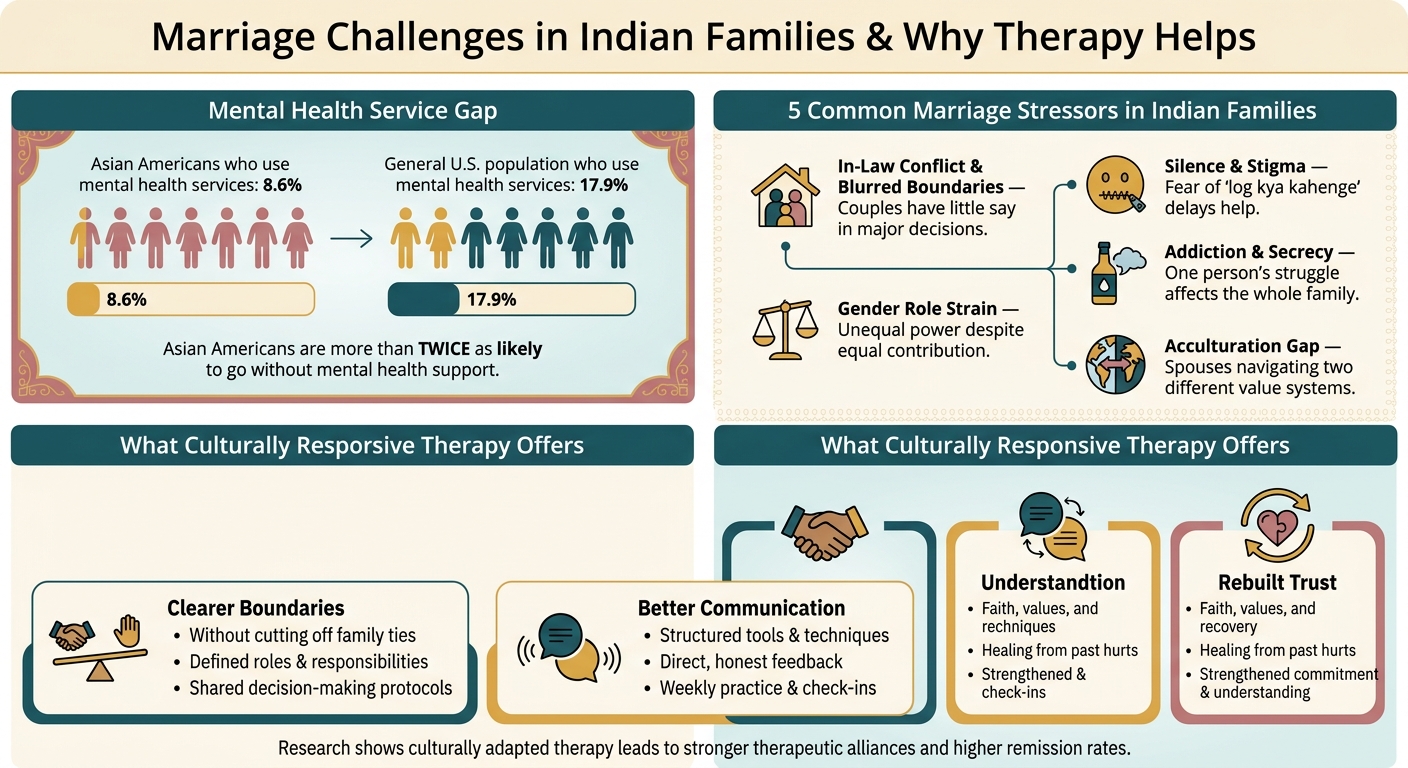
Mental Health Service Usage: Asian Americans vs. General Population & Key Marriage Stressors in Indian Families
INDIA’S #1 COUPLES THERAPIST: Top 10 Questions Answered
sbb-itb-596b85d
Common marriage problems in Indian families
These problems often show up in a few familiar ways: blurred boundaries, split loyalty, and silence.
In-law conflict, pressure from in-laws and shared decision-making, and blurred boundaries
In many families, parents and in-laws stay closely involved in major decisions, even when the couple lives separately. Choices about holidays, child-rearing, and other big life matters may still go through parents and elders first. Over time, that can leave couples feeling like they don’t have much real say in their own marriage.
Setting boundaries can feel disrespectful in many households. So instead of speaking up, couples often stay quiet until resentment starts to build.
Many women are expected to run the home, defer to in-laws, work outside the home, and still avoid conflict. When that strain builds quietly over the years, it often comes out as repeated arguments, emotional withdrawal, or a growing sense of distance between spouses.
When a couple can’t set limits, even small choices can start to feel like power struggles.
Arranged marriage dynamics, gender roles, and loyalty conflicts
Arranged marriages often begin with duty and family fit, not deep intimacy. And parental influence doesn’t always end after the wedding. Families may keep weighing in on major decisions, while spouses feel torn between parental expectations and the marriage itself [2].
Gender roles make this even harder. When one spouse earns more but still has little say in decisions, resentment grows and the balance of power gets shaky:
"In a household where a woman is the chief breadwinner but has minimal standing in decision making, the situation leads to role resentment and disorganized power structure." – Rakesh K. Chadda and Koushik Sinha Deb [4]
This kind of imbalance usually doesn’t fix itself. If there’s no room to name the problem out loud, it can settle into emotional distance between spouses.
That pressure around loyalty often spills into fights about money, parenting, and contact with family.
Addiction, secrecy, and emotional distance
Alcohol use and other addictions are real stressors in Indian families, and they rarely stay limited to one person [1]. In close-knit family systems, one person’s addiction quickly affects everyone.
The fear of log kya kahenge – "what will people say" – often keeps families from talking openly about addiction or marital strain. By the time a couple gets help, the distance between spouses is often deep, and the pattern of secrecy is already firmly in place.
These patterns are often where repair starts in therapy.
How marriage therapy addresses these problems
Therapy can help a couple protect the marriage without cutting off the family. That distinction matters. The goal isn’t to push parents away. It’s to help spouses act like a team when stress, opinions, and outside pressure start piling up.
Setting boundaries without disrespecting family ties
Once a couple sees where the pressure shows up, therapy can turn recurring fights into clear rules for decisions. It reframes boundaries as a form of respect, not rebellion.
"Many clients worry therapy will turn them against their parents. In reality, effective therapy helps clarify boundaries without erasing love or loyalty." – Jessica Demla, MA, LPC, Uptown Counseling [3]
In day-to-day life, that often means helping couples sort out which choices belong to the marriage and which ones can still include family input. It also means cutting down triangulation, when a parent or in-law gets pulled into the couple’s conflict. If that keeps happening, the couple’s own agreement starts to lose force.
Using structured, direct counseling
Once boundaries are clearer, the next step is building new communication habits. Many Indian-American clients do better with therapy that gives them specific tools, weekly practice tasks, and direct feedback instead of abstract reflection [5]. Culturally adapted CBT, EFT, and the Gottman Method give couples direct tools, clear feedback, and weekly practice.
Therapists may assign short home exercises and then review them in session. That kind of guidance helps couples practice hard conversations they’ve been avoiding at home. It’s a bit like using a workout plan instead of just talking about getting in shape.
Growth and Change Counseling uses this directive, solutions-focused style in California couples work, including intensive support for marriages in crisis.
Bringing faith, values, and addiction recovery into treatment
When conflict is tied to faith or addiction, therapy should work with the couple’s own values, not against them. That can mean using ideas like dharma, forgiveness, and duty as shared language for repair. In plain terms, therapy helps guide reconciliation, accountability, and the rebuilding of trust between spouses.
When addiction is part of the picture, therapy helps the couple respond together to secrecy and broken trust instead of leaving one spouse to carry the weight alone.
For Indian-American couples, this kind of approach matters even more when privacy, stigma, and family expectations make asking for help feel hard.
What culturally responsive therapy looks like for Indian-American couples
Acculturation stress, privacy concerns, and stigma around getting help
When secrecy, boundary issues, and family pressure are already part of the relationship, therapy has to deal with more than surface-level symptoms. For many Indian-American couples, one of the biggest obstacles is the fear of being seen getting help. "Log kya kahenge" can shape how families think about therapy, especially when spouses have different comfort levels with direct communication and personal boundaries. Concerns about privacy, community reputation, and even future marriage prospects can make reaching out feel risky.
Some couples also deal with an acculturation gap. One spouse may feel at ease with American norms like direct communication and individual boundaries. The other may still be working from a more family-centered framework. That gap by itself can create tension at home.
That’s why cultural understanding needs to show up in the assessment process, not only later in treatment.
What therapists need to understand about Indian family systems
Therapists need to understand Indian family systems as part of the marriage itself, not as something separate from it. That includes family hierarchy, the role of elders in decision-making, and the way conflict is often managed through silence or deference. A standard Western model that pushes individual autonomy without making room for family-centered expectations can miss the point and add more strain.
"For many South Asian couples, tradition remains a resource: resilience, family support, rootedness. Therapy doesn’t ask you to abandon that; it asks you to integrate it intentionally." – Prerna Menon, LCSW [2]
Research shows that culturally adapted therapy leads to better outcomes, stronger therapeutic alliances, and higher remission rates than non-adapted approaches [3]. And adaptation means more than language. It also includes understanding how culture shapes emotion, conflict, and ideas about what a healthy marriage looks like.
In California, this kind of care is available through Growth and Change Counseling.
Growth and Change Counseling for Indian families in California
Growth and Change Counseling provides culturally sensitive couples therapy for Indian families in California. For marriages in crisis, The Marriage Rescue Institute offers a directive 12-week couples coaching process focused on rebuilding the marriage. Services are available in Campbell, San Jose, Los Angeles, and Roseville, along with telehealth across California.
Conclusion: Marriage therapy can protect both the relationship and the family
Indian families often deal with in-law conflict, rigid gender roles, addiction, secrecy, and bicultural tension. Therapy can help couples take that pressure and turn it into change they can actually use.
Marriage therapy can help protect the relationship without forcing couples to cut off family ties. That tends to work best when the therapy fits the couple’s cultural reality instead of ignoring it.
For Indian-American couples, cultural fluency and structured tools often matter most. Therapy gives couples a shared language for in-law expectations, clearer boundaries, and a path toward rebuilt trust. When a couple gets that kind of clarity, the effect doesn’t stop with them. The whole household can feel it.
Repairing the marriage can also lower stress across the wider family system. For Indian families living between two cultures, relational health is worth the investment.
FAQs
How do we set boundaries with in-laws respectfully?
In Indian family systems, setting boundaries with in-laws often means walking a fine line between personal space and respect for elders. It also means protecting family harmony, which can feel like a lot to carry. That’s where therapy can help. It gives couples room to talk through the expectations that often go unspoken and build a shared way to handle compromise.
With a culturally sensitive approach, couples can get clearer on what they need, support emotional safety, and honor family traditions without losing sight of their partnership. Growth and Change Counseling offers integrative therapy to help strengthen these family relationships.
Can therapy help if one spouse is private or hesitant?
Yes. Therapy can still help by creating emotional safety and a nonjudgmental space that lowers stigma and builds trust, especially when family and social pressure make it harder to ask for help in many Indian family settings.
In more collectivist family setups, it can also help to involve family with care or focus on couple dynamics. That can improve communication without pushing someone to disclose everything right away. Growth and Change Counseling offers structured couples counseling tailored to support hesitant partners.
What should we expect in culturally responsive marriage therapy?
You can expect the therapist to treat culture as a central part of mental health. That includes understanding how collectivist family systems, intergenerational and extended-family roles, and in-law dynamics can shape conflict in a marriage.
They should use assessment that fits the couple’s background, notice shifts in acculturation and gender-role expectations, and avoid stereotyping or picking a side too fast. A good therapist will also support gradual change in a way that protects dignity, emotional safety, and core family values.
Related Blog Posts
- Top 7 Therapy Approaches for Cross-Cultural Couples with Addiction
- Checklist for Therapists Working with Asian-American Couples
- Study: Impact of Cultural Awareness on Marriage Counseling
- Trauma Recovery for Cross Cultural Couples
