When couples feel like roommates rather than partners, emotional disconnection may be at play. This issue is common, with 20% to 60% of couples experiencing it. Emotional disconnection often stems from surface-level communication, unresolved conflicts, stress, and life changes. It can lead to loneliness, reduced intimacy, and even marital crises.
Key Points to Address Emotional Disconnection:
- Communication issues: Replace transactional talks with meaningful conversations. Avoid harmful patterns like criticism or stonewalling.
- Unresolved conflicts: Address lingering issues and rebuild trust through accountability and transparency.
- Stress and life changes: Recognize how external pressures impact your relationship and prioritize quality time.
Solutions:
- Practice active listening and respond to your partner’s emotional needs.
- Rebuild trust with consistent actions and sincere apologies.
- Rekindle intimacy through small gestures like holding hands or sharing gratitude daily.
If these efforts don’t help, professional counseling can provide structured guidance. Many couples find therapy improves their relationship satisfaction by 70%-80%. Don’t wait – take the first step toward reconnecting today.
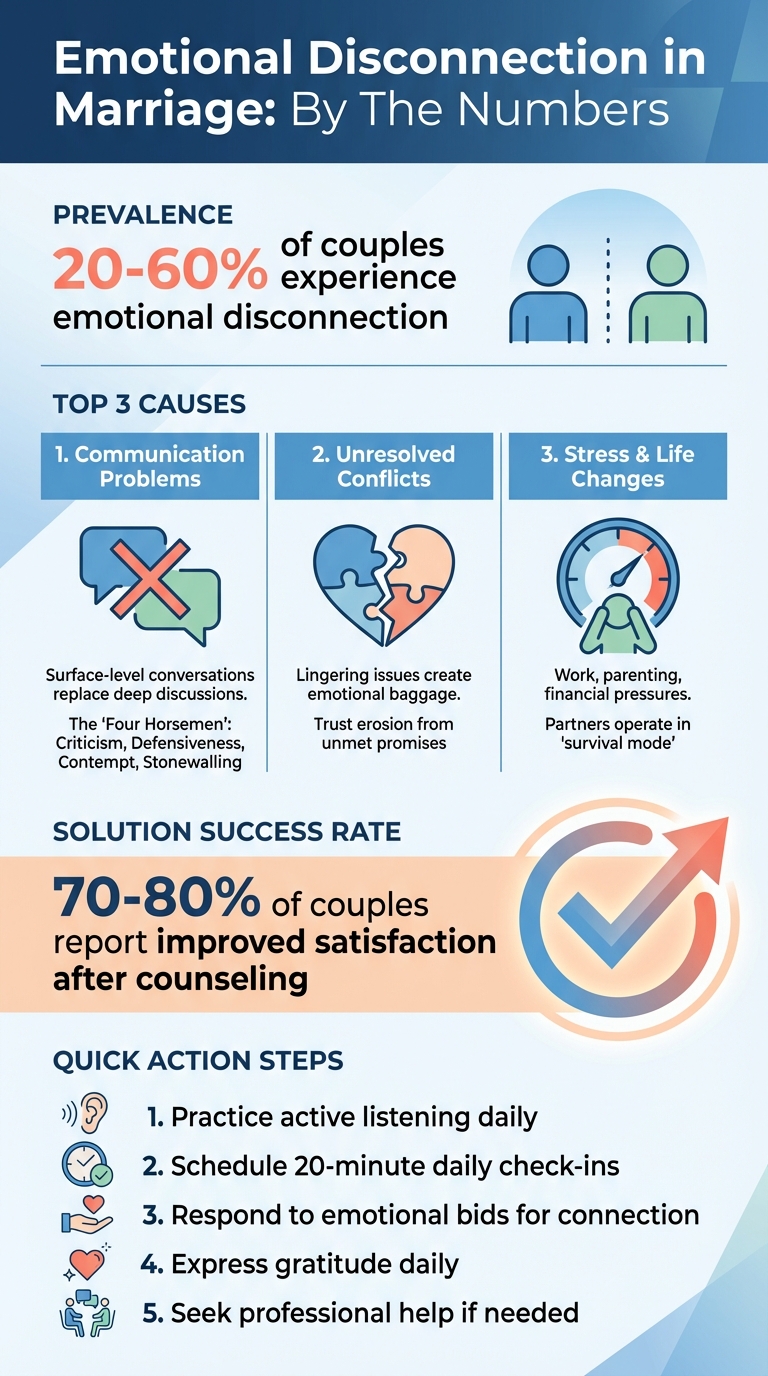
Emotional Disconnection in Marriage: Key Statistics and Solutions
Main Causes of Emotional Disconnection
Communication Problems and Surface-Level Conversations
When couples get caught up in the daily grind, their conversations often shift to practical matters – things like grocery lists, bill payments, or coordinating schedules. These routine exchanges replace the deeper discussions about feelings, dreams, and fears that help build emotional intimacy [2]. According to the Gottman Institute, there are four harmful communication patterns that can wreak havoc on relationships: criticism (attacking a partner’s character), defensiveness (acting like the victim), contempt (mocking or belittling), and stonewalling (shutting down or withdrawing). These behaviors, collectively called the "Four Horsemen", are major red flags for emotional disconnection [2].
Adding to the problem, digital distractions like "phubbing" – the act of ignoring a partner in favor of a smartphone – can make meaningful connection even harder [4]. David Schramm, an Extension Associate Professor at Utah State University, emphasizes the importance of being fully present, stating:
"Perhaps the greatest gift you can give your spouse is not your time, but your full undivided attention." [6]
Another common issue is the pursue-withdraw cycle. In this dynamic, one partner’s need for connection can come across as overwhelming, causing the other to retreat. This back-and-forth often replaces empathy with problem-solving, which only widens the emotional gap [8]. Over time, these communication breakdowns lead to unresolved conflicts that further strain the relationship.
Unresolved Conflict and Broken Trust
When conflicts are left unaddressed, they don’t just disappear – they linger, creating emotional baggage that seeps into future interactions [4] [9]. Trust often takes a hit during these moments, whether it’s due to infidelity, hidden spending, or unmet promises. Instead of fostering vulnerability, partners may resort to self-protection [4]. As Dr. Sarah Schewitz points out:
"Conflict that goes unspoken doesn’t go away – it just takes up space in the background, quietly shaping the way you interact." [4]
This emotional clutter makes it harder for couples to feel safe with one another. For example, behaviors like stonewalling often signal that one partner feels too drained to engage, and prolonged disengagement is a strong predictor of divorce [7] [9]. Without trust, emotional intimacy becomes nearly impossible to maintain. And when external stressors pile on, the situation can spiral further.
Stress, Burnout, and Major Life Changes
Constant stress – whether from work, parenting, or financial struggles – can leave couples operating in survival mode. In this state, even spending quality time with a spouse can feel like just another chore on an already overwhelming to-do list [4] [9]. Lisa Rabinowitz, LCPC, explains:
"When you’re exhausted, it’s easy to default to ‘survival mode’ and put your marriage on autopilot." [9]
Major life transitions, like having a baby, moving to a new city, or navigating career shifts, can also disrupt relationship dynamics. These changes often reduce partners to co-managers of daily responsibilities, leaving little room for emotional connection [4] [7]. On top of that, chronic stress can keep your nervous system stuck in fight-or-flight mode, making you more reactive during arguments and less capable of meaningful connection [8]. When both partners are emotionally drained, it becomes increasingly difficult to nurture the bond that keeps a marriage thriving.
Warning Signs of Emotional Disconnection
Common Daily Signs of Disconnection
Emotional distance doesn’t happen overnight. It’s a gradual shift that often starts with subtle, everyday changes. One of the first signs is when conversations lose their depth and become purely transactional. Instead of sharing thoughts, feelings, or even the small joys and challenges of the day, discussions revolve around practical matters like scheduling, errands, or paying bills. In these moments, partners may feel more like co-managers of a household than two people in a meaningful relationship.
Another red flag is when small efforts to connect go unnoticed or ignored. Simple gestures – like sharing a funny anecdote, asking for a hug, or making casual comments – might be met with indifference, distraction, or even one-word replies. The growing influence of digital distractions, sometimes called “technoference,” can also create a barrier, making it harder to engage in genuine interaction.
Over time, one or both partners may begin to pull back emotionally. Instead of leaning on each other for support, they might turn to friends, family, or even social media for validation. This avoidance often extends to deeper conversations, with partners steering clear of vulnerable or emotionally charged topics. As Minkyung Chung, MS, LMHC, a therapist with Talkspace, explains:
"Emotional distance is not an overnight occurrence. It occurs over a period of time and often through repeated actions that lead to less communication." [3]
These small, repeated patterns can slowly chip away at both emotional and physical intimacy.
How Disconnection Affects Physical and Emotional Intimacy
When emotional safety starts to fade, physical intimacy often follows. Acts of affection or sexual connection may become rare or feel detached, lacking genuine desire. For many, especially women, trust and vulnerability are essential for meaningful intimacy. Without these, physical connection can feel forced or empty.
Even routine tasks that require teamwork – like parenting or handling finances – can become sources of tension. Disagreements that might have been minor in the past can quickly escalate, or one partner might begin making decisions alone, eroding trust further. Sometimes, one partner’s attempts to bridge the gap can unintentionally push the other further away, creating a cycle of frustration and isolation [10].
When intimacy issues reach this level, they often signal that the underlying emotional disconnection has grown into a more serious marital challenge.
When Disconnection Signals a Marriage Crisis
While subtle signs of emotional distance are concerning, certain behaviors indicate a relationship may be at a breaking point. One such behavior is stonewalling – when a partner completely shuts down or refuses to engage during conversations. This isn’t just taking a moment to cool off; it reflects a deeper emotional withdrawal, where one partner has essentially checked out [7].
Another critical warning sign is apathy. Arguments might stop, not because issues are resolved, but because one or both partners no longer care enough to engage. John Gottman, Ph.D., a renowned marriage researcher, explains:
"When a couple stops connecting, this is not good. It often can mean that one or both people have given up, are too tired to keep fighting for the relationship, and are simply ready for it to end." [7]
Living under the same roof without emotional connection can feel like coexisting as business partners. Communication may focus solely on logistics, with no room for sharing personal thoughts or feelings. Chronic contempt – manifested through mockery, name-calling, or constant criticism – can further erode the foundation of the relationship. And when one or both partners begin seeking emotional or physical fulfillment outside the marriage – whether through work, hobbies, friendships, or extramarital relationships – it’s often a sign that professional help is urgently needed.
Practical Solutions for Rebuilding Emotional Connection
Improving Communication and Creating Emotional Safety
Rebuilding emotional connection starts with thoughtful and intentional communication. Using "I" statements – like saying, "I feel disconnected when we don’t have deeper conversations" – can lower defensiveness and encourage open dialogue. The key is to focus on listening without interruption or judgment.
Incorporating daily rituals can also nurture connection. For example, set aside 20 minutes each day for each partner to share their stressors while the other listens with empathy. Weekly check-ins are another great habit to discuss feelings and strengthen emotional bonds. These small, consistent practices help create a sense of vulnerability and reliability in the relationship.
Pay close attention to your partner’s subtle bids for connection. These could be simple gestures like a comment, a look, or a gentle touch. Responding positively to these small moments can build intimacy over time. As Dr. John Gottman explains, the strength of a relationship often lies in these everyday interactions rather than in grand, sweeping gestures.
Rebuilding Trust and Healing Past Hurts
Once communication improves, the next step is to rebuild trust and address any past wounds. Trust can only be restored through accountability and transparency. If one partner has caused hurt, they must take full responsibility for their actions, avoid defensiveness, and commit to being completely honest. A heartfelt apology should acknowledge the specific pain caused, express genuine remorse, and seek forgiveness – without rushing or pressuring the healing process. On the other hand, the hurt partner should set clear, loving boundaries and allow themselves the time and space to process their emotions.
Consistency is essential here. Trust grows when actions consistently align with words. Even small repair efforts during moments of tension can help ease conflicts and rebuild connection.
| Role | Responsibilities in Rebuilding Trust |
|---|---|
| Partner Who Hurt | Take responsibility, stop harmful behaviors, apologize sincerely, and give the hurt partner the time they need to heal. |
| Hurt Partner | Set healthy boundaries, communicate needs clearly, avoid dwelling on past events, and work toward forgiveness at your own pace. |
| Both Partners | Spend quality time together, engage in non-sexual touch, and practice active listening in daily interactions. |
Restoring Intimacy Step by Step
After trust and communication are on firmer ground, you can begin rebuilding both emotional and physical intimacy. Start small with non-sexual touch, like holding hands or sharing a quick cuddle. Even simple gestures, like a 6-second kiss each day, can reignite feelings of romance.
Make time for each other by scheduling two-hour activities twice a week that you both enjoy. Additionally, take a moment each day to express gratitude for one another – it’s a simple way to reaffirm your connection. If discussions become heated, pause for 20 minutes to cool off before continuing. This break allows emotions to settle, making it easier to approach the conversation with clarity and understanding.
sbb-itb-596b85d
When to Seek Professional Help
Signs You Need Professional Support
Sometimes, despite your best efforts, reconnecting with your partner feels impossible. If your attempts to mend things aren’t making progress or communication has completely broken down, it might be time to seek professional support.
Key warning signs include unresolved arguments that keep coming back, patterns of negative interactions, or turning to others outside the relationship for emotional support. Perhaps most concerning is emotional apathy – when one partner seems to have given up on trying to improve the relationship. According to research from the American Association for Marriage and Family Therapy, 70% to 80% of couples who seek counseling report a noticeable improvement in their relationship satisfaction [11].
"Seeking therapy isn’t an admission of failure – it’s investing in your relationship’s future and is a brave step towards creating a fulfilling and lasting relationship."
– The Gottman Institute
If these behaviors or feelings resonate with you, it’s a clear signal that professional help could be the key to restoring your connection. When harmful patterns persist despite your efforts, it’s time to consider intervention.
How Growth and Change Counseling Can Help
Professional counseling can disrupt unhealthy cycles and pave the way for meaningful change. Growth and Change Counseling specializes in helping couples who feel emotionally disconnected. For those in particularly tough situations, the Marriage Rescue Institute offers a structured, 12-week coaching program. This intensive approach goes beyond traditional weekly therapy, helping couples rebuild communication, identify harmful patterns, and address deep-seated issues – whether from past trauma, mismatched attachment styles, or years of unresolved pain.
In addition to couples counseling, the practice provides individual therapy, family therapy, and parent coaching. Sometimes, one partner may need to work on emotional awareness individually before joint sessions are most productive. Services are available in Campbell, CA; San Jose, CA; Los Angeles, CA; Roseville, CA; and through telehealth across California, ensuring accessibility no matter where you are.
For individual therapy, sessions with a Licensed Marriage and Family Therapist are $200 for 45 minutes, while Associate therapists offer sessions at $150. Sliding scale options start at $100, making support available to a range of budgets.
Conclusion: Maintaining Long-Term Emotional Connection
Key Takeaways for Reconnecting
Emotional disconnection doesn’t happen overnight, and rebuilding that bond takes time and consistent effort. It’s the small, everyday actions – not sweeping gestures – that make the biggest difference [1][2]. Start by tuning into your partner’s "bids" for attention – those little moments when they share a thought, ask for a hug, or make a passing comment. Responding warmly to these bids helps build trust and emotional security.
Incorporate simple daily habits that align with your routine. Many couples face similar challenges, so you’re not alone in this journey. The focus should be on mending disconnections and addressing issues rather than avoiding conflict [5].
If your efforts to reconnect don’t lead to meaningful progress, seeking professional help might be the next step.
The Value of Professional Guidance
When personal efforts hit a wall, professional guidance can help break unproductive patterns and rebuild emotional intimacy. Growth and Change Counseling’s Marriage Rescue Institute offers a 12-week intensive program designed for couples in crisis. This approach goes beyond traditional weekly therapy, tackling deeper issues and fostering healthier communication.
Dr. Sarah Schewitz emphasizes this point:
"It’s not the disconnection itself that defines your relationship. It’s what you do next" [4].
Whether it’s through small, intentional actions or seeking professional support, the key is to take that first step today. Prioritize your relationship – it’s worth the investment.
Emotional Disconnection in Marriage: What it is exactly, how it shows up, and what to do about it
Reconnecting with Growth and Change Counseling
What are the early signs of emotional disconnection in a marriage?
Emotional disconnection in a marriage often starts subtly, with small shifts in how you and your partner communicate. Conversations might narrow down to practical matters – like managing schedules or household responsibilities – while discussions about personal feelings, dreams, or deeper thoughts take a back seat. You might notice that your partner seems less engaged, leaving you with a sense of being overlooked or unheard.
Other telltale signs can include a noticeable drop in physical affection – fewer hugs, kisses, or moments of closeness. It might even start to feel like you’re living as roommates rather than romantic partners. Irritability may rise, meaningful conversations might be avoided, or one or both of you may begin seeking emotional support outside the relationship. These patterns often point to a growing emotional gap.
Spotting these signs early is crucial to addressing the issue before it deepens. If this resonates with you, reaching out for professional guidance can make a world of difference. Growth and Change Counseling offers a 12-week intensive couples coaching program through The Marriage Rescue Institute, specifically designed to help couples rebuild trust, reconnect, and reignite emotional intimacy.
How can couples improve communication and rebuild trust in their marriage?
Rebuilding trust and improving communication begins with creating an environment where open and honest conversations can thrive. A helpful method to achieve this is the “I-Feel” formula: “I feel [emotion] when [specific event]; what I need is [request].” This technique allows individuals to share their emotions without assigning blame, fostering vulnerability and deeper understanding. Combine this with active listening, where you reflect back what your partner shares, ensuring they feel acknowledged and valued.
Building trust also involves adopting consistent, thoughtful habits. Start conversations with a gentle tone, make repair attempts to reduce tension when conflicts arise, and respond warmly to your partner’s efforts to connect. Incorporating small, meaningful actions into daily life – like keeping promises, checking in about each other’s feelings or plans, and spending quality time together without distractions (such as cooking or going for a walk) – can significantly strengthen emotional bonds.
For couples seeking extra guidance, Growth and Change Counseling offers a 12-week coaching program through The Marriage Rescue Institute. This program is specifically designed to help partners rebuild trust and deepen their connection.
When is it time for a couple to seek professional help for emotional disconnection?
Couples might want to think about getting professional help when emotional distance becomes a persistent issue that affects both intimacy and daily routines. Some warning signs to watch for include frequent withdrawal during conversations, feeling like your voice isn’t heard, constant defensiveness, or the sensation of "walking on eggshells." Other red flags might be fewer shared moments, surface-level communication, or the relationship starting to feel more like a business partnership than a loving connection.
If these patterns linger for weeks or months, even after trying to improve – like setting aside quality time or addressing outside stress – it could mean deeper emotional needs aren’t being met. When this emotional gap starts to impact parenting, work life, or mental well-being, it’s time to take action. Seeking help early can give couples the tools to rebuild trust, reconnect emotionally, and strengthen their bond.
Growth and Change Counseling offers tailored support, including a focused 12-week couples coaching program through The Marriage Rescue Institute. Taking this step sooner rather than later can make a big difference in overcoming emotional disconnection and restoring your relationship.
Related Blog Posts
- Rebuilding Emotional Intimacy After Addiction
- 5 Ways Grief Impacts Marriages
- Addiction Recovery and Emotional Connection in Marriage
- Ultimate Guide to Emotional Intimacy Through Shared Faith
