Loving someone with an addiction is tough. The way you support them can either help their recovery or unintentionally make things worse. Here’s the key difference:
- Accountability: Encourages the person to take responsibility for their actions and face consequences, which can drive meaningful change.
- Enabling: Shields them from consequences, often prolonging harmful behaviors and dependency.
When you enable, you might pay their bills, make excuses for them, or clean up their mess – actions that come from love but can harm their recovery. On the other hand, holding them accountable helps them build coping skills, confidence, and independence, which are essential for lasting sobriety.
Setting boundaries, offering emotional support, and seeking professional guidance can help you transition from enabling to accountability while protecting your own well-being.
Enabling vs. Accountability: Understanding Addiction Support | #Addiction #Rehab #Recovery #Sobriety
sbb-itb-596b85d
Main Differences Between Accountability and Enabling
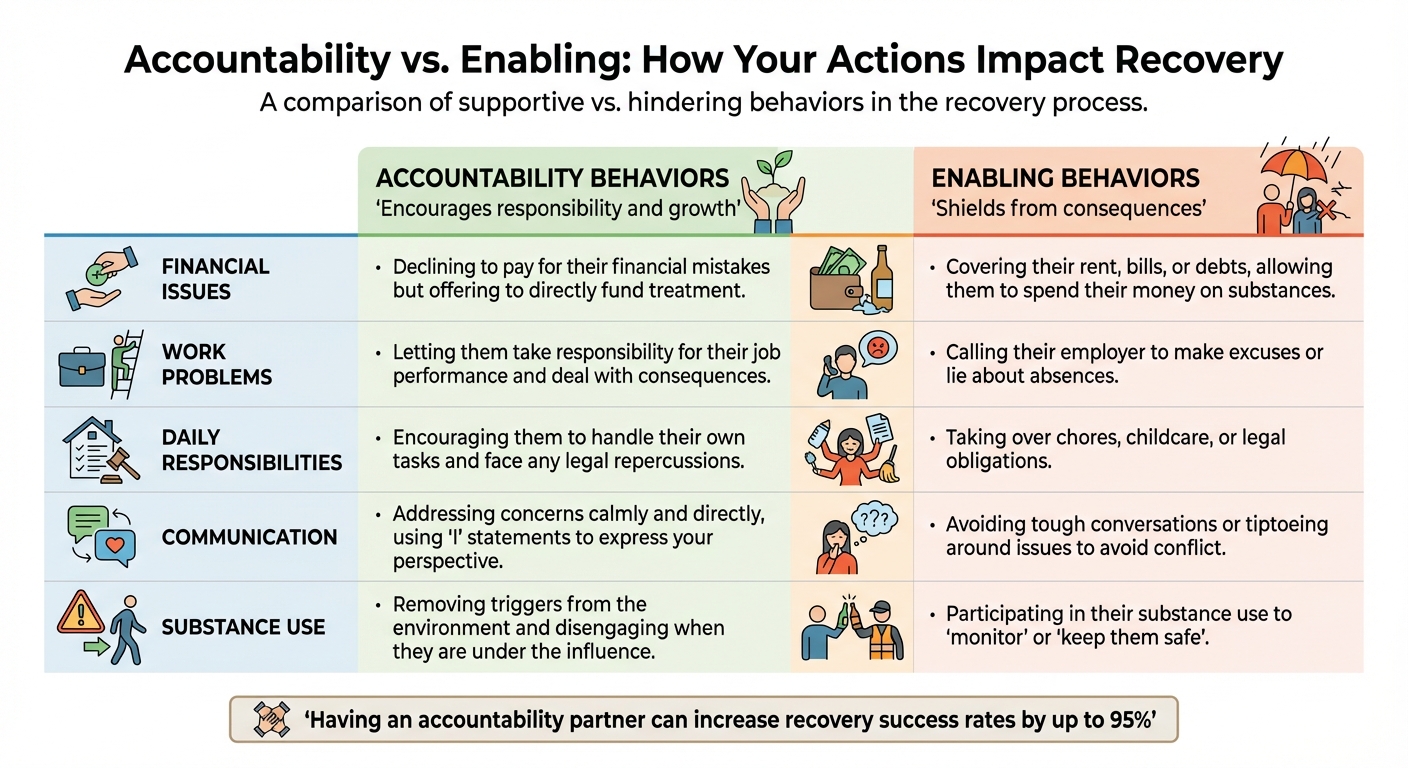
Accountability vs Enabling Behaviors in Addiction Recovery
When supporting someone through addiction recovery, the line between helping and hindering can be surprisingly thin. Both accountability and enabling often stem from a place of care, but they lead to very different outcomes. Accountability encourages your partner to confront the consequences of their actions, while enabling shields them from these realities, often prolonging the cycle of dependency.
Dr. Marco M. Zahedi, Medical Director at Compassion Recovery Center, offers a clear distinction:
"Supportive behavior is characterized by actions that foster independence, accountability, and growth… Enabling behavior, conversely, involves actions that protect the person with addiction from the negative consequences of their substance use."
The core difference lies in how consequences are handled. Accountability allows your partner to experience the natural outcomes of their choices – like financial difficulties, strained relationships, or career setbacks. These moments can act as powerful motivators for change. Enabling, on the other hand, removes these consequences, reducing the urgency to seek help. Below, we’ll explore specific behaviors that highlight the contrast between these two approaches.
Behaviors That Show Accountability vs. Enabling
Here’s how accountability and enabling play out in real-life scenarios:
| Situation | Enabling Behavior | Accountability Behavior |
|---|---|---|
| Financial Issues | Covering their rent, bills, or debts, allowing them to spend their money on substances. | Declining to pay for their financial mistakes but offering to directly fund treatment. |
| Work Problems | Calling their employer to make excuses or lie about absences. | Letting them take responsibility for their job performance and deal with consequences. |
| Daily Responsibilities | Taking over chores, childcare, or legal obligations. | Encouraging them to handle their own tasks and face any legal repercussions. |
| Communication | Avoiding tough conversations or tiptoeing around issues to avoid conflict. | Addressing concerns calmly and directly, using "I" statements to express your perspective. |
| Substance Use | Participating in their substance use to "monitor" or "keep them safe." | Removing triggers from the environment and disengaging when they are under the influence. |
For example, paying their bills after they’ve spent their paycheck on substances sends a message that their actions have no real consequences. On the other hand, refusing to bail them out financially – while offering practical support like helping arrange treatment – provides a clear boundary. These examples highlight how accountability promotes recovery, while enabling reinforces harmful patterns.
How Each Approach Affects Recovery
The effects of accountability versus enabling on recovery are profound. Accountability lays the groundwork for personal growth by encouraging resilience, self-confidence, and independence. When someone faces the natural outcomes of their behavior, they begin to develop the skills needed to sustain long-term sobriety.
By contrast, enabling fosters dependency. When you consistently step in to resolve problems, your partner may come to rely on you to shield them from the fallout of their actions. This constant intervention erodes their motivation to change and can hinder their ability to stand on their own.
Even if your partner enters treatment, enabling behaviors can undercut their progress. If they believe there’s always a safety net – whether it’s financial support or covering for their mistakes – they may feel less urgency to fully commit to recovery. Accountability, on the other hand, reinforces the importance of personal responsibility, a crucial element for lasting change.
Recognizing When You’re Enabling
Accountability helps people face the natural consequences of their actions, but enabling hides those realities, often making things worse. It’s easy to confuse enabling with support, especially when your actions come from a place of love and concern. You might think you’re helping by stepping in during tough situations, but these well-meaning gestures can actually stop your partner from making the changes they need. Identifying enabling behaviors can help you understand when your support might be doing more harm than good.
Common Enabling Actions
Enabling can sneak into everyday decisions, often disguised as harmless help. One of the most common examples is financial support. Whether it’s paying their rent after they’ve used their money on substances, covering legal fees for a DUI, or buying back items they’ve pawned, these actions remove consequences that might otherwise push them toward seeking help.
Covering and lying is another form of enabling. This could look like calling their boss to say they’re "sick" when they’re actually hungover or making excuses to family and friends for their behavior. Taking over responsibilities, such as doing all the household chores, managing childcare alone, or completing work they’ve neglected, is also enabling in disguise.
Sometimes enabling comes in the form of minimizing or denial. You might brush off the seriousness of the problem, telling yourself, “It’s just a rough patch,” or “They’re under a lot of stress.” Some partners even join in the substance use, thinking they can keep things under control or ensure their partner stays safe at home. As the Hazelden Betty Ford Foundation puts it:
"Enabling means doing things for someone that they could and should be doing for themselves, especially when those actions allow their substance use to continue unchecked."
Another red flag is sacrificing your own well-being. If you’re neglecting your financial stability, mental health, or physical needs to constantly manage crises, you’re likely caught in an enabling cycle. Lack of boundaries – such as ignoring disrespect, making empty threats, or failing to enforce consequences – only deepens the problem.
Why It’s Hard to See Your Own Enabling
Recognizing your own enabling behaviors is tough, especially when you’re emotionally tied to someone you care about. Love and concern can make it hard to separate helpful support from harmful intervention. Your instinct to protect them from pain can blur the lines, making it difficult to see what they truly need.
Fear and guilt are powerful drivers of enabling. You might worry that stepping back will lead to serious consequences, like homelessness or jail. Or maybe you feel responsible for their addiction, believing that if you just try harder, you can “fix” them. This desire to keep things feeling "normal" often leads families to act as if everything is fine, even when it’s clearly not.
The American Psychological Association describes enabling as "the process by which a person contributes to the self-destructive or compulsive behavior of another person." Yet enabling often comes with its own emotional rewards. You might feel a sense of purpose in being “needed,” gain control by managing crises, or take pride in your sacrifices. This dynamic, known as codependency, can become an addictive pattern in itself, making it incredibly challenging to break free.
Exhaustion can also play a big role. Sometimes, you enable simply because you’re too drained to face another argument or crisis. It feels easier to pay the bill, make excuses, or clean up the mess than to confront the situation head-on. Ask yourself: Do you overlook unacceptable behavior to avoid conflict? Do you lie to cover up their actions? Do you keep offering help even when it’s unacknowledged? If you answered yes to any of these, it might be time to reevaluate your approach and consider healthier ways to support your partner.
How to Support Accountability Instead of Enabling
Shifting from enabling to encouraging accountability doesn’t mean you’re giving up on your partner – it’s about encouraging responsibility. This shift involves stepping back from rescuing them and allowing them to face the natural outcomes of their actions. While this can be tough, especially if you’ve spent years trying to hold everything together, this approach lays the foundation for lasting recovery. The strategies below focus on moving away from crisis management and toward empowerment.
Setting Clear Boundaries
Boundaries aren’t about controlling your partner – they’re about protecting your own well-being. They define what you will and won’t tolerate, such as banning substances in your home, refusing to lend money that might support unhealthy habits, or not being present when your partner is under the influence [11][12].
To make your boundaries clear, use "I" statements. For instance, instead of saying, "You need to stop drinking", you could say, "I’m not comfortable being around you when you’re intoxicated" [12]. Be specific about what will happen if your boundaries are crossed. The Hazelden Betty Ford Foundation explains:
"Boundaries are the limits you set to protect your time, energy and well-being. They help to define what’s okay and what’s not in your relationships, routines and even your self-talk." [12]
The key is to follow through consistently. If a boundary isn’t enforced, it loses its significance. This can bring up feelings of guilt or fear of rejection, but remember that sticking to your boundaries is essential for your well-being and helps support your partner’s recovery [10][12]. Once your boundaries are in place, the focus can shift to encouraging your partner to take charge of their recovery.
Helping Your Partner Own Their Recovery
Encouraging accountability means allowing your partner to experience the real consequences of their choices, rather than shielding them from reality. For example, don’t cover up their mistakes or try to fix everything for them.
Instead, recognize and celebrate substance-free actions. Praise efforts like attending therapy or paying off debts [2]. Spend time together in activities that don’t involve substances to create positive, recovery-focused memories [4][7]. Use non-judgmental language and "I" statements, such as, "I’m concerned about your health", to keep communication open and supportive [6].
One effective method is the CRAFT approach (Community Reinforcement and Family Training), which emphasizes positive communication while letting natural consequences happen [1]. This approach, often referred to as compassionate detachment, allows you to care for your partner without taking responsibility for their actions or emotions [5][1]. Combined with professional support, these steps create an environment where recovery becomes a shared journey, while still respecting individual responsibility.
Getting Professional Help
Balancing support with accountability can be overwhelming, and seeking professional help can make all the difference. Therapists who specialize in addiction can guide families through effective strategies, focusing on addiction as a chronic brain condition rather than assigning blame [9][4][5]. They can also coach you on setting and maintaining boundaries, even when it feels difficult [9][14][13].
Family therapy is another valuable tool, involving everyone in the recovery process while ensuring the person with addiction remains responsible for their own progress [4]. For partners, individual therapy can address issues like healthy boundaries vs. codependency and help rebuild self-worth outside of the role of "rescuer" [14][13]. Mutual-help groups like Al-Anon, Co-Dependents Anonymous (CoDA), or Adult Children of Alcoholics (ACA) also provide ongoing support for learning how to "detach with love" [2][1].
Growth and Change Counseling offers specialized support through individual, family, and couples counseling via The Marriage Rescue Institute. Their services help families develop recovery plans that address conflict resolution, improve communication, and reduce triggers using recovery strategies. They’re available in Campbell, CA; San Jose, CA; Los Angeles, CA; Roseville, CA; and through telehealth across California.
Long-Term Benefits of Accountability in Recovery
Accountability plays a crucial role in moving beyond the immediate challenges of recovery. Unlike enabling, which often shields someone from the repercussions of their actions, accountability encourages personal responsibility and long-term growth. Choosing accountability helps lay the groundwork for lasting sobriety and healthier relationships. By stepping away from the habit of protecting your partner from consequences and instead supporting them in owning their choices, you create a pathway to improved trust, reduced relapse rates, and stronger recovery resources.
Building Trust in Your Relationship
Honesty and openness are at the heart of accountability. When your partner takes responsibility for their actions and communicates – even about setbacks – it fosters a level of transparency that can break cycles of denial [17]. This transparency helps rebuild the trust that addiction often erodes [15]. Accountability allows for honest conversations about triggers and progress, creating a foundation of trust that grows stronger over time [15][2]. As Scot Chadwick puts it:
"Accountability helps you grow in self-control as you know you will have to answer for your choices and actions" [16].
This mutual honesty and respect strengthen your relationship in ways that enabling never could.
In fact, research reveals that having an accountability partner can increase recovery success rates by up to 95% [18]. Creating an environment where both partners feel safe discussing every aspect of recovery – good or bad – shifts the focus from blame to empowerment, encouraging your partner to make healthier decisions [15].
Lower Relapse Risk
While relapse rates can exceed 40%, incorporating accountability into recovery can drastically lower these odds [18]. Allowing your partner to face the natural consequences of their actions – whether it’s financial strain, legal issues, or fractured relationships – turns those experiences into powerful motivators for staying sober [9][8]. Accountability fosters essential coping skills that enabling undermines. Without being constantly "rescued", your partner learns to navigate the challenges of recovery independently, building confidence and a sense of control over their life [9]. As Keri George, Chief Nursing Officer at Granite Recovery Centers, explains:
"By letting them take responsibility for their well-being, you help increase their self-confidence" [7].
Regular check-ins and participation in support groups can also help identify and manage relapse triggers early on. Setting clear boundaries reinforces the message that while your partner is deeply loved, their addiction will not be supported [9].
Creating Recovery Capital
Recovery capital refers to the resources – both internal and external – that support long-term sobriety. These include self-confidence, effective coping strategies, sober support networks, and stable relationships [9][7]. When your partner takes ownership of their recovery journey, they begin to build the independence necessary for lasting change [9]. This means learning to handle stress without substances, forming positive relationships, and creating meaningful, substance-free experiences.
Simple steps, like engaging in sober activities together and removing triggers from your shared environment, can further strengthen recovery capital [4][7][13]. Combined with a commitment to accountability, these efforts help establish a stable, sustainable foundation for recovery, protecting both of you from the turmoil that enabling often creates.
Conclusion: Supporting Recovery Through Accountability
Are you encouraging growth through accountability, or are you unintentionally shielding your partner from the consequences of their actions? When you enable, you remove the immediate discomfort that might push someone to confront their addiction. On the other hand, accountability allows natural consequences to drive meaningful change. Interestingly, research indicates that treatment can be just as effective for individuals compelled to begin by external pressures as it is for those who seek help on their own [19].
Setting clear boundaries is essential – not just for your partner’s recovery, but for your own well-being. This means refusing to pay substance-related bills, lying to employers, or excusing harmful behavior. As Brittany Tackett puts it:
"Helping empowers an addict to take responsibility rather than creating dependency" [3].
These boundaries aren’t about controlling your partner’s actions but about creating a healthier environment for yourself. Once established, reinforcing these boundaries becomes easier with professional support.
Professional guidance can help you shift from being a rescuer to becoming a supportive partner. Family therapy, programs like CRAFT (Community Reinforcement and Family Training), family systems therapy, and support groups such as Al-Anon teach you how to "detach with love." This approach allows you to care deeply while letting go of the need to control your partner’s choices. Growth and Change Counseling offers specialized services in addiction recovery and family therapy throughout California to support this journey.
When you combine clear boundaries with professional support, accountability becomes a powerful tool for lasting recovery. It helps your partner build self-confidence, develop coping mechanisms, and take ownership of their recovery. At the same time, it allows you to safeguard your mental health and model healthy boundaries. By prioritizing personal responsibility, both you and your partner can achieve stronger recovery and healthier relationships.
Defining Enabling vs. Accountability: Growth and Change Counseling
How can I tell if I’m helping or enabling someone with an addiction?
Enabling might seem like you’re helping someone, but it often keeps a person struggling with addiction from confronting the consequences of their actions. Some common signs of enabling include making excuses for their behavior, hiding their substance use, giving them money that could fund their addiction, or stepping in to resolve their legal or financial problems. You might also struggle with guilt when trying to set boundaries, or notice that their substance use continues unchanged despite your efforts.
To move from enabling to promoting accountability, start by establishing firm and consistent boundaries – such as refusing to provide financial support or cover for their actions. Encourage them to seek professional help, and don’t overlook the importance of seeking support for yourself to break unhealthy patterns. Growth and Change Counseling offers therapy for individuals, couples, and families, providing tools to set boundaries and support recovery in a healthier way. By fostering accountability, you create an environment for genuine healing while also protecting your own emotional well-being.
How can I set healthy boundaries with my partner without harming our relationship?
Setting boundaries in a healthy way begins by recognizing when supportive actions cross the line into enabling. This could include things like covering up mistakes, providing money that might be misused, or repeatedly shielding your partner from the consequences of their actions. To communicate your boundaries effectively, use calm, non-judgmental "I" statements. For example: "I need to feel secure in our home, so I can’t financially support choices that harm your recovery." Writing down your boundaries and consistently reinforcing them helps establish that they are firm yet fair.
Maintaining the relationship requires finding a balance between setting boundaries and fostering emotional connection. Make time for regular, open conversations to share progress and challenges. Practice active listening to ensure both partners feel heard and understood. If discussions become heated, take a step back and revisit the topic later when emotions have settled. Seeking professional support, like couples counseling, can also provide valuable guidance. Programs such as the 12-week offering from Growth and Change Counseling are designed to help rebuild trust, improve communication, and support recovery as a team. By blending empathy with clear boundaries, you can promote accountability while nurturing a stronger partnership.
How does accountability support long-term addiction recovery?
Accountability is a key part of addiction recovery, helping individuals take ownership of their actions and progress. It often includes regular check-ins with therapists, supportive friends, or peers who offer encouragement, celebrate achievements, and address challenges along the way. This practice not only keeps individuals honest with themselves but also builds trust and fosters personal growth.
By encouraging self-awareness, setting clear goals, and recognizing early signs of relapse, accountability plays a big role in improving long-term recovery. It helps strengthen coping strategies, lowers the chances of relapse, and turns recovery into a shared effort. At Growth and Change Counseling, therapists weave accountability into their sessions, helping clients stay focused and work toward lasting sobriety.
Related Blog Posts
- Boundaries for Addiction Recovery and Healthy Love
- How Couples Build Accountability After Addiction
- How to Stop Enabling a Partner with Addiction
- Managing Relapse Triggers in Family Systems
