Recovering as a couple after addiction can be tough, but improving communication is key. Addiction often damages trust, creates secrecy, and leads to emotional distance. This article covers seven practical strategies to help couples rebuild trust, improve communication, and support each other during recovery.
Key Takeaways:
- Understand Barriers: Recognize how secrecy, guilt, and fear hinder communication.
- Active Listening: Pay full attention, validate emotions, and avoid interrupting.
- Use "I" Statements: Express feelings without blaming to reduce defensiveness.
- Set Boundaries: Agree on clear, respectful limits to support recovery.
- Rebuild Trust: Commit to honest, consistent communication over time.
- Use Time-Outs: Pause during heated moments and return to calm discussions.
- Seek Professional Help: Counselors can guide couples with proven techniques.
Actionable Tip: Start with daily 2–5 minute check-ins to share feelings and progress. Gradually increase to 10–15 minutes, focusing on honest, blame-free conversations.
If challenges feel overwhelming, professional counseling can provide tools and guidance to strengthen your relationship while navigating recovery.
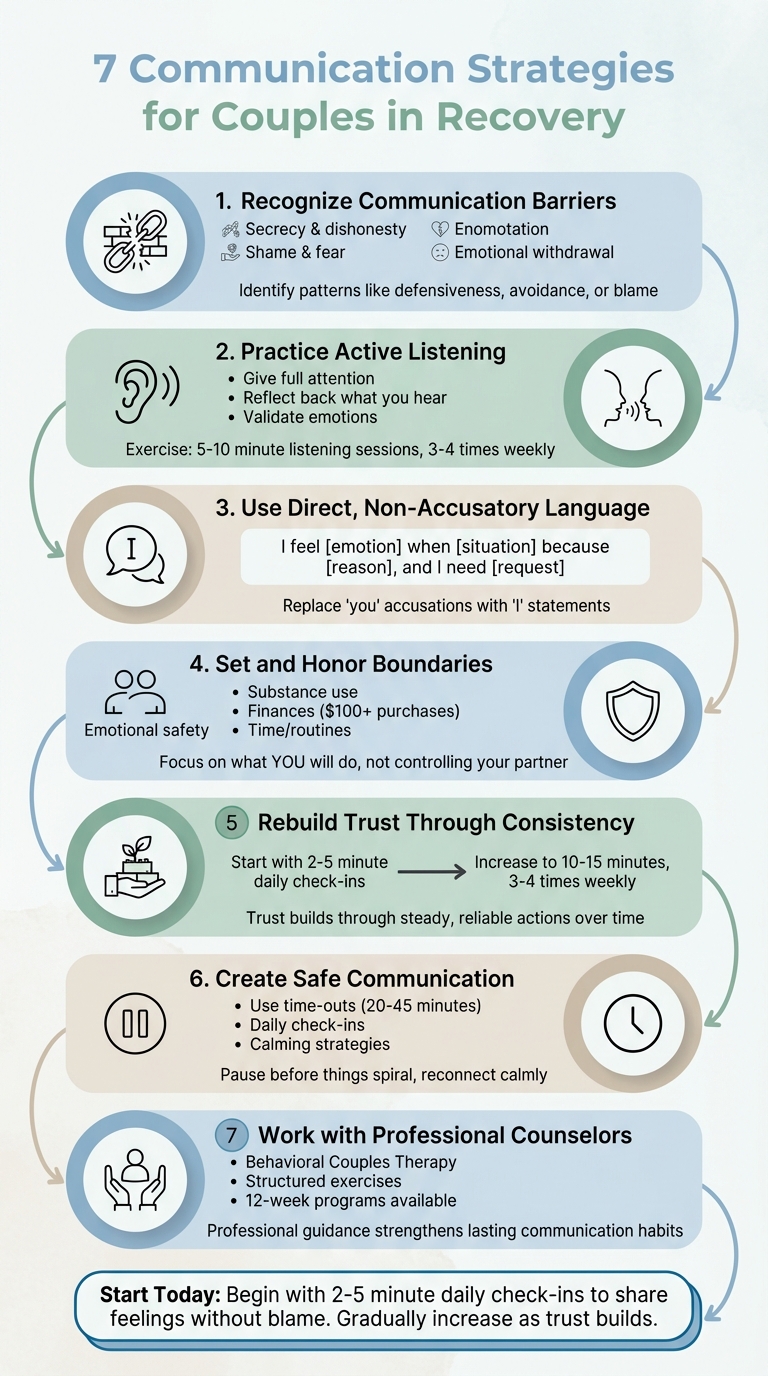
7 Communication Strategies for Couples in Addiction Recovery
Addiction Recovery | 6 Keys for Effective Communication
1. Recognize the Communication Barriers That Come with Recovery
Before improving communication, it’s crucial to pinpoint what’s not working. One of the most common hurdles couples face is secrecy and dishonesty – not just about substance use, but also about cravings, finances, triggers, and setbacks. For example, even after achieving sobriety, the partner in recovery might hide a tough day or a near-relapse to "keep the peace", while the other partner might resort to constant monitoring. This can create a vicious cycle: one partner feels controlled, while the other feels lied to. These behaviors make open and honest conversations nearly impossible and pave the way for deeper emotional disconnects.
Shame and fear also play a big role in communication breakdowns. The partner in recovery might carry guilt over past actions, making it hard to admit struggles or ask for support. On the other hand, the other partner may still feel anger or resentment, which could show up as sarcasm, criticism, or even silence. Sometimes, even neutral comments are misunderstood – a simple "How was your day?" might feel like an accusation, or saying "I’m tired" could be taken as a sign of bigger problems.
Emotional withdrawal is another common issue. Couples may avoid sensitive topics like relapse risks, finances, or trust, walking on eggshells until tensions boil over. Those in recovery might also struggle to express their feelings clearly. Instead of saying, "I feel scared", they might lash out, withdraw completely, or change the subject. Behavioral Couples Therapy research highlights how blame, contempt, defensiveness, and stonewalling only make these negative patterns worse.
To start breaking these cycles, ask yourself: Are we stuck in unresolved arguments? Do we shut down or explode when discussing recovery? Are we avoiding tough conversations altogether? Identifying a recurring pattern – like saying, "We both get defensive when money comes up" – can be a critical first step toward finding solutions together.
If these barriers feel too overwhelming to tackle alone, professional support can make a big difference. Growth and Change Counseling‘s Marriage Rescue Institute offers services across California, including telehealth options, to help couples rebuild trust and improve communication.
2. Practice Active Listening and Validate Each Other’s Emotions
To strengthen your relationship, start by genuinely listening to your partner. Active listening means giving your full attention – put down your phone, make eye contact, and face your partner while they speak. It’s not just about hearing words but understanding their message. Reflect back what you hear (e.g., "So you felt really alone when I missed that meeting?"), ask clarifying questions, and resist the urge to interrupt, defend yourself, or jump in with solutions. In the context of recovery, this approach can help rebuild trust and break cycles of secrecy, showing that your partner’s feelings and experiences matter in the here and now.
Validation takes listening a step further by acknowledging your partner’s emotions as real, even if you see things differently. For example, saying, "It makes sense that you’re scared when I’m late, given everything that’s happened", doesn’t mean you agree with every detail but shows you recognize their feelings. This approach can reduce defensiveness and create space for real problem-solving. Studies in Behavioral Couples Therapy reveal that couples who prioritize structured listening and validation often report stronger relationships and better outcomes in managing substance use.
Here’s a simple exercise to try at home: Choose a calm moment, set a timer for 5–10 minutes, and decide who will speak first. The speaker uses "I" statements to discuss one issue at a time, while the listener focuses on maintaining eye contact, avoiding interruptions, and summarizing what they hear (e.g., "You’re saying you feel anxious when I go out at night because it reminds you of when I was using. Is that right?"). Follow up with a validating response like, "I can see why that scared you" or "Given what we’ve been through, it makes sense you feel that way." Then, switch roles. Practicing this three or four times a week can help prevent old conflict patterns from resurfacing.
Avoid harmful habits like assuming intentions ("You just want to control me"), defensiveness ("That’s not what happened"), or dismissing emotions ("You’re overreacting"). These reactions can shut down open communication and increase feelings of shame, which can be a relapse trigger. Instead, replace invalidating comments with empathetic ones, such as, "I understand why you feel angry", or "This is really hard for you, and I get that." With time and consistency, these practices can reshape your automatic responses, making empathy a natural part of your communication style.
If conversations still escalate into arguments or emotional shutdowns, professional support may help. Growth and Change Counseling’s Marriage Rescue Institute offers a 12-week coaching program designed to improve communication through structured exercises. Their services, available in Campbell, San Jose, Los Angeles, and Roseville, as well as statewide via telehealth, provide specialized support for couples navigating recovery.
3. Use Direct, Non-Accusatory Language in Hard Conversations
When tackling sensitive topics like relapse fears, broken promises, or trust issues, it’s important to express your concerns clearly and without blame. The key is to focus on your own feelings and needs rather than pointing fingers. For example, instead of saying, "You always ruin our plans" or "You’re going to use again", you could say, "I feel worried when plans change unexpectedly" or "I feel scared about your meeting with old friends because it reminds me of past relapses." Shifting from "you" accusations to "I" statements helps avoid defensiveness and encourages open, productive conversations.
Using accusatory language often damages trust, while focusing on your own emotions fosters understanding. For instance, saying, "I feel anxious when I don’t know your whereabouts" keeps the focus on your experience without assigning blame. Studies on Behavioral Couples Therapy reveal that couples who practice non-blameful communication experience lower relapse rates and greater relationship satisfaction compared to those in individual therapy alone [4].
A helpful framework for these conversations is: "I feel [emotion] when [specific situation] because [reason], and I need [specific request]." For example, you might say, "I feel overwhelmed by cravings at family events and need us to leave early together", or "I feel hurt when secrets come up, and I want us to share openly." Practicing these types of statements during calm, scheduled 10–15 minute sessions can make them feel more natural over time.
It’s also important to avoid common pitfalls that undermine direct communication. Replace phrases like "You never support me" with "I need more support during stressful times." If a discussion becomes heated, taking a brief time-out can help. Use a cue like, "I need a moment to calm down", and return to the conversation with an "I" statement, such as, "I felt attacked earlier and want to express my side calmly."
If blame cycles continue to disrupt communication, seeking professional guidance can be a game-changer. Growth and Change Counseling’s Marriage Rescue Institute offers a 12-week coaching program specifically designed to teach couples how to communicate effectively and rebuild trust during addiction recovery. With services available in Campbell, San Jose, Los Angeles, and Roseville, as well as via telehealth across California, they provide tailored support to help couples transform conflict into connection.
4. Set and Honor Boundaries That Support Recovery
Boundaries are essential for protecting each partner’s emotional well-being, physical safety, and recovery journey – without trying to control the other person. A healthy boundary focuses on what you will do to maintain safety and support recovery, rather than trying to dictate your partner’s actions. For example, saying, "If you come home under the influence, I will stay at a friend’s house for the night", is a healthy approach. On the other hand, saying, "You’re not allowed to see your friends anymore", crosses into controlling behavior [4].
Key areas where couples in recovery often focus on boundaries include:
- Substance use: Agreeing to keep the home free of drugs, alcohol, or any related items in shared spaces.
- Finances: Setting spending guidelines, such as discussing purchases over a certain amount (e.g., $100).
- Time and routines: Protecting time for therapy sessions, meetings, or other recovery activities.
- Emotional safety: Committing to respectful communication, avoiding yelling, name-calling, or threats during conflicts [4].
Studies on Behavioral Couples Therapy show that couples who create clear agreements in these areas report fewer days of substance use and feel more satisfied in their relationship compared to those who only receive individual treatment [4].
To make boundary discussions productive, schedule calm, distraction-free sessions. Use "I" statements to express your needs clearly. For example, you might say, "I need you to let me know if you’re experiencing cravings so I can be prepared", or, "I need us to leave social events early if cravings become overwhelming." Keeping these check-ins brief – 10 to 15 minutes, three to four times a week – helps ensure boundaries are regularly reviewed and adjusted as needed [4].
Once boundaries are set, honor them consistently and without blame. For instance, if you’ve agreed that "If you miss a therapy appointment, we reschedule before making other plans", stick to that agreement. Over time, as trust builds, these boundaries can shift from strict recovery measures to more adaptable guidelines [4].
If you’re struggling to establish or maintain healthy boundaries, seeking professional help can make a big difference. Growth and Change Counseling‘s Marriage Rescue Institute offers a 12-week intensive coaching program to help couples navigate these challenges. With services available in Campbell, San Jose, Los Angeles, and Roseville – or through telehealth across California – they provide tailored support to strengthen both sobriety and relationships. Clear, consistent boundaries are a cornerstone for rebuilding trust and sustaining recovery.
sbb-itb-596b85d
5. Rebuild Trust Through Consistent and Honest Communication
Trust isn’t something that appears overnight – it’s built over time through steady, reliable actions. Addiction often thrives in secrecy, shame, and dishonesty, which can isolate partners and erode the foundation of a relationship. The antidote? Consistent and honest communication. It breaks down walls of mistrust, replaces isolation with empathy, and opens the door to genuine reconnection. [2][3]
To start, create structured, distraction-free times to connect. Begin with brief daily check-ins lasting about 2–5 minutes, focusing on small positive moments or caring actions. Once these feel natural, extend them to 10–15 minutes three to four times a week, allowing space to discuss feelings, challenges, or progress in recovery. Keeping these conversations face-to-face and in a private, quiet setting helps shift from reactive exchanges to meaningful, trust-building habits.[4] Over time, these regular check-ins pave the way for deeper and more impactful discussions.
Honesty is key. This means openly sharing struggles, like cravings or fears. For instance, if a partner feels the pull of relapse, speaking up allows the other to offer timely support, which can prevent further damage to trust.[7] Using "I" statements – like "I feel anxious about…" – helps express concerns without assigning blame, making the conversation more constructive.[5] Simple actions like maintaining eye contact, actively listening, and validating each other’s emotions go a long way in rebuilding a sense of connection.[3][6]
As John Mark Kane, LMFT, insightfully puts it:
"It is in this place of vulnerability that we can admit our struggles, face our true selves, and then grow to become all that we are meant to be!"
– John Mark Kane, LMFT, Growth and Change Counseling
Seeking professional help can also make a big difference. Behavioral Couples Therapy, for example, teaches communication skills through therapist-led guidance, modeling, and practice. Homework assignments reinforce positive habits, helping couples develop tools for resolving conflicts and building commitment.[4][8] If open dialogue feels too difficult, Growth and Change Counseling offers a 12-week intensive program, available in California or through telehealth, to support couples on their journey to rebuild trust.
6. Create Safe Communication Through Time Outs and Daily Routines
When emotions start running high, taking a time out can be a game-changer. It’s a structured way to pause before things spiral, giving both partners a chance to cool off and avoid saying something they might regret. The idea is to plan ahead: agree on a neutral phrase like, "I need a time out so I don’t say something hurtful," set a specific time to reconnect (usually 20–45 minutes), and stick to it. During the break, focus on calming activities – deep breathing, a short walk, or even journaling can help reset your mindset [5][3]. These pauses work hand-in-hand with daily routines that strengthen connection.
Daily check-ins are another simple but powerful tool. They create consistent moments of connection and help address small issues before they grow. Research from Behavioral Couples Therapy shows that couples who engage in brief, structured conversations experience improved relationship satisfaction and better outcomes, like maintaining abstinence [4]. A check-in can be as straightforward as each partner sharing one feeling, one stressor, and one thing they appreciate about the other.
Combining time outs with daily check-ins builds a solid foundation for safe and productive communication. For example, during your regular check-in, you can discuss potential stressors – like payday or an upcoming social event – and plan how to support each other. If an argument starts to escalate, either partner can call a time out, use the agreed-upon calming strategies, and then return to a structured conversation. This might involve taking turns speaking, using "I" statements, and focusing on present needs instead of rehashing past mistakes [4]. This approach creates predictability, which helps shift the dynamic from conflict to collaboration.
To keep these routines emotionally safe, it’s important to stick to a few ground rules: only one person speaks at a time, avoid name-calling or bringing up past relapses, and focus on one topic per session. Keeping daily check-ins short – just 10–15 minutes – makes them easier to maintain and more effective [4]. However, if conflicts escalate frequently or either partner feels unsafe, it’s crucial to seek professional help. Growth and Change Counseling, for example, offers couples coaching and therapy across California, helping partners create personalized communication plans tailored to their needs, schedules, and recovery goals.
7. Work with Professional Counselors to Strengthen Communication
While practicing communication strategies on your own is a great start, working with a professional counselor can take your skills to the next level. Counselors who specialize in addiction recovery bring proven techniques to the table, helping couples navigate difficult moments and build lasting communication habits. They guide you through exercises like healthy dialogue modeling, supervised practice sessions, and even homework assignments. This hands-on approach is a core element of Behavioral Couples Therapy (BCT), which focuses on resolving conflicts and fostering positive interactions both in and out of therapy sessions [4][8].
During therapy, you’ll dive into active listening, using "I" statements to express yourself without blame, and sharing your vulnerabilities in a safe, controlled environment. Counselors create a space where both partners can openly discuss fears, recovery goals, and the mistrust that addiction often leaves behind [2][6]. These sessions typically include structured communication exercises, starting with short 2–5 minute dialogues daily and gradually increasing to 10–15 minutes, three or four times a week. This ensures each partner has uninterrupted time to speak, fostering balanced and meaningful exchanges [4]. These practices build on the daily habits discussed earlier, turning healthy communication into a sustainable part of your recovery journey.
For couples facing severe challenges, intensive programs like Growth and Change Counseling’s 12-week Marriage Rescue Institute offer structured interventions and relational homework designed to rebuild trust and repair strained relationships.
Counselors also integrate communication techniques with recovery tools like 12-step programs, helping embed these skills into your daily life [4][8]. The ultimate goal is to make these strategies second nature, ensuring you can handle challenges effectively long after therapy concludes.
Conclusion
Recovering from addiction requires more than just personal effort – it calls for intentional communication to rebuild relationships. The strategies outlined earlier serve as a starting point to establish trust and create emotional safety. By consistently practicing these techniques, you can begin to replace patterns of secrecy and isolation with understanding and meaningful connection.
To get started, begin with small, achievable steps. For instance, take 2–5 minutes daily to acknowledge a kind gesture from your partner. Over time, expand this practice to include 10–15 minute conversations several times a week, where you can openly share feelings and challenges without interruptions. It’s important to remember that setbacks, including relapses, are part of the process. Approach them with patience and focus on celebrating progress, no matter how small.
Seeking professional guidance can further support your journey. As John Mark Kane, LMFT at Growth and Change Counseling, emphasizes:
"You are a relational being, wired for healthy relationship. The more relationally healthy people are, the less anxious, addicted, and depressed they are." [1]
Therapists specializing in addiction recovery offer structured tools and insights that can turn communication into a powerful asset.
For couples seeking targeted support, the Marriage Rescue Institute at Growth and Change Counseling provides a 12-week program designed to address both addiction and relationship challenges. This focused approach helps couples rebuild trust while supporting each other’s recovery. Services are available in Campbell, CA; San Jose, CA; Los Angeles, CA; Roseville, CA; and through telehealth across California.
FAQs
What are the best ways for couples to set and maintain healthy boundaries during recovery?
Establishing and maintaining healthy boundaries during recovery begins with open, honest communication about each partner’s needs and limits. It’s essential for couples to collaborate on clear agreements that emphasize mutual respect and emotional well-being. As life evolves, revisiting these boundaries regularly helps ensure they stay relevant and effective.
Sticking to these boundaries requires consistency – both partners need to actively honor the commitments they’ve made. Professional support, like couples counseling, can offer helpful tools and guidance to navigate this journey and build a stronger connection.
What are the common communication challenges couples face during addiction recovery?
Couples navigating recovery often encounter communication hurdles that can slow their progress. These challenges might look like avoiding difficult topics, misunderstanding each other’s intentions, pulling away emotionally, having trouble with active listening, or struggling to share feelings openly.
Overcoming these obstacles takes time, effort, and a shared dedication to honest and open conversations. Developing stronger communication skills not only deepens your bond but also plays a key role in moving forward and healing as a team.
Why should couples in recovery consider professional counseling?
Professional counseling serves as an important resource for couples navigating recovery, providing a secure and understanding environment to tackle challenges as a team. Experienced therapists guide partners in improving communication, rebuilding trust, and addressing the emotional scars left by addiction.
In these sessions, couples gain practical strategies to reinforce their bond and work toward lasting healing. The process ensures that both individuals feel valued and supported throughout their recovery journey.
Related Blog Posts
- Addiction Recovery and Marriage Communication
- How Addiction Impacts Marital Stability
- Ultimate Guide to Couples Communication in Addiction Recovery
- Trust-Building Exercises for Couples in Recovery
