I can’t control the other parent’s behavior, but I can choose my next step. When stress builds, I can stop typing, take a few slow breaths, and check what my child needs before replying.
These 7 practices give me a place to start – not a ranking:
- Get individual support through therapy or parent coaching.
- Pause before responding instead of sending an angry reply.
- Check facts rather than guessing motives.
- Keep messages brief and focused on my child.
- Keep children out of adult conflict, including arguments and message delivery.
- Put schedules and communication rules in writing, while following court orders.
- Help children name their feelings and practice safe ways to calm down.
My goal is fewer reactive moments, not perfect calm. I can start with one change this week.
<u>Safety comes before cooperation.</u> If there are threats, stalking, coercive control, or violence, I need safety planning – not just calmer messages. In the U.S., I can call 911 for immediate danger or the National Domestic Violence Hotline at 1-800-799-7233 for safety planning, using a safer device if mine may be monitored.
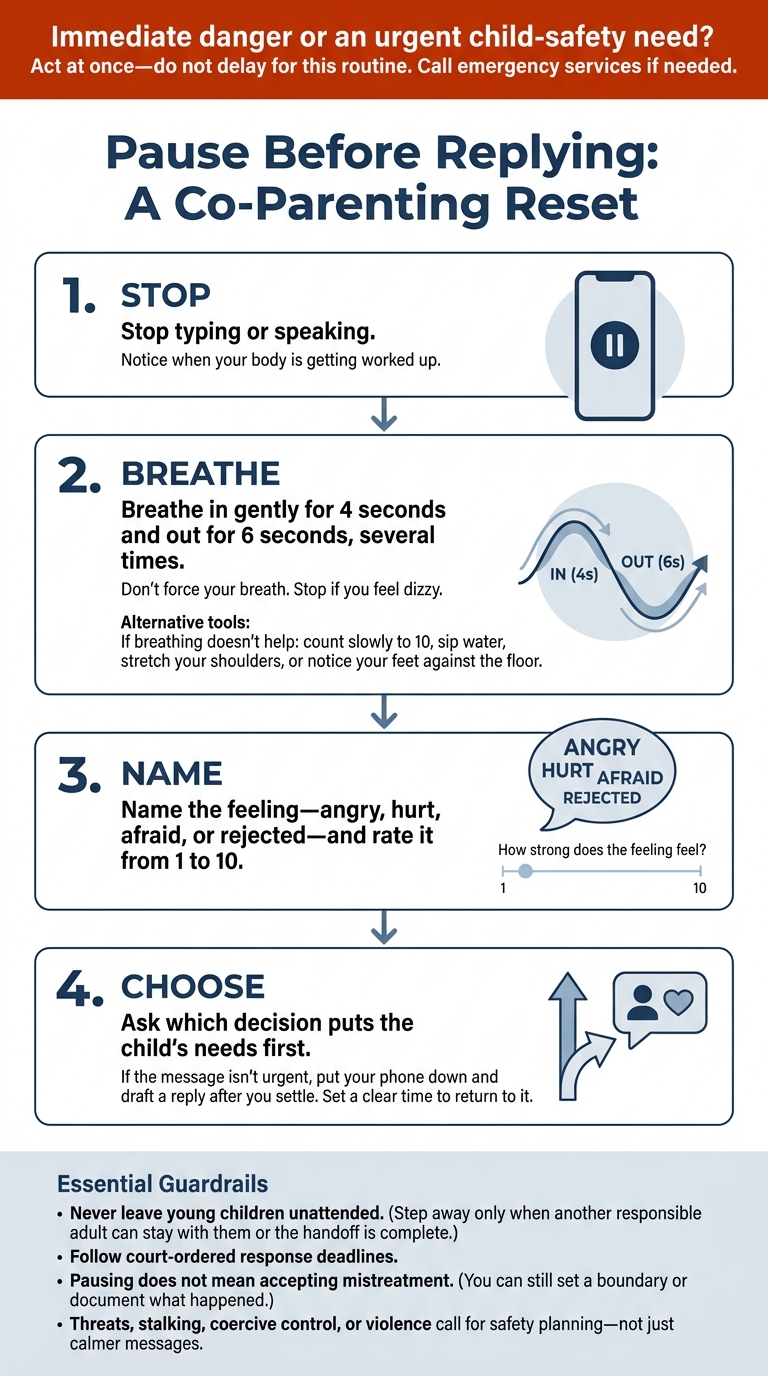
Pause Before Replying: A Co-Parenting Reset
Somatic Strategies for Co-Parenting | Growth and Change Counseling
sbb-itb-596b85d
Understand Emotional Regulation and Know When Safety Comes First
Pausing can help you avoid messages that fuel conflict or put children in the middle. Strong anger or fear can lead to rushed, inaccurate reactions. A racing heart, clenched jaw, or rapid texting is your cue to stop.[4][5]
Name what you’re feeling, put down the phone, and take several slow breaths. If the message can wait, return to it only when you can focus on your child’s needs. If a court-ordered response deadline applies, use the safest available communication method.[4] When the situation starts to feel unsafe, shift from managing your emotions to safety planning.
A scheduling disagreement differs from behavior that makes you fear retaliation for speaking up. Repeated monitoring, intimidation, threats, or isolation can signal coercive control. Stalking, dangerous substance-related impairment, suspected abuse or neglect, and unsafe driving call for a safety assessment – not just better wording.[3][7][9]
If retaliation is likely, stop joint problem-solving and seek safety planning tailored to your situation. This may cover exchanges, pickup procedures, emergency contacts, and device security. When it’s safe, save threatening messages and record dates, times, and facts. Don’t ask children to investigate.[3][6][8]
If you’re unsure about safety, seek help rather than continuing the conversation. Call 911 for immediate danger. For urgent concerns that don’t involve immediate danger, the National Domestic Violence Hotline provides safety planning and referrals at 1-800-799-SAFE (7233). Use a safer device if yours may be monitored.[2][6][8]
1. Seek Individual Therapy or Parent Coaching
If you keep struggling to manage your reactions, get outside support before the next exchange. Individual therapy or parent coaching can help when exchanges remain explosive, fear lasts between handoffs, or anxiety makes parenting difficult. Therapy helps you work through triggers. Parent coaching focuses on calmer exchanges, boundaries, and how you respond to your children.
Growth and Change Counseling offers individual therapy and parent coaching for anxiety, trauma, addiction, and relationship stress in California, including through telehealth.
Before your first session, track conflict for one to two weeks. Note two or three recurring triggers, your reactions, and the outcomes you want to change. Use that first session to identify patterns. Ask about the provider’s experience with high-conflict co-parenting, coercive control, and child safety, along with how they handle confidentiality. Set one goal and review your progress after 30 days.
For example, aim to keep disagreements out of your child’s hearing.
Emotional regulation can help protect children, but it does not make unsafe joint treatment appropriate. Do not use family therapy when abuse, intimidation, or coercive control makes joint sessions unsafe. Therapy does not replace emergency services, legal advice, or court orders. Bring your parenting plan so sessions can focus on following it. If you need help interpreting or changing the plan, seek qualified legal guidance.
2. Pause Before You Respond
When you feel your body getting worked up, pause before replying. Use a stop-breathe-name-choose routine: stop typing or speaking, breathe slowly, name your emotion and how strong it feels, then choose your next practical step.
Try breathing in gently for 4 seconds and out for 6 seconds, several times. Don’t force your breath, and stop if you feel dizzy. If breathing doesn’t help you settle, count slowly to 10, sip water, stretch your shoulders, or notice how your feet feel against the floor.
Name the feeling – angry, hurt, afraid, or rejected – and rate it from 1 to 10. Then ask yourself which decision puts the child’s needs first. If a message isn’t urgent, read it once, put your phone down, and draft a reply after you settle. Set a clear time to return to it so you address the decision rather than leave it unanswered.
Only step away when another responsible adult can stay with the children or the handoff is complete. Never leave young children unattended.
Pausing doesn’t mean accepting mistreatment or denying your anger. You can still set a boundary or document what happened. If a child faces immediate danger, violence, unsafe supervision, or a medical emergency, act at once and call emergency services if needed. After your pause, check the facts before you answer.
3. Separate Facts From Assumptions
After you pause, sort out what happened from what you think it means. Ask yourself: Can I verify this through a message, calendar, or direct observation? Reframing changes your interpretation – not the facts. It can help you stay calmer under stress without denying what happened.[11][12]
Hypothetical example – delay: The exchange was scheduled for 5:00 p.m.; it is now 5:20 p.m. Replace They are doing this to ruin my day with The exchange is late; I can confirm the arrival time and document the delay. Send: The exchange was scheduled for 5:00 p.m., and it is now 5:20 p.m. Please confirm your estimated arrival time.
Before replying, jot down: Trigger, Facts, Assumption, Feeling, Child need, Next step. With the facts clear, keep your reply brief and focused on your child.
Do not use reframing to excuse threats or documented harm. Intimidation, stalking, coercive control, abuse, and repeated parenting-plan violations call for action and documentation – not positive spin. Seek safety, legal, or clinical support as needed. Use emergency services if there’s immediate danger.[13]
4. Keep Messages Brief and Child-Focused
Once you have the facts, focus your reply on the child’s immediate need. One message, one child need. Say what needs to happen, when, and where. Skip sarcasm, accusations, and unrelated details. Short replies leave less room for conflict. If a message includes insults, answer only the child-related question.
Please confirm pickup at 5:30 p.m. Friday at the agreed location.
Cut anything that doesn’t help address the child’s need. Respond promptly to urgent health, safety, transportation, or supervision concerns. Follow court-ordered response deadlines, notification rules, and approved communication methods.
Keep clear records to reduce confusion and avoid repeat arguments. Securely save messages, confirmations, and schedule changes. Record only dates, times, requests, and actions taken.
If every exchange turns into a fight, ask a qualified professional whether parallel parenting could help reduce contact and conflict. This approach uses a detailed plan, more independent day-to-day parenting, and written communication limited to necessary child-related matters. It must still follow court orders and, when abuse or coercive control is present, safety planning.
With written exchanges calm and brief, the next step is protecting children from adult tension.
5. Keep Children Out of Adult Conflict
Keeping children out of adult conflict is one of the clearest ways to reduce their stress and protect them.
Children are not messengers, mediators, or confidants. They should never have to carry emotions adults struggle to manage. Don’t ask them to deliver complaints, settle disagreements, keep adult secrets, report on the other household, or comfort you during a dispute. Pressure to choose sides can be especially harmful.[14]
Keep disagreements away from handoffs, school events, sports, birthdays, and medical visits. Discuss money, custody, and relationship conflicts privately, where children cannot overhear.[15]
Show them how to repair a tense moment. Name your frustration and apologize if you speak sharply. If your child hears an argument, wait until you’re calm and say:
That was an adult issue. It was not your fault. You do not need to fix it or choose sides.
Keep your explanation brief. Turn to another adult – not your child – for emotional support.
After transitions between households, give children room to talk about their feelings. Listen, note only what matters for safety, and take any disclosure of danger seriously. Help them feel more settled by explaining what happens next, including when the next pickup will be.
With children out of the middle, you can help them name and manage their own feelings.
6. Set Clear Schedules and Communication Rules
Once your responses are calmer, put the routine in writing to reduce the conflict itself.
Write down recurring decisions so you don’t have to renegotiate them under stress. Your parenting plan should cover weekly schedules, exchanges, transportation, school and activity logistics, holidays, vacations, contact rules, information sharing, and decision-making authority. Spell out exact times, who handles transportation, what happens when school is closed, and how to request schedule changes. State which holiday or vacation schedule takes priority.[1][18][19][20]
Leave room for flexibility without leaving room for confusion. Set an advance-notice deadline, require written confirmation, and follow the court order for formal changes.[19][22]
Clear rules mean fewer last-minute negotiations and a more predictable routine for children. They can also ease the stress that leads to reactive messages. Choose a communication structure that’s safe and realistic for your situation:
| Approach | Communication level | Appropriate conditions | Practical requirements |
|---|---|---|---|
| Collaborative co-parenting | Frequent direct coordination | Both parents can cooperate safely | Shared calendar, decision rules, routine updates |
| Low-contact co-parenting | Limited written communication | Minimal interaction, no safety concern | One written channel, response window, standard format |
| Parallel co-parenting | Highly structured, minimal negotiation | High conflict makes collaboration unreliable | Detailed plan, neutral exchanges, written records |
Use one written channel, such as email or a co-parenting app. Agree on a response window for nonurgent matters, such as 24–48 hours.[17]
Separate emergencies involving an immediate risk to your child’s health or safety from routine logistics. The plan should explain who to contact, when to call 911, and how soon the other parent must be notified. Differences in meals or bedtime generally remain household choices unless safety, medical needs, or the court order require coordination. Follow the order’s consent rules for major medical and educational decisions.[1]
These labels don’t override safety needs or court orders. Threats, stalking, coercive control, or violence call for help from a domestic-violence advocate, attorney, or court-approved professional – not more direct cooperation. Follow protective orders and safety plans, including supervised exchanges or approved third-party contact.[16][21]
A clear routine can also give children less confusion to sort through as they learn to manage their feelings.
7. Help Children Name and Manage Feelings
A predictable routine helps, but children still need support naming feelings after tense exchanges or schedule changes. Start with emotion coaching: Name sadness, anger, or worry before offering solutions. Notice body signals, like tight fists or a tense stomach, and let your child confirm or correct your guess. Validation means accepting the feeling – not agreeing with the story behind it.
Keep behavior limits clear. Anger is allowed; hitting, threats, and damaging property are not. If your child describes possible danger or abuse, put safety first and follow safety guidance rather than investigating yourself.
Once the feeling has a name, help your child choose a way to settle down. Practice calm-down skills during calm moments, so they’re ready to use before handoffs, after calls, or when stress builds. Make a short coping menu together: belly breathing, drawing, stretching, walking, music, or a short break.
Your response teaches these skills, too. Briefly name your own feeling and show a safe way to handle it. If you yell, apologize and reset calmly. Remind your child that adult conflict is not their job.
Conclusion: Start With One Small Change
Focus on fewer reactive replies, clearer facts, and calmer handoffs. Small changes can help limit your child’s exposure to adult conflict. Start with one change you can repeat this week.
For the next seven days, choose one grounding skill, one message rule, and one handoff routine. Then check what helped: Were replies shorter? Did handoffs go more smoothly? Keep what worked and adjust one step.
If conflict stays intense, seek individual therapy or parent coaching. Support is available through Growth and Change Counseling.
If you’re facing danger – not just stress – shift from coping to safety planning. Threats, stalking, coercive control, abuse, or violence call for safety-focused guidance, not simply better communication. Seek qualified domestic-violence, legal, or child-protection support, and follow applicable court guidance.[10][23] Call 911 if you’re in immediate danger.
FAQs
How can I set boundaries if my co-parent ignores them?
Stay calm and restate your boundaries without escalating the conflict. If a non-urgent message arrives outside your agreed-upon times, calmly explain when you’ll respond – for example, at your next scheduled check-in. Use BIFF (Brief, Informative, Friendly, and Firm) to keep your reply on track.
If the behavior continues, try Grey Rock: short, unemotional replies that discourage conflict. Keep all communication in writing. If needed, involve a professional mediator or parenting coordinator to help reinforce the parenting plan.
How can I tell if my child needs therapy?
Consider professional support if your child avoids school, has frequent mood swings, loses interest in activities, or behaves differently between homes. Feeling caught in parental conflict or showing sudden changes in appetite, sleep, or school performance can also be signs that they need help.
If these issues persist, therapy can offer a safe space to work through emotions. Growth and Change Counseling provides individual and family therapy through telehealth across California and at in-person locations.
What if calming exercises make my anxiety worse?
If calming exercises make you feel more anxious, you may be struggling to shift out of fight-or-flight mode. Try simple physical grounding instead of complex mental tasks, such as splashing cold water on your face or planting your feet firmly on the ground.
If anxiety continues or interferes with daily life, Growth and Change Counseling offers professional support to help you develop ways to manage your emotions that fit your needs.
Related Blog Posts
- 5 Steps to De-Escalate Co-Parenting Arguments
- How to Communicate Effectively in High-Stress Co-Parenting
- Managing Triggers in High-Stress Co-Parenting Situations
- 5 Ways to Protect Children from Parental Conflict
