A strong marriage across two backgrounds usually comes down to relational intelligence for intercultural couples: clear expectations, calm talks, firm family limits, and shared routines. In the U.S., 17% of newlyweds marry someone of a different race or ethnicity, so this is a common issue, not an odd one.
If I had to sum up the article in plain terms, it would be this:
- Name the differences early instead of fighting about them over and over
- Talk about them in a calm, set way with short check-ins and clear rules
- Set limits with relatives as a team before pressure builds
- Put money, parenting, and home rules in writing
- Get outside help if resentment, withdrawal, or family conflict keeps coming back
A few points stand out:
- Disagreements about money, affection, privacy, chores, faith, and parenting often come from old family expectations
- Outside pressure from in-laws, bias, or social stigma can make marriage stress worse
- A direct style can sound harsh, while an indirect style can sound vague
- Written plans, like a $200 per month family-support cap, can stop repeat arguments
- Support may be needed when conflict becomes chronic, especially around in-law stress
Bottom line: I’d treat this less like “fixing personality differences” and more like building clear rules for daily life that both spouses can live with.
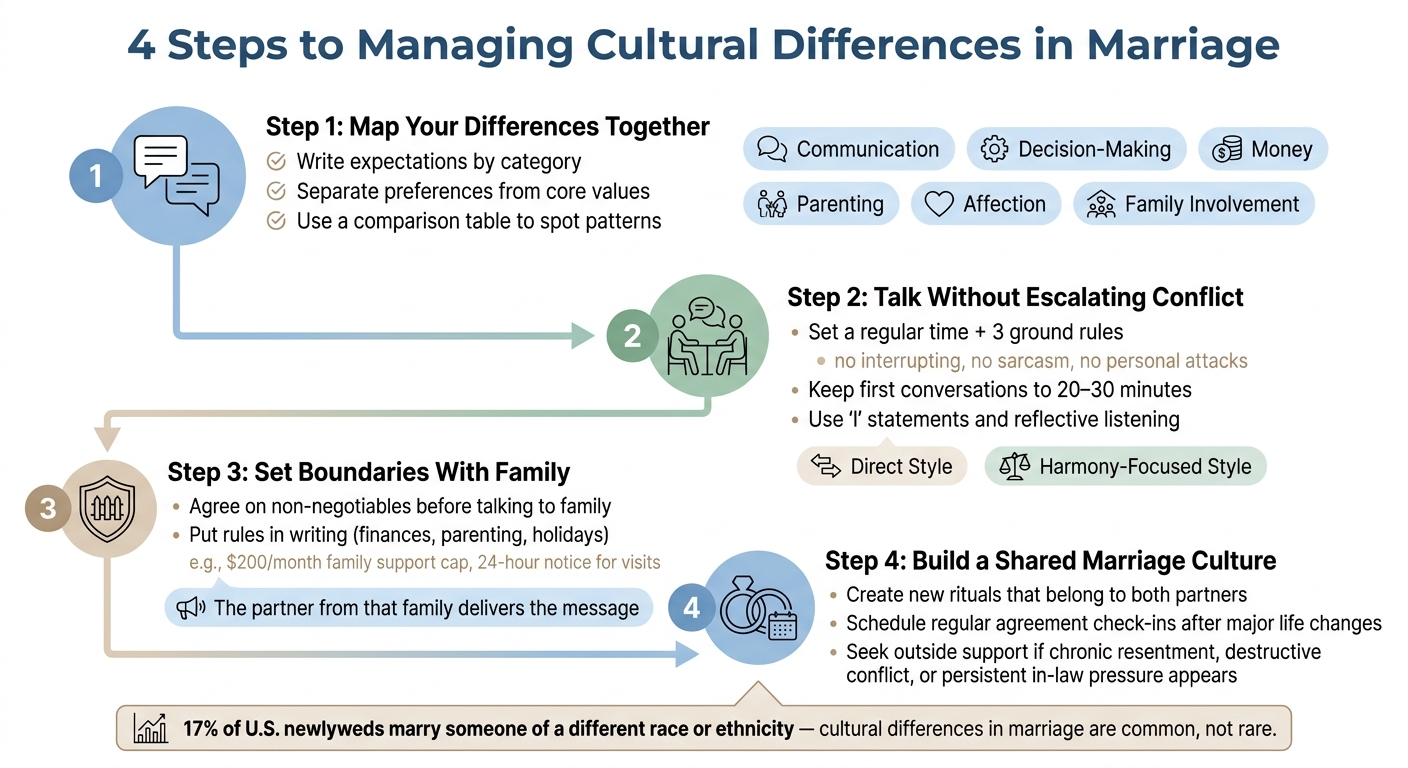
4 Steps to Managing Cultural Differences in Marriage
How to Navigate Cultural Differences in a Relationship | Build Unity, Respect & Real Love
If self-guided efforts feel overwhelming, professional cross cultural couples therapy can provide the structured support needed to bridge deep-seated differences.
sbb-itb-596b85d
Step 1: Map Your Differences Together
Start by writing down your expectations separately. The point isn’t to figure out who’s right. It’s to make both sets of expectations visible.
That simple shift can turn the same old fights about money, family, parenting, and roles into clear issues you can work on. Once the differences are on the page, it’s easier to talk about them without mind-reading, blame, or guesswork.
Write Down Your Expectations by Category
Each partner should do this alone before comparing notes. Focus on areas like communication, decision-making, money, faith, parenting, in-law involvement, and gender roles.
A few prompts can help pull hidden assumptions to the surface. For example: What did your family teach you was respectful? You may find beliefs you’ve been carrying for years without even noticing. Write first, then compare.
Separate Preferences From Core Values
Not every difference means the same thing. Some are everyday preferences, like communication style or how chores get split up. Others run deeper and touch autonomy, family duty, and how connected a couple should be.
For example, shared money may feel like family duty to one partner, while separate accounts may feel like independence to the other.[2] Neither is wrong. But when you know which issues are flexible and which are tied to identity, you stop treating every disagreement like a five-alarm fire.
Use a Comparison Table to Spot Patterns
Once you’ve both written out your expectations, put them side by side. That makes patterns easier to spot. Go one category at a time so the conversation doesn’t spiral.
| Domain | Partner A’s Expectation | Partner B’s Expectation | Main Tension | Agreed Plan |
|---|---|---|---|---|
| Family Involvement | High obligation to extended family; frequent visits | Priority on nuclear family privacy and autonomy | In-laws feel like an intrusion vs. feeling isolated | Set a specific visit schedule; define which decisions stay private |
| Decision-Making | One person decides | Both decide together | Feeling controlled vs. nothing gets decided | Consensus for big items; individual autonomy for small ones |
| Money | Shared approach; pooled resources | Individual accounts; financial independence | Control vs. security | Joint account for shared bills; separate accounts for personal spending |
| Parenting | Emphasis on cultural traditions and family hierarchy | Emphasis on child autonomy and personal choice | Clashes over discipline and rituals | Agree on three non-negotiable traditions to pass down together |
| Affection | More private | More openly affectionate | Feeling unloved vs. feeling overwhelmed | Negotiate specific cues that signal affection for each partner |
After you map the differences, the next move is to talk through them without letting the discussion boil over. If the tension feels too high to manage alone, intensive therapy for couples can provide a structured environment to resolve deep-seated conflicts.
Step 2: Talk About Differences Without Escalating Conflict
Once you’ve mapped your differences, talk about them before they turn into the same fight on repeat. In many relationships, the issue isn’t just the issue. It’s the tone, the silence, or the bluntness wrapped around it.
Set a Regular Time and Ground Rules for Hard Conversations
Don’t wait until things boil over to bring up a hard topic. In intercultural marriages, a common pattern is putting off problems until one or both partners hit a breaking point. That tends to increase the emotional strain and can lead to destructive arguing [1]. So before you try to fix anything, set up the conversation in a way that gives both of you a fair shot at staying calm.
Start with three simple ground rules: no interrupting, no sarcasm, and no personal attacks. Keep the first conversation short, around 20 to 30 minutes. That time limit matters. It helps stop a hard talk from turning into a marathon.
It also helps to explain the meaning behind a practice before deciding whether it stays or goes. Something that looks odd or unnecessary to one partner may hold deep meaning for the other.
Use Reflective Listening and ‘I’ Statements
One of the best ways to lower tension is to make sure your partner feels heard before you move into problem-solving. Two tools help a lot here: the "I" statement and reflective listening.
Instead of saying, "You always dismiss what I say", try "I feel dismissed when…" That keeps the focus on your experience, not your partner’s personality. Then, after your partner speaks, respond with "What I hear you saying is…" and repeat back what you understood.
That small shift can change the whole tone of a conversation. Reflective listening slows down knee-jerk reactions and keeps both of you focused on the problem instead of the hurt.
Style differences also play a big part in misunderstandings, even when both people mean well.
Direct vs. Harmony-Focused Communication: A Side-by-Side Look
Many intercultural couples run into trouble not because of what they say, but how they say it. As Anthony T. Machette of the University of Oklahoma notes, "Intercultural couples may find a lot of miscommunication comes from nonverbal behaviors." [1] A lot of arguments begin when one spouse reads the other’s style as rude, cold, or evasive.
| Direct | Harmony-Focused (Indirect) | |
|---|---|---|
| Strengths | High clarity; focused on personal goals [2] | Preserves dignity and group harmony [2] |
| Risks | Can feel harsh or dismissive of face-saving needs [1] | Can feel unclear or like avoiding the issue [1] |
| Common misreading | Silence is taken as agreement or lack of interest | Directness is taken as a personal attack |
| Practical hybrid | Use "I" statements to stay direct while softening tone | Name the concern calmly and specifically rather than hinting |
Neither style is automatically better. What matters is seeing your default pattern, naming it out loud, and adjusting before the conversation slips into a fight.
Once you can talk without things escalating, set shared boundaries that protect the marriage from outside pressure.
Step 3: Set Boundaries With Family and Build Shared Agreements
Once you can talk about differences without things heating up, the next step is to turn those talks into clear boundaries. In intercultural marriages, pressure from in-laws often comes from different beliefs about autonomy, obligation, privacy, and how decisions should be made as a couple [1].
Agree on Your Boundaries Before Talking to Family
Before you speak with family, get on the same page about your non-negotiables and where you have room to bend. For each issue that keeps coming up, spell out four things: the problem, the boundary, who says it, and what happens if the boundary is ignored.
Say a relative keeps stopping by without warning. Don’t improvise in the moment. Agree on the rule ahead of time and decide who will deliver it. In most cases, it helps if the partner from that family says: "We love seeing you, but visits need 24 hours’ notice." It stays respectful, and it shows that both of you are standing together.
Write Shared Rules for Money, Roles, and Parenting
Put your rules in writing for finances, household work, holidays, and parenting. This doesn’t need to be fancy. A simple written agreement can save you from having the same argument over and over.
For money, set a fixed limit for family support – for example, $200 per month, only after your household needs are covered [1][2]. For parenting, you might agree that parents make the final call on discipline and health, while grandparents can share advice but don’t decide. For holidays, decide ahead of time whether you’ll alternate major holidays between families or start a new shared tradition at home. Writing these rules down cuts down on yearly renegotiation.
Use a Boundary Planning Table for Recurring Pressure Points
When the same issues keep popping up, a simple table gives you something to come back to. It keeps both of you aligned and stops every problem from turning into a brand-new debate.
| Situation | Couple Boundary | Who Communicates It | Follow-Up Response |
|---|---|---|---|
| Unannounced visits | Visits must be scheduled at least 24 hours in advance | Partner whose family is visiting | "We love seeing you, but visits need 24 hours’ notice." |
| Money requests | Family support capped at $200/month, only after household budget is met | Partner related to the requester | "We’ve reached our budget limit for this month." |
| Holiday plans | Alternate years between cultures; one holiday is strictly for the nuclear couple | Partner whose family is being declined that year | "We value this tradition, but we’ve decided to start our own this year." |
| Parenting criticism | Parents make final decisions on discipline and health; grandparents advise only | Partner being criticized | "Thank you for your perspective; we’ll consider it as we make our decision." |
Use the table when pressure picks up, especially during money stress or family conflict. If tensions remain high, consult a family conflict resolution guide for specific mediation steps. Once the rules are written, the next move is to protect them with repeatable routines and review them on a set schedule.
Step 4: Keep a Shared Marriage Culture and Get Help When Needed
Build New Rituals and Review Agreements on a Schedule
Once your boundaries are in place, the next job is keeping them alive in daily life. It’s one thing to agree on a plan during a calm talk. It’s another to make that plan part of normal life.
That’s where shared routines and traditions matter. Build habits that belong to both of you, not just one family background or the other. Start small: a regular dinner rhythm, holiday plans, weekend habits, or simple daily routines that reflect both sides. These shared rituals help each partner feel seen.[3][4]
Rituals also make your agreements easier to keep because they move them out of theory and into real life. And those agreements should not sit untouched forever. Set check-ins after major life changes like a new baby, job loss, a move, or recovery.[2]
Signs That You Need Outside Support
Most couples can handle day-to-day friction with the tools in this guide. But some patterns are tougher to change on your own.
"Most couples developed effective ways to manage such challenges without reducing their marital satisfaction, except when challenges involved their in-laws." – Anthony T. Machette & Ioana A. Cionea, University of Oklahoma [1]
The table below shows the difference between strain you may still be able to work through together and strain that calls for outside help.
| Area | Still Manageable | Seek Support When… |
|---|---|---|
| In-Law Relations | Occasional friction or minor boundary-setting | In-laws cause persistent arguments or chronic resentment [1] |
| Communication | Occasional misunderstandings | Conflict turns destructive or one partner feels persistently misunderstood [1][5] |
| Cultural Values | Negotiating holidays or household roles | You can’t balance family obligations with personal autonomy [2] |
| Emotional State | Temporary frustration after a disagreement | Chronic resentment or emotional withdrawal [2][3] |
If these patterns keep showing up, especially around in-law pressure, rigid family pressure, addiction, or trauma, that’s a strong sign to bring in outside support.
Conclusion: Shared Values, Clear Boundaries, and Timely Support
Managing cultural differences in marriage is an ongoing process, not a one-time fix. The steps in this guide give you a framework you can return to: map your differences, talk through them without letting things spiral, set united boundaries with family, and build a shared marriage culture on purpose.
If the same conflicts keep coming back even after clear agreements, Growth and Change Counseling’s Marriage Rescue Institute offers focused couples coaching for couples in serious difficulty.
FAQs
How do we tell the difference between a cultural issue and a personality issue?
Telling these two apart isn’t always easy. Cultural issues usually come from shared beliefs, everyday habits, and expectations shaped by the way you were brought up. Personality issues, on the other hand, tend to come from individual traits, habits, and preferences.
A simple way to think about it: is this behavior just a personal preference, or does it come from a deeply held social norm learned early in life? Growth and Change Counseling can help couples work through these differences with support tailored to their relationship.
What should we do if our families ignore the boundaries we set?
If your families ignore the boundaries you and your spouse have set, focus on what you can control: your relationship and how you show up as a team.
Be clear about your expectations. Back each other up. When things get tense, a little humor can help take the edge off.
You can’t force your families to accept your marriage. At some point, you may need to move ahead with confidence and give them the time and space to come around.
When should we get professional help for cultural conflict in marriage?
It may be time to get professional help when cultural differences keep leading to the same unresolved conflicts or unhealthy patterns between you and your partner.
If you’ve both tried to meet in the middle and it still isn’t working, or you feel stuck in a cycle of misunderstanding and hurt, Growth and Change Counseling offers focused support for couples who want to reconnect and rebuild their marriage through an intensive 12-week process.
Related Blog Posts
- Guide to Supporting Cross Cultural Couples in Therapy
- Guide to Relational Intelligence for Intercultural Couples
- Study: Impact of Cultural Awareness on Marriage Counseling
- Marriage Therapy for Indian Families
