Most couples don’t need less conflict. They need better conflict. In couples therapy, I see the same pattern again and again: when one person speaks up without care, talks turn into fights; when one person stays caring but silent, resentment grows.
Here’s the core idea in plain English:
- Assertiveness means saying what I feel, need, or want in a clear and respectful way.
- Empathy means I slow down enough to understand what my partner is feeling before I push my point.
- Both skills have to work together. One without the other usually leads to distance, shutdown, or repeated arguments.
A few points stand out from the article:
- Flooding can shut down useful conversation, especially once heart rate goes above 100 bpm
- A simple pause rule, like “I need a 20”, can stop a bad talk from getting worse
- Couples therapy often uses tools like I-statements, reflective listening, validation, and clear boundaries
- Approaches like EFT, the Gottman Method, and CBT-based couples therapy all teach a similar pattern: say the feeling, make a clear request, listen back, then repair
- Research cited in the article says 70% to 75% of couples in EFT move from distress to recovery, with gains lasting 2 years or more
If I had to sum it up in one line, it would be this: say hard things clearly, hear hard things calmly, and pause before the talk turns into damage.
For couples dealing with couples therapy and self-healing after betrayal, addiction recovery, money fights, or chronic conflict, these skills often need more structure, tighter rules, and short repair steps. That’s the point of the article: not theory, but usable communication habits that help couples stop fighting each other and start dealing with the pattern.
ACT for Couples: Communication & Conflict Resolution Skills (#3)
sbb-itb-596b85d
Quick Comparison
| Skill or Pattern | What it looks like | Common result |
|---|---|---|
| Passive communication | Staying quiet, saying “it’s fine,” avoiding the issue | Needs go unmet, distance grows |
| Assertive communication | Saying “I feel… when… because… I need…” | More clarity, more safety |
| Aggressive communication | Blame, “you always,” “you never,” yelling | Shutdown, counterattacks, loss of trust |
| Empathy in action | Reflecting, validating, checking emotion first | Less tension, more openness |
Bottom line: I’d read this piece as a guide to turning conflict into a more direct, calmer, and more caring conversation.
What assertiveness and empathy mean in a relationship
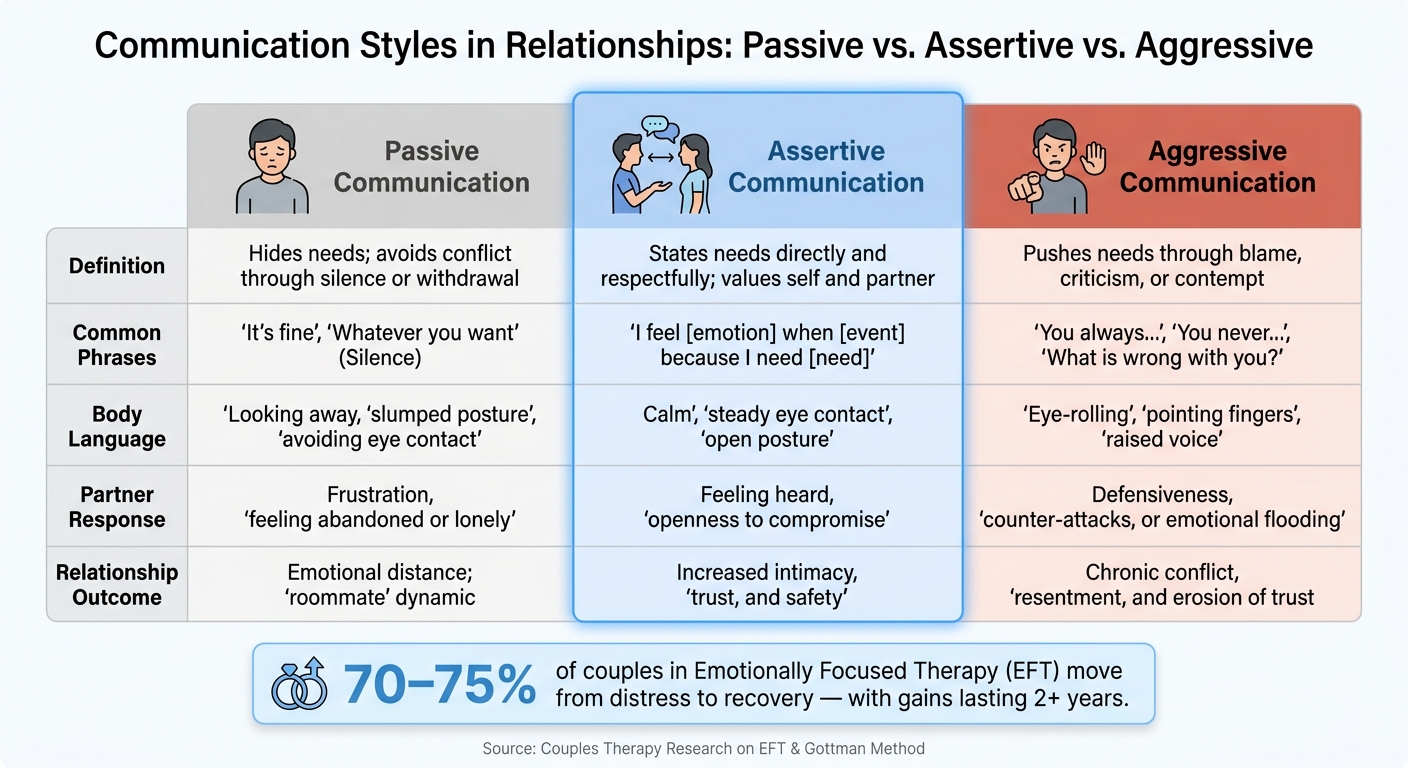
Passive vs. Assertive vs. Aggressive Communication in Relationships
Assertiveness means saying what you need, feel, or want in a clear, respectful way. It’s direct, but not harsh. The focus stays on your experience instead of turning into blame.
Empathy means trying to understand your partner’s inner experience, even if you don’t agree with hurtful behavior. That small shift can lower defensiveness fast.
Once those two skills make sense, it helps to see what they look like in actual conversations.
Passive, assertive, and aggressive communication: a side-by-side comparison
These patterns often build little by little. A lot of couples don’t spot them until conflict gets more intense. Here’s how passive, assertive, and aggressive communication tend to play out.
| Communication Style | Definition | Common Phrases | Body Language | Likely Partner Response | Relationship Outcome |
|---|---|---|---|---|---|
| Passive | Hides needs; avoids conflict through silence or withdrawal | "It’s fine", "Whatever you want", (Silence) | Looking away, slumped posture, avoiding eye contact | Frustration, feeling abandoned or lonely | Emotional distance; "roommate" dynamic |
| Assertive | States needs directly and respectfully; values self and partner | "I feel [emotion] when [event] because I need [need]" | Calm, steady eye contact, open posture | Feeling heard, openness to compromise | Increased intimacy, trust, and safety |
| Aggressive | Pushes needs through blame, criticism, or contempt | "You always…", "You never…", "What is wrong with you?" | Eye-rolling, pointing fingers, raised voice | Defensiveness, counter-attacks, or emotional flooding | Chronic conflict, resentment, and erosion of trust |
Flooding – when heart rate rises above 100 bpm – can make productive conversation impossible [2]. At that point, the talk usually stops being useful.
Why balance matters more than choosing one skill over the other
Assertiveness without empathy can sound like a demand. Empathy without assertiveness can leave resentment simmering under the surface. Neither extreme gives a relationship the safety it needs to deepen.
When one partner has a lot of empathy but rarely speaks up, their needs often go unmet. Over time, that silence can harden into bitterness. On the other side, when someone is direct but doesn’t slow down and notice how their words land, even honest communication can feel like an attack. John Kane, Relationship Therapist at Growth and Change Counseling, puts it this way:
"Conflict is a pathway to intimacy. If there’s no conflict in a relationship, at least one person isn’t being genuine." [1]
In couples therapy, the aim is to help partners stop reacting at each other and start facing the problem together. From there, therapy helps turn these ideas into habits couples can use again and again.
The next step is learning the specific tools couples therapy uses to build both skills.
How couples therapy builds assertiveness and empathy step by step
Knowing what assertiveness and empathy mean is one thing. Using them in the middle of a tense conversation is something else entirely. That’s where couples therapy helps. It closes the gap with modeling, guided practice, and in-the-moment coaching. One of the first steps is naming the negative interaction cycle – like pursue-withdraw – so the pattern becomes the problem, not the partner.
Assertiveness tools: I-statements, specific requests, and clear boundaries
One of the main assertiveness tools is the I-statement formula: I feel [emotion] when [behavior] because [impact], and I need [request]. This keeps the focus on your own experience instead of turning the conversation into a judgment of your partner’s character. Therapists often pair it with a gentle opening – a calm way to bring up a need without slipping into blame.
If a complaint is too broad, therapists usually help couples narrow it down to one specific incident instead of a sweeping accusation. That shift matters. It’s a lot easier to talk through what happened Tuesday night than to argue about what always happens.
Clear boundaries work in a similar way. They’re not ultimatums. They’re statements about what you can and can’t engage with. For example: I want to hear you, but I cannot continue if there is yelling.
When flooding starts, the goal is simple: pause, breathe, and come back only when both people can stay engaged.
Empathy tools: reflective listening, validation, and emotional check-ins
Empathy in therapy isn’t just a feeling. It’s a set of behaviors people can learn and practice. Reflective listening means putting your partner’s message into your own words, including the emotion underneath it, before you respond. That sounds simple, but in a heated moment, it can feel like trying to hit the brakes on a car already going downhill.
Therapists also teach couples to validate first and solve later. Feeling understood often lowers defensiveness more than jumping straight to a fix. Another useful shift is assuming positive intent, which can soften that first impulse to defend yourself or strike back.
Between sessions, couples may use short check-ins and simple emotion logs to notice triggers and track how they respond.
Therapists then bring these skills together inside larger models of change.
How therapy models combine both skills in real conversations
In session, therapists turn these tools into a conversation pattern couples can repeat.
Emotionally Focused Therapy (EFT) helps couples map their negative interaction cycle and practice vulnerable self-disclosure – naming feelings like loneliness instead of moving into blame – so assertiveness and empathy can work side by side to rebuild emotional safety [3][7].
The Gottman Method teaches couples to replace the Four Horsemen with gentle openings, taking responsibility, and repair attempts, with each step tied to observable communication behavior [2].
CBT-based couples therapy helps partners notice automatic thoughts, reframe them, and rehearse new responses. The focus stays on the same core pattern: pause, name the feeling, make a clear request, validate the partner, and return to the conversation with more structure.
For high-conflict couples, these tools tend to work better with firmer structure and shorter repair attempts.
Using these skills in high-conflict and addiction recovery relationships
When conflict runs hot or addiction is part of the picture, these same skills need more structure. Assertiveness and empathy still matter, but on their own, they usually aren’t enough. Without clear guardrails, hard talks can go off the rails fast.
If either partner gets emotionally flooded, stop the conversation and take at least 20 minutes before trying to fix anything. Talks about sobriety, betrayal, or money should end the moment either person hits that point. Pushing through usually makes things worse, not better.
In addiction recovery, silence or withdrawal often hides deep shame. That shame needs to be named directly instead of left sitting in the dark. Real accountability means saying what happened out loud and facing the impact of it. When assertiveness and empathy work side by side, they make room for that kind of honesty without pushing the other person into shutdown. One partner can speak plainly about what happened while still staying open to what the other person is carrying.
Once the stakes get this high, couples usually need scripts and rules that keep the conversation from falling apart.
Scripts and ground rules for hard conversations
Before a hard conversation starts, both people need to agree on a few basic rules. The biggest one is the "I Need a 20" rule. When either partner feels flooded, they use a pre-agreed signal to pause the conversation for at least 20 minutes. The person calling the timeout agrees to come back to the discussion within 24 hours [5]. This is a reset, not avoidance.
During the conversation, keep the focus on one specific incident instead of drifting into a fight about trust or sobriety as a whole [4]. That small shift can lower defensiveness and make it easier to hear what the other person is saying.
Repair attempts matter too. A short phrase like "I bet you didn’t mean to come across that way, but I felt a little shut down just now" [4] can interrupt a negative cycle before it takes over. Weekly check-ins can also help. Use them to review triggers, cravings, repair attempts, and any broken agreements.
If a couple can’t stay regulated long enough to use these tools, structure starts to matter more than insight.
When a structured program can help couples in crisis
Standard weekly therapy can work well for couples dealing with moderate conflict or communication patterns they want to change. But when a relationship is under heavy strain – active addiction, infidelity, or imminent separation – weekly sessions may not move fast enough or go deep enough to create change that sticks.
Growth and Change Counseling offers The Marriage Rescue Institute, a structured 12-week couples coaching process built for marriages in crisis [1]. It’s directive and intensive, made for couples who have already tried more standard approaches or are facing imminent separation. The focus is on rebuilding trust, communication, and accountability from the ground up.
Weekly therapy fits skill-building. A structured 12-week program fits couples in crisis who need tighter accountability and faster stabilization.
For couples dealing with addiction, accountability, vulnerability, and structured support are the framework that makes honest change possible.
Conclusion: Turning communication skills into lasting relationship change
The big takeaway is simple: assertiveness and empathy don’t cancel each other out. Used together, they help partners be honest without losing care and respect.
This kind of change doesn’t come from one perfect talk. It comes from repetition. Studies on Emotionally Focused Therapy show that 70% to 75% of couples move from a state of distress to recovery through structured therapy, and those gains tend to last for two years or more after treatment ends [3][6]. Daily emotional check-ins, repair rituals after conflict, and the habit of assuming your partner isn’t trying to hurt you are the kinds of practices that help those gains stick.
I-statements, reflective listening, structured pauses, and specific requests matter most when couples use them in actual conversations. That’s where the shift happens. Small, steady practice can turn new ways of talking into lasting patterns.
When conflict is severe, daily practice on its own may not be enough. Growth and Change Counseling offers The Marriage Rescue Institute, an intensive, directive 12-week couples coaching process designed for couples in relationship crisis who need structured support to rebuild trust and stability. Whether a couple needs that level of support or is just starting to build better habits, the goal stays the same: speak honestly, listen with care, and repair quickly. The aim isn’t to win arguments. It’s to make repair the default.
FAQs
How do I stay assertive without sounding harsh?
Stay assertive by talking about your own needs and feelings instead of going after your partner. Use "I" statements rather than blame-heavy lines like "you always" or "you never."
It also helps to share the softer feelings under the surface, like fear, sadness, or loneliness. That kind of honesty can open the door to connection instead of pushing the other person away.
Try to stay curious, too. Give your partner the benefit of the doubt when you can, and assume positive intent instead of jumping to the worst-case story. And if you feel yourself getting too worked up, take a calm, short break. Sometimes stepping away for a bit is the best way to come back steady and say what you mean.
What should we do when one of us gets flooded?
When you’re flooded, your nervous system is overloaded. At that point, clear thinking is pretty much offline. Watch for signs like a heart rate above 100 beats per minute, tight muscles, or a strong urge to shut down or walk away.
Instead of pushing through the conflict, use a phrase you agreed on ahead of time, such as, "I’m feeling flooded; I need a 20." Then step away for at least 20 minutes. Come back to the conversation within 24 hours.
When do communication tools need professional support?
Professional support can make a big difference when couples feel trapped in the same painful cycle – constant arguing, shutting down, or using harsh words that leave both people hurt.
It can also help when conflict starts to feel too heavy to manage, anger doesn’t let up, or personal struggles like trauma, anxiety, or depression get in the way of feeling close. In cases like that, Growth and Change Counseling offers focused support, including The Marriage Rescue Institute, a directive 12-week intensive process for couples in serious distress.
Related Blog Posts
- How Active Listening Resolves Couple Conflicts
- Q&A: Managing Anger and Communication in Marriage
- Ultimate Guide to Emotional Communication in Marriage
- Healing Emotional Neglect in Romantic Relationships
