If you feel alone even when you’re together, emotional neglect may be part of the problem. I’d sum it up like this: the relationship may still “work” on paper, but the emotional part feels thin, flat, or missing.
Here’s the short version:
- Emotional neglect is about missing emotional response, not constant fighting
- It often starts with small missed moments of connection
- Childhood emotional neglect can make it hard to name needs, ask for comfort, or trust closeness
- The result can be loneliness, resentment, low mood, anxiety, and less intimacy
- Repair often starts with naming feelings, making direct requests, and setting weekly check-ins
- If the pattern has lasted months or years, marriage therapy may help
A few facts stand out. Research and clinical sources in the article link emotional neglect with lower relationship satisfaction, more conflict, and less emotional closeness. The pattern is also easy to miss because there may be 0 big blowups – just a slow loss of warmth, care, and response.
What I’d want to know right away is simple: Do we mostly talk about chores, money, and schedules? Do I stop reaching for my partner because I expect little back? If the answer is yes, that’s a sign to take seriously.
The core fix is simple, but not easy: notice the distance, put it into words, respond with care, and repeat that process every week.
Emotional Neglect Creates This Pattern in Relationships: Losing Yourself
sbb-itb-596b85d
What Emotional Neglect Is and Where It Comes From
Emotional neglect is a pattern of missing emotional response. It happens when someone’s feelings or needs aren’t noticed, answered, or validated. As Dr. Harel Papikian notes:
"Emotional neglect is not about what is done. It is about what is missing." [5]
This is why emotional neglect can be hard to spot. On the surface, a family or relationship may look fine. Bills get paid. Routines work. Day-to-day life keeps moving. But the emotional bond is thin or absent. Over time, that gap can make closeness feel tense, awkward, or even unsafe.
Childhood Emotional Neglect and Adult Attachment Patterns
When caregivers often miss a child’s emotional needs, that child may grow up with a quiet but painful belief: my needs don’t matter. In adulthood, that can show up as strong self-reliance and a hard time leaning on other people. Adults with a history of childhood emotional neglect often struggle to name what they need, ask for comfort, or trust that closeness will stay there. They may also carry a sense that something is wrong with them or that they’re different from other people. [4]
"Childhood Emotional Neglect is somewhat like an invisible barrier that blocks spouse from spouse, holding the two emotionally apart, creating and feeding distance and a deep sense of being alone." – Jonice Webb, Ph.D., Licensed Psychologist [1]
Those early coping habits don’t just disappear with age. They often resurface in adult relationships as distance, defensiveness, or silence.
How Early Neglect Affects Adult Relationship Quality
Adults who went through childhood emotional neglect often report lower relationship satisfaction, more conflict, and less emotional closeness. [5] And the damage isn’t only about feeling distant. It also affects emotional safety. If you don’t feel safe being open, even small moments of disconnection can sting.
Another problem is that emotional neglect can start to seem normal. Some partners may assume the growing distance is just what happens when people get older together. [6] But that view can hide the real issue.
There’s an important point here: emotional neglect is often unintentional. In many cases, a partner isn’t cold or withholding on purpose. They may have never learned how to respond when someone is hurt, scared, or vulnerable. [5] That matters, because once the pattern becomes clear, it can start to change.
Next, look for how emotional neglect shows up in daily interaction, not just in major conflict.
How to Recognize Emotional Neglect in Your Relationship
Common Signs of Emotional Neglect Between Partners
One of the clearest signs isn’t constant arguing. It’s emotional absence.
The pattern to watch for is repeated missed bids for connection. If you feel lonelier sitting next to your partner than you do when you’re by yourself, that’s a strong sign something is off.[1] The same goes if you keep turning to friends or family for comfort because you no longer expect your partner to respond with care.[1]
Another clue shows up in everyday talk. If most conversations are just about bills, schedules, chores, and logistics, with little interest in how either of you is actually doing, that points to emotional deprivation rather than just a packed week.[2][5] And the small moments matter more than people think. A joke, an offhand comment, a quiet attempt to open up – when those keep getting met with distraction, short replies, or silence, the bond starts to wear down.[2][5]
A total lack of conflict can point to disconnection too. As Dr. Jonice Webb notes:
"Strangely enough, often it’s the couples who fight the least who are in the most trouble." [1]
That can sound backward at first. But when partners stop reaching for each other, fights may fade because the relationship has gone emotionally flat. Over time, that repeated absence changes how safe the relationship feels.
What Emotional Neglect Does to Mental Health and Intimacy
Emotional neglect chips away at trust, desire, and the sense that the relationship is a safe place to land. Over time, it can lead to anxiety, low self-worth, sadness, resentment, and less intimacy.[5][3][4]
It can also change how closeness feels. A partner may start to feel emotionally unsafe, and sex can begin to feel performative instead of connected.[4][8] One person may pull back to avoid feeling like they’re failing. The other may protest or press harder because they’re scared of being left.
When the Problem Goes Beyond Neglect
Emotional neglect is not the same as a rough patch.
A hard month at work, a health scare, or a brutal stretch of parenting can create distance for a while. What sets neglect apart is the pattern and how long it lasts. Temporary disconnection often eases when the stress does. Neglect sticks around, and after enough time, it can start to feel normal.[5][3]
There’s also a line between neglect and abuse. Neglect means a lack of emotional response. Abuse adds control, intimidation, or fear.[5] If the relationship includes coercion, threats, or fear, intensive therapy for couples in crisis is not the first move. Safety boundaries need to come first.[5]
Once you can name the pattern, the next step is learning how to rebuild emotional awareness and repair. For those in neurodiverse relationships, emotional growth often requires specific strategies to bridge communication gaps.
How to Heal Emotional Neglect Step by Step
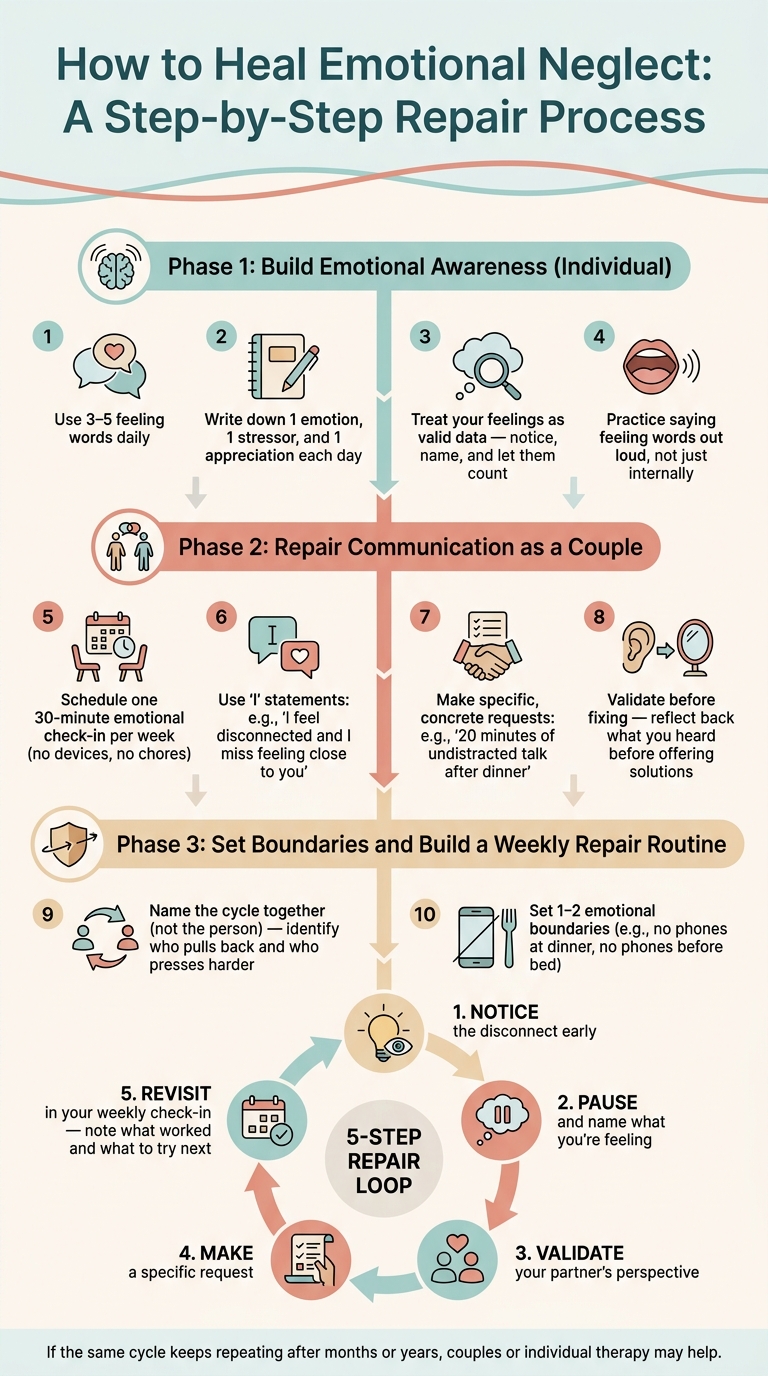
How to Heal Emotional Neglect: A Step-by-Step Repair Process
Rebuild Emotional Awareness, Language, and Self-Trust
If emotional neglect shaped your early relationships, the first move is simple: get clearer about what’s happening inside you.
Use three to five feeling words each day, and write down one emotion, one stressor, and one appreciation.[2] That small habit can help you spot patterns instead of brushing past them.
Treat your feelings as valid data, and respond to them in a steady way.[7] In plain terms, if you feel hurt, tense, lonely, or shut down, don’t talk yourself out of it right away. Notice it. Name it. Let it count.
"Emotional presence is not automatic. It is a skill that requires attention and intention." – Dr. Harel Papikian, Licensed Clinical Psychologist [5]
The next part matters just as much: use those feeling words out loud in your next conversation, not only in your head. That’s where self-awareness starts turning into connection.
Repair Communication and Emotional Attunement as a Couple
Bring that self-awareness into the relationship with short, scheduled check-ins.
Set aside one 30-minute emotional check-in each week, away from chores and devices.[2][5] Think of it as protected time for the relationship, not a last-minute talk squeezed in while someone loads the dishwasher.
During those conversations, use "I" statements to explain your experience and make clear requests. "I feel disconnected lately and I miss feeling close to you" lands very differently than "You never pay attention to me." If you need something concrete, say, "I would like 20 minutes of undistracted talk after dinner." When your partner shares something hard, validate before you move into fixing mode. Reflect back what you heard, and make room for the feeling before offering a solution.[2][5]
Set Boundaries and Build a Weekly Repair Process
Lasting change usually comes from a repeatable structure that catches disconnection early, before it hardens into distance.
Start by naming the pattern together – not as a blame exercise, but as a shared problem. Look at what each person tends to do when the emotional gap gets bigger. Does one partner pull back? Does the other press harder? Name the cycle, not the person.[8]
Then set one or two emotional boundaries that protect connection time. A "no phones during dinner" rule or a "no phones before bed" agreement creates space where emotional responsiveness can happen.[5][2]
The repair process can stay simple:
- Notice the disconnect early.
- Pause and name what you’re feeling.
- Validate your partner’s perspective.
- Make a specific request.
- Revisit the conversation in your weekly check-in, and note what worked and what to try next.[2][5]
Use that weekly check-in to review one repair that worked and one that didn’t. As Dr. David Hawkins, Director, Marriage Recovery Center, notes:
"Attunement means being deeply present with your partner – emotionally, mentally, and even physically." – Dr. David Hawkins, Director, Marriage Recovery Center [7]
If repairs keep stalling, therapy can give you a place to practice the process with support.
If the same cycle keeps repeating, outside support can help keep things on track.
Professional Support and Key Takeaways
When to Seek Individual or Couples Therapy
If emotional distance has been there for months or even years, and your attempts to reconnect keep going nowhere, it may be time to bring in outside help. The same applies when talks about the relationship keep ending in defensiveness or complete shutdown. In that case, couples therapy can give both people a clear, structured place to break that cycle [5][2].
Individual therapy can be the right move when one partner refuses to join couples counseling, when anxiety or depression is making connection harder, or when family patterns like addiction or trauma need attention before the relationship can start to heal [1][2]. A lot of the time, individual and couples therapy work well side by side.
Growth and Change Counseling offers individual therapy, trauma-informed care, and couples counseling in California, including telehealth.
When the same pattern keeps repeating, therapy can help move insight into day-to-day repair.
Key Takeaways for Lasting Change
Early neglect can leave adults unsure how to name their needs or trust closeness [4][1]. Change tends to come from building emotional awareness, responding directly to bids for connection, and using a repair routine you can return to again and again [2][5].
The pattern is pretty simple:
- Notice the absence
- Name the pattern
- Repair the response
- Repeat the process
Daily check-ins and weekly repair conversations can help keep that process in motion [2][5]. If progress starts to stall, professional support is the next step.
Losing Yourself to Emotional Neglect: Growth and Change Counseling
Can emotional neglect happen in a loving relationship?
Yes. Emotional neglect can happen in a loving relationship because it’s about what isn’t there, not obvious harm like constant fights or betrayal.
That’s why it can slip under the radar in relationships that look stable or calm from the outside. On paper, things may seem fine. But day to day, one or both people may still feel lonely, unseen, or oddly empty even while they’re together.
A lot of the time, this comes from a lack of emotional attunement or needs that never get said out loud.
How do I bring up emotional neglect without starting a fight?
Pick a calm, distraction-free time and bring it up gently. Keep the focus on how you feel, not on blame. For example: "I’ve been feeling lonely, and I miss our closeness."
You can also share an article about emotional neglect and ask what they think. That can make the talk feel less like a face-off and more like a way to work on things together.
How long should we try to fix this before getting therapy?
Seek professional support if you feel stuck in a cycle of silence or emotional distance that you can’t break on your own.
When the same arguments or long stretches of silence keep happening for months, and every attempt to reconnect seems to add more distance or resentment, getting outside help makes sense. In many cases, early support can help couples recover sooner. Growth and Change Counseling offers focused help through its 12-week couples coaching process.
Related Blog Posts
- Relationship Trauma: Root Causes and Solutions
- Addiction Recovery and Emotional Connection in Marriage
- Emotional Disconnection in Marriage: Causes and Solutions
- Nonverbal Signs of Emotional Distance in Marriage
