When a parent enters recovery, kids need three things first: safety, steady routines, and calm adults. In 2023, nearly 19 million U.S. children lived with a parent or caregiver with a substance use disorder. That means many children are still dealing with fear, confusion, or broken trust even after substance use stops.
If I want to support a child during this time, I focus on what I can control:
- Keep co-parent communication calm and child-focused
- Match routines and basic rules across both homes
- Use honest, age-appropriate words about addiction and recovery
- Set clear safety rules around visits, driving, and substances
- Validate the child’s feelings without asking them to comfort adults
- Watch for stress signs like withdrawal, anger, stomachaches, or regression
- Use therapy, school support, and trusted adults when needed
- Put relapse plans and custody steps in writing
This article boils down to a simple idea: children do better when adults are predictable. I’d treat trust as something I rebuild through small actions, not big promises.
Quick Comparison
| Focus Area | What I’d Keep in Place | Why It Helps the Child |
|---|---|---|
| Communication | Brief, respectful, written when needed | Lowers stress during conflict |
| Routines | Similar bedtimes, meals, homework rules | Makes daily life feel steady |
| Recovery talks | Simple, honest, age-based language | Cuts confusion and self-blame |
| Safety rules | No intoxication, no impaired driving, locked meds | Protects physical and emotional safety |
| Emotional support | Regular check-ins and validation | Helps kids name feelings safely |
| Outside help | Therapy, school counselor, trusted adults | Gives the child more than one safe adult |
If I keep those basics steady, I give the child a safer and more stable day-to-day life while recovery takes shape.
1. Make Communication Between Co-Parents Emotionally Safe
Calm, child-focused communication helps children feel safe, even when co-parents are under strain.
Child Emotional Safety
Keep interactions brief and centered on the child. Don’t criticize the other parent during handoffs or in messages. If pickups tend to get tense, use a neutral place like a school or community center. Neutral handoffs can take some of the pressure out of the moment.
Consistency Across Households
A written co-parenting plan cuts down on guesswork. When visitation schedules, healthcare duties, and behavior rules are spelled out clearly, both parents know what to expect – and so does the child. Once communication becomes steady, the next step is lining up daily routines.
Trauma-Informed Support
Use "I" statements and a neutral, respectful tone instead of blame. Saying "I feel concerned when appointments are missed" opens the door to a conversation. "You always let them down" usually puts the other person on guard.
Clear Recovery-Related Boundaries
Use agreed recovery updates to lower tension. If direct communication often turns into conflict, co-parenting apps like OurFamilyWizard or TalkingParents keep exchanges written and timestamped, which can reduce escalation and maintain a clear record [1]. Calm, predictable communication also makes it easier to keep routines and rules in sync across both homes.
sbb-itb-596b85d
2. Build Consistent Daily Routines Across Both Homes
Children need predictability more than perfection. When co-parents keep day-to-day routines as steady as they can in both homes, kids are more likely to feel calm and safe during a parent’s recovery.
Routine and Household Alignment
Keep the basics steady: bedtimes and wake-up times, meals, and homework or screen-time limits. A shared digital calendar can help both parents stay on the same page with school events, therapy appointments, and recovery meetings [2]. When both homes follow the same core rules – homework before screen time, and similar expectations for chores and behavior – the child is less likely to feel stuck between two sets of standards.
That kind of stability matters. It gives kids one less thing to worry about and makes it easier to talk about recovery without piling on more uncertainty.
Trauma-Informed Support
After a transition, give the child a few quiet minutes to settle in before asking questions or handing out tasks. A low-pressure check-in helps children reconnect and feel grounded before moving into the next part of the day.
Clear Recovery-Related Boundaries
Keep alcohol, medications, and sharps locked away, and make visits substance-free. This protects the child’s physical and emotional safety, not just the house rules. It also helps to do a quick safety check before visits.
When safety feels steady, the next step is helping the child understand what’s going on.
Once routines feel predictable, children are better able to take in honest, age-appropriate conversations about recovery.
3. Talk About Addiction and Recovery in Age-Appropriate, Honest Terms
Silence usually makes things harder. When co-parents avoid this topic, kids often fill in the blanks on their own. And when that happens, they may blame themselves or imagine something far scarier than the truth. Once the adults agree on the facts, children need to hear those facts in calm, simple language.
Child Emotional Safety
Come back to these three messages again and again:
- "It is not your fault."
- "You are safe and loved."
- "You did not cause this, cannot control it, and cannot cure it."
That repetition matters. Kids often need to hear the same message more than once before it sinks in, especially when life feels shaky.
Use person-first language, such as "parent with a substance use disorder" or "parent in recovery." Skip labels like "addict" or "bad parent." The words you choose shape how a child understands the situation, and they can either lower shame or pile more of it on.
Consistency Across Households
Before either parent talks with the child, agree on one simple explanation. That way, the child hears the same core message in both homes. Mixed messages can leave kids confused and put them in a loyalty bind, which is the last thing they need.
Trauma-Informed Support
Pay close attention to behavior changes after talks about recovery. You may see clinginess, withdrawal, irritability, or regression. Those reactions are often a child’s way of dealing with uncertainty, not "bad behavior."
Early help can make a big difference. Support through play therapy or support groups may help keep those reactions from turning into long-term anxiety or trust issues [5].
How to Talk to Children About Addiction by Age Group
Use language like the examples below [5].
| Age Group | What to Say |
|---|---|
| Young children (ages 3–8) | "Mom/Dad has a health problem. Grown-ups are helping." |
| Tweens (ages 9–12) | "Addiction affects the brain. Our rules are there to keep you safe." |
| Teens (ages 13+) | "Addiction is a health problem. We have boundaries to protect you. What questions do you have?" |
The point isn’t to say everything at once. It’s to give kids enough truth that they don’t have to guess. After that, clear rules should follow. The talk should lead into those rules, not stand in for them.
4. Set Clear, Safety-Focused Boundaries Around Substance Use
Once children understand recovery, they also need clear rules that make contact feel steady and safe.
Household Safety Rules
Children should never be used as messengers or pulled into adult conflict. That puts them in the middle of problems they didn’t create and can’t fix.
It also helps to keep the same substance-use standard in both homes: no intoxication, no substances on-site, and no impaired supervision. When the rules match, kids know what to expect.
Sobriety and Transportation
Both homes should stay substance-free zones whenever the child is present [9]. And driving after any substance use is non-negotiable [5].
That rule needs to be simple. No gray area. If a parent has used a substance, they do not drive the child.
Trauma-Informed Support
Sobriety by itself doesn’t always mean a parent is ready on an emotional level. A parent may be sober and still be too unstable to provide a safe setting for a child [4].
That’s why safety planning can’t stop at substance use alone. Emotional regulation, consistency, and sound judgment matter too.
Clear Recovery-Related Boundaries
Expanded parenting time should be tied to verified progress, not verbal promises [9][2][4]. In plain terms, words aren’t enough. There needs to be proof.
A written relapse plan can help spell out what happens next, including:
- supervision rules
- custody changes
- next steps after a relapse
Any medication that could impair supervision should be used only as prescribed [9][2][5].
When rules are clear, the next task is responding to the stress those rules can surface.
5. Apply Trauma-Informed Parenting Strategies
Trauma-informed parenting focuses on the stress a child may still carry after addiction has shaken home life. Once a child feels physically safe, the next step is helping lower that emotional strain.
Child Emotional Safety
Let children show anger, distrust, or sadness without pushing them to forgive before they’re ready. That matters. Start by validating what they lived through. Name the impact the substance use had on the family, and don’t turn the talk into an attempt to explain or defend the parent’s choices.
Consistency Across Households
Trust usually doesn’t come back through big promises. It comes back through small promises that are kept. Being home exactly when you said you would, showing up to a school event, and sticking to steady wake and sleep routines can help a child feel safer.
Kids can also be triggered by inconsistency between households, not just by the stress tied to the addiction itself. Research shows that children in families with structured support report better well-being and more empowerment in handling stress [8].
Trauma-Informed Support
During active addiction, many children slip into survival modes without saying a word. One child may become hyper-responsible. Another may pull away. Another may crack jokes to dodge stress. These patterns don’t vanish just because a parent gets sober. They often need direct support to loosen their grip.
Therapy can help here. Play therapy may work well for younger children, while CBT or trauma-focused therapy may fit older children and teens better.
Clear Recovery-Related Boundaries
Trauma-informed parenting also means firm, predictable boundaries. If direct co-parenting communication is too volatile, parallel parenting can help protect children from being pulled into conflict. In that setup, each parent handles their own household and communicates only through written channels. It works as a trauma-protection tool, not just a way to manage communication [3][5].
Keep visits substance-free and follow the written safety plan.
After that, regular check-ins give the child a safe place to put words to what they’re feeling.
6. Schedule Regular Emotional Check-Ins and Practice Validation
Child Emotional Safety
Give children room to talk about their feelings without judgment or pushback. If a child shows distrust or frustration, name it and validate it. Don’t jump in to defend past behavior.
Use open-ended questions instead of yes-or-no prompts. After transitions between homes, you might ask, "How did it go? Is there anything you want to talk about?" This keeps the check-in low-pressure and lets the child share at their own pace [5].
Consistency Across Households
Set a weekly or every-other-week check-in so the child knows when support will happen. The timing should be predictable in both homes. Co-parenting apps can help track calendars, agreements, and key child updates [2][1].
Regular check-ins can help you spot problems early, before they get bigger.
Trauma-Informed Support
Pay attention to stress signs after transitions, such as stomachaches, regression, withdrawal, or irritability [5]. A child may say very little, but their behavior can still tell you a lot. The goal is to respond in a way that lowers pressure, not adds more.
| Child’s Reaction | Response |
|---|---|
| Anger or outbursts | "I understand why you’re angry. I hurt you, and I’m listening." |
| Withdrawal or silence | "You do not have to talk now. I’m here when you’re ready." |
| Guilt or self-blame | "This is not your fault." |
| Fear of relapse | "I am working with my team to stay well and keep you safe." |
Clear Recovery-Related Boundaries
Validation is not the place to unload recovery struggles. Keep check-ins focused on the child, and keep co-parent updates brief, neutral, and necessary [4].
Once the child feels heard, the next step is to make the rest of the home just as predictable.
7. Align Household Rules, Discipline, and Screen-Time Limits
Child Emotional Safety
Both homes should stick to the same basic rules. After a period of instability, different rules can leave children feeling like they have to guess what kind of home they’re walking into that day. When the basics line up, it also gets easier to match discipline and screen-time limits.
Consistency Across Households
Predictable rules can lower stress for children moving between two homes. A simple rule like homework before screen time, used in both places, gives them a clear expectation they can rely on. It also helps to set one screen-free block each day and agree on which shows or apps are okay.
Trauma-Informed Support
Discipline should stay firm and calm. Clear expectations, followed by calm consequences, can help children feel safe. If direct co-parenting is too tense, use parallel parenting while keeping the same core rules [3].
Clear Recovery-Related Boundaries
Behavior expectations, curfews, and screen-time limits should stay in sync so the child doesn’t get mixed messages [9][3]. A shared calendar can help both homes track agreed rules, chores, and screen-time limits [1].
Once rules stop shifting from house to house, children can spend less energy trying to manage the differences and more energy getting the support they need.
8. Connect the Child with Supportive Adults, Therapy, and Community Resources
Once home routines feel steady and the child knows what to expect, the next layer of protection comes from trusted adults outside the home.
Child Emotional Safety
Match the support to the child’s age. Younger children often do well with play therapy. Older children and teens may need CBT or trauma-focused therapy.
Consistency Across Households
Share the child’s therapist, school counselor, and pediatrician across both homes so each parent is working from the same contact list. That way, the child hears the same message in both places instead of getting mixed signals.
Trauma-Informed Support
Let trusted school staff know what to watch for, such as withdrawal, falling grades, or physical complaints like stomachaches. For peer support, groups like Alateen can help kids feel less alone by connecting them with other young people facing similar problems [11].
Clear Recovery-Related Boundaries
Choose adults who have shown steady, safe support over time. And be firm about limits with anyone who has enabled substance use.
Even with a strong support network, children should never be pushed into adult roles or caught in loyalty conflicts.
9. Keep the Child Out of Adult Roles and Loyalty Conflicts
Once outside support is in place, the next step is simple: keep the child out of adult conflict. Recovery should lighten the child’s emotional load, not add to it.
Child Emotional Safety
Guilt can push a parent to lean on a child for comfort or blur the line between parent and child. That puts an adult weight on young shoulders. Recovery talk and complaints about the other parent should stay between adults. After visits, keep it simple. You can ask, "Do you want to talk about anything?"
Consistency Across Households
Some children try to lower tension with humor, distraction, or overcompliance. Those are coping responses, not personality traits. When both parents agree to keep conflict off the child’s radar, it can stop this pattern at the source.
That means:
- no using the child as a messenger
- no asking what happens at the other home
- no arguing in front of the child
Trauma-Informed Support
Many children in homes affected by addiction slip into caretaker roles because they feel they have to. They may manage siblings, take on household tasks, or try to fix a parent’s addiction. Recovery should shift those adult duties back to the parent, with steady follow-through. Follow-through rebuilds trust faster than promises.
Clear Recovery-Related Boundaries
If conflict between co-parents is high, parallel parenting is worth a look. This approach keeps direct contact to a minimum and leans on written communication through apps or email for logistics [3][5]. The adults deal with the conflict. The child doesn’t.
It also helps to put sobriety rules in the parenting plan and stick to them.
Once the child is no longer stuck in the middle, the recovering parent can put that energy where it belongs: showing up, day after day, for the child’s needs.
Build a Support Network for Your Child at Growth and Change Counseling
Support recovery in ways that protect the child’s stability and safety first.
Child Emotional Safety
Practical help should never push adult scheduling stress onto the child. If the recovering parent needs time for therapy or support groups, any flexibility should make life easier for the child, not turn the child into the one carrying the load.
Children build trust through repeated follow-through, not reassurance. Showing up to school events and keeping small commitments does more than any promise [10].
Consistency Across Households
Agree on a written relapse plan that spells out custody and safety steps [9][7].
After that plan is in place and steady, pay close attention to how the child is doing emotionally.
Trauma-Informed Support
Watch for survival behaviors and guide the child back to age-appropriate routines. When co-parents talk through concerns, using "I" statements – "I feel worried when…" rather than "You always…" – helps keep the conversation productive and lowers stress for everyone involved [9].
Clear Recovery-Related Boundaries
Use objective sobriety monitoring so safety does not rest on promises alone [7]. A zero-tolerance household rule – no substances present during the child’s visit – should be written into the parenting plan, not left as an informal agreement [9]. That gives the child protection and gives the recovering parent a clear structure with real accountability.
Communication Styles That Reduce Stress for Children
Once safety and routines are in place, the next pressure point is how co-parents talk to each other. Short, child-focused exchanges cut down on confusion and worry. Blame, fights, and sending messages through the child do the opposite.
A simple shift helps a lot: describe what happened instead of attacking the other parent’s character. For example, "You missed Tuesday pickup" is much easier to deal with than "You’re an addict" [6].
If direct contact keeps turning into conflict, co-parenting apps like OurFamilyWizard or TalkingParents can help. They keep messages written and documented, which cuts down on conflicting accounts and improves accountability [2].
The table below shows how each communication style affects the child:
| Communication Style | Approach | Effect on the Child |
|---|---|---|
| High-Conflict | Labels, blame, child used as messenger | Raises anxiety, erodes trust, creates unpredictability [2][3] |
| Low-Conflict / Child-Focused | Observable behaviors, "I" statements, written exchanges | Builds predictability and emotional safety [6][2] |
| Parallel Parenting | Minimal direct contact, app-based communication | Shields the child from ongoing conflict when trust is broken [3] |
These habits tend to work best when both homes stick to the same daily routines and rules.
Routine and Household Stability Compared Across Both Homes
Children affected by addiction need predictable routines in both homes. Matching sleep, meal, homework, and exchange times can lower stress fast.
When both homes stick to the same basic schedule, children spend less energy wondering what happens next. That matters. A lot. Even small agreements, like a shared "homework before screens" rule, can cut confusion and stop kids from bouncing between two sets of rules.
Transitions are often some of the hardest moments for children during recovery. Be on time for exchanges. If a parent is late, it can stir up an old fear that adults won’t do what they said they would do. Brief, calm exchanges in a neutral place, like school or a community center, can help shield the child from adult tension during an already hard moment.
| Routine Element | What Stability Looks Like Across Both Homes | Benefit to the Child |
|---|---|---|
| Sleep | Same bedtime and wake-up time, including weekends | Supports steadier sleep |
| Meals | Predictable meal times; no phones or tablets during meals | Creates predictability |
| Schoolwork | "Homework before screens" in both homes | Builds responsibility and keeps both homes using the same standard |
| Screen Time | Agreed daily limits and shared rules on allowed content | Keeps digital boundaries consistent across both homes |
| Household Chores | Similar age-appropriate tasks and consequences in each home | Prevents pressure to act like an adult |
| Transitions | Punctual, brief exchanges at neutral locations | Rebuilds trust in parental reliability |
A shared calendar can make this much easier. Use one place to track exchanges, school events, therapy, and activities so both homes stay on the same page.
Once routines are steady, the next step is using simple, age-appropriate language to explain recovery.
How to Talk to Children About Addiction by Age Group
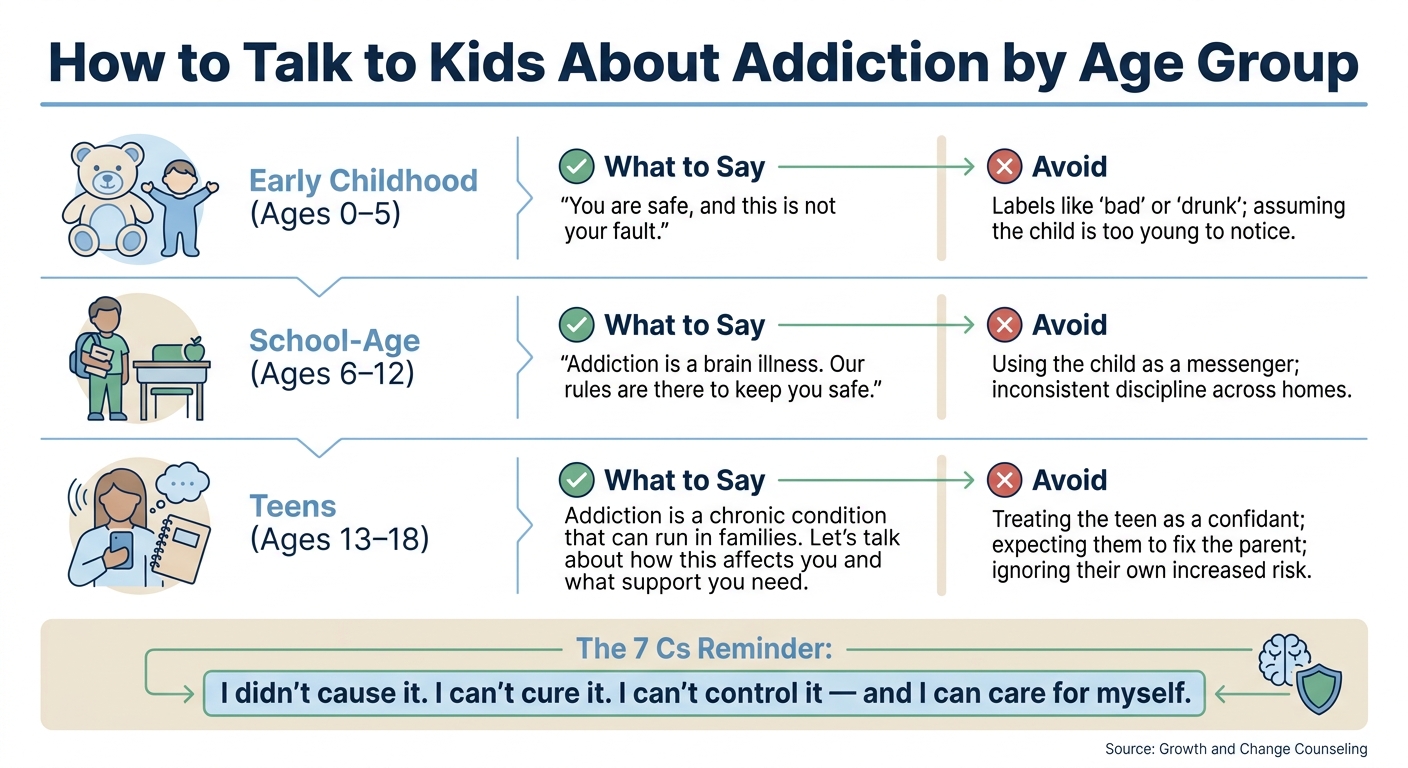
How to Talk to Kids About Addiction by Age Group
Once both homes agree on the basics, the next step is simple: match the message to the child’s age and attention span.
Children pick up on more than adults often realize. If they don’t get simple, clear facts, they tend to fill in the gaps on their own. And when that happens, many kids end up blaming themselves. That’s why it helps to keep these talks short, calm, and suited to the child’s stage of development.
| Developmental Stage | What to Say | Avoid |
|---|---|---|
| Early Childhood (Ages 0–5) | Use one simple reassurance: "You are safe, and this is not your fault." [5][12] | Labels like "bad" or "drunk"; assuming the child is too young to notice. [5][13] |
| School-Age (Ages 6–12) | Explain addiction as a brain illness and keep both homes using the same wording. [5][12] | Using the child as a messenger; "good cop/bad cop" discipline across homes. [13][14] |
| Teens (Ages 13–18) | Name addiction as a chronic condition that can have a genetic component, set safety boundaries, and offer their own support: "Let’s talk about how this affects you and what support you need." [5][12] | Treating the teen as a confidant; expecting them to fix the parent; ignoring their own increased risk for substance use. [12][13][14] |
The 7 Cs can give children of any age a simple way to make sense of what’s going on: I didn’t cause it, I can’t cure it, I can’t control it – and I can care for myself.
Once the child has a basic understanding of what’s happening, shift the conversation toward safety and clear household boundaries.
Safety Boundaries That Protect the Child’s Physical and Emotional Well-Being
Once both homes are using the same language around addiction, the next step is simple: turn that agreement into clear safety rules.
This is where things move from general intent to day-to-day practice. A child does better when expectations stay steady, no matter which home they’re in.
| Boundary Category | Agreed Standard | How It Supports Child Safety |
|---|---|---|
| Visitation & Overnights | Start with short daytime visits; introduce overnights only after a verified period of sobriety. | Prevents overnights before trust is rebuilt. |
| Transportation & Exchanges | Handoffs at neutral, public locations such as a school or library. No driving after any substance use. | Reduces conflict exposure and eliminates impaired driving risk. |
| Home Environment | All medications and hazardous materials stored in a locked cabinet; working smoke and carbon monoxide detectors required. | Eliminates accidental ingestion risks and keeps the home predictable. |
| Visitors & Social Circle | No guests who are actively using substances; no gatherings where substance use is normalized. | Shields the child from unsafe individuals and prevents misuse from being treated as normal. |
| Monitoring & Accountability | Use sobriety verification during parenting time, with all communications documented in a co-parenting app. | Provides clear accountability and ensures the child is always in the care of a sober adult. |
| Extended Family & New Partners | Set clear limits on relatives with a history of enabling; wait at least six months before introducing new romantic partners to the child [9]. | Reduces emotional disruption during an already unsettled period. |
Put these rules in writing so they don’t shift in the middle of a crisis. When emotions run high, people often improvise, and that’s usually when problems start.
Written boundaries give both parents something firm to point to. They also make it easier to keep discussions centered on the child’s safety instead of old arguments. Once those guardrails are in place, the next job is calm, child-focused communication that keeps the plan on track.
Common Trauma Triggers and Healthier Co-Parenting Responses
Written safety rules help hold things together. But for many children, the hard part isn’t only the big crisis. It’s the smaller moments too: a missed pickup, a broken promise, or an argument they overhear.
Those moments carry weight. Children often react to the day-to-day disruptions just as much as the larger events.
When promises are missed or plans change without warning, kids can start to expect adults to let them down. That’s why a steady response matters so much. If you respond the same calm way each time, your child doesn’t have to wonder what comes next.
| Trauma Trigger | Harmful Response | Healthier, Trauma-Informed Alternative |
|---|---|---|
| Missed Pickup or Lateness | Defending the absent parent or showing anger in front of the child. | Validate the disappointment: "It’s okay to feel sad that plans changed. Let’s stick to our backup routine." |
| Parental Mood Swings | Telling the child they’re being "too sensitive." | Reassure safety directly: "Mom/Dad is struggling today, but you are safe." |
| Broken Promises | Overpromising a big makeup event to compensate. | Acknowledge the feeling: "I can’t change what happened, but I’m here now." |
| Child Expressing Anger | Taking the anger personally or pressuring the child to forgive. | Allow the feeling: "It makes sense you’re angry. Things were unpredictable for a long time. I’m listening." |
| Sudden Schedule Changes | Last-minute cancellations with no explanation. | Maintain a shared written calendar and give the child a predictable debrief after every transition. |
| Role Reversal (Parentification) | Relying on a child to manage siblings or household tasks. | Restore the parental role and limit the child to age-appropriate responsibilities. |
It’s also worth saying this plainly: a parent can be sober and still feel unsafe to a child. If that parent is emotionally unstable, blaming, or hard to predict, the child may feel the same anxiety they felt during active substance use.
Younger children may regress, become clingy, sleep poorly, or complain about stomachaches and headaches. Older children may pull back, struggle in school, or seem more irritable than usual. Spotting these signs early gives you a chance to respond with calm instead of alarm.
Over time, this kind of response makes emotional check-ins feel less loaded. The child starts to learn that hard moments don’t always spin out of control, and that can change a lot.
Helpful vs. Unhelpful Ways to Respond to a Child’s Feelings
After a check-in, what you say next matters a lot. A child is quietly deciding, Can I keep talking, or should I shut this down? That moment turns on trust.
One point needs to stay clear: the child did not cause, cure, or control the addiction. Repeat the Three Cs often.
| Child’s Feeling | Helpful Response | Unhelpful Response | Impact |
|---|---|---|---|
| Sadness | "It’s okay to be sad. Mom/Dad has an illness, and they’re working with doctors to get better." | "Don’t be sad – they’ll be back soon. They’re just away on a long vacation." | Helpful: Builds trust. Unhelpful: Creates mistrust. |
| Guilt | "This is an adult problem. You did nothing to cause this, and it is not your fault." | "If you had behaved better, maybe things wouldn’t be so stressful for your parent." | Helpful: Relieves responsibility. Unhelpful: Guilt and anxiety. |
| Anger | "I can see you’re angry, and that’s okay. You’re allowed to feel however you feel about this." | "You shouldn’t be angry at them – they are trying their best. Stop being disrespectful." | Helpful: Supports regulation. Unhelpful: Suppresses emotions. |
| Withdrawal | "I’m here to talk whenever you’re ready. You can ask me anything, and I’ll tell you the truth." | "Why aren’t you talking? You’re making this harder for everyone by being so quiet." | Helpful: Builds openness. Unhelpful: Increases isolation. |
| Fear/Confusion | "Addiction changes how the brain works. We have rules to keep you safe, and you can tell me anything." | "You don’t need to worry about that – it’s grown-up stuff." | Helpful: Reduces fear. Unhelpful: Leaves gaps for imagination. |
The goal isn’t to fix the feeling on the spot. It’s to name it, make room for it, and stay with the child through it. That steady, calm response tells them their inner world isn’t too much for you.
It also helps to call addiction an illness. That language cuts shame and blame. And when children feel heard, shared rules and discipline are often easier for them to accept.
Agreed Rules and Expectations Across Both Homes
Once routines feel steady, the next step is lining up the rules that shape everyday behavior. When addiction has shaken family life, kids often carry that stress with them. Consistent rules help lower the chaos. This matters most during transitions, when children need the same basic expectations in both homes. It’s not just about avoiding confusion. It also helps stop kids from playing one parent against the other.
The goal isn’t to make both homes run the exact same way. Match the core rules, not every house habit. Focus on things like homework before screen time, bedtime ranges, and clear standards for respectful behavior. That gives children a steady rhythm without making each home feel like a copy of the other.
| Rule Category | Agreed Co-Parent Standard |
|---|---|
| Homework | Assignments completed before screen time or free time in both homes |
| Bedtime | Lights-out times within a 30- to 60-minute window, even on weekends |
| Respectful Behavior | Unified expectations for tone and language, with consistent consequences |
Post the same rules in both homes so kids can see them without having to guess. Put them in a co-parenting app like OurFamilyWizard or TalkingParents too, so both parents stay accountable [9][2]. And keep all medications, including recovery prescriptions, locked up in both homes.
With those rules set, the next priority is building outside support around the child.
Building a Shared Support Network Around the Child
Once home routines feel more steady, it helps to widen support beyond both households. Bring in therapists, school staff, and other trusted adults so the child has steady support during recovery.
The table below keeps the focus on co-parent coordination: who communicates, who handles scheduling, and who shares updates.
| Support Type | Primary Focus | Co-Parent Collaboration Points |
|---|---|---|
| Family Therapy | Repairing parent-child bonds and improving household communication | Both parents participate and help stay aligned during hard conversations. |
| Child Counseling | Providing a safe space for emotional expression and healthy coping skills | Parents share background on triggers and validate the feelings the child brings home after sessions. |
| Individual Therapy | Managing personal stress, recovery stability, and emotional regulation | Share schedule changes that affect the child. |
| Parent Coaching | Practical discipline strategies, safety boundaries, and age-appropriate communication | Co-parents align on rules and consequences across both homes. |
| School Support | Academic stability, daily check-ins, and social-emotional monitoring | Share relevant concerns, coordinate school support, and attend meetings for the child. |
| Community Support | Peer connection through groups like Alateen and trusted mentors | Coordinate transportation and encourage participation without pressure. |
School support tends to work best when both parents share the same concerns and use the same contact points. If grades or attendance start to slip, a brief, need-to-know conversation with the school counselor can flag early warning signs before things get worse.
The key is to keep that support centered on the child. The child shouldn’t have to carry updates between adults or act as the go-between.
Adult Roles Children Should Not Take On and What to Do Instead
Even when support is in place, kids can still get pulled into adult problems. In homes shaped by recovery struggles, that happens a lot. A child starts doing jobs that belong to parents. That’s where co-parents need to step in and take those jobs back.
The goal is plain: move every adult task back to adults.
Also pay attention to warning signs. A child may not say, “I’m overwhelmed,” but the stress can show up in other ways. Watch for regression, headaches, or mood changes tied to instability in the parent’s recovery.
| Adult Role | Likely Impact on the Child | Adult Action Instead |
|---|---|---|
| The Messenger (relaying schedules or demands between parents) | Loyalty conflicts and chronic anxiety | Use direct communication between parents through email, text, or a co-parenting app. |
| The Emotional Outlet (absorbing a parent’s recovery stress or complaints about the other parent) | Forced adult responsibility and blurred boundaries | The parent should use a support group or work with a personal therapist. |
| The Fixer (trying to manage a parent’s relapse risk) | Guilt, regression, and loss of safety | Rely on professional treatment teams, recovery coaches, and adult sponsors. |
| The Spy/Informant (reporting on the other parent’s behavior or household) | Erosion of trust and fear of betraying a parent | Use adult-only communication, supervised exchanges, or formal monitoring when required. |
If you need a simple line to use, this says it well:
"This is an adult problem, and adults are working to fix it." – Renew Recovery Center [15]
That’s the core idea. A child can have feelings, fears, and questions. But they should not be asked to carry adult duties.
Conclusion
Stable routines, safe communication, and clear boundaries help children feel more secure during recovery.
Taken together, these steps create predictability, safety, and emotional steadiness. They work because they cut uncertainty, protect the child, and keep them out of adult conflict. The aim is steady, child-centered co-parenting that lowers stress and supports safety.
Small, steady co-parenting choices can ease stress and help protect a child’s well-being. For families who want support putting these steps into practice, Growth and Change Counseling offers family therapy, parent coaching, and individual therapy in California and through telehealth. That kind of support can matter most when communication is strained or progress feels uneven. Progress isn’t always linear, but child-first co-parenting helps keep the path steadier.
FAQs
What if the other parent does not follow the safety plan?
Prioritize your child’s immediate physical safety. If a parent arrives impaired, do not release the child into their care.
Write down exactly what you see and hear, including speech, behavior, and physical signs. If possible, have a witness present too. That kind of detail matters.
If there is urgent danger, contact local authorities, keep the child with a sober caregiver, and get legal advice about emergency custody, enforcement, or changes such as supervised visitation or mandatory testing.
How can I tell if my child needs therapy?
Consider professional support if your child has lasting emotional or behavior changes. That can look like irritability, clinginess, pulling away from friends or family, falling grades, or big shifts in sleep or appetite.
Other warning signs include frequent headaches or stomachaches, regression such as bedwetting, self-harm, severe withdrawal, or trauma symptoms. Growth and Change Counseling offers family therapy and individual sessions in California and through telehealth.
What should I do if a relapse happens?
If a relapse happens, put your child’s safety first. Make sure they’re in a stable setting, and use any backup childcare plans you already have in place.
Speak in a calm, clear way. Tell your child this is not their fault and that they are loved. If you need extra help, Growth and Change Counseling can support families through family therapy and parent coaching. If your child’s safety is in immediate danger, contact local authorities or legal professionals.
Related Blog Posts
- Ultimate Guide to Co-Parenting in Recovery
- Parenting Strategies For Addiction Recovery Support
- How Relapse Impacts Co-Parenting Dynamics
- Balancing Sobriety Goals with Parenting Duties
