Most repeat fights in neurodiverse marriages are not about bad intent. They are about mismatch. I’d sum up the fix like this: name the pattern, state needs out loud, plan by capacity, and repair with clear steps instead of guessing. When couples do that, daily life gets less confusing and conflict does less harm.
Here’s the short version of what matters most:
- Start with a shared vision for marriage, home, parenting, and money
- Sort issues into 3 groups: nonnegotiables, preferences, and flexible areas
- Say needs directly instead of hoping your partner will infer them
- Use timing rules like pause-and-return when overload hits
- Build weekly systems such as a 15–20 minute check-in
- Divide labor by capacity, not by a strict 50/50 rule
- Repair conflict in order: safety → connection → clear thinking → problem-solving
- Get outside help if the same loops keep coming back or if trauma, addiction, or severe shutdowns are part of the picture
A few concrete examples stand out from the article:
- Replace “You should know I need help” with “Please move the laundry to the dryer every Tuesday night.”
- Replace “They went quiet, so they don’t care” with “Do you need a pause or a written follow-up time?”
- Replace “You forgot again” with “Let’s put it on the shared calendar today.”
One point I think is worth underlining: clear requests cut down on avoidable pain. And when one partner is overloaded, a pause is not always rejection. In many cases, it is a nervous-system limit.
If I had to reduce the whole piece to one idea, it would be this: stop treating the partner as the problem and start treating the pattern as the problem. That shift changes how couples talk, plan, and repair.
| Focus area | What I’d do |
|---|---|
| Shared goals | Pick 1–2 clear outcomes for marriage, home, parenting, and finances |
| Communication | Use plain requests with a task, time, and result |
| Daily stability | Use a shared calendar, task board, and short weekly meeting |
| Conflict repair | Pause when flooded, return at a set time, and address one issue only |
| Support needs | Seek couples help when repeat breakdowns do not change |
According to the article, tools like weekly check-ins, direct language, and written follow-up can lower repeat conflict because they reduce guesswork. That matters a lot in neurodiverse relationships, where overload, executive-function strain, and different processing speeds often shape how each moment lands.
So if you want the simplest takeaway, here it is: be direct, make the invisible visible, and repair on purpose.
A New Mindset for Navigating Neurodiverse Relationships
sbb-itb-596b85d
Build a Shared Vision Before You Solve Problems
Many neurodiverse couples try to fix the same fights again and again before they agree on what they’re building as a team. That’s where things start to slip. Relational intelligence begins with a clear outcome. First agree on where you’re headed. Then deal with the conflict. Shared effort matters more than trying to make both people act the same.
Define Shared Goals for Marriage, Home, Parenting, and Finances
Shared goals work best when they’re specific. Vague goals like "be closer" or "fight less" don’t give you much to work with. They sound good, but they don’t guide daily choices.
It’s far more useful to name the exact result you want. For example, "We want to handle money decisions together before spending over $200" gives both people something clear to follow. That’s a lot easier to act on than "We want to be better with money."
Pick one or two concrete outcomes for marriage, home, parenting, and finances. Clear language cuts down on guesswork, and guesswork is often where conflict starts.
Use a Values Map: Nonnegotiables, Preferences, and Flexible Areas
This map helps you sort what must stay fixed and what can bend. Once you’ve named your shared goals, place the issues in your relationship into three groups: nonnegotiables, preferences, and flexible areas.
- Nonnegotiables are tied to safety or capacity limits, like a decompression period after work. These are support needs, not preferences.
- Preferences matter, but they leave room for compromise.
- Flexible areas can change based on the week, stress, or capacity.
This simple sorting exercise lowers power struggles because it stops every disagreement from feeling equally urgent. When couples know what needs firm agreement and what can shift, they spend less energy defending turf and more energy fixing the problem in front of them.
Hold Both Perspectives Without Assigning Blame
Before you try to solve a repeat conflict, get clear on what you’re trying to protect. Hold both experiences at the same time: one partner feels dismissed, and the other feels overwhelmed. Neither is lying. Neither is the villain.
The shift is practical and direct. Move from "What is wrong with you?" to "What is happening between us?" Think of the relationship as the shared system you’re trying to protect. When conflict starts, the goal is not to win. The goal is to protect the shared vision you defined together.
| Behavior Seen | What’s Actually Happening | Shared Goal It Protects |
|---|---|---|
| "You went cold and shut down." | Overload and shutdown [1][3] | Safety and recovery for both partners |
| "You forgot again." | Executive-function strain, not indifference [1][3] | Predictability and trust in daily life |
| "You only care about your own thing." | Hyperfocus; a neurological drive, not selfishness [2] | Growth and contribution for the family |
With the shared vision in place, the next step is to make expectations explicit in daily life.
Align Communication and Expectations in Daily Life
Once you know what matters most to both of you, put it into everyday words and habits. A shared vision doesn’t do much on its own. It starts to work when both partners say their needs out loud, in plain language. In neurodiverse relationships, the trouble often shows up in small moments that keep repeating.
State Needs Directly Instead of Relying on Assumptions
A lot of daily conflict starts with one problem: assumption. If you need something, say it directly. Be clear about what you need, when you need it, and what it should look like. Instead of saying, "I wish you’d help more around the house," try: "I’m overwhelmed by laundry. Please move the clothes to the dryer every Tuesday night."
That kind of request leaves less room for guessing. It also protects the goals you already named for marriage, home, parenting, and money.
If one partner has a hard time naming feelings in the moment, it helps to use state-based language instead of pushing for a long emotional explanation. A phrase like "I am shutting down" gives the other person something clear to work with.
When meaning feels fuzzy, use a short verification script: "I heard you say [X] and take that to mean [Y]. Did I understand you correctly?" It may sound simple, but it can stop a lot of avoidable conflict.
Set Clear Rules for Timing, Tone, and Follow-Up
Hard talks usually go better when both people agree ahead of time on when to have them. Starting a heavy conversation when one person is overwhelmed or overstimulated often sends the whole thing off the rails.
One tool that helps is the Pause-and-Return rule. The idea is simple: if either partner gets overwhelmed, pause the conversation and choose a specific time to come back to it. That break gives both nervous systems time to settle. When you return, stick to one issue at a time instead of dumping every old problem into the same talk.
For follow-up, written agreements help keep the plan visible. Shared visual calendars and task boards make next steps easier to track and cut down on repeated verbal reminders, which can land like criticism.
The table below shows how spoken expectations can stop the same pattern from starting up again.
Comparison Table: Spoken Expectations vs. Assumed Expectations
The difference here is often the difference between a one-time problem and the same fight showing up again. Implicit expectations tend to repeat conflict. Explicit expectations make repair more likely.
| Assumed Expectation | Spoken Expectation | Outcome |
|---|---|---|
| "They should see I’m overwhelmed and help with the dishes." | "I am at my sensory limit. Please take over the dishes tonight so I can decompress." | Removes guesswork and gives a clear, actionable request. |
| "They went quiet after the argument." | "Do you need a pause or a written follow-up time?" | Treats withdrawal as a timing need, not rejection. |
| "I’ll hint that the house is messy and hope they clean it." | "I need the kitchen counters cleared by 6:00 PM so I can start cooking without feeling stressed." | Provides a specific task and deadline. |
| "If they loved me, they’d remember our anniversary." | "Our anniversary is next Tuesday – let’s add a reminder to our shared calendar today." | Externalizes the task instead of testing the relationship. |
| "They are ignoring my emotional needs on purpose." | "I feel disconnected. I’d love a 10-minute check-in without phones after dinner." | Names the need and proposes a concrete solution. |
Build Daily Systems That Support Connection and Stability
Once expectations are clear, the next step is to turn them into routines you can repeat. In neurodiverse marriages, small systems cut down on guesswork and help both people stay connected.
Run Short Weekly Check-Ins and Plan Together
Set aside 15 to 20 minutes each week for a quick check-in. Review the calendar, compare stress levels, decide who is handling what, and name one relationship priority for the week. A shared calendar helps because it makes the plan visible instead of leaving it in one person’s head.
This check-in also helps you divide work by capacity, not symmetry.
Divide Responsibilities by Strengths, Limits, and Capacity
Drop the 50/50 model. It sounds fair on paper, but real life doesn’t work that way.
A better option is a capacity-based division of labor. Capacity can shift from one day to the next, so it helps to look at things like reliability, energy, executive functioning, and sensory tolerance. One partner may do better with detail-heavy tasks. The other may handle flexible or time-sensitive work more easily.
The point is not equal output. The point is a system that protects trust, lowers overload, and supports the marriage.
A Short Routine Checklist for Daily and Weekly Connection
These habits are small, steady, and easy to work into daily life.
| Frequency | Habit | Why It Helps |
|---|---|---|
| Daily | Transition/decompression time after work | Lets the nervous system regulate before connection or tasks begin [1] |
| Daily | One direct appreciation | Builds emotional safety through visible, consistent proof of work |
| Daily | Quick sensory check-in | Catches overload early, before it turns into conflict |
| Weekly | 15–20 minute planning meeting | Keeps both partners informed and prevents one partner from becoming the planner and reminder-bearer [4][1] |
| Weekly | One named relationship priority | Keeps connection intentional rather than accidental |
Repair Conflict and Know When Outside Support Is Needed
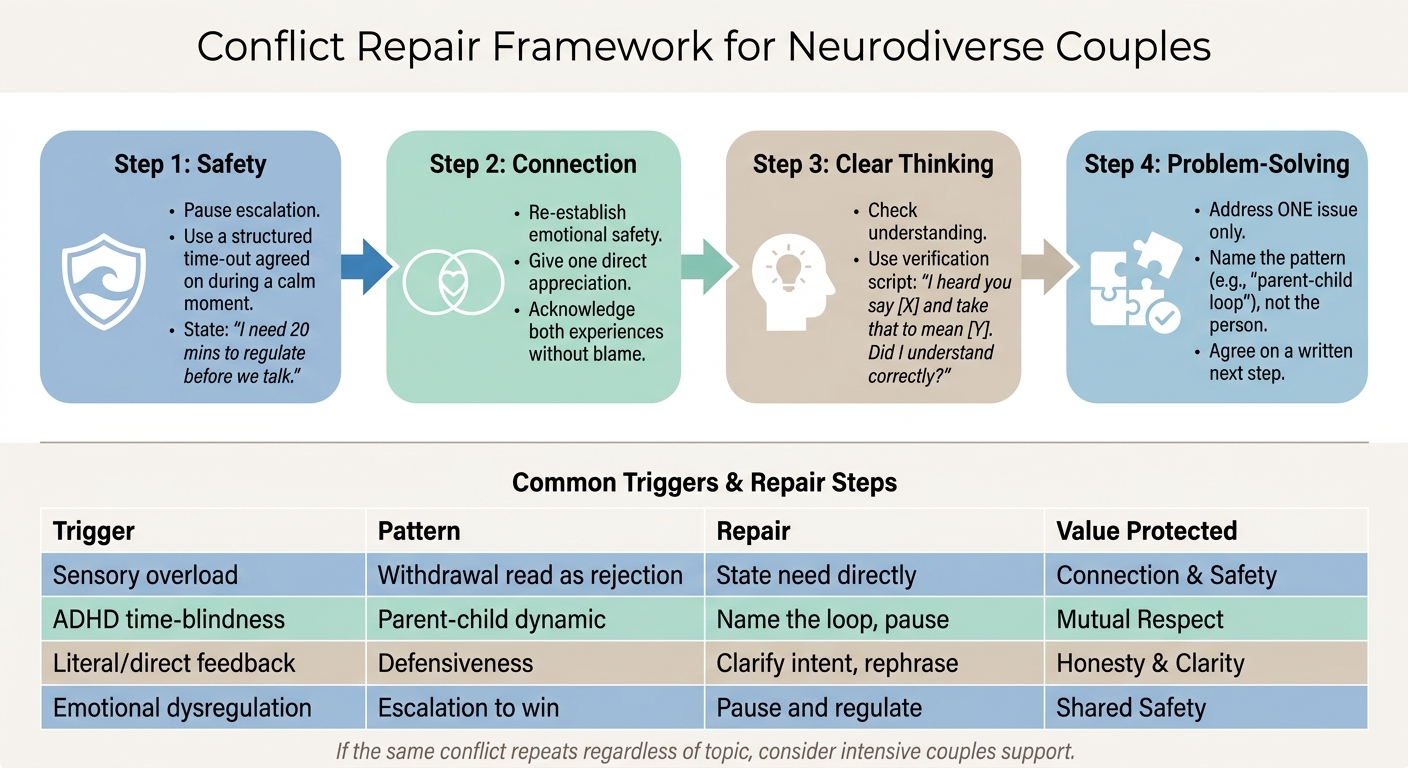
Conflict Repair Framework for Neurodiverse Couples
Conflict will still happen. The goal isn’t to avoid it at all costs. It’s to recover faster and with less damage. That’s where relational intelligence helps. Repair is how couples protect the shared values they named earlier.
Name the Pattern, Pause Escalation, and Return and Repair
Start with the pattern, not the person. Give repeat arguments a simple label – like the parent-child loop – so you can point to the cycle instead of blaming each other. That shift changes the feel of the conversation. It becomes us vs. the problem, not me vs. you.
Repair works best in this order: safety, connection, clear thinking, then problem-solving. If someone’s nervous system is overloaded, trying to solve the issue right away usually backfires. A structured time-out, agreed on during a calm moment, gives both partners space to regulate before coming back to the conversation.
When you return, say what you need. Then check what you heard from the other person. Simple? Yes. Easy in the moment? Not always. But this is often where repair starts to click.
Comparison Table: Trigger, Pattern, Repair Step, and Shared Value Protected
| Trigger | Recurring Pattern | Immediate Repair Step | Shared Value Protected |
|---|---|---|---|
| Sensory overload (noise, clutter) | Withdrawal read as rejection | State the need directly: I’m overloaded; I need 20 mins of quiet before we talk. | Connection and safety |
| ADHD time-blindness (lateness, missed tasks) | Parent-child dynamic; one corrects, one feels shamed | Name the loop: We’re in the parent-child loop. Let’s pause. | Mutual respect and reliability |
| Direct or literal feedback | Defensiveness | Clarify the intent and ask to rephrase. | Honesty and clarity |
| Emotional dysregulation mid-conflict | Escalation focused on winning rather than resolving | Pause and regulate. | Shared safety |
When Repeated Breakdowns Call for Intensive Couples Support
Sometimes couples hit a wall. Self-guided repair can help a lot, but there are times when it stops being enough. If the same conflict keeps coming back no matter what the topic is, if one partner floods before the conversation can even begin, or if addiction, trauma, or severe communication breakdowns are in the mix, the tools in this guide may not work well on their own.
In those cases, outside help can make sense. For couples stuck in repeated breakdowns, Growth and Change Counseling offers directive 12-week intensive couples coaching through The Marriage Rescue Institute.
Common Questions for Growth and Change Counseling
How do we start a shared vision together?
Start with honest, intentional conversations about what matters most to each of you. Don’t treat different views like they cancel each other out. Instead, look for the places where your values meet.
Build your goals together in a clear, direct way instead of assuming you’re both on the same page. With curiosity, teamwork, and mutual respect, you can shape a shared vision that makes room for both of your neurological profiles.
What if one of us shuts down during conflict?
Shutting down during conflict often comes from sensory overload, mental fatigue, or emotional flooding. It does not mean someone doesn’t care.
It helps to treat shutdown as a trigger and plan for it during calm moments. Pick a clear pause signal, like a hand gesture or “I need space,” and set aside a sensory-friendly place to reset.
If this feels tough to sort out, Growth and Change Counseling offers specialized support for neurodiverse relationships.
How do we divide chores fairly if capacity changes?
When capacity shifts, fair treatment starts with a simple idea: a person’s ability to function can change from one day to the next. Stress, illness, or nervous system regulation can all affect what someone can handle on a given day.
So if tasks get done inconsistently, it helps not to label that as laziness. A better move is to keep expectations flexible and use direct communication to line up responsibilities with current capacity. Growth and Change Counseling helps neurodiverse couples build personalized, systems-focused ways to handle these day-to-day challenges.
Related Blog Posts
- Emotional Intelligence for Neurodiverse Couples
- Study: Trust Dynamics in Neurodiverse Relationships
- 5 Strategies for Healthy Conflict in Neurodiverse Couples
- Q&A: Common Challenges in Neurodiverse Partnerships
