Conflict in neurodiverse relationships can feel overwhelming due to differences in communication styles, sensory sensitivities, and emotional processing. But with the right tools, you can turn these challenges into opportunities for connection. Here’s a quick summary of five practical strategies to manage conflict effectively:
- Identify and Manage Triggers: Create a list of sensory and communication triggers and plan how to address them.
- Use Clear Communication: Focus on direct, structured dialogue using "I" statements and softened startups.
- Take Time-Outs and Repair: Use breaks to calm down and follow up with rituals to rebuild trust.
- Practice Active Listening: Give full attention, ask clarifying questions, and respect your partner’s boundaries.
- Learn Together: Educate yourself about neurodiversity and use strengths-based conflict resolution.
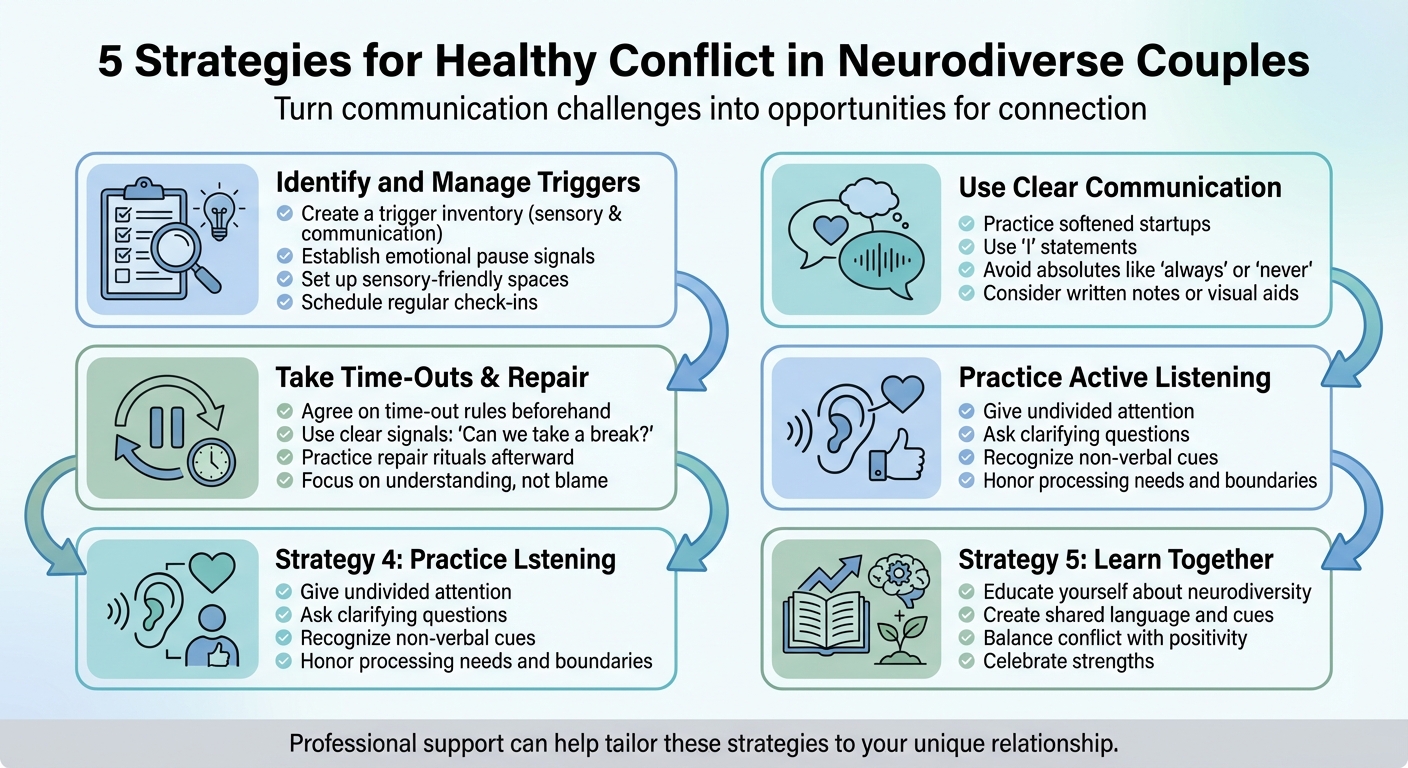
5 Strategies for Healthy Conflict Resolution in Neurodiverse Couples
My TOP 10 Conflict-Resolution Methods for Neurodiverse Couples #autismmarriage
Strategy 1: Identify and Manage Your Conflict Triggers
The first step in managing conflict is understanding what sets it off. Triggers usually fall into two main categories: sensory-based and communication-based. Sensory triggers might include things like bright fluorescent lighting, loud noises, certain textures, or overpowering smells. Communication triggers, on the other hand, often involve behaviors such as interrupting, jumping to conclusions, or misreading nonverbal cues.
Yolanda Renteria, LPC, offers this advice:
"Make an inventory with your partner on those things with which both of you struggle. Is it interrupting? Jumping to conclusions? Sensory overload? Shutdown? Make a plan on how to address these before they show up." [1]
Here’s how to take stock of these triggers and prepare to handle them effectively.
How to Create a Conflict Trigger Inventory
Start by sitting down with your partner during a calm moment to list out your sensory and communication sensitivities. For sensory triggers, think about how you react to light, sound, touch, smell, and movement. When it comes to communication triggers, reflect on patterns like feeling criticized, being interrupted mid-thought, or experiencing rejection sensitivity dysphoria (RSD) – a strong emotional response to perceived rejection that’s often seen in neurodivergent individuals [1].
In addition to pinpointing the challenges, include sensory comforts in your inventory. These could be things like the soothing weight of a blanket, calming scents, or the sound of rain – all of which can help regulate your emotions when you’re feeling overwhelmed. Pay attention to physical signs of stress, too, such as clenching your jaw, sweaty palms, or a racing heart. These can act as early warnings that tension is building [3].
How to Respond to Triggers
Once you’ve identified your triggers, it’s time to create a plan to manage them. One effective strategy is to establish "emotional pause" signals – these could be a specific hand gesture or a phrase like "I need space" – to let your partner know when you’re nearing your limit. You might also set up a sensory-friendly space in your home where either of you can retreat to calm down. This gives both partners the chance to reset and return to the conversation with a clearer head.
Finally, make it a point to schedule regular check-ins to review and update your trigger inventory. Triggers can evolve over time, so staying on the same page ensures you’re prepared to handle new challenges as they arise [2].
Strategy 2: Use Clear and Structured Communication
In a neurodiverse relationship, how you communicate can be just as important as what you say. Clear, structured dialogue helps eliminate confusion and provides a roadmap for navigating conflict. This is especially relevant when considering the "double empathy problem" [3]. Building on the idea of managing triggers, refining communication techniques can make a significant difference in resolving conflicts.
Practice Softened Startups and ‘I’ Statements
Once you’ve identified triggers, expressing yourself clearly can prevent things from escalating. The way you approach a difficult conversation often sets the tone for how it unfolds. A softened startup – beginning the discussion gently and without blame – can make all the difference. For example, instead of saying, "You never help with the lunches", try, "I made the lunches this week; could you handle them next week?" This approach reduces defensiveness and encourages a more constructive dialogue [7].
Pair this with "I" statements to focus on your own feelings rather than pointing out your partner’s shortcomings. Statements like, "I feel hurt when that happens", or, "I feel disconnected when we don’t talk", convey your emotions without assigning blame. Avoid using absolutes like "always" or "never", which can come across as overly critical and shut down the conversation. Instead, describe the specific situation and express a positive need – what you’d like to happen, rather than just what you’re unhappy about.
Use Visual Aids and Written Notes
When verbal communication becomes difficult, alternative methods can be incredibly helpful. Written communication, for example, can be a game-changer for some neurodivergent individuals. For those who find verbal exchanges overwhelming or struggle with interpreting non-verbal cues, writing provides a neutral way to process and respond without immediate pressure [1][5].
Yolanda Renteria, LPC, NCC, highlights this flexibility:
Some prefer phone calls, video chats, or written notes. [1]
When emotions are running high, consider writing a letter to your partner or using a shared document where both of you can share your thoughts. Visual aids, like a chart of agreed-upon signals or a list of clarifying questions, can also help structure conversations. For instance, asking, "Do you want advice on this, or do you just need me to listen?" can provide clarity and reduce misunderstandings [3]. These tools help both partners communicate more effectively, especially during emotionally charged moments.
Strategy 3: Take Time-Outs and Use Repair Rituals
Even the best communication can hit a wall when emotions run high. That’s where taking a time-out comes in – it’s not about avoiding your partner but about giving yourself the space to calm down and think clearly. This is especially important in neurodiverse relationships, where sensory overload or different ways of processing emotions can make it tough to stay grounded. Time-outs provide the breathing room needed to reset, making it easier to return to the conversation with a clearer head and a more productive mindset.
Once things have cooled off, repair rituals can help rebuild trust and strengthen your emotional connection. Dr. John Gottman, a renowned relationship researcher, explains:
Your future together can be bright even if your disagreements tend to be very negative. The secret is learning the right kind of damage control. [6]
These rituals aren’t about keeping score or assigning blame. Instead, they focus on understanding each other’s needs and finding ways to move forward as a team.
Rules for Effective Time-Outs
The key to making time-outs work is setting clear rules ahead of time – preferably during a calm moment. Agree that breaks are tools to help regulate emotions, not ways to avoid tough conversations. Decide on a time frame that works for both of you. Some couples might need just 15 minutes, while others may need several hours or even a whole day, depending on how they process emotions.
When it’s time to take a break, use clear and respectful signals. Instead of storming off, try saying, "Can we take a break?" or "I need a moment to calm down." During the break, focus on activities that help you regulate – whether that’s deep breathing, journaling, or simply taking a walk. Make sure to agree on a specific time to reconnect and pick up the conversation.
Examples of Repair Rituals
Once you’re ready to reconnect, shift the focus to understanding each other’s needs rather than rehashing the argument. For example, clinical social worker Leslie A. Sickels shared a story about a neurodiverse couple who struggled with household tasks. Instead of blaming each other, Susan expressed her need for reliability, while Mark explained his need for lead time and visual reminders. Together, they created a weekly "task check-in", where they made a physical to-do list and added it to a shared calendar. This simple ritual helped rebuild trust without reigniting old frustrations.
Another way to repair is by using structured phrases that soften the tone of your discussions. Here are some examples:
| Repair Category | Example Phrases |
|---|---|
| I Feel… | "I feel misunderstood" / "That felt like an insult" |
| I Need… | "Can we take a break?" / "I need your support right now" |
| Sorry… | "I can see my part in this" / "Let me try again" |
| Appreciation | "I know that this isn’t your fault" / "Thank you for listening" |
You can also practice summarizing each other’s perspectives. By repeating back what your partner has said, you show them that you’re listening and that their feelings matter. For ongoing maintenance, consider starting a gratitude habit. Share one thing you appreciated about each other each day – it’s a small but powerful way to build a stronger foundation and create a buffer against future conflicts.
sbb-itb-596b85d
Strategy 4: Practice Active Listening and Respect Boundaries
Active listening is all about genuinely understanding what your partner is trying to communicate. In neurodiverse relationships, this can be especially important since both partners may interpret social cues and emotions differently. By practicing active listening, you reduce the chances of misunderstandings and show your partner that their perspective matters. At the same time, respecting boundaries – like allowing time for processing or addressing sensory needs – creates a safe space where conflicts can be addressed without either person feeling overwhelmed or dismissed.
Here’s how you can approach active listening and boundary respect effectively.
Steps for Active Listening
Start by giving your undivided attention. Set aside distractions – put your phone away, turn off the TV, and focus entirely on your partner. Face them directly and listen with the intent to understand, not just to respond.
One key aspect of active listening is asking clarifying questions. Instead of jumping to conclusions, try asking things like, "Can you explain more about what’s making you feel this way?" or "If I’m understanding correctly, are you worried about the deadline?" For vague terms, you might ask, "What does ‘support’ look like for you right now?" Another helpful question is, "Do you want advice, or would you prefer me to just listen?" These questions help you respond in a way that meets your partner’s emotional needs at that moment.
Don’t overlook non-verbal cues, especially in neurodiverse relationships where they might differ from what you expect. For instance, your partner might engage in stimming behaviors – like tapping or rocking – as a way to stay focused. Other signs, like jaw clenching, a racing heartbeat, or avoiding eye contact, could signal sensory overload. Recognizing these cues can help you know when to pause or adjust the conversation.
Honor Your Partner’s Processing Needs
Respecting boundaries also means understanding that your partner might need extra time or space to process emotions or information. For many neurodiverse individuals, taking time to organize their thoughts or recover from sensory overload is essential before continuing a tough discussion.
If your partner asks for space, view it as a way for them to regulate their emotions or sensory input – not as a sign of rejection. They’re not shutting you out; they’re making sure they can re-engage in a healthier and more productive way. Together, you can identify each other’s "window of tolerance", which is the amount of emotional or sensory input you can handle before feeling overwhelmed. Agree to pause conversations when either of you approaches that limit.
You can also create an environment that supports these discussions. Work together to pinpoint what might cause sensory overwhelm – like bright lights or loud noises – and what helps soothe, such as dim lighting, soft music, or a weighted blanket. Establish a specific cue, like saying, "I feel like I’m losing connection", to signal when a conversation is becoming too intense. These small adjustments show respect for your partner’s needs and help both of you stay present and engaged during challenging moments. They also set the stage for more meaningful and balanced communication as you move forward.
Conflict Tools from Growth and Change Counseling
Once you’ve established active listening and respect for boundaries, taking steps to deepen your understanding of neurodiversity can further enrich your connection. Learning about neurodiversity isn’t a one-time event – it’s an ongoing journey that fosters empathy and helps reduce misunderstandings. When you understand the reasons behind your partner’s reactions, it becomes easier not to take things personally. For instance, if your partner experiences Rejection Sensitivity Dysphoria (RSD) – a heightened emotional reaction to perceived criticism – you can approach concerns in a way that feels less threatening. Similarly, recognizing challenges like executive functioning difficulties or sensory sensitivities can help you see certain behaviors as reflections of how your partner processes the world, rather than as personal affronts.
Learn About Neurodiversity
Start by identifying specific neurodiverse traits in your partner. Do they struggle with low frustration tolerance or find themselves hyper-focused on certain tasks? Are they prone to sensory overload from loud sounds, bright lights, or an overwhelming amount of information? Using tools like the Conflict Trigger Inventory from earlier strategies can serve as a practical way to better understand these patterns. Discuss how sensory sensitivities influence emotional availability – for example, when your partner’s nervous system feels overloaded, they might need time to regulate before tackling a tough conversation.
Creating a shared language can make communication smoother. Some couples develop simple cues or phrases to signal when they’re feeling hurt or need space, helping to avoid unnecessary tension [4]. After a conflict, having a "post-game" check-in where you both share your feelings and brainstorm ways to handle things differently next time can turn challenges into learning moments [4]. This shared knowledge allows you to reframe conflicts, emphasizing mutual strengths and reinforcing earlier de-escalation strategies. The more you educate yourselves about one another, the easier it becomes to respond with compassion rather than frustration.
Balance Conflict with Positivity
While resolving conflicts is essential, it shouldn’t dominate your relationship. Regularly making time for check-ins, sharing words of appreciation, and affirming each other’s strengths can help keep things balanced. Celebrate what makes each of you special, whether it’s direct communication, attention to detail, or high levels of empathy, and use these traits as tools during disagreements [1][2].
Beyond managing conflict triggers, explore “sensory joys” – things like weighted blankets, soft lighting, or other calming stimuli that help regulate your nervous systems during stressful moments [3]. Injecting humor and playfulness into tense situations can also release pressure and highlight the progress you’ve made together [4]. By focusing on what connects you and celebrating growth, you can transform conflicts into opportunities to strengthen your bond rather than seeing them as threats to your relationship.
How to Use These Strategies with Professional Support
Applying these strategies to your relationship, especially when navigating neurodiverse challenges, requires patience and persistence. While concepts like conflict triggers, clear communication, time-outs, and repair rituals are great starting points, professional support can take these efforts to the next level. A therapist experienced in neurodiverse relationships can provide tailored guidance, helping you avoid common missteps and accelerate progress. Therapist Liz Zhou emphasizes the importance of developing a "shared vocabulary" around neurodivergence – language that highlights strengths rather than focusing on deficits [3]. This reframing shifts conversations away from blame and toward mutual understanding, making it easier to apply the strategies you’ve been working on. When you hit roadblocks, professional input can help fine-tune your approach.
Therapists trained in this area are particularly helpful when feelings of misunderstanding or resentment start to creep in, even after you’ve tried your best. They can help you refine your shared vocabulary and structured techniques, ensuring they work for both partners. However, it’s worth noting that not all therapists have the specialized training needed for neurodiverse relationships. Growth and Change Counseling, for instance, offers neurodiversity-affirming care across California. Their therapists focus on helping couples regulate their nervous systems and stay within their "window of tolerance" during conflicts. They also assist in identifying sensory triggers and calming strategies to ease tension [3].
For couples facing more severe challenges, The Marriage Rescue Institute provides a focused 12-week coaching program. This intensive process is designed to help partners in crisis rebuild their connection and restore their relationship. Unlike traditional weekly sessions, this approach offers more concentrated support tailored to your specific communication needs. Services are available in Campbell, San Jose, Los Angeles, and Roseville, as well as through telehealth options for accessibility across California.
Getting started is simple: consult a therapist who can adapt these techniques to your situation. During sessions, you’ll work together to practice active listening – using clarifying questions like "What do you mean by ‘support’ here?" – and create "sensory-welcoming" environments for tough conversations [3]. Virtual therapy options make it easier than ever to access this kind of support from the comfort of your own space.
Conclusion
Transforming conflict into connection in a neurodiverse relationship is possible with the right strategies. The five approaches discussed here – identifying triggers, clear communication, taking time-outs with repair rituals, active listening, and learning through education – offer practical tools to bridge gaps in understanding. Therapist Liz Zhou highlights the "double empathy problem" [3], emphasizing that communication breakdowns stem from differences in neurotypes, not deficiencies in either partner.
These strategies create a solid foundation for healthier interactions. As The Gottman Institute wisely states, "Small things often can create big changes over time" [1]. Tools like a trigger inventory, shared language for expressing needs, and recognizing sensory preferences can foster meaningful improvements. Research shows that consistent, incremental changes can lead to noticeable progress [1]. With so many individuals navigating neurodivergence, these tailored techniques can make a significant difference. Whether addressing autism, ADHD, sensory sensitivities, or other forms of neurodivergence, these methods provide a clear path toward better understanding and connection. And when self-implemented efforts fall short, seeking professional help can refine and enhance your approach.
Start where it feels most manageable – perhaps by creating a trigger inventory or agreeing on a time-out signal – and build from there. The important part is to take that first step and let momentum guide you. If challenges persist, therapists experienced in neurodiverse relationships can offer tailored guidance. For example, Growth and Change Counseling, along with The Marriage Rescue Institute, specializes in helping couples navigate these unique dynamics effectively.
Your relationship deserves support that respects and celebrates your differences. These strategies can help you nurture a deeper, more connected partnership.
FAQs
What are effective ways for neurodiverse couples to identify and manage conflict triggers?
Neurodiverse couples can navigate conflict triggers more effectively by understanding and respecting each partner’s emotional and cognitive needs. Acknowledging differences – like sensory sensitivities, slower emotional processing, or sudden mood shifts – can help reduce misunderstandings and ease tension. When couples focus on these neurological variations, they can approach disagreements with greater empathy and clarity.
Clear communication plays a key role in managing conflicts. Using explicit language, visual aids, or agreed-upon cues can make emotional situations easier to handle. Recognizing sensory triggers – such as loud noises or bright lights – and having calming strategies on hand, like creating quiet spaces or using relaxation tools, can also help prevent conflicts from escalating. Regular emotional check-ins and working together to track patterns can help couples anticipate and address potential triggers before they become overwhelming.
With patience, self-awareness, and personalized approaches, neurodiverse couples can transform conflicts into opportunities to strengthen their connection and understanding of each other.
How can I practice active listening in a neurodiverse relationship?
Active listening in a neurodiverse relationship means recognizing and adjusting to each partner’s distinctive way of communicating. One practical approach is to allow extra time for processing and responding, as some neurodiverse individuals might need a bit more time to fully participate in conversations. Sharing discussion topics ahead of time or providing a summary of key points afterward can also help ensure everyone is on the same page.
Clear and direct language plays a crucial role. For instance, using "I" statements can help express feelings and needs without sounding accusatory. Visual aids, like written notes or emotion charts, can also make communication smoother. Another idea is to develop a shared emotional language – specific words or phrases that make it easier to express feelings and avoid confusion. By prioritizing patience, clarity, and a structured approach, active listening can deepen understanding and strengthen the bond in neurodiverse relationships.
Why is it important to understand neurodiversity in relationships?
Understanding neurodiversity in relationships plays a key role in building empathy, enhancing communication, and minimizing misunderstandings between partners. Neurodiverse couples often navigate unique challenges, as they may experience emotions differently, interpret social cues in varied ways, or have specific sensory sensitivities. Acknowledging these differences allows partners to approach conflicts with patience and understanding, seeing them as chances to grow together rather than as barriers to compatibility.
When couples take the time to learn about neurodiversity, they can create personalized strategies for connection. This might include using clear, direct communication or establishing routines that account for sensory preferences. Embracing neurological differences as natural variations – not flaws – can foster mutual respect and deepen emotional connections. By investing in this understanding, couples can turn potential hurdles into meaningful opportunities for collaboration and a stronger relationship.
Related Blog Posts
- ADHD and Autism: Conflict Resolution Strategies
- Checklist for Strengthening Neurodiverse Relationships
- Study: Trust Dynamics in Neurodiverse Relationships
