Prayer may help some neurodiverse families feel calmer, more steady, and more connected – but the type of prayer matters. Research in the article points to a clear pattern: prayer that focuses on strength, acceptance, gratitude, and shared meaning is linked with lower stress, while prayer tied to shame, punishment, or waiting only for a cure can make family strain worse.
Here’s the short version:
- 85.2% of parents in one survey said they pray daily.
- 55.8% said faith became more important after their child’s diagnosis.
- 33% said church involvement dropped after diagnosis, often because of sensory barriers or lack of support.
- Short, repeated prayer routines may help bring more calm than long or formal ones.
- Prayer seems to work best when it supports regulation, connection, and acceptance.
- It can also fit many communication styles, including AAC, sign, movement, and quiet presence.
- Prayer should not replace therapy, parent coaching, or other evidence-based care. This is especially true when supporting neurodiverse couples with mental health issues like anxiety or depression.
If I had to sum up the whole article in one line, it would be this: small, low-pressure prayer practices can help a family cope, but they should never add shame or block needed support.
A few ideas stand out:
- A brief prayer at the same time each day can help make life feel less chaotic.
- Gratitude and forgiveness prayer may help lower tension at home.
- Shared prayer can slow conflict and give family members a pause before things escalate.
- Prayer routines often work better when they match a child’s sensory, language, and attention needs.
- If prayer keeps leaving someone more upset, tired, or ashamed, the routine needs to change.
Quick comparison
| Prayer approach | What it looks like | Likely effect |
|---|---|---|
| Acceptance-focused prayer | Praying for strength, patience, peace | Lower stress, more steady coping |
| Gratitude prayer | Naming small wins or good moments | Better mood, less fixation on hard parts |
| Shared family prayer | Short prayer together, even in silence | More calm, better connection |
| Low-demand prayer | One sentence, visual cards, movement, AAC | Easier participation for neurodiverse families |
| Negative religious coping | Seeing a child as punishment or feeling abandoned by God | More anxiety, more depression, worse family strain |
So when I read the article as a whole, the message is simple: prayer can help, but it needs to be gentle, short, and fitted to the family you have – not the family you think you’re supposed to be.
sbb-itb-596b85d
What Research Says About Prayer, Coping, and Family Resilience
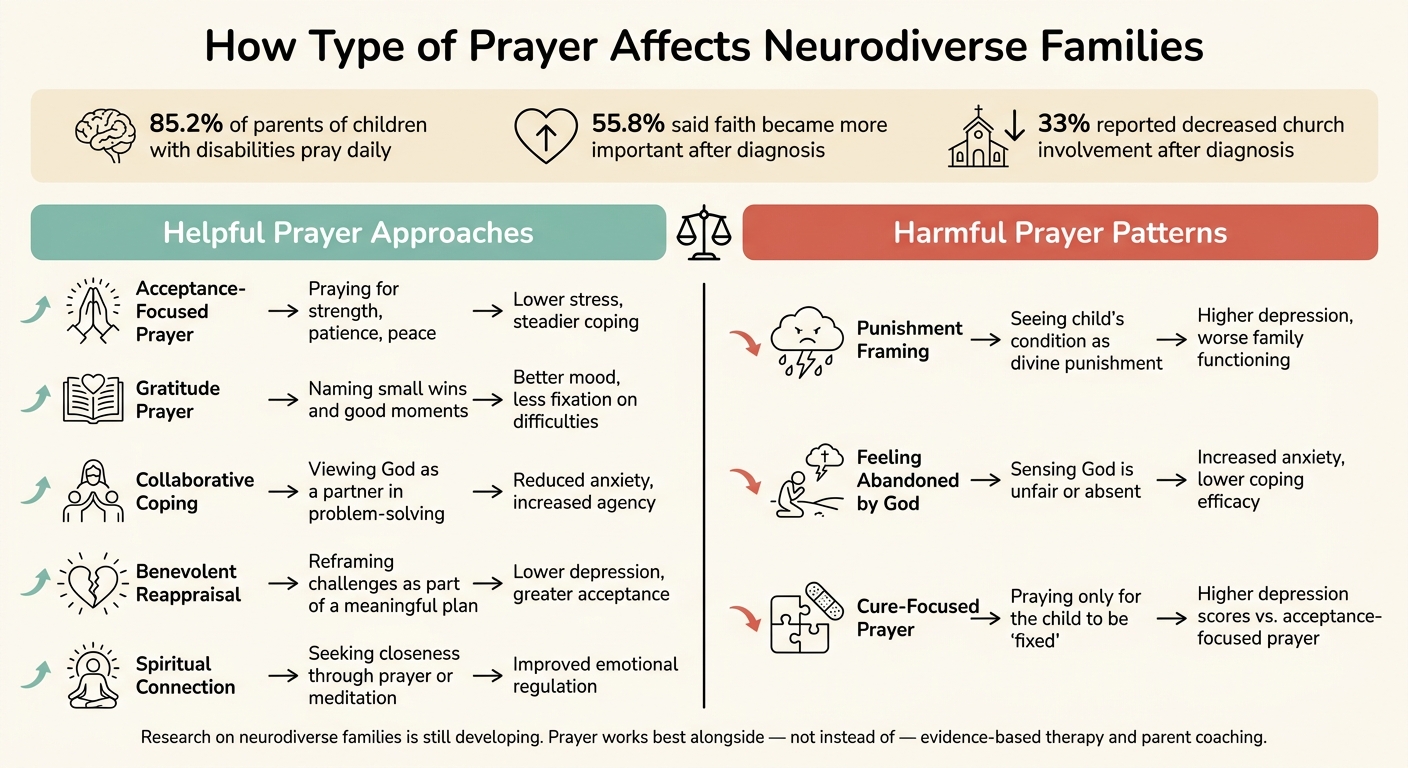
Positive vs. Negative Religious Coping in Neurodiverse Families
Prayer and Lower Stress: What the Research Shows
Research points to prayer as a common part of daily life for many parents of children with disabilities. In one large survey, 85.2% said they pray every day, and 55.8% said their faith became much more important after their child’s diagnosis [2].
But here’s the part that matters most: the kind of prayer seems to make a difference. Parents who pray for strength and acceptance tend to report lower depression scores than parents whose prayers focus mainly on a cure or requests for intervention [1]. In that sense, prayer is not just about asking for something. It can also be a way to steady yourself.
Slow, quiet prayer may work a lot like mindfulness. It can lower arousal and help regulate overload [1]. And when one person in the home feels less overwhelmed, that calmer state can ripple through the rest of the family.
Gratitude, Forgiveness, and Stronger Family Relationships
Long-term caregiving stress often spills into marriage and can increase conflict [3]. Shared spiritual practices may help soften that strain. Couples who make meaning together through faith – by getting on the same page about values, parenting roles, and how they see their child’s future – report stronger partnership and less relational strain [5].
Researchers also point to gratitude prayer as one of the strongest emotion-regulating practices available to caregivers. Why? Because it shifts attention toward progress and small good moments instead of staying fixed on deficits [1]. That shift may sound simple, but in a hard season, it can change the tone of a day.
Higher spirituality is also linked to benefit finding – the ability to view a child’s neurodivergence as a positive part of family life, not only a source of difficulty. Mothers who report this perspective show lower anxiety levels [6]. Forgiveness practices may also help families move from diagnosis grief toward more adaptive functioning [6].
Where the Evidence Falls Short for Neurodiverse Households
There’s an important gap here. Direct research on prayer in neurodiverse family systems is still limited, so this section leans mostly on broader studies of family resilience and religious coping [1][3].
Faith can matter deeply without leading to more church involvement. In fact, 33% of parents of children with disabilities said their church involvement decreased a lot after diagnosis, often because of sensory barriers or limited inclusion [2]. For some families – especially those dealing with sensory overload, routine disruption, and communication strain – religious community life can add pressure instead of easing it [6].
So the main issue is not simply whether a family uses religious coping. It’s which type of religious coping they use [1]. Positive religious coping, such as seeking connection and finding meaning in hardship, is linked to better outcomes. Negative religious coping – like seeing a child’s condition as punishment or feeling abandoned by God – is tied to higher depression and worse family functioning [1][4].
| Coping Strategy | Description | Associated Outcome |
|---|---|---|
| Benevolent Reappraisal | Reframing challenges as part of a meaningful plan | Lower depression, greater acceptance [1] |
| Collaborative Coping | Viewing God as a partner in problem-solving | Reduced anxiety, increased agency [1] |
| Spiritual Connection | Seeking closeness through prayer or meditation | Improved emotional regulation [1] |
| Seeing the Child’s Condition as Punishment from God | Interpreting neurodivergence as divine punishment | Higher depression, worse functioning [1] |
| Feeling Abandoned by God | Sensing God is unfair or absent | Increased anxiety, lower coping efficacy [1] |
These patterns help explain why prayer can support some families in daily life while making things harder for others.
How Prayer May Help Neurodiverse Families Day to Day
Research on stress and resilience starts to matter most when it meets daily life. In a neurodiverse home, that means prayer has to be usable, not long or polished. The aim isn’t more prayer. It’s prayer that fits the day as it is.
Predictable Prayer Routines Can Reduce Chaos and Build Safety
For many neurodiverse children, routine helps regulate the nervous system. A short prayer at the same time each day can lower chaos and help the home feel safer [1]. Length matters less than consistency. The steady rhythm is what helps. Saying the same short prayer before bed, in the car, or at breakfast can make the moment feel familiar instead of demanding.
Shared Prayer Can Help Families Communicate More Calmly
In homes where people have different sensory thresholds and communication styles, conflict can build fast. Sensory overload can make calm communication physically hard [8]. A brief prayer pause can slow the moment down and help family members respond with more calm. When the pace drops, words are less likely to spiral.
Shared prayer doesn’t mean everyone has to talk. Sometimes it looks like sitting quietly next to a child and praying out loud without asking for any reply [1]. That kind of low-pressure presence can do a lot.
Adjusting Prayer Practices to Fit Individual Needs
One of the most helpful shifts is letting go of the idea that prayer has to look one way. Sitting still and speaking out loud are not required. Movement during prayer still counts. Pacing, swaying, or other self-regulating movement may help a child stay with the moment [7].
For nonverbal or minimally verbal family members, simple sign language or AAC devices can make prayer more open to everyone [1]. Visual prayer cards can also lower mental effort for both children and parents, especially when they use a short three-part format:
- thank you
- help them
- help me
That kind of adjustment makes prayer easier to use in daily life. The next section looks at devotional formats that stay short, flexible, and low-demand, much like the specialized support found when you choose a neurodiverse couples therapist to navigate family dynamics.
Devotional Formats That Work for Different Family Needs
No single devotional format works for every family. The goal isn’t to force one “right” way to do devotions. It’s to find a rhythm that feels light enough to keep going. Short, flexible devotionals lower pressure and make connection possible, and prayer tends to support resilience best when it fits the family’s actual day-to-day life.
Short and Flexible Prayer Routines
High-stress moments – like the morning school rush or the after-school crash – are usually the hardest time to start a new routine. Later in the evening, after a snack, or on slower weekend mornings often works better [9][10].
Five calm minutes beats a longer routine that turns into chaos.
That can look like a one-sentence “popcorn” prayer, a repeated bedtime phrase, or a simple three-part prayer. It doesn’t have to be elaborate. Predictable repetition helps the moment feel safe [9].
Once the timing feels steady, the format can get even simpler to fit attention and sensory needs.
Low-Demand Devotionals for Mixed Attention and Communication Styles
That same flexibility applies to format too. Families can shape the devotional around the child’s attention span and communication style. For many neurodiverse children, the main hurdle is pretty simple: too much reading, too much sensory input, or too many demands all at once. Simpler translations, graphic Bibles, and interest-based devotionals can lower the reading load [10].
Sensory anchors can help a lot here. Prayer beads, a soft cloth, or a small tactile object held during prayer may help a child stay present without asking them to sit still or talk.
For children who struggle with structured devotions, this shift in mindset can help:
"If you’ve been a safe space for them – they see a safe God. … If you’ve allowed distractions when praying or reading – you’ve shown a God who understands their brain." [10]
Participation doesn’t have to look neat or quiet. It may mean fidgeting, signing, or using AAC.
Devotional Format Comparison Table
The table below can help families pick the least demanding place to start.
| Devotional Format | Potential Benefits | Participation Challenges | Best Fit |
|---|---|---|---|
| Brief Bedtime Prayer | Predictable end-of-day anchor; low demand; builds safety | Fatigue may reduce focus | Families with high-energy children needing a calming sleep transition |
| One-Sentence "Popcorn" Prayer | Reduces pressure; easy to memorize; flexible | May feel too short for parents used to more familiar formats | Busy households managing multiple schedules |
| Visual/Sensory Devotional | Uses picture cards and tactile tools to ground attention | Requires prep time for visual aids or sensory materials | Nonverbal children or those with major sensory processing needs |
| Movement-Based Worship | Engages kinesthetic learners; releases energy | Can overstimulate without a calm-down transition | Children with ADHD or those who struggle to sit still |
| Comic/Themed Bible Reading | Leverages special interests to increase engagement | May not follow standard chapter/verse structure | Children with strong visual interests or those intimidated by large text |
Healthy Boundaries, Outside Support, and Conclusion
When Prayer Helps and When It Becomes Pressure
The next issue isn’t whether prayer can help. It’s when it starts to add weight.
Prayer tends to help most when it supports acceptance instead of trying to “fix” a child. It starts to become pressure when impulsivity, distractibility, or trouble sitting still gets treated like disobedience. That framing can create shame. And using prayer to sidestep grief or put off evidence-based treatment can also hurt, because it delays the support a child actually needs [1].
Autistic traits are not moral failings, and prayer routines should make room for regulation needs.
Here’s a simple gut check: if a prayer routine keeps leaving a child or parent feeling worse, more ashamed, or more worn out, the format needs to change – not the family.
How Faith Practices and Counseling Can Work Together
When prayer isn’t enough on its own, outside support and helpful articles can carry the practical load. Prayer can still work alongside therapy and parent coaching by helping families stick with them over time [1].
For California families, Growth and Change Counseling offers family therapy, parent coaching, and neurodiverse relationship support in person and via telehealth.
It’s worth seeking professional help when persistent anxiety doesn’t ease up, or when a family is relying only on prayer while turning down evidence-based treatments [1].
Conclusion: Small, Consistent Practices Build Resilience Over Time
Research on prayer and neurodiverse families is still developing, but what we have points in the same direction: consistency and shared meaning matter more than format or length [1]. The goal isn’t a perfect devotional routine. It’s a steadier home.
Start small. Stay flexible. Bring in outside support when the weight gets heavy.
Making Prayer Work for Your Family at Growth and Change Counseling
What kind of prayer helps most?
There’s no single formula for prayer. The most helpful prayer is honest and specific, not just ritual.
Whether you pray for guidance, patience, or gratitude, the best prayer should reflect your family’s own needs and neurotype. Taking part matters more than getting it perfect, and even when focus slips or words don’t come, the Spirit intercedes.
How can we make prayer work for a neurodiverse child?
Prayer isn’t about following a rigid script. It’s about meeting your child where they are.
That may mean adding movement, using tactile items, or bringing in visual tools so prayer feels easier to join. For some kids, sitting still and listening works. For others, it helps to hold something, look at pictures, or move while they pray. The goal isn’t perfection. It’s connection.
Try not to force participation or turn family devotions into a power struggle. That usually backfires. Instead, keep the rhythm steady, the time short, and the approach flexible. Let your child set the pace, and build from there.
When should prayer be paired with counseling or therapy?
Prayer can help most when it sits alongside evidence-based therapy and professional support, not in place of them. Think of it as an extra layer of comfort. During periods of high anxiety or emotional strain, it may offer steadiness, relief, and a sense of support.
Growth and Change Counseling takes this combined approach through individual, family, and couples therapy for neurodiverse families.
Related Blog Posts
- How Family Prayer Builds Stronger Bonds
- Christian Parenting: Building Resilient Families
- Parenting Stress: Solutions for Neurodiverse Families
- Trauma and Self-Esteem in Neurodiverse Kids
