When families experience frequent emotional outbursts, withdrawal, or unpredictable mood swings, unresolved trauma and emotional dysregulation are often the root causes. Trauma-informed family therapy offers a way to address these challenges by focusing on the underlying trauma rather than just surface-level behaviors. Here’s what you need to know:
- Emotional dysregulation stems from the nervous system’s response to trauma, often leading to heightened reactivity or emotional shutdowns.
- Trauma impacts family dynamics, with patterns of stress and coping often passing through generations.
- Trauma-informed therapy prioritizes understanding "what happened" rather than focusing on "what’s wrong" and emphasizes safety, trust, and emotional connection.
- Practical strategies include co-regulation techniques, emotional labeling, breathing exercises, and structured routines.
- The ARC Model (Attachment, Regulation, Competency) provides a framework for building emotional resilience in families.
With the right tools and support, families can break cycles of trauma and create healthier, more connected relationships. For deeper guidance, trauma-informed therapy can help address these challenges effectively.
Webinar: Parental Mental Health Through a Trauma-Informed Lens | Healing Child Parent Relationships
sbb-itb-596b85d
How Trauma Affects Family Systems
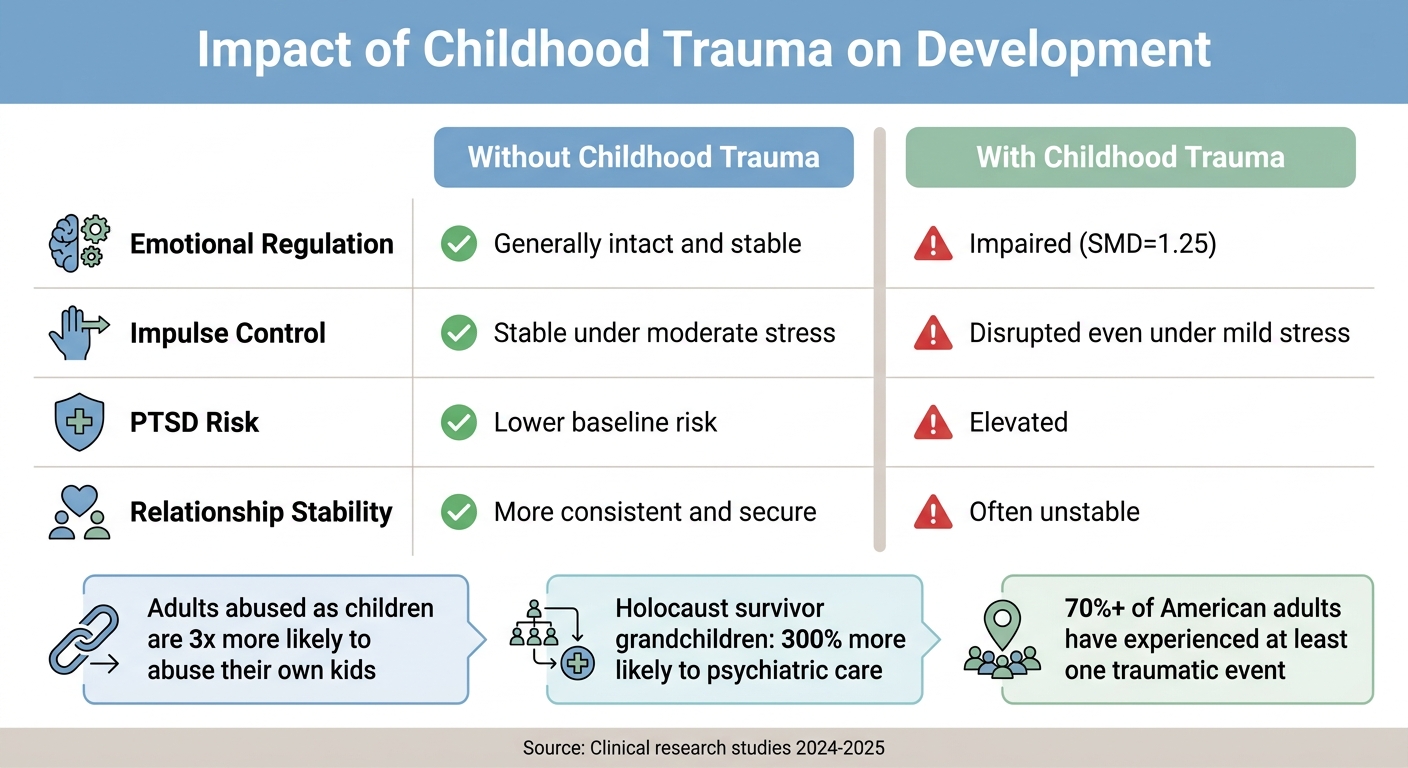
Impact of Childhood Trauma on Emotional and Behavioral Development
The Brain Science Behind Trauma and Emotional Dysregulation
Trauma reshapes the way the brain handles emotions. The prefrontal cortex, which helps with logical thinking and emotional regulation, becomes less active. Meanwhile, the amygdala – essentially the brain’s alarm system – stays on high alert [3]. This leaves the nervous system stuck in survival mode, constantly scanning for threats even when there’s no real danger.
"Early trauma doesn’t just leave emotional scars. It changes how the brain processes, stores, and responds to experience across the entire lifespan." – Patricia Alvarado, Licensed Therapist, Alvarado Therapy [3]
Trauma’s effects are both mental and physical. It can activate the body’s fight-or-flight response, leading to rapid heartbeats and shallow breathing, or cause a shutdown response with muscle tension and emotional numbness [1]. Trauma survivors also tend to have lower heart rate variability (HRV), which measures how well the body transitions between stress and calm [1]. Studies reveal that childhood trauma significantly impacts emotion regulation, with a standardized mean difference of 1.25 – a notable clinical finding [3].
These changes in the brain and body don’t exist in isolation. They ripple outward, influencing family dynamics in profound ways.
How Trauma Passes Through Generations
Trauma’s impact doesn’t stop with the individual – it spreads through family systems, often affecting multiple generations [2]. For example, parents with adverse childhood experiences (ACEs) are more likely to have children who struggle with behavioral issues, perpetuating cycles of trauma [2].
This generational transmission happens in several ways. Behaviorally, children often imitate their parents’ coping mechanisms, whether it’s emotional withdrawal, conflict escalation, or constant vigilance [2]. Emotionally, parents who struggle to manage their own stress may find it difficult to help their children develop emotional regulation skills [2]. A parent who experienced neglect might become overly protective, while one who endured abuse could oscillate between being distant and overly reactive.
The statistics are sobering. Adults who were abused as children are up to three times more likely to abuse their own kids [5]. In a study involving descendants of Holocaust survivors, grandchildren were 300% more likely to be referred to psychiatric clinics compared to the general population [4]. However, there is hope – research from 2025 showed that trauma-informed parenting programs significantly reduced emotional and behavioral issues in children [2].
These inherited patterns of coping and emotional regulation shape how trauma manifests within family systems.
Common Dysregulation Patterns in Families
Unresolved trauma often shows up in predictable emotional patterns within families. One of the most noticeable is heightened emotional reactivity. Here, small conflicts can escalate into major crises because family members’ nervous systems perceive minor stressors as significant threats [2] [6]. For instance, a parent might react to a child’s forgotten homework with the intensity reserved for an actual emergency.
Another common pattern is hypervigilance and overprotectiveness, especially in caregivers who experienced trauma in their own childhoods. These parents may become overly controlling, limiting their children’s independence and growth [2] [6]. On the flip side, emotional numbing and withdrawal often leads to distant relationships. Family members may use dissociation as a way to avoid pain, resulting in a household where emotional connection is minimal [2] [6].
Children in these environments typically respond in one of two ways. Some exhibit externalizing behaviors like aggression and defiance, while others develop internalizing behaviors such as anxiety and depression [2]. Both responses stem from the same underlying cause: a nervous system that never learned it was safe to experience and express emotions.
| Domain | Without Childhood Trauma | With Childhood Trauma |
|---|---|---|
| Emotional Regulation | Generally intact and stable | Impaired (SMD=1.25) [3] |
| Impulse Control | Stable under moderate stress | Disrupted even under mild stress [3] |
| PTSD Risk | Lower baseline risk | Elevated [3] |
| Relationship Stability | More consistent and secure | Often unstable [3] |
These patterns aren’t personal failings – they’re survival strategies shaped by past experiences [1]. Recognizing these dynamics is a crucial step toward effective trauma-informed family therapy techniques.
Core Principles of Trauma-Informed Family Therapy
Trauma-informed family therapy shifts the focus from blaming behaviors to understanding their roots. Instead of asking, "What’s wrong with you?" this approach reframes the question to, "What happened to you?" This perspective acknowledges that behaviors often stem from past experiences rather than inherent flaws. In fact, research shows that more than 70% of American adults have experienced at least one traumatic event in their lives [8].
The foundation of this therapy lies in several key principles. Safety and trust are paramount – without them, families cannot move beyond survival mode to address deeper emotional needs. Empowerment and choice help individuals reclaim control lost to trauma, while collaboration ensures therapists and families work together. Recognizing and respecting each family’s background and values adds another layer of care.
Building Safety and Trust in the Family
Safety goes beyond just feeling secure; it’s a biological state. For families to address emotional challenges effectively, their nervous systems must shift out of "threat mode" and into "connection mode." This requires creating both physical safety – through predictable routines and clear boundaries – and emotional safety, which comes from non-judgmental and consistent support.
Predictability plays a big role in building trust. For example, when parents stick to regular mealtimes, bedtime routines, and communicate changes in advance, children feel less anxious and more secure. These routines not only provide structure but also foster emotional connections that help regulate emotions. A 2025 study even highlighted that trauma-informed parenting training led to noticeable reductions in children’s emotional and behavioral issues [2].
"Trauma-informed care offers a different lens for understanding and responding to children’s behaviors. By focusing on building trust and safety first, this approach creates the foundation for genuine cooperation, emotional growth, and lasting connection."
- Dr. Jeanette Sawyer-Cohen, Child Development Expert [7]
One practical example of this principle is the "connection before correction" approach. When conflicts arise, parents are encouraged to first connect with their child – acknowledging their feelings and getting on their level – before addressing the behavior. Repairing relationships after conflicts, such as apologizing sincerely for losing one’s temper, reinforces that love remains constant, even when mistakes happen.
Strengthening Attachment and Emotional Bonds
Emotional regulation is built through strong relationships. When family members feel securely connected, they are better equipped to handle tough emotions. Trauma-informed programs that emphasize attachment have been shown to improve parenting interactions and even enhance parents’ mental well-being, according to 2024 research [2].
A key part of this process is co-regulation. A calm caregiver – through steady voice, soft body language, and warm eye contact – provides the stability children need to feel safe. Simple rituals, like sharing a cup of tea, listening to calming music, or practicing deep breathing as a family, can further strengthen these bonds. A 2024 meta-analysis found that even small, consistent practices can significantly boost family resilience and emotional stability [2].
Teaching Families About Trauma and Regulation Skills
When families understand how trauma impacts the brain, it can change how they respond to challenging behaviors. For instance, seeing defiance as a fight-or-flight reaction rather than intentional disrespect can foster greater empathy and patience. This shift encourages families to approach behaviors as stress responses rather than personal attacks.
Equipping families with practical regulation tools is another essential step. Techniques like deep breathing, sensory grounding (e.g., noticing five things you see and four you hear), and guided visualization help manage intense emotions in the moment. Identifying triggers tied to past trauma can also improve communication and reduce misunderstandings. Non-verbal outlets, such as body awareness exercises or expressive arts, provide additional ways to process complex emotions. Together, these tools support a more comprehensive path to healing [9].
Next, we’ll dive into specific strategies for managing emotional dysregulation within family dynamics.
Techniques for Managing Emotional Dysregulation in Families
Building on the principles of safety, attachment, and trauma awareness, these strategies provide practical ways to address emotional dysregulation in family settings.
Co-Regulation: Supporting Each Other’s Emotions
Children rely on their caregivers to help regulate their emotions – they can’t do it alone. This process, called co-regulation, happens through the body’s social engagement system, which responds to facial expressions, tone of voice, and body language [10]. When a caregiver stays calm during a child’s meltdown, their steady presence helps the child regain control. It’s like lending your calm to their chaos, giving them the tools to eventually self-regulate.
Simple actions like getting down to their eye level, speaking softly, and validating their emotions before addressing their behavior can strengthen this connection. For example, saying, “I see you’re upset, and that’s okay,” can go a long way. After moments of dysregulation, a heartfelt apology or reassurance shows that the relationship remains intact [10]. Additionally, shared rituals – like listening to soothing music, enjoying a warm drink together, or using a comforting scent – can foster co-regulation by encouraging the release of oxytocin and dopamine [1].
Emotion Regulation Skills for Families
One of the most effective tools for managing emotions is simply naming them. For instance, saying, “You’re feeling frustrated right now,” can activate the prefrontal cortex, helping to calm the brain’s alarm system, the amygdala [10]. Parents can model this by pausing when they feel triggered, naming their own emotions internally, and responding thoughtfully rather than reacting impulsively [2].
Breathing exercises are another powerful way to manage intense emotions. Coherent breathing – inhale for five seconds, exhale for five – can stabilize emotions quickly. In particularly high-stress moments, extending the exhale (breathe in for four seconds, exhale for six to eight) helps shift the nervous system into a calmer state [1]. Similarly, paying attention to physical tension, like a clenched jaw or tight shoulders, and consciously relaxing those areas can signal safety to the body [1].
Establishing consistent routines, like regular mealtimes and clear transition cues, also helps reduce stress and smooth transitions between activities [10]. Research from 2025 even shows that trauma-informed parenting training significantly reduces children’s emotional and behavioral challenges, including hyperactivity and conduct issues [2].
These foundational skills prepare families for structured therapeutic approaches, such as the ARC Model.
Applying the ARC Model in Family Therapy
The ARC Model – short for Attachment, Regulation, and Competency – offers a structured framework for fostering emotional resilience, particularly in families dealing with trauma [2].
- Attachment focuses on strengthening the caregiver–child bond through practices like connection before correction and repairing relationships after conflicts.
- Regulation equips families with tools like breathing techniques, emotional labeling, and body awareness to manage stress responses.
- Competency emphasizes building problem-solving skills and helping children develop age-appropriate emotional abilities.
"If the goal is a young adult who can manage frustration… then the investment is in the co-regulatory practices that wire that capacity over years." – Conscious Discipline Authority [10]
Therapists using the ARC Model emphasize that emotional regulation grows out of shared experiences and supportive environments, not isolation [1]. With over half of adults living with unresolved trauma – which can make staying calm during conflicts especially challenging – focusing on attachment, regulation, and competency lays the groundwork for healthier emotional patterns in the long run [2].
Tracking Progress and Maintaining Emotional Regulation
Signs of Progress in Therapy
Therapy progress often reveals itself in small, everyday moments. For instance, families might notice a shift from reactive discipline to more nurturing communication. Parents may start responding with curiosity rather than punishment when children act out [2]. You might also see family members pausing to take a breath and label their emotions before reacting, instead of snapping back immediately [2][11]. A study conducted in 2025 found notable reductions in children’s conduct issues and hyperactivity after parents underwent trauma-informed training [2].
Other signs of progress include greater parental awareness, more empathetic interactions between parents and children, and an increase in self-compassion [2][11]. When families establish predictable routines and set clear expectations, it’s often a sign that they’re moving toward a more stable and secure environment [2]. According to research, these changes in behavior are a more reliable measure of progress than simply gaining a cognitive understanding of trauma [12].
"Every time you pause before reacting, every time you respond with empathy instead of punishment, every time you create safety for your child, you’re breaking cycles and building new patterns." – Serenium Wellness [2]
These observable shifts lay the foundation for maintaining healthy habits even after therapy ends.
Maintaining Progress After Therapy
To keep the momentum going, it’s crucial to weave trauma-informed practices into daily life. Start by prioritizing connection over correction – make eye contact, acknowledge emotions, and stay present before addressing behavior [2]. Stick to routines, like consistent mealtimes or giving advance warnings for transitions. When conflicts arise, focus on repair by owning mistakes and taking steps to rebuild trust [2].
Simple regulation techniques can also be powerful tools. Coherent breathing (inhaling for five seconds and exhaling for five seconds) helps stabilize emotions during stressful moments [1]. Body scans can reveal areas of tension, which can then be eased through gentle physical relaxation [1]. Incorporating sensory rituals – like playing soothing music, using grounding scents, or sharing a warm drink – can further promote emotional balance [1].
How Growth and Change Counseling Supports Families

Specialized counseling services can play a key role in sustaining long-term progress. Growth and Change Counseling offers trauma-informed family therapy tailored to each family’s specific needs. Their approach focuses on attachment and regulation techniques, as discussed throughout this guide. They provide in-person therapy in Campbell, San Jose, Los Angeles, and Roseville, along with telehealth sessions available throughout California. Costs are $200 for 45-minute sessions with a Licensed Marriage and Family Therapist or $150 with an Associate Marriage and Family Therapist. Sliding scale options start at $100 for families facing financial challenges.
Growth and Change Counseling specializes in addressing emotional dysregulation, trauma, anxiety, depression, and parent–child relationship issues. Whether you’re just beginning to understand how trauma impacts your family or you’re looking for ongoing support, their integrative and solutions-focused methods can help. To learn more or schedule a consultation, visit https://johnmarkkane.com.
Conclusion and Key Takeaways
Summary of Main Concepts
Trauma-informed family therapy focuses on fostering healing through safety, empowerment, and understanding. This approach replaces judgment with empathy by explaining how trauma affects both the brain and body. A key element of this therapy is breaking generational cycles – helping families recognize and change patterns of emotional disconnection passed down over time. By doing so, families can create healthier environments for future generations.
Rather than relying on a therapist-driven model, this approach ensures that every family member has a voice and actively participates in decisions.
"Trust builds when families know they are heard and their concerns matter." – Embody + Mind Collective
The therapy incorporates techniques like somatic awareness, grounding exercises, and creative outlets. These tools are designed to help families process emotions that may be hard to express in words. Methods such as coherent breathing, body scans, and expressive arts address both the physical and emotional aspects of dysregulation, offering practical ways to manage emotions in the moment.
These foundational principles pave the way for actionable steps families can take.
Next Steps for Families
If your family is struggling with emotional dysregulation, consider starting with simple practices like active listening, grounding exercises, and regular, judgment-free check-ins. These small changes can build trust and create space for healing.
However, for deeper wounds or during major life transitions, professional support may be essential. Growth and Change Counseling offers trauma-informed family therapy tailored to your needs. They provide sessions in Campbell, San Jose, Los Angeles, Roseville, and via telehealth across California. Costs are $200 for a 45-minute session with a Licensed Marriage and Family Therapist or $150 with an Associate Marriage and Family Therapist, with sliding-scale rates starting at $100. Visit https://johnmarkkane.com to schedule a consultation and take the first step toward healing today.
Supporting Parental Mental Health with Growth and Change Counseling
How can I tell if my family’s outbursts are trauma-related?
Trauma-related outbursts are often tied to how the nervous system reacts to past trauma or ongoing stress. These automatic responses can make it tough to manage emotions, sometimes resulting in intense or frequent outbursts. It’s important to view these behaviors as responses to trauma rather than deliberate misbehavior. If the outbursts feel persistent or overwhelming, reaching out to a trauma-informed mental health professional can help uncover the root causes and provide direction for healing.
What can we do at home during a meltdown?
During a meltdown, the priority should be creating a feeling of safety and connection. Instead of reacting with punishment, approach the situation with curiosity, understanding that emotions are signals from the nervous system. Encourage resilience by introducing calming practices like deep breathing or somatic awareness. Focus on maintaining a calm environment, use gentle communication, and guide the person toward regaining a sense of safety. These actions can help ease distress and support emotional balance.
How long does trauma-informed family therapy take to work?
The length of trauma-informed family therapy depends on several factors, including the family’s unique dynamics and the specific challenges they face. While some families may begin to see progress in as little as 3 to 6 months, achieving deeper healing often takes longer – sometimes a year or more. Emotional regulation doesn’t happen overnight; it requires steady effort and consistent practice, making therapy a journey that builds resilience and encourages growth over time.
Related Blog Posts
- Trauma-Informed Family Therapy Techniques
- Family Therapy for Trauma Recovery: What Works
- Relational Intelligence in Parenting: Lessons from Trauma Recovery
- How Family Therapy Improves Trauma Communication
