Parenting isn’t just about discipline – it’s about understanding your child’s emotions and needs. This concept, known as relational intelligence, focuses on building secure, healthy relationships by addressing both the parent’s and child’s emotional well-being. For parents with unresolved trauma, this becomes even more important, as past experiences can unknowingly affect how they respond to their children.
Key takeaways include:
- Trauma’s impact on parenting: Unresolved trauma can lead to heightened emotional reactions or emotional withdrawal, shaping insecure attachments in children. Statistics show that 75% of parents with unresolved trauma have children with insecure attachments.
- Breaking generational cycles: Trauma-informed parenting shifts the focus from blame to understanding, helping parents regulate their emotions and respond to their child’s needs with empathy.
- Effective recovery methods: Attachment-based therapy, mindfulness practices, and emotion-focused therapy help parents process their trauma, improve emotional regulation, and strengthen their connection with their children.
- Practical strategies: Techniques like “Special Time,” countdown alerts during transitions, and naming emotions help create a sense of safety and emotional security for children.
Trauma-Informed Parenting: Understanding and Applying PACE to Build Connection and Healing.
sbb-itb-596b85d
How Trauma Affects Parenting
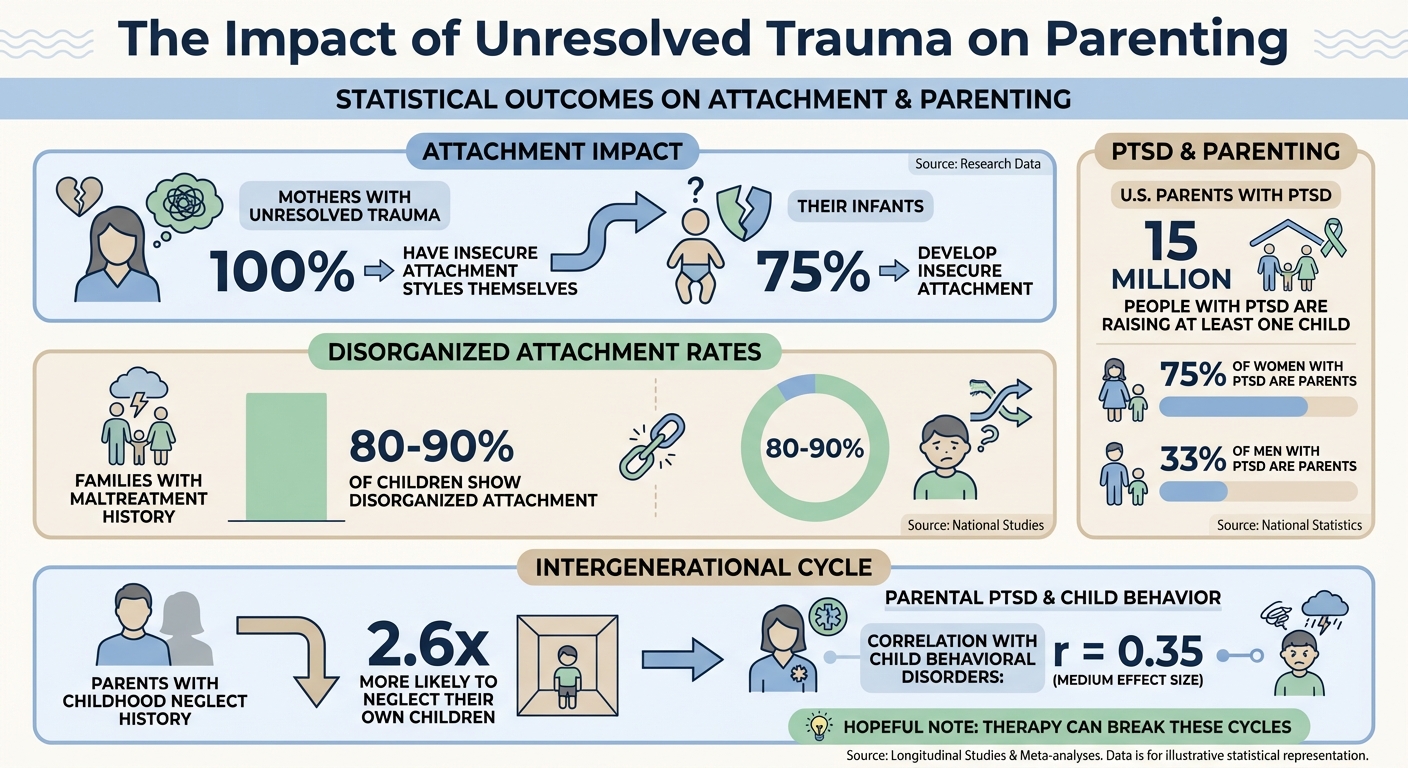
Impact of Unresolved Trauma on Parent-Child Attachment: Key Statistics
Unresolved trauma can deeply influence how parents perceive and respond to their children. For instance, a child’s cry might feel overwhelming, or a toddler’s defiance could provoke intense anger. This happens because trauma keeps the brain’s threat response – centered in areas like the amygdala and hippocampus – on constant high alert. These reactions aren’t moral failings; they are rooted in the brain’s response to past pain. Over time, this heightened state of alertness shapes how trauma is unintentionally passed down through daily parent-child interactions.
The statistics are stark: 100% of mothers with unresolved trauma have been found to have insecure attachment styles themselves, and over 75% of their infants also develop insecure attachment [3]. This highlights how trauma, when left unaddressed, creates a ripple effect across generations.
How Trauma Passes from Parents to Children
Trauma doesn’t get passed down through genetics alone. It flows through everyday interactions, often without the parent even realizing it. One major factor is impaired reflective functioning – the reduced ability to see a child’s behavior as a reflection of their internal needs, feelings, or beliefs, rather than as a personal challenge or threat [5].
"Cues given by children when needing their caretakers can be misinterpreted by parents with a history of child abuse or neglect as threatening and overwhelming, and can lead to perceptual distortions that inhibit the child’s needs from getting met." – Pamela San Cristobal, Psychology Researcher [5]
Parents with unresolved trauma may unconsciously project their unmet childhood needs onto their children. For example, a parent who felt abandoned during their own childhood might misinterpret a child’s separation anxiety as rejection [5]. Research even shows that mothers with unresolved trauma exhibit reduced amygdala activation when they see their infant in distress, which may reflect a kind of emotional disengagement [3]. In families with a history of maltreatment, the rates of disorganized attachment in children are alarmingly high – 80% to 90% [2].
In this way, unresolved trauma doesn’t just alter how parents perceive their children; it actively shapes the interactions that are crucial for building secure and healthy relationships. Utilizing trauma-informed family therapy techniques can help families navigate these challenges and rebuild trust.
Common Parenting Problems Linked to Trauma
These underlying mechanisms often show up in parenting behaviors that disrupt secure attachment. Trauma-affected parenting typically falls into two patterns: hyperarousal and dissociation. Parents in a hyperaroused state might react to their child’s distress with intense emotions, intrusive behaviors, or controlling tendencies, often trying to manage their own anxiety in the process [4][7]. On the other hand, parents in a dissociative state may seem emotionally detached, under-responding to their child’s needs or "shutting down" when faced with emotional demands [4].
In the U.S., about 15 million people with PTSD – including three-quarters of women and one-third of men with the condition – are raising at least one child [7]. Common struggles for these parents include role reversal (seeking emotional support from their child), inconsistent or harsh discipline, emotional withdrawal, and overprotection driven by their own fears rather than the child’s actual needs [7]. Additionally, parents with a history of childhood neglect are 2.6 times more likely to neglect their own children [6]. The effects are profound: parental PTSD has been linked to a medium effect size (r = 0.35) in the development of emotional and behavioral disorders in children [7].
As Udita Iyengar from the Institute of Psychiatry, Psychology, and Neuroscience explains:
"Unresolved trauma or loss may interfere with a mother’s expectations and perceptions of her child, as well as her ability to sensitively respond, thus compromising the development of secure attachment in her infant." [3]
Trauma Recovery Methods That Improve Relational Intelligence
The promising news is that therapy can help parents break free from trauma-driven patterns and build secure, healthy connections with their children. These methods go beyond just addressing surface symptoms – they work on the deeper emotional and neurological processes that keep parents trapped in reactive cycles.
Attachment-Based Therapy
Attachment-based therapy focuses on enhancing Parental Reflective Functioning (PRF) – a parent’s ability to understand and interpret their child’s behavior in terms of their inner emotional world, such as their needs, desires, and beliefs [5][10].
"Parental reflective functioning is understood as the capacity to perceive and interpret human behavior in terms of intentional mental states, such as, needs, desires, goals, beliefs, etc." – Pamela San Cristobal, Frontiers in Psychology [5]
Programs like Circle of Security-Intensive (COS-I) and Attachment and Biobehavioral Catch-Up (ABC) have shown measurable success in improving attachment security. For instance, after participating in COS-I, secure attachment rates increased from 20% to 54%, while disorganized attachment patterns dropped from 60% to 25% [8]. Similarly, the ABC program demonstrated higher rates of secure attachment and fewer disorganized attachment patterns compared to control groups [5][8].
These programs teach parents to understand "miscues" – when children act out instead of directly asking for emotional support. Parents are guided to adopt three key relational practices: being emotionally present, staying open to their child’s emotions, and providing gentle yet firm guidance [9]. This approach helps parents view their child’s behavior as meaningful and manageable rather than overwhelming [10].
Mindfulness-Based Interventions
Mindfulness practices equip trauma-affected parents to reduce emotional reactivity and interrupt harmful patterns [12]. When trauma triggers a fight-or-flight response, mindfulness helps parents pause, observe, and respond thoughtfully instead of reacting impulsively.
"Mindfulness decreases reactivity, tolerates distress, and interrupts maladaptive cycles." – Alexandra Vaporidis, MFT in Training [12]
Key benefits include greater self-compassion, mental flexibility, and the ability to observe rather than react to challenging child behaviors [12]. This creates space for parents to better understand their child’s emotions without projecting their own trauma responses onto the situation. As a result, parents can co-regulate with their children, offering a steady emotional presence that helps kids learn to manage their own feelings.
Practical mindfulness exercises for parents include short, daily grounding practices that foster presence during interactions with their children [11]. These exercises don’t require long meditation sessions – even calmly observing a child’s behavior during stressful moments without reacting can help parents break reactive patterns [12].
Emotion-Focused Therapy
Emotion-Focused Therapy (EFT) helps parents address the deeper emotional roots of relational struggles instead of just focusing on surface-level symptoms [12][1]. For parents with unresolved trauma, EFT uncovers defensive patterns – like anger, withdrawal, or emotional shutdown – that were once protective but now hinder close relationships [1][11].
"We have to address the core issues in order to help people effectively heal." – Jamula Taylor, LMFT, Growth and Change Counseling [1]
EFT supports parents in developing relational intelligence, enabling them to shift from reactive, trauma-driven responses to more empathetic and attuned caregiving [1]. It reframes conflict as an opportunity for connection rather than a sign of failure, teaching parents how to use disagreements to strengthen bonds and repair emotional ruptures [1].
Through EFT, parents learn to recognize when a trauma memory or defensive reaction is triggered by their child’s behavior. They develop healthier, more constructive ways to respond, ensuring emotional safety for both themselves and their children [1].
Growth and Change Counseling provides parent coaching and trauma therapy services that incorporate these evidence-based approaches. Their services are available in Campbell, CA, San Jose, CA, Los Angeles, CA, Roseville, CA, and through telehealth across California, helping parents break generational trauma cycles and build stronger relationships.
These therapeutic methods set the stage for practical parenting strategies that nurture relational intelligence.
Practical Parenting Strategies from Trauma Recovery
Trauma-Informed Parenting Practices
Trauma-informed parenting takes a different approach, shifting the focus from simply managing behavior to fostering connection and helping children regulate their emotions. Instead of asking, "What’s wrong with this child?" parents are encouraged to ask, "What happened to this child?" This shift promotes understanding and empathy.
One practical framework for this approach is Trust-Based Relational Intervention (TBRI), which is built on three key pillars: Empowerment (meeting physical needs), Connection (strengthening attachment), and Correction (addressing behavior) [13]. Small, intentional changes can make a big difference. For instance, offering regular, nutritious snacks helps stabilize blood sugar levels, which in turn supports mood regulation. Similarly, using countdown alerts – like 15, 10, 5, and 1-minute warnings – during transitions provides children with the predictability they need to feel secure and in control [13].
Another effective tool is "Special Time", where parents dedicate 10–15 minutes to one-on-one play, allowing the child to lead while the parent follows [14]. During emotional meltdowns, a technique called "Staylistening" involves the parent staying physically present and offering non-judgmental attention, helping the child process and release overwhelming emotions. There’s also "Playlistening", a playful method where the child takes on a more empowered role – like pretending to be stronger or faster – to relieve tension through laughter and build confidence [14]. Additionally, guiding children to name their emotions and describe physical sensations can help them develop self-awareness, an essential skill for emotional regulation [15].
"The parent-child connection is the most powerful mental health intervention in the world." – Bessel van der Kolk [15]
These strategies lay the groundwork for deeper parent coaching, which transforms reactive parenting into a more responsive and connected approach.
Parent Coaching for Better Relationships
Parent coaching builds on trauma-informed practices by addressing the root causes of reactive behaviors. Instead of focusing solely on the child, coaching empowers caregivers, often leading to more lasting results [1]. Research shows that over 90% of maltreated children are victimized by one or both parents, making the parent-child relationship a critical space for both trauma and healing [2].
Through coaching, parents gain insights into how their own beliefs and past experiences influence their interactions with their children [1]. For example, Growth and Change Counseling uses coaching to help parents reframe negative beliefs and trauma memories, turning them into relational strengths. This approach emphasizes connection over immediate compliance, encouraging parents to prioritize the relationship [15][16].
"What you believe about yourself defines and shapes all of your relationships!" – John Kane, LMFT, Growth and Change Counseling [1]
The Attachment and Biobehavioral Catch-Up (ABC) model shows how even short-term coaching can have a long-term impact. In just 10 sessions, parents saw improvements in their children’s cortisol regulation that lasted for at least three years [2]. Coaching often includes tools like "Listening Partnerships", where parents can process their own emotional triggers with peer support, helping to prevent burnout [14].
Growth and Change Counseling provides parent coaching in locations such as Campbell, San Jose, Los Angeles, and Roseville, CA, as well as through telehealth across California. Their solutions-focused approach helps families rebuild relationships, often achieving noticeable progress in as little as 12 weeks [1]. They offer specialized support for challenges like trauma, anxiety, depression, and neurodiverse relationships. This includes specialized emotional growth strategies for neurodiverse couples to help partners navigate unique communication styles.
Trauma-Informed Parenting Tools at Growth and Change Counseling
Trauma recovery techniques, rooted in attachment-based, mindfulness, and emotion-focused therapies, aim to build stronger emotional connections between parents and children. By fostering relational intelligence, these methods help break cycles of trauma, leading to secure attachments and healthier stress responses that can last for years [2].
These approaches are not just about quick fixes – they lay the groundwork for meaningful, lasting change. The journey from reactive to responsive parenting may take time, but the results are profound. As John Mark Kane, LMFT and Founder of Growth and Change Counseling, explains:
"The more relationally healthy people are, the less anxious, addicted, and depressed they are" [1].
When parents address their own trauma and develop skills like mentalizing, they create a nurturing environment for their children’s social and emotional growth while improving their own mental health.
Professional guidance can make this process smoother. Short-term relational interventions (often fewer than 16 sessions) have shown significant success in enhancing parenting sensitivity [2]. Additionally, specialized coaching helps parents shift deep-seated beliefs that influence their relationships. Growth and Change Counseling offers tailored support, including in-person and telehealth services throughout California. Their solutions-focused approach addresses challenges like anxiety, depression, trauma, and neurodiverse relationships, empowering families to achieve positive change.
For those grappling with emotional triggers or feelings of disconnection, trauma-informed strategies offer practical tools for genuine transformation. Strengthening the parent–child bond doesn’t just impact childhood – it creates lasting ripple effects throughout life.
FAQs
How does unresolved trauma impact the way I parent?
Unresolved trauma can deeply shape how you parent, often in ways that aren’t immediately obvious. It can interfere with your ability to understand and respond to your child’s emotions, sometimes leading to reactions that feel overly strict, emotionally detached, or unpredictable. These responses can make it harder to connect with your child and meet their emotional needs, which may affect their sense of security and overall well-being.
Trauma can also amplify stress responses, making it tough to stay calm or engage in nurturing interactions. This might show up as overly harsh discipline, emotional withdrawal, or difficulty soothing both yourself and your child. Over time, these patterns can create a cycle of stress and emotional disconnection that spans generations.
If you recognize these patterns in your parenting, there’s help available. Trauma-focused therapy or parent coaching can provide the tools you need to build healthier, more connected relationships with your children while addressing the underlying issues. Growth and Change Counseling offers personalized support to help parents navigate these challenges and create stronger emotional bonds with their kids.
How can I strengthen my emotional connection with my child while supporting their growth?
Building a strong bond with your child begins with providing a safe and steady environment. When they express emotions, respond with calm and attentiveness to show you’re truly listening. For instance, if your child is upset, you might say something like, "I can tell you’re feeling frustrated because…" This not only helps them understand their emotions but also builds trust and connection.
Keep routines consistent and set clear, gentle boundaries. Explaining the "why" behind rules helps strike a balance between ensuring their safety and encouraging independence. Make it a priority to carve out time for meaningful moments, whether through daily check-ins or shared activities. Actively listening and tackling small challenges together lets your child know they’re valued and supported.
For parents seeking more tailored advice, Growth and Change Counseling offers parent coaching and trauma-focused therapy to help you strengthen your relationship and create a nurturing environment that meets your family’s unique needs.
How can therapy help parents break the cycle of trauma?
Therapy offers parents a safe and supportive space to work through unresolved trauma, understand how it influences their parenting, and adopt healthier ways to manage emotions and relationships. By addressing these past experiences, parents can move away from reactions like hyper-vigilance, mistrust, or overly strict discipline and instead develop tools like mindfulness and emotional regulation.
Studies highlight that parents who engage in therapy often become more in tune with their children’s needs, leading to stronger connections and secure attachments. This process can help break harmful patterns passed down through generations. Growth and Change Counseling specializes in trauma-focused services designed to strengthen family resilience and nurture deeper, more connected relationships.
Related Blog Posts
- How Trauma Impacts Parent-Child Relationships
- Trauma-Informed Family Therapy Techniques
- Intergenerational Trauma and Addiction Recovery
- Family Therapy for Trauma Recovery: What Works
