Christian counseling combines biblical teachings with therapy to help families overcome challenges like conflict, trauma, and addiction. By integrating prayer, Scripture, and clinical techniques, it addresses emotional, relational, and spiritual needs. Key steps include:
- Understanding family dynamics: Counselors evaluate family relationships and spiritual history to identify root causes of issues.
- Incorporating faith: Prayer and Scripture are used to guide healing and build resilience.
- Strengthening relationships: Biblical principles help rebuild marriages and improve parenting.
- Addressing deeper struggles: Trauma and addiction are tackled with faith-based recovery methods.
- Building long-term resilience: Families establish faith-centered habits for ongoing growth.
Christian counseling offers a faith-driven approach to healing, focusing on both personal and spiritual transformation.
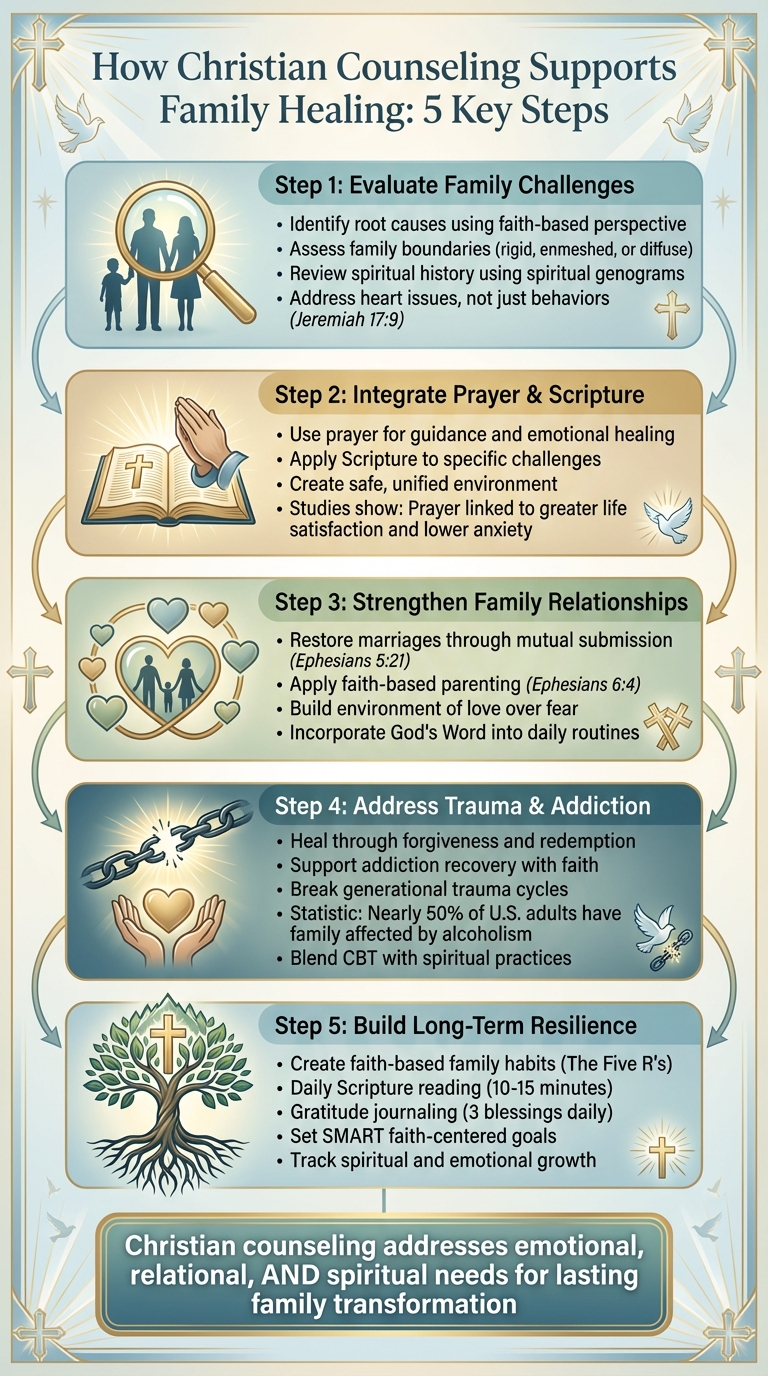
5 Steps of Christian Family Counseling for Healing and Recovery
Trauma and God: Where Is He in My Pain? | Eliza Huie
Step 1: Evaluate Family Challenges Using a Faith-Based Perspective
The initial step in Christian counseling goes beyond addressing surface-level problems. It involves a thorough evaluation of the family as a connected system. Counselors recognize that what might seem like a child’s behavioral issue could actually stem from deeper marital conflicts, where one person’s anxiety impacts the entire household. This foundational assessment helps uncover the unique dynamics at play within the family.
Find the Root Causes of Family Problems
Christian counselors take a blended approach, using clinical techniques alongside biblical principles to identify underlying issues. Many incorporate Structural Family Therapy with Scripture to examine family relationships, authority structures, and boundaries [3]. This method helps pinpoint patterns like triangulation, where a child’s behavior serves as a distraction from marital stress [3]. Since strained marriages often lead to broader family dysfunction, counselors prioritize examining marital interactions first [3][6].
During this process, counselors evaluate family boundaries, which can fall into three categories:
- Rigid boundaries: These can create an authoritarian environment, often leading to rebellion or heightened anxiety.
- Enmeshed boundaries: Overprotective dynamics in this category may limit a child’s independence.
- Diffuse boundaries: A lack of clear rules here can push children into taking on responsibilities prematurely.
Unlike secular therapy, which often focuses on behavior modification, Christian counseling aims at deeper transformation by addressing the "heart" of the issue. Drawing from Jeremiah 17:9, this approach emphasizes that true, lasting change requires a shift in the heart. Counselors work with families to replace false beliefs about identity with the truth that they are made in God’s image (Imago Dei), which helps alleviate distress and build self-worth [1][8]. This process also involves exploring the family’s spiritual history to gain further insight into their challenges.
Review the Family’s Spiritual Background
A family’s spiritual history plays a crucial role in Christian counseling. Counselors examine both current and past spiritual beliefs and practices [1][7]. As Tacoma Christian Counseling explains:
I have found it to be extremely important to check in with the family about their spiritual beliefs and practices within their current family system and the family system they came from. [7]
This spiritual assessment helps identify both obstacles and opportunities for healing. To uncover patterns, counselors may use spiritual genograms, which visually map out a family’s spiritual history, highlighting coping mechanisms or sources of distress [7]. Additionally, they address conflicts that arise when family members hold differing beliefs, ensuring that everyone’s perspective is acknowledged with respect [4][6]. These insights guide how faith-based practices will be woven into the healing process.
Step 2: Use Prayer and Scripture in Therapy Sessions
After evaluating family dynamics, counselors bring prayer and Scripture into therapy sessions. This approach shifts counseling from being solely clinical to a more comprehensive process that touches on emotional, relational, and spiritual needs. Christian counselors don’t see faith as separate from therapy; instead, they use prayer and biblical teachings alongside evidence-based techniques to create a well-rounded approach.
This progression from assessment to active intervention strengthens the role of faith in the counseling process.
Apply Prayer for Guidance and Healing
Prayer plays a central role in Christian family counseling, serving multiple purposes. Counselors use prayer to invite God’s presence into the session, creating a safe and unified environment [12]. Studies have shown that regular prayer is connected to greater life satisfaction, improved self-esteem, and lower levels of anxiety and depression [11].
Sessions often begin or end with prayer, setting a reflective and open tone [12]. Beyond its spiritual significance, prayer helps clients manage emotions, cope with stress, and work through trauma [11]. Dr. Don from Christian Counseling Services of Arizona highlights its impact:
"Prayer can bolster the counseling process and outcomes when used adjunctively" [11].
Counselors also explore each family’s prayer habits to better understand their spiritual practices and determine how ready they are for faith-based interventions [1][7].
Use Scripture to Address Challenges
Scripture provides a practical and spiritual framework for tackling family challenges. Christian counselors often combine biblical truths with clinical strategies to address issues like negative thought patterns [9]. For instance, if a parent struggles with feelings of inadequacy, counselors might reference Genesis 1:27 and 1 John 3:1 to affirm their worth as someone created in God’s image. Incorporating Scripture into daily routines helps counteract the self-doubt and anxiety that can take hold [9].
| Family Challenge | Scripture Reference | Application in Therapy |
|---|---|---|
| Rigid Parenting | Ephesians 6:4 | Encourages parenting with love rather than fear to reduce rebellion and anxiety [1][3] |
| Marriage Conflict | Ephesians 5:21, Malachi 2:15 | Stresses mutual respect and faithfulness as cornerstones of a strong family [1][3] |
| Anxiety About Priorities | Matthew 6:33 | Guides families to focus on God’s kingdom to realign their goals [1] |
| Grief or Trauma | 2 Corinthians 12:9 | Reminds families that God’s grace is sufficient during times of weakness and loss [5] |
Research from the Journal of Psychology and Theology suggests that weaving Scripture thoughtfully into counseling can boost treatment adherence [10]. By selecting verses tailored to a family’s specific struggles – whether it’s parenting, marital conflict, or trauma – counselors provide spiritual tools that clients can use even outside of sessions.
Step 3: Strengthen Family Relationships Through Biblical Principles
After incorporating prayer and Scripture into therapy, the next step is to focus on rebuilding family relationships. Christian counseling uses teachings from the Bible to address both spiritual and relational needs, aiming for a transformation of the heart that strengthens connections within the family unit [1].
The process often begins with reinforcing the marriage bond. A strong, healthy marriage provides the foundation of security that children need to feel safe and optimistic about the future [3][4]. Adding a spiritual element to therapy has been shown to boost feelings of gratitude, hope, and optimism among family members [1]. With this renewed focus on relationships, counselors can then guide families through specific biblical practices for restoring marriages and nurturing faith-based parenting.
Restore Marriages Centered on God
Rebuilding a marriage through faith involves applying biblical principles that encourage mutual respect and effective conflict resolution. As described in Matthew 7:24-25, a marriage grounded in God’s teachings is like a house built on rock – it can withstand challenges. One key practice is mutual submission, where spouses honor each other’s needs and roles, as instructed in Ephesians 5:21: “Submit to one another out of reverence for Christ” [3][1].
Counselors help couples replace blame and defensiveness with solutions rooted in Scripture. Malachi 2:15 underscores the importance of faithfulness to the marriage covenant, which serves as a cornerstone for family stability [3]. Couples are encouraged to resolve conflicts privately, creating a unified front that models love and respect for their children [3]. This approach fosters an environment of love over fear, which studies link to stronger family connections and reduced anxiety [3][1].
Apply Faith-Based Parenting Methods
Once the marital relationship is solid, attention shifts to parenting within a faith-centered framework. Counselors guide parents to balance compassion with clear boundaries, helping them avoid the pitfalls of rigid authoritarianism. Ephesians 6:4 advises parents not to exasperate their children but to provide guidance in a loving and nurturing way [3]. This includes setting family rules that ensure safety while remaining flexible enough to encourage open communication and individual growth [3].
Practical strategies for faith-based parenting include incorporating God’s Word into everyday life, as instructed in Deuteronomy 6:6-7. Parents are encouraged to discuss biblical teachings during daily routines – whether at home, on car rides, or before bedtime [2][1]. By prioritizing their own faith and “seeking first the kingdom of God” (Matthew 6:33), parents model a way of life for their children to emulate [1]. Proverbs 22:6 reinforces the importance of instilling good habits early, emphasizing that a strong spiritual foundation equips children to navigate challenges with confidence and faith [1]. This approach nurtures both emotional resilience and spiritual growth, preparing children for a life rooted in God’s principles.
sbb-itb-596b85d
Step 4: Address Trauma and Addiction Through Faith-Based Recovery
Christian counseling not only rebuilds family relationships but also delves into deeper wounds caused by trauma and addiction. This approach provides a path to healing that addresses both emotional pain and spiritual well-being. Unresolved trauma often surfaces in physical symptoms, creating a cycle of distress that requires attention [15]. Recovery unfolds in three key stages: creating a sense of safety, processing trauma through faith, and fostering integration and healing [15].
The journey begins by establishing a safe space where families can openly confront their pain. As Kegan Mosier, M.A., LPC, from Cornerstone Christian Counseling explains, "Forgiveness is between you and God; reconciliation is between you and another person (if it’s even possible or safe)" [13]. This distinction helps individuals release bitterness and anger without risking further emotional harm. By focusing on forgiveness and employing specific strategies for addiction recovery, families can lay the groundwork for true healing.
Heal Through Forgiveness and Redemption
In Christian counseling, forgiveness is about freeing oneself from the grip of bitterness – not excusing harmful actions [13][14]. Counselors emphasize that forgiveness is a personal, spiritual process between the individual and God, while reconciliation requires safety and genuine repentance from the other party [13]. This perspective ensures that vulnerable family members are protected while allowing space for spiritual renewal.
Through therapy, individuals can reconnect with their identity in Christ. As Cornerstone Christian Counseling highlights, "Trauma tells us we are abandoned – faith counters with the truth that we are eternally cherished" [13]. Scripture plays a vital role in this healing process. Verses like Psalm 147:3, "He heals the brokenhearted and binds up their wounds", provide comfort and reassurance [14][15]. This spiritual focus fosters resilience and helps families address harmful beliefs and emotional wounds. By breaking generational cycles of trauma, families can create a healthier legacy for future generations [15][1].
Support Addiction Recovery Through Faith
Christian counseling views addiction recovery as a transformative journey that not only strengthens family bonds but also deepens their connection with God, who is seen as the ultimate healer [1]. With nearly half of all U.S. adults having a close family member affected by alcoholism [5], this approach addresses a pressing need by focusing on the entire family system rather than isolating the struggling individual.
Recovery involves a profound change of heart, targeting the spiritual roots of addiction rather than just the behaviors [1]. Families are encouraged to incorporate daily prayer for guidance and strength, while Scripture provides a moral compass for identifying and addressing harmful behaviors [16][1]. The promise in 2 Corinthians 12:9 – "My grace is sufficient for you, for my power is made perfect in weakness" – offers hope that God’s grace can mend broken trust and heal emotional wounds [5]. Counselors blend evidence-based methods like Cognitive Behavioral Therapy (CBT) with spiritual practices, creating relapse prevention plans that include identifying triggers and using Scripture-based meditation as a coping tool [16][13]. This comprehensive approach nurtures the mind, body, and spirit, bringing renewed hope and unity to families navigating recovery.
Step 5: Build Long-Term Resilience Through Faith
Prayer and Scripture don’t just help in moments of immediate need – they’re also the foundation for long-term resilience. Think of resilience as daily strength training for your family, preparing everyone to face future challenges head-on [17]. Tim Sanford, a counselor and author, puts it this way:
Resilience isn’t about denying the depth of pain and its ongoing impact. Instead, it’s about learning from and growing through adversity – about becoming comfortable with being uncomfortable [21].
Experts often refer to "protective factors" as key to building resilience. These are the internal strengths and external supports that create a sense of security and connection within a family [22]. The Apostle Paul beautifully captures this idea in 2 Corinthians 4:8-9:
We are hard pressed on every side, but not crushed; perplexed, but not in despair; persecuted, but not abandoned; struck down, but not destroyed [17][22].
Create Faith-Based Family Habits
To strengthen these protective factors, focus on creating daily habits that nurture resilience through faith. Incorporate the "Five R’s" into your routine: Regulation (guided by Psalm 23), Reflection (inspired by Romans 12:1-2), Relationships, Respite, and Reason (staying connected to God’s purpose) [18].
Start small with spiritual practices that feel natural for your family. Dedicate 10–15 minutes each morning to Scripture reading, and use tools like a feelings wheel to help family members identify and express their emotions during tough times [21]. Gratitude journaling – writing down three blessings each day – can also help foster hope and positivity [20]. As Stormie Omartian reminds us:
There’s only one power in the world great enough to help us rise above the difficult things we face: the power of God [20].
Incorporate the Psalms into family prayers to create space for honest emotions while affirming God’s faithfulness [21]. Use blessings and Scripture memorization to reinforce your children’s identity as cherished by God [22]. Joining community groups can also provide mutual support, as families learn to carry one another’s burdens [19]. Keep in mind that building new habits takes time – sometimes hundreds or even thousands of repetitions – before they become second nature [22].
Track Progress with Faith-Centered Goals
Once your family establishes these habits, measure growth by setting faith-centered goals. Adapt the traditional SMART framework to include a spiritual dimension: make goals Specific (seek God’s guidance in prayer), Meaningful (track actions like memorizing one verse per week), Attainable (use resources God has already provided), Relevant (align with your family’s spiritual gifts), and Timely (follow God’s timing) [24][26].
Aaron Potratz, LPC and Co-Owner of Life Discovery Counseling Services, explains:
Faith-based goals focus on aligning your life with God’s will, fostering both spiritual growth and emotional well-being [24].
Use a prayer or gratitude journal to document how God is working in your family’s life, and track specific prayer requests and their outcomes [23][24]. Set solution-focused goals by breaking them into clear, actionable steps that you can commit to consistently. Focus on what’s within your control while trusting God to handle the rest [17]. Celebrate milestones along the way to stay motivated and recognize your family’s emotional and spiritual growth [24]. As Shana Schutte from Focus on the Family points out:
Because goals are the ‘map’ that will guide you toward your God-given purpose, without setting them you will also wander in circles without getting where you need to go [25].
Christian Counseling Services at Growth and Change Counseling

Family and Marriage Counseling Options
At Growth and Change Counseling, faith-based principles are combined with clinical expertise to support and heal families. Their services include marriage therapy, family therapy, individual counseling, and parent coaching. These sessions are offered in Campbell and San Jose, CA, as well as virtually through HIPAA-compliant telehealth for clients across California. Each 45-minute session costs $165, and they accept insurance from Anthem Blue Cross, Aetna, United Health Care, Oxford, and Oscar Health [28].
For couples dealing with infidelity, separation, or intense conflict, The Marriage Rescue Institute offers a focused 12-week program aimed at restoring relationships in crisis. John Mark Kane, LMFT and founder of Growth and Change Counseling, shares:
The Marriage Rescue Institute, our 12-week marriage program, is in the habit of putting marriages in dire circumstances back together! [27]
Parent coaching is another key service, designed to help families navigate challenges like ADHD, ODD, or Asperger’s. This coaching empowers parents to reestablish authority within the home and rebuild healthy dynamics. These services reflect the practice’s commitment to applying Christian values in practical, meaningful ways.
Customized Faith-Based Care
Growth and Change Counseling tailors its therapeutic approach to meet each family’s unique needs, blending Christian faith with effective clinical methods. Karin Wiese, LMFT, explains their approach:
At Growth and Change Counseling, we have a foundational process that we take couples, individuals, addicts, and parents through. This process is tailored to the situation that you are dealing with and helps you develop the relational intelligence to put your relationships and mental health back together [27].
For families who wish to incorporate their faith into therapy, the practice uses Christian Psychology, drawing inspiration from passages like 1 Corinthians 13 to guide relational healing. The counselors address deep-seated issues such as unresolved anger, trauma, and addiction, helping families transform their mindset and strengthen their connection with God. Specialized support is also available for pastors, missionaries, cross-cultural workers, and Third Culture Kids (TCKs), addressing their unique challenges.
With over 13 years of experience, Growth and Change Counseling equips families with practical tools to rebuild trust, improve communication, and create meaningful, lasting change – all rooted in their faith. Their goal is to ensure that the skills learned in therapy continue to benefit families long after sessions end.
Conclusion
Christian counseling blends professional therapeutic techniques with biblical principles to address both the surface-level symptoms and the deeper roots of family struggles. Whether it’s broken trust, addiction, or lingering conflict, this approach offers a path to healing through a mix of clinical insight and spiritual guidance.
By incorporating faith into therapy, families find strength during tough times and build resilience grounded in shared values and a stronger relationship with God. Studies show that adding a spiritual element to traditional therapy can increase feelings of gratitude, optimism, and hope among family members [1]. This spiritual grounding often leads to meaningful changes in how families interact day to day.
Through a Scripture-based approach, families not only learn practical skills for communication and resolving conflicts but also deepen their spiritual connections. This process helps break harmful generational patterns and equips family members to face future challenges with renewed strength. As California Christian Counseling explains:
Christian family counseling is a grace-filled, redemptive process that brings the family into a closer relationship with each other and with God, who is the ultimate source of all healing [1].
Christian counseling provides families with the tools to rebuild trust, mend relationships, and move forward with confidence. By combining professional expertise with biblical truth, it offers a transformative path to healing and lasting growth for families.
Begin Your Healing Journey With Growth and Change Counseling
How does Christian counseling combine faith and therapy to support healing?
Christian counseling blends faith with therapeutic practices, focusing on the emotional, mental, and spiritual aspects of a person’s life as interconnected elements. Counselors draw from biblical teachings – like Scripture and prayer – while incorporating proven therapeutic methods such as cognitive-behavioral techniques, family systems approaches, and trauma-informed care. This approach offers clients both spiritual guidance and practical tools to navigate challenges.
A typical session might include prayer, discussing relevant Bible passages, and setting goals grounded in Christian values like forgiveness and humility. These faith-based principles are combined with evidence-based strategies to encourage healing and improve relationships. By aligning therapy with a client’s faith, Christian counseling provides a path for emotional well-being and spiritual renewal.
Growth and Change Counseling embraces this approach, offering faith-based therapy for individuals, couples, and families. Their services focus on emotional and relational health while nurturing spiritual growth, providing compassionate support both in-person throughout California and via telehealth.
How does prayer contribute to the healing process in Christian counseling?
Prayer holds a meaningful place in Christian counseling, acting as a bridge to emotional connection, spiritual growth, and renewed hope. It becomes a shared practice that can bring families closer, strengthen emotional bonds, and offer solace during tough moments. By seeking divine guidance, prayer provides a pathway for clients to work through painful experiences and move toward healing on both emotional and spiritual levels.
Christian counselors often weave prayer into their sessions by starting or ending with a brief prayer, focusing on specific concerns, or drawing on biblical principles. This integrated approach nurtures the mind, body, and spirit, guiding individuals and families toward restoration and renewal through the combined power of faith and therapy.
How does Christian counseling help families heal from trauma and addiction?
Christian counseling provides essential support for families dealing with trauma and addiction by addressing the entire person – mind, body, and spirit. Combining evidence-based therapeutic methods with biblical teachings, counselors guide individuals and families through confronting painful experiences, breaking destructive cycles, and discovering hope through faith. By anchoring the healing journey in Scripture and prayer, families are encouraged to embrace forgiveness, repentance, and a renewed identity in Christ.
During family sessions, counselors create a safe space for honest conversations, teach practical skills like relapse prevention and effective communication, and nurture a shared vision of healing rooted in love and understanding. Growth and Change Counseling offers faith-based services such as individual and family therapy, parent coaching, and specialized care for trauma and addiction. These services are available in-person throughout California or via telehealth. This holistic approach helps families rebuild trust, strengthen their bonds, and move forward together with faith as their cornerstone.
Related Blog Posts
- 5 Ways Faith Supports Emotional Healing in Marriage
- Overcoming Addiction and Anxiety in Christian Marriages
- Parent Coaching with Faith in Addiction Recovery
- How Faith Helps Couples Overcome Addiction Together
