Struggling to connect in an autism-neurotypical marriage? You’re not alone. The key lies in understanding each other’s emotional and sensory needs. Autistic partners often process emotions differently, rely on direct communication, and may face challenges like alexithymia or sensory sensitivities. Neurotypical partners, on the other hand, often seek emotional validation and subtle cues, which can lead to misunderstandings.
Here’s what you need to know:
- Communication is critical. Direct, literal language works best – avoid sarcasm or vague hints.
- Sensory needs matter. Create a calming environment and recognize triggers to reduce stress.
- Support each other. Use tools like “Support or Strategy” questions to clarify emotional needs.
- Professional help works. Autism-informed therapy can improve understanding and connection by up to 45%.
This guide covers practical steps, communication tips, and sensory management strategies to help you build a stronger, more connected relationship. Keep reading to learn how to navigate differences and thrive together.
How Neurodiverse Marriages Thrive with Growth and Change Counseling
Understanding Emotional Differences
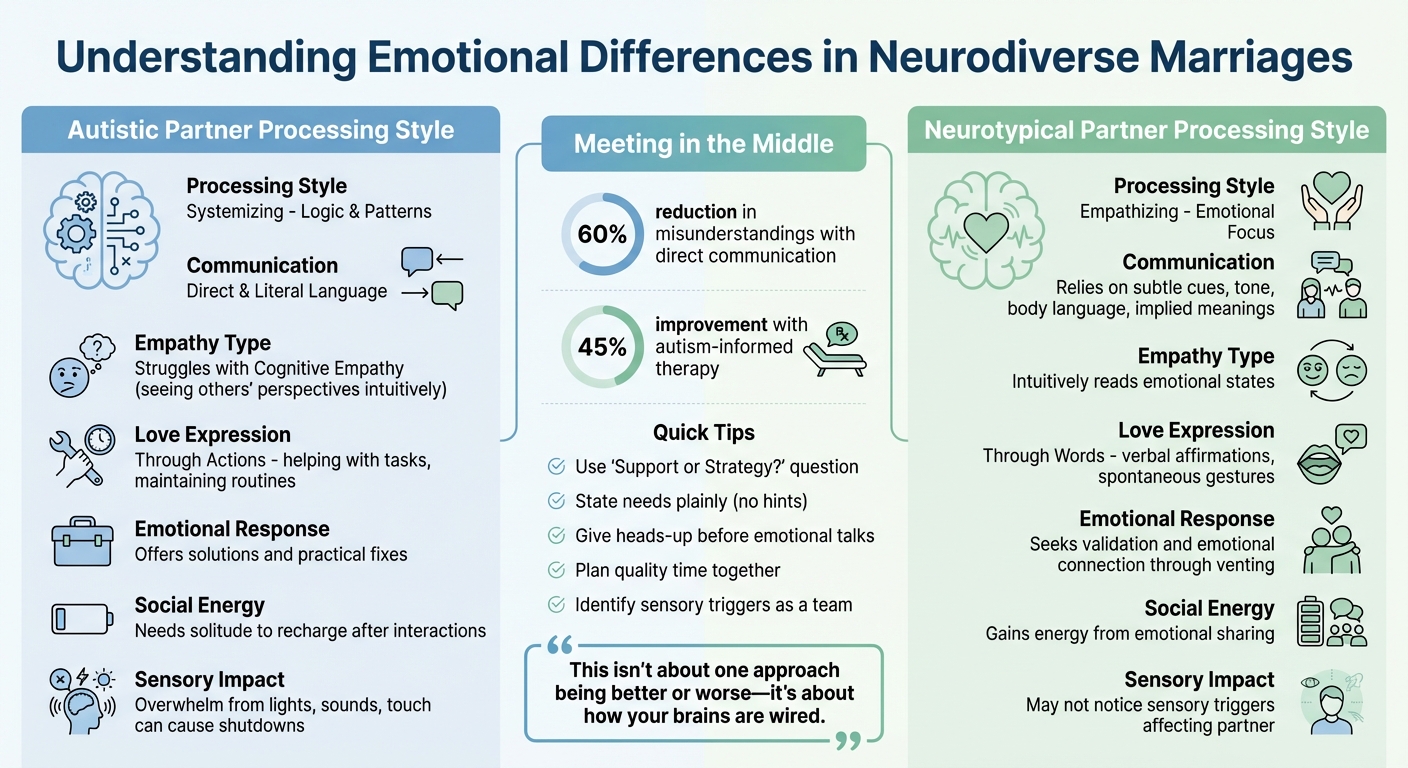
Emotional Processing Differences in Autism-Neurotypical Marriages
The first step in building emotional support within your marriage is recognizing that you and your partner likely experience and process emotions in different ways. This isn’t about one approach being “better” or “worse” – it’s about how your brains are wired. For example, autistic individuals may need clear, direct communication to understand someone else’s perspective, while neurotypical partners often rely on subtle cues like tone of voice, body language, or implied meanings – things their autistic spouse might not naturally notice [1][6].
"Individuals on the autism spectrum experience deficits in Theory of Mind, which is the ability to consider both their own perspective and that of someone else…" – Leslie A. Sickels, LCSW [1]
This difference can show up in everyday conversations. For instance, if you say, “I’m fine” while clearly upset, your autistic partner may take your words literally and not realize there’s more to unpack. While it’s a common myth that autistic individuals lack empathy, research shows they are capable of understanding emotions. However, they may struggle with cognitive empathy – the ability to intuitively see things from another person’s perspective [1][7]. Let’s explore how these differences play out in daily life.
How Autism Affects Emotional Expression
Autistic individuals often lean toward "systemizing", which means they focus on logic, patterns, and practical solutions [1]. So, when you share a problem, their first instinct might be to offer advice or a fix, rather than simply validating your feelings. This isn’t a lack of care – it’s their natural way of trying to help. Similarly, they might express love through actions, like helping with tasks or maintaining shared routines, rather than through verbal affirmations or spontaneous romantic gestures [6][3].
Sensory sensitivities can also play a major role. Bright lights, loud noises, or even unexpected touch can overwhelm your autistic partner, leading to anxiety or a shutdown. What might seem like a “blank stare” during a heated moment is often their nervous system’s way of coping with overload – not a sign that they don’t care [1][3]. Additionally, social interactions can be exhausting, requiring them to recharge with solitude afterward. If you’re unaware of this need, it can feel like rejection [7].
Neurotypical Emotional Patterns
As a neurotypical partner, you likely process emotions by "empathizing", which means focusing on the emotional aspects of a situation rather than its logical components [1]. You might feel better after venting or talking through your feelings, even if you’re not looking for solutions. This contrasts with autistic communication, where direct and literal statements often convey the entire message, without hidden emotional layers [7].
You may also crave spontaneous acts of affection or verbal reassurance to feel loved and connected [6]. When these don’t come naturally from your autistic spouse, it’s easy to misinterpret their actions as indifference. But here’s the thing: your partner might be expressing love in ways you’re overlooking – through their reliability, loyalty, or by maintaining routines that bring stability to your relationship [6][3].
Meeting Each Other’s Emotional Needs
Bridging the emotional gap starts with clear and direct communication. Avoid sarcasm, idioms, or rhetorical questions, and state your needs plainly. For example, instead of hinting or implying dissatisfaction, say something like, “I need a hug to feel close” [2][3]. A simple tool like the “Support or Strategy” question can also work wonders. By asking, “Do you need support or strategy?” you can help your partner understand whether you’re looking for emotional validation or practical advice [1].
It’s also helpful to give your autistic partner a heads-up before diving into emotional discussions. This allows them time to shift their focus and prepare for the conversation [1]. Beyond communication, addressing sensory challenges can improve emotional connection. For instance, plan quality time together instead of relying on spur-of-the-moment interactions, and work as a team to identify sensory triggers and comforts – like dim lighting or weighted blankets – that create a calming environment [7][3][5].
The goal is to acknowledge and respect each other’s differences while finding ways to support one another. By doing so, you’re laying the foundation for better communication, which we’ll dive into next.
Communication Strategies That Work
When it comes to bridging the emotional differences in neurodiverse relationships, effective communication is the glue that holds everything together. It’s not about speaking the same "language" perfectly – it’s about finding practical ways to make sure both of you feel heard and understood. These strategies aim to build mutual respect and understanding, which are essential in any partnership.
"Communication is the bedrock of any strong relationship, but it holds even greater significance in neurodiverse partnerships." – Dr. Kenneth Roberson, Psychologist [8]
By tweaking the way you express yourself, listen, and share, you can minimize misunderstandings and strengthen your emotional connection.
Using Clear and Direct Communication
Being clear and direct is a game-changer. Vague statements like "We should probably deal with this" or "I’m fine" (when you’re clearly not) can lead to unnecessary confusion. Instead, say exactly what you mean. For example: "Can you help with the dishes tonight?" or "I’m upset because I felt dismissed during our talk."
A handy tip is the "Support or Strategy" rule. Let your partner know upfront if you’re looking for emotional validation or practical advice. This simple step can help avoid frustration on both sides. Similarly, giving a heads-up before discussing important topics allows your partner time to prepare.
"Don’t use intuition to communicate, use your words. Say what you want clearly and mean what you say." – Dr. Nicole Gurash, Psy.D.
And don’t forget the power of "I" statements. Instead of saying, "You never listen to me", try, "I feel unheard when I share my day and don’t get a response." It shifts the focus to your feelings rather than assigning blame, which can help keep the conversation productive.
Once you’ve clearly expressed your needs, the next step is to actively listen to your partner.
Active Listening Methods
Active listening goes beyond just hearing words – it’s about understanding how your partner processes emotions. Neurotypical partners may need to accept that their autistic spouse might not instinctively pick up on unspoken feelings. At the same time, autistic partners can learn that their neurotypical spouse might need more explicit emotional validation.
One effective approach is to ask clarifying questions like, "Can you tell me more about why you’re feeling that way?" or "Do I understand correctly that you’re concerned about [X]?" These questions not only show you’re engaged but also help avoid misunderstandings.
It’s also crucial to respect nonverbal cues. For instance, if your autistic partner avoids eye contact, it’s likely a self-regulation technique rather than a sign of disinterest. Studies show that for some autistic individuals, making eye contact can activate the brain’s fear center, leading to a fight-or-flight response.
"The goal of providing emotional support is not to agree but rather to identify that something is ‘a difficult situation’ for a partner." – Leslie A. Sickels, LCSW
Give your partner time to process their thoughts rather than expecting an immediate response. If needed, follow up with a written summary of your discussion to reinforce key points. Setting the tone from the start – such as saying, "I’m sharing this to connect, not to criticize" – can also help create a collaborative atmosphere.
When words don’t quite cut it, nonverbal communication can fill in the gaps.
Nonverbal Communication Options
Sometimes, words alone aren’t enough – or they might even feel overwhelming. For autistic individuals, putting internal sensory experiences into language can be challenging. Nonverbal methods like written notes or visual aids can help bridge the gap.
For example, writing a quick note or sending a text about a topic in advance gives your partner time to process and prepare. Tools like digital planners or phone alerts can also help with transitions, making things feel less abrupt.
Another helpful approach is creating emotional signposts. You can use color codes (like red for "I need space" or green for "I’m open to talking"), emojis, or simple phrases to communicate your emotional state quickly and without lengthy explanations.
"Establishing emotional signposts involves creating a shared language or symbols that represent different feelings or needs. This could be as simple as using color codes, emojis, or specific phrases." – Dr. Kenneth Roberson, Adult Autism Psychologist [8]
Parallel play – doing activities side-by-side without constant conversation – can also be a meaningful way to connect. Whether it’s working on a puzzle, drawing, or just listening to music together, these shared moments can offer comfort and strengthen your bond.
Lastly, be upfront about physical gestures for affection or support. Subtle cues like a raised eyebrow or a soft tone might go unnoticed, so being explicit – like offering your hand for a hug or saying, "I’d like to sit close to you right now" – ensures your intentions are clear and your partner can respond appropriately.
Managing Sensory Sensitivities and Emotional Overload
Sensory sensitivities go beyond just being about comfort – they have a direct impact on your partner’s emotional well-being and their ability to connect with you. By understanding how sensory input influences emotions, you can create an environment where both of you feel supported and at ease.
How Sensory Input Affects Emotions
Think of sensory input like filling a cup throughout the day. When that cup overflows, your partner might feel anxious, frustrated, or even shut down completely. This isn’t a mood swing or a choice – it’s a physiological response to being overwhelmed.
"When sensory input exceeds an individual’s tolerance, it can lead to a state of overload. This can manifest as anxiety, frustration, or withdrawal, effectively shutting down the relaxation response needed for intimacy." – Liz Zhou, Holistic Therapist [5]
Research shows that up to 50% of autistic adults also have an anxiety disorder, which is double the rate seen in neurotypical adults [10]. This means sensory overload can intensify existing anxiety, making recovery even harder. Triggers can include scratchy clothing, fluorescent lights, chewing sounds, strong perfumes, or even an unexpected light touch. What might seem trivial to one person can feel overwhelming to someone with sensory sensitivities.
Learning your partner’s "window of tolerance" – the amount of sensory input they can handle before becoming overwhelmed – is key. Watch for physical signs like jaw clenching, increased stimming, irritability, or a racing heartbeat. These early indicators can help you step in before a full meltdown occurs. Recognizing these signs allows you to make practical adjustments to your shared environment.
Creating a Sensory-Friendly Home
Your home should feel like a sanctuary, not a source of stress. Start by having an open conversation during a calm moment to identify what sensory triggers overwhelm your partner and what brings them comfort. A simple chart can help organize this information:
| Sensory Category | Potential Triggers | Potential Soothing Factors |
|---|---|---|
| Tactile | Scratchy clothing, unexpected light touch | Weighted blankets, firm pressure |
| Auditory | Chewing sounds, clinking silverware, loud music | Noise-canceling headphones, calming music |
| Visual | Harsh fluorescent lighting, cluttered rooms | Dimmed lights, neutral-colored walls |
| Olfactory | Strong perfumes, cooking smells | Lavender essential oil, unscented products |
Designate a low-stimulation space in your home, such as a bedroom with blackout curtains or a quiet corner with soft lighting. Stock it with items like noise-canceling headphones, weighted blankets, fidget toys, or calming apps. This can serve as a retreat when sensory input becomes overwhelming [11].
Make small but meaningful changes to the environment. Swap harsh fluorescent lights for dimmable or softer lighting. Discuss thermostat settings, as neurodivergent individuals often have unique temperature preferences [5]. For issues like misophonia (sensitivity to specific sounds such as chewing), consider using white noise or allowing headphones during meals [11]. Once the home environment feels more supportive, it’s equally important to know how to help your partner recover when they’re overwhelmed.
Helping Your Partner Recover from Overload
When sensory overload happens, your partner may experience a meltdown – a temporary loss of emotional control that helps reset their overwhelmed nervous system [11]. This isn’t manipulation; it’s an involuntary process.
During a meltdown, your partner might lose the ability to speak or process what’s being said. Asking questions or trying to discuss the situation can make things worse [11]. Even though you might instinctively want to offer a comforting hug, physical touch can feel overstimulating or even painful in these moments [11][5].
The best thing you can do is remove the sensory trigger or gently guide your partner to their designated quiet space. Once they’re there, step back and let the meltdown run its course without engaging verbally. Sometimes, simply being present in the room without doing anything is the most supportive action you can take [11].
"Their need for solitude is important to respect, as it keeps away depression and burnout. While granting them this time is important, it can also leave you feeling lonely." – The Couples Center [10]
Having a "meltdown kit" ready can make a big difference. Include items your partner finds helpful, like noise-canceling headphones, a weighted blanket, calming music, or puzzle apps [11][5]. After they’ve fully recovered, when they’re no longer exhausted, you can calmly discuss what caused the overload and what helped during recovery [11]. This kind of teamwork helps both of you prepare for future situations.
sbb-itb-596b85d
Building Long-Term Emotional Strength
Building a strong, enduring bond in an autism-neurotypical marriage requires consistent habits that nurture both partners over time. Often, communication struggles arise not from personal flaws but from differences in neurological processing. As Liz Zhou, a holistic trauma therapist, puts it:
"Communication difficulties are not due to the deficits of either autistic or allistic people, but due to the differences in neurotype" [5].
Recognizing these differences as natural variations in emotional processing can help foster understanding and connection.
Making Self-Care a Priority for Both Partners
Self-care is a cornerstone for both partners to stay emotionally present in the relationship. Research highlights that autistic adults often experience mental health challenges from masking, while neurotypical partners thrive when they prioritize their own well-being [4].
For the autistic partner, having time alone is key to self-regulation. Setting aside a "no-talk" period after work can provide space for unmasking and sensory recovery before diving into relationship discussions [12]. Creating a self-regulation toolbox – complete with stimming tools, fidget toys, weighted blankets, or grounding meditations – can also be incredibly helpful. Additionally, dedicating time to special interests can bolster emotional balance [5][4].
Meanwhile, the neurotypical partner benefits from maintaining a sense of self outside the caregiving role [4]. Pursue personal goals, nurture friendships, and explore hobbies that bring you joy. Lean on external support networks – like friends, family, or hobby groups – to meet needs your partner might not be able to fulfill [15]. Eva A. Mendes, a couples’ counselor, emphasizes:
"A relationship cannot be satisfying if either of the individuals is running on empty. So, create, select, and lean on your community… as every relationship, ND or not, thrives in an ecosystem of support and interdependence!" [15].
In your shared home, consider designating low-sensory spaces where either partner can retreat to recharge without it being seen as a rejection [13]. Sensory-friendly adjustments can reduce anxiety by up to 70% for those with sensory processing differences [4].
When both partners prioritize self-care, it becomes much easier to tackle challenges together.
Working as a Team
Facing challenges as a team starts with clear and respectful communication. Avoid using absolute terms like "always" or "never" during disagreements, as these can derail discussions by sparking debates over literal interpretations [12]. Agree on a neutral signal to pause conversations during heated moments to prevent emotional escalation [13]. For neurodiverse couples, it can be helpful to pause late-night arguments and revisit them the next day when both partners are more emotionally regulated [12]. Kristina Jones, LMHC, notes:
"While it seems like a script could feel cold, it actually often ends up with both partners feeling more heard and cared for in a deeper way" [12].
Deepening Emotional Connection
To deepen emotional bonds, create opportunities for shared yet independent moments. Parallel play – spending time together while engaging in separate activities like reading or gaming in the same space – offers connection without the pressure of constant conversation [9]. Establish simple, repeatable rituals, like a "two-minute feelings check", to keep emotional connection a daily priority [14]. Using a relationship schedule for conversations, shared leisure, and intimacy can help ensure connection remains central, even when executive functioning challenges arise [16]. Incorporating "planned spontaneity" with flexible time blocks during the week can balance the need for variety with a preference for predictability [13].
In addition to identifying triggers, focus on discovering "sensory joys" – calming sights, sounds, or textures – that create a nurturing atmosphere for intimacy [5]. Celebrate non-traditional expressions of love, such as sharing a special interest ("info-dumping") or embarking on spontaneous shared activities ("side quests"), as meaningful ways to connect [12]. Even small gestures, like handling a task to ease your partner’s day or leaving a thoughtful note, can go a long way in strengthening your bond [14].
As Ashley Grubbs from Seaport Coaching points out:
"When we focus on the positive attributes our neurodivergent partners bring to the relationship, we have higher satisfaction because of the differences, not in spite of them" [17].
Getting Professional Support
Why Professional Guidance Helps
Professional counseling plays a critical role in bridging communication gaps between neurodiverse partners, helping them develop what’s often referred to as "relational intelligence." This is the practical ability to convey emotional needs without relying on subtle social cues. In fact, research indicates that about 70% of couples who undergo marriage counseling report improvements in their relationship [18].
Therapists trained in neurodiversity focus on making emotional needs more explicit and easier to understand. As Leslie A. Sickels, LCSW, puts it:
"The goal of providing emotional support is not to agree but rather to identify that something is ‘a difficult situation’ for a partner" [1].
Specialized therapy also tackles hidden stressors like masking, Rejection Sensitive Dysphoria (RSD), and Cassandra Syndrome – patterns that can quietly strain relationships. These therapists create a neutral space where both partners can openly share their perspectives without one being dismissed or invalidated [18]. This supportive environment sets the stage for the services detailed below.
Growth and Change Counseling Services
Growth and Change Counseling provides tailored support for neurodiverse couples across California, with in-person offices in Campbell, San Jose, Los Angeles, and Roseville, as well as telehealth options available statewide. Sessions are priced at $165 for 45 minutes. The practice works with major insurance providers and offers superbills for out-of-network reimbursement [26,29].
Their approach typically involves 6 to 8 sessions, integrating techniques like Emotion Focused Therapy (EFT), Cognitive Behavioral Therapy (CBT), and Imago Dialogue [26,27]. Specialists trained in Applied Behavioral Analysis (ABA) and Autism Spectrum Disorder (ASD) ensure that the unique communication styles and sensory needs of both partners are respected and addressed [20]. This structured approach is designed to deliver practical solutions that neurodiverse couples can apply in everyday life.
For couples dealing with more severe challenges – such as infidelity, separation, or ongoing conflict – the Marriage Rescue Institute offers a 12-week program aimed at rebuilding relationships [19]. They also provide a dual-support model, where couples meet together but also work individually with therapists who offer skills training tailored to each partner’s neurotype [21].
What Happens in Therapy
Here’s a closer look at what you can expect during therapy.
The process starts with a detailed assessment of your relationship history, current struggles, and future goals. This helps create a customized treatment plan [18]. Weekly sessions include discussions, communication coaching, skill-building exercises, and regular progress reviews [18].
Couples are also given "relational homework" between sessions to practice new strategies in real-life situations. This hands-on approach helps accelerate progress and ensures lasting change [26,29]. As Karin Weisse, LMFT at Growth and Change Counseling, explains:
"We don’t believe therapy should go on forever. You deserve real results in the quickest way possible" [18].
For neurodiverse couples, therapy often includes structured empathy exercises. These help the autistic partner learn to receive, connect with, and respond to their partner’s emotions using clear, step-by-step methods rather than relying on intuition alone [21]. Growth and Change Counseling highlights this philosophy:
"Autism is NOT a fixed condition that locks someone into the same behaviors throughout life. It is subject to the same forces of change that occur in anyone’s life" [21].
Therapists also work on practical aspects of life, such as parenting, time management, financial planning, and even sensory-sensitive approaches to sexual intimacy [21].
Conclusion
Fostering emotional connection in an autism-neurotypical marriage isn’t about changing one another – it’s about understanding the unique ways both partners process emotions. As we’ve explored, many challenges arise from differences in brain wiring, not from a lack of love or effort [1][3][4]. Shifting from intuitive to direct, literal communication can cut misunderstandings by nearly 60% [4].
Some key approaches include open communication and creating sensory-friendly environments. For instance, adapting the home to be more sensory-friendly can lower anxiety and stress levels by as much as 70% for those with sensory processing differences [4]. These small but meaningful changes can make daily interactions more positive and supportive.
Seeking autism-informed professional support can also make a significant difference, improving relationship outcomes by 45% [4]. As covered in the professional guidance section, therapists who specialize in neurodiversity provide targeted strategies that help couples navigate challenges. Leslie A. Sickels, LCSW, highlights the importance of validation in relationships:
"The goal of providing emotional support is not to agree but rather to identify that something is ‘a difficult situation’ for a partner" [1].
This kind of acknowledgment fosters emotional safety, which is crucial for any partnership.
When it comes to conflict, it’s important to remember that disagreements don’t signify a broken relationship. As Barbara (Blaze) Lazarony, LMFT, explains:
"Conflict doesn’t mean your relationship is broken. In fact, conflict can be a gateway to deeper connection – if both partners have the tools to navigate it" [3].
The focus should be on developing strategies for repair and practicing direct communication, rather than striving for perfection. These tools can help couples manage conflict and build a stronger connection.
However, if issues like chronic shutdowns, resentment, or burnout persist, reaching out for specialized help can be a vital step. Growth and Change Counseling offers autism-informed therapy throughout California, with offices in Campbell, San Jose, Los Angeles, and Roseville, as well as telehealth options for statewide support. Investing in this kind of guidance can help create the relationship both partners deserve.
FAQs
How can I communicate more effectively with my autistic spouse?
Communicating effectively with an autistic partner requires recognizing that they might process and express information differently than you do. Give them extra time to respond rather than expecting immediate answers. It can also help to preview topics before a conversation and summarize key points afterward to ensure you’re both on the same page. Be straightforward, specific, and literal in your communication – steer clear of idioms or implied meanings – and encourage them to ask for clarification whenever needed.
It’s equally important to respect their sensory and social energy levels. Opt for calm, low-stimulus environments for significant discussions, and allow breaks if they feel overwhelmed. Developing a shared "relationship language" rooted in curiosity and mutual respect can turn your differences into opportunities for growth. Instead of viewing misunderstandings as obstacles, treat them as chances to better understand each other’s communication styles. Tools like regular check-ins, written notes, or visual reminders can also strengthen emotional bonds and help minimize conflicts.
If you’re finding these strategies difficult to put into practice, Growth and Change Counseling provides specialized couples coaching and therapy designed for neurodiverse relationships. Services are available in-person throughout California and via telehealth.
How can we create a sensory-friendly home environment for our neurodiverse relationship?
Creating a sensory-friendly home begins with crafting a space that feels calm and predictable, reducing the chances of overstimulation. Start by setting up a cozy corner with soft lighting, muted tones, and comfortable seating like bean bags or a plush blanket. Add soothing tools such as fidget toys, weighted blankets, or textured items to help each partner manage sensory needs during overwhelming moments.
To minimize sensory triggers, designate quiet zones, use white-noise machines, and choose soft furnishings that help dampen sound. Pay attention to elements like lighting, temperature, and noise levels, adjusting them to suit both partners. Using a shared sensory checklist can make these adjustments easier and help avoid misunderstandings. Flexible routines, paired with visual timers or clear schedules, can also make transitions smoother and reduce stress.
For more tailored guidance, Growth and Change Counseling provides specialized support for neurodiverse couples, helping you create a sensory-friendly home while deepening emotional connections.
How can therapy help improve our autism-neurotypical marriage?
Therapy can make a huge difference in autism-neurotypical marriages by helping both partners better understand and navigate their differences. A therapist experienced in neurodiversity can help couples see that many challenges arise from distinct communication styles or sensory needs, not from a lack of love or effort. This insight can build empathy and reduce unnecessary conflict.
Therapists also provide couples with practical strategies, like using shared calendars, scheduling regular check-ins, or creating sensory-friendly routines. These tools help partners address each other’s needs more effectively. Through psychoeducation, couples are encouraged to view traits like literal communication or intense focus not as problems to fix but as differences to appreciate. This shift in mindset promotes mutual respect and strengthens the bond between partners.
For those seeking specialized support, Growth and Change Counseling offers a Marriage Rescue Institute program. This 12-week intensive coaching experience is designed to help neurodiverse couples reconnect and rebuild their relationships. With both in-person and telehealth options across California, couples can get the support they need to thrive, no matter their location.
Related Blog Posts
- 5 Ways to Support Your Neurodiverse Partner
- Emotional Intelligence for Neurodiverse Couples
- Understanding Emotional Cues in Neurodiverse Couples
- Ultimate Guide to Emotional Growth for Neurodiverse Couples
